Construction fleet management is undergoing the most significant technology transformation since GPS tracking became standard a decade ago. In 2026, three converging technologies — IoT sensor networks, AI-powered analytics, and connected workflow automation — are reshaping how construction companies monitor equipment health, predict failures, optimise utilisation, and coordinate maintenance across distributed fleets. Companies that adopt these technologies are reporting 30–45% reductions in unplanned downtime, 20–28% lower total maintenance costs, and equipment utilisation improvements that effectively add 10–15% capacity to existing fleets without capital expenditure. FleetRabbit's platform integrates all three technology pillars into a single construction-specific fleet management system. Book a demo to see FleetRabbit's AI-powered fleet intelligence.
FleetRabbit 2026 Technology
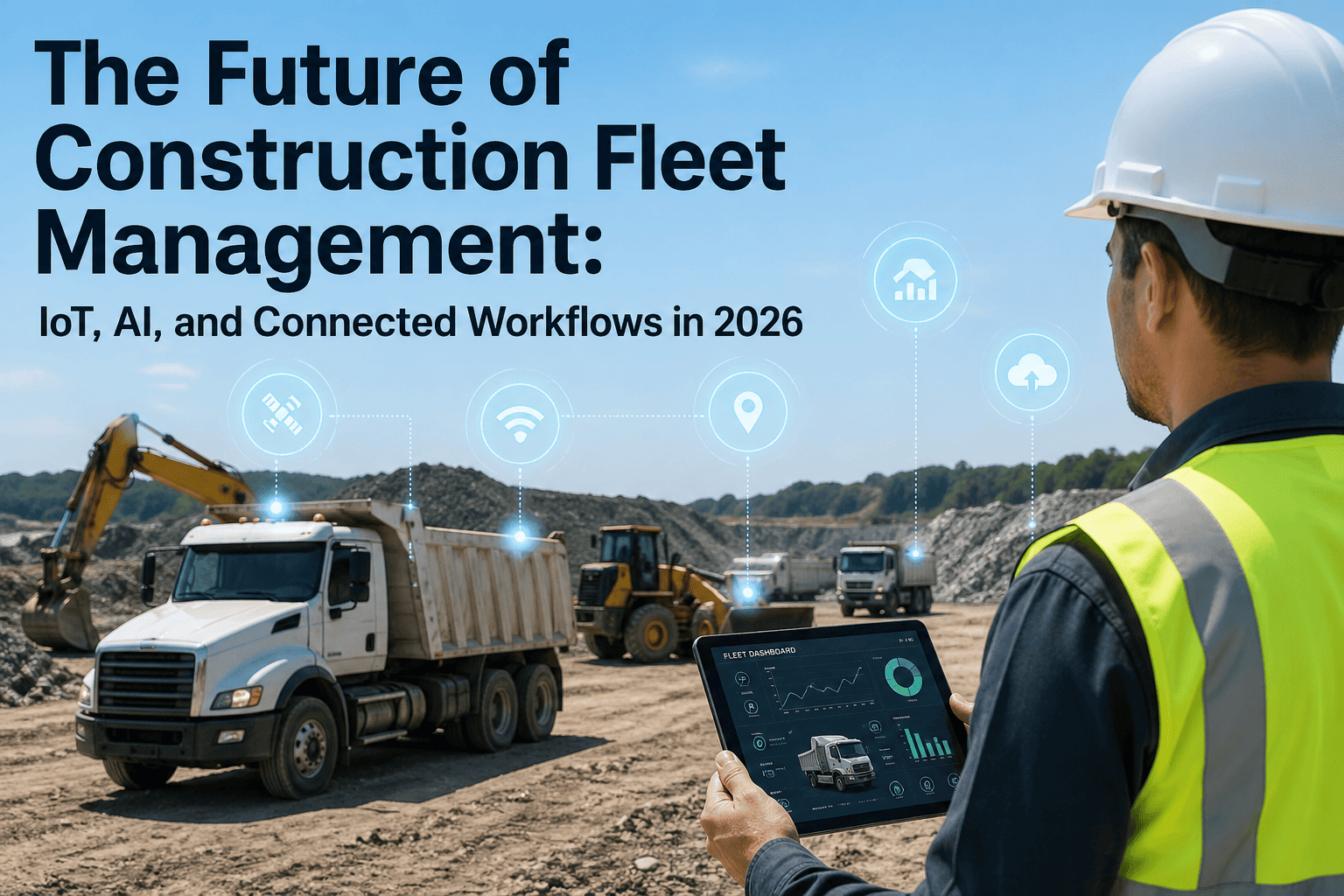
The Future of Construction Fleet Management: IoT, AI, and Connected Workflows in 2026
How Internet of Things sensors, artificial intelligence analytics, and connected digital workflows are transforming construction fleet operations — from reactive maintenance to predictive intelligence, from manual coordination to automated optimisation.
73%Contractors Planning IoT Investment by 2027
30–45%Downtime Reduction With Predictive AI
$4.2BConstruction IoT Market Size 2026
10–15%Effective Fleet Capacity Gain
Pillar 1: IoT Sensor Networks — Beyond GPS Tracking
First-generation fleet telematics gave construction companies GPS location and basic engine data — odometer, engine hours, and fault codes. IoT sensor networks in 2026 go exponentially deeper: vibration sensors on bearings and drivetrain components detect micro-failures weeks before they become breakdowns. Hydraulic pressure transducers monitor system health in real time. Fluid quality sensors analyse oil condition continuously rather than waiting for periodic lab samples. Temperature sensors across engine, transmission, and hydraulic systems identify thermal anomalies that indicate developing problems.
Vibration Analysis Sensors
Accelerometers mounted on bearings, gearboxes, and pump housings measure vibration frequency and amplitude continuously. Normal bearing vibration follows predictable patterns — when amplitude increases or frequency shifts, it indicates bearing wear, misalignment, or imbalance developing inside the component. FleetRabbit's IoT integration processes vibration data and triggers maintenance alerts 2–4 weeks before failure would occur — giving maintenance teams time to schedule replacement during planned downtime rather than responding to catastrophic breakdown.
Hydraulic System Monitoring
Pressure transducers on hydraulic circuits measure operating pressure continuously. Gradual pressure loss indicates internal pump wear, valve leakage, or cylinder seal deterioration. Sudden pressure spikes indicate relief valve issues or flow restrictions. FleetRabbit correlates hydraulic pressure data with operating load — identifying systems that are losing efficiency before they fail completely. Hydraulic pump replacement at 85% wear costs $3,500; emergency replacement after failure costs $18,000+ including downtime and secondary damage.
Real-Time Fluid Analysis
Inline oil condition sensors measure particle count, viscosity, moisture content, and oxidation level continuously — replacing quarterly lab samples with real-time fluid health monitoring. When oil quality deteriorates beyond threshold, FleetRabbit generates a service alert with specific findings: "Engine oil particle count exceeding limit — schedule oil change within 20 hours." This eliminates both premature oil changes (wasting good oil) and late oil changes (allowing contaminated oil to damage engine internals).
Thermal Anomaly Detection
Temperature sensors across engine coolant circuits, transmission oil, hydraulic reservoirs, and exhaust systems establish normal operating temperature baselines per equipment type. When any system runs 15–25°F above baseline under similar operating conditions, FleetRabbit flags a thermal anomaly — indicating cooling system restriction, internal friction increase, or fluid degradation. Early thermal alerts prevent overheating events that cause warped heads, seized bearings, and cracked housings.
Pillar 2: AI-Powered Analytics — From Data to Decisions
IoT sensors generate massive volumes of data — a single piece of heavy equipment with comprehensive sensor packages produces 2,000–5,000 data points per hour. Without AI, this data overwhelms fleet managers who are already stretched thin managing daily operations. AI transforms raw sensor data into actionable intelligence: predicting which specific component on which specific machine will fail within what timeframe, and recommending the optimal intervention to prevent it.
01
Predictive Failure Modelling
AI analyses historical failure patterns across your fleet — correlating component age, operating hours, vibration trending, thermal data, and fluid quality to predict remaining useful life for critical components. FleetRabbit's AI doesn't just alert when something is wrong — it predicts when something will go wrong, with confidence intervals that improve as the system learns your fleet's specific operating patterns. A new FleetRabbit deployment achieves 70% prediction accuracy within 90 days; mature deployments (12+ months) reach 88–92% accuracy.
02
Automated Maintenance Prioritisation
When 200+ assets each have multiple developing conditions, fleet managers need AI to prioritise: which repairs are most urgent, which can wait, and which interventions deliver the highest ROI. FleetRabbit's AI ranks every pending maintenance action by criticality (safety impact), cost avoidance (emergency repair cost if deferred), and scheduling feasibility (parts availability, technician capacity, equipment utilisation schedule). Fleet managers receive a daily prioritised action list instead of an overwhelming alert stream.
03
Utilisation Optimisation Intelligence
AI analyses equipment utilisation patterns across all sites — identifying underutilised assets, over-deployed equipment types, and seasonal demand patterns. FleetRabbit recommends fleet rebalancing: "Move excavator E-142 from Site 7 (18% utilisation this month) to Site 3 (excavator shortfall causing schedule delays)." These recommendations convert idle fleet capacity into productive hours — effectively adding 10–15% capacity without purchasing additional equipment.
04
Total Cost of Ownership Forecasting
AI projects future maintenance costs per asset based on current condition data, historical cost curves for similar equipment, and predicted remaining component life. FleetRabbit identifies the optimal economic replacement point for each asset — the inflection where continuing to maintain becomes more expensive than replacing. This shifts fleet replacement decisions from calendar-based cycling (replace every 7 years) to condition-based cycling (replace when projected maintenance cost exceeds ownership benefit).
FleetRabbit AI Platform
IoT Data Collection. AI Analysis. Automated Actions. Zero Manual Effort.
FleetRabbit integrates IoT sensor data, applies AI-powered analytics, and automates maintenance workflows — delivering predictive fleet intelligence that prevents failures, optimises utilisation, and reduces total cost of ownership across your entire construction fleet.
Pillar 3: Connected Workflows — Eliminating Information Silos
The third technology pillar connects previously disconnected systems into unified workflows. In traditional operations, telematics data sits in one vendor portal, maintenance records live in spreadsheets, inspection findings stay on paper, parts inventory exists in accounting software, and project schedules are managed in separate planning tools. Connected workflows unify all data sources into a single platform where every action triggers the next appropriate response automatically.
Sensor Alert → Work Order → Parts → Technician
When an IoT sensor detects a developing condition, FleetRabbit automatically generates a work order with the specific finding, recommended repair procedure, required parts list, and estimated labour hours. The system checks parts inventory across all locations — if the part is available at a nearby yard, it's reserved immediately. The work order routes to the nearest qualified technician based on skill match, location proximity, and current workload. The entire chain from detection to technician assignment happens in under 60 seconds with zero human intervention.
Inspection Finding → Defect → Repair → Close
An operator completes a mobile pre-start inspection and flags a hydraulic hose showing wear. FleetRabbit creates a defect record, classifies severity based on the operator's photo and description, generates a work order if severity warrants immediate attention, assigns to a technician, tracks repair completion, and closes the defect — all without the fleet manager manually processing any step. The operator sees the defect status update in their app: "Your reported hose wear on Unit 347 — repair completed by Tech Rodriguez at 2:15 PM."
Utilisation Data → Project Billing → Cost Reports
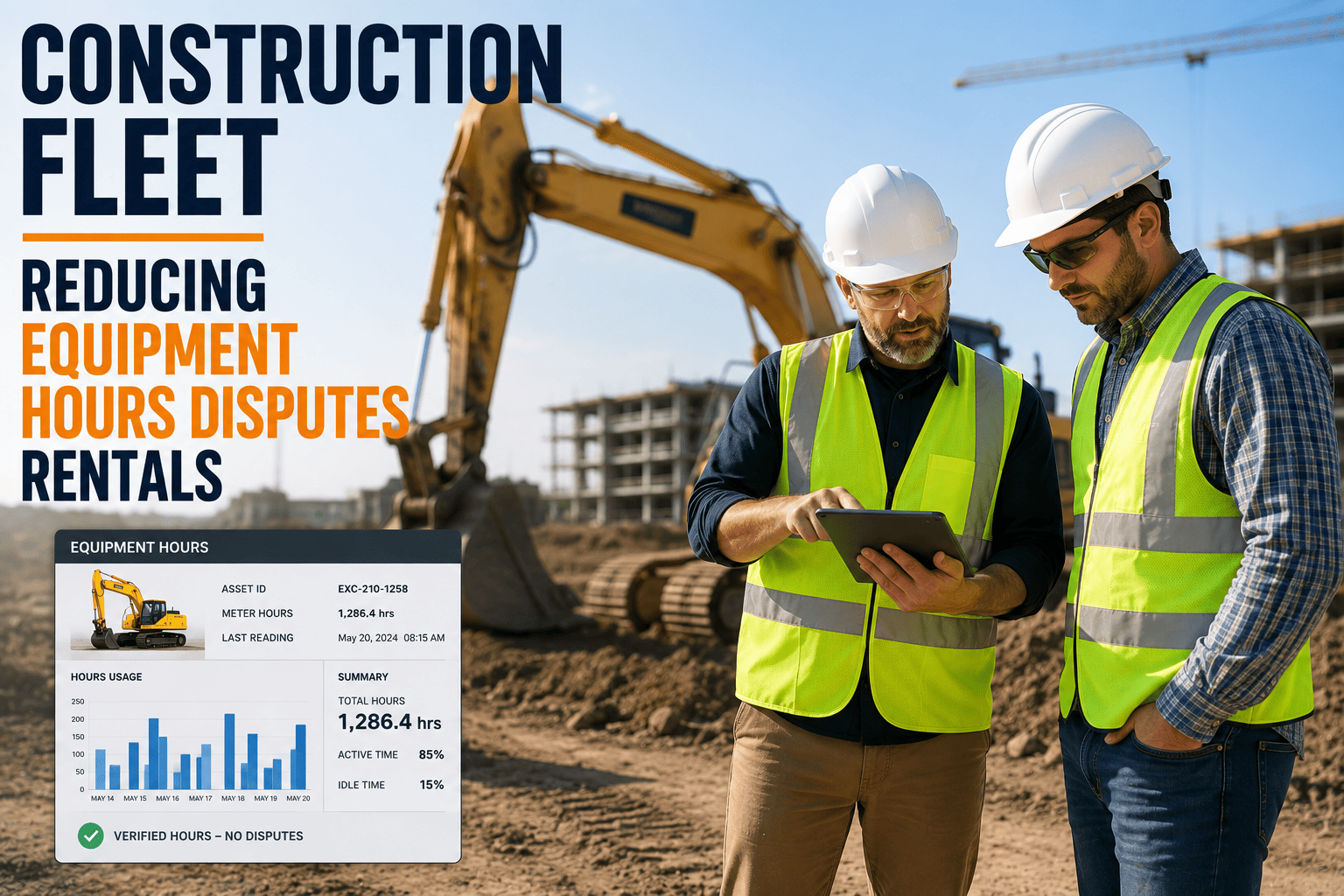
Equipment time-on-site data from GPS and geofencing flows directly into project cost allocation. Every hour a piece of equipment spends within a project site geofence is automatically logged and allocated to that project's equipment charges. Monthly project cost reports generate automatically — showing each project manager exactly which equipment was used, for how many hours, and at what cost rate. No manual time tracking, no spreadsheet compilation, no billing disputes over equipment usage claims.
Compliance Events → Documentation → Audit Reports
Certifications, annual inspections, emissions tests, and operator qualifications are tracked with expiry dates and renewal workflows. When a certification approaches expiry, FleetRabbit generates renewal task, assigns to responsible person, and blocks equipment assignment if certification lapses. During OSHA or DOT audit, FleetRabbit generates a complete compliance package — inspection history, certification status, operator qualifications, and maintenance records — in under 60 seconds. No file cabinets, no searching through folders, no missing documents.
From the Field
"We installed vibration sensors on 12 critical hydraulic pumps across our excavator fleet as a pilot. In the first 90 days, FleetRabbit's AI predicted three pump failures — all three were confirmed at 80–90% wear when we inspected. Each predictive replacement cost $3,200. The same failures as emergencies would have cost $15,000–$22,000 each including secondary damage, towing, and expedited parts. That's $45,000 in avoided emergency costs from a $4,800 sensor investment on 12 machines. We're now deploying sensors fleet-wide across all 180 assets."
Fleet Director
·
Heavy Civil Contractor — 180 Assets — IoT Pilot Program
Frequently Asked Questions
QDoes FleetRabbit require special IoT hardware to use AI features?
No. FleetRabbit's AI works with data from existing telematics (Geotab, Samsara, OEM systems) — fault codes, engine hours, and operating parameters already provide enough data for predictive maintenance modelling. Additional IoT sensors (vibration, pressure, fluid quality) enhance prediction accuracy but aren't required to start. Most customers begin with existing telematics data and add specialised sensors to high-value assets based on initial AI recommendations.
QHow long does the AI take to learn our fleet's patterns?
FleetRabbit's AI begins generating predictions within 30 days using a combination of your fleet's historical data and generalised models trained on similar equipment types across the FleetRabbit customer base. Prediction accuracy improves continuously — 70% accuracy at 90 days, 80%+ at 6 months, and 88–92% at 12 months as the system learns your fleet's specific operating conditions, duty cycles, and failure patterns.
QWhat ROI should we expect from AI-powered fleet management?
Enterprise customers report 30–45% reduction in unplanned downtime, 20–28% lower total maintenance costs, and 10–15% effective fleet capacity improvement through utilisation optimisation. Typical payback period is 2–4 months depending on fleet size. The highest-value returns come from prevented catastrophic failures — a single avoided emergency repair on heavy equipment ($15K–$25K) often exceeds the entire annual AI platform investment.
QCan FleetRabbit's connected workflows integrate with our existing project management tools?
Yes. FleetRabbit provides API access for integration with project management platforms (Procore, PlanGrid, Autodesk Construction Cloud), accounting systems (QuickBooks, Sage), and ERP systems. Equipment cost data, utilisation reports, and maintenance status can flow bidirectionally between FleetRabbit and your existing technology stack — no duplicate data entry required.
FleetRabbit — Built for 2026 and Beyond
IoT Sensors. AI Analytics. Connected Workflows. One Platform.
FleetRabbit delivers the complete technology stack for modern construction fleet management — IoT data integration, AI-powered predictive maintenance, automated work order workflows, and enterprise reporting. The future of fleet management is here, and it's already proven across thousands of construction assets.
IoT Integration
Predictive AI
Connected Workflows
Automated Work Orders
Enterprise Scale
April 29, 2026
By Michael
All Posts