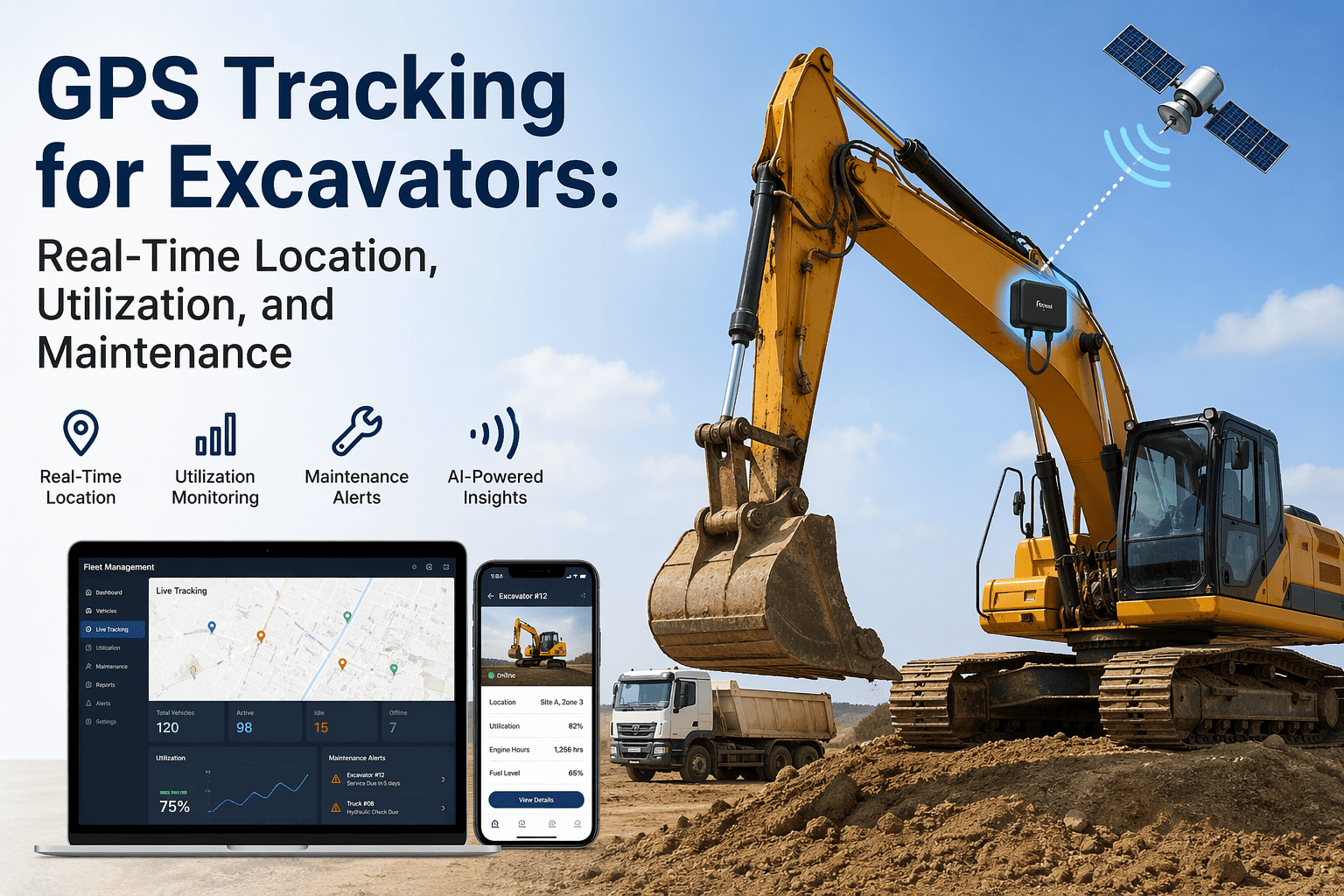
Excavators are the highest-value, highest-utilisation assets on most construction sites — and the most expensive to lose track of. A single Cat 336 excavator represents a $400,000–$600,000 capital investment, consumes $200–$500 in fuel per operating day, and generates $2,000–$5,000 in production value per hour when running at capacity. Yet most construction companies track their excavators with the same tools they use for everything else: phone calls to foremen, weekly spreadsheet updates, and paper-based hour meter readings that are already outdated by the time they reach the office. GPS tracking transforms excavator fleet management from reactive guesswork into real-time intelligence — giving fleet managers instant visibility into where every excavator is, how many hours it is running, how efficiently it is being utilised, and when it needs its next preventive maintenance service. Book an excavator tracking demo with FleetRabbit.
FleetRabbit Excavator Intelligence
GPS Tracking for Excavators: Real-Time Location, Utilisation, and Maintenance
How GPS telematics transforms excavator fleet management — from real-time location visibility and engine hour tracking to automated PM scheduling and theft prevention — delivering measurable ROI within 90 days of deployment.
$400K–$600KAverage Excavator Investment
$200–$500Daily Fuel Cost Per Excavator
10,000–12,000Useful Life (Engine Hours)
15–25%Typical Idle Time Waste
The 5 Data Points GPS Tracking Delivers for Every Excavator
GPS tracking for excavators is not just about location — it is about building a continuous, automated data stream that replaces manual data collection and enables real-time decision-making. FleetRabbit captures five categories of data from every GPS-equipped excavator, each feeding a different operational intelligence capability.
01
Real-Time Location
Know exactly where every excavator is — on which project site, in which zone of the site, or in transit between locations. FleetRabbit displays live GPS positions on a map dashboard with geofence alerts that notify you instantly if an excavator moves outside its assigned project boundary. After-hours movement alerts provide theft detection and unauthorised use monitoring without additional security systems. Location history provides a complete audit trail showing where every excavator has been and for how long.
02
Engine Hours & Runtime
Automated engine hour tracking eliminates manual hour meter readings entirely. FleetRabbit receives engine hours directly from the excavator's telematics system — updated continuously, not weekly. This data feeds PM scheduling (services triggered by actual hours, not calendar estimates), utilisation analysis (actual runtime vs. available hours), and cost-per-hour calculations that require accurate, current hour data. No more Monday morning phone calls to foremen asking for hour meter readings.
03
Idle Time & Fuel Consumption
Excavator idle time is invisible without telematics — the engine runs, fuel burns, and hours accumulate, but zero production occurs. FleetRabbit tracks idle time separately from productive runtime, calculating idle percentage for every excavator on every shift. Excessive idle time (above 15–20% is typical for excavators) indicates operational inefficiency — waiting for trucks, operator breaks with engine running, or poor job planning. Fuel consumption data from telematics identifies excavators burning more fuel per hour than their benchmark, flagging potential mechanical issues or operator behaviour problems.
04
Utilisation Rate
Utilisation rate — actual runtime divided by available hours — is the single most important metric for excavator fleet profitability. An excavator running 6 hours in a 10-hour shift has 60% utilisation; industry target is 65–85% depending on application. FleetRabbit calculates utilisation automatically for every excavator, every day, every project — identifying underutilised assets that should be redeployed and overutilised assets that may need additional support. This data directly informs fleet sizing decisions: do you need more excavators, or do you need to use the ones you have more effectively?
05
Diagnostic Fault Codes
Modern excavators generate diagnostic fault codes (DTCs) through their onboard computer systems. FleetRabbit receives these codes in real time via telematics, alerting the fleet manager and mechanic immediately when an excavator reports a fault — engine derate, high coolant temperature, hydraulic pressure anomaly, or emissions system warning. Early fault detection prevents catastrophic failures: a $200 sensor replacement addressed promptly avoids a $15,000 engine repair caused by continued operation under fault conditions.
FleetRabbit Excavator Tracking
Every Excavator. Every Hour. Every Data Point. One Dashboard.
FleetRabbit consolidates GPS location, engine hours, idle time, fuel consumption, utilisation rates, and diagnostic codes from every excavator in your fleet into a single real-time dashboard — whether your excavators use Cat Product Link, Komatsu KOMTRAX, John Deere JDLink, Volvo ActiveCare, or aftermarket GPS devices.
Automated Maintenance Scheduling Based on Real Engine Hours
Preventive maintenance scheduling based on calendar intervals is inherently inaccurate for excavators because excavator utilisation varies dramatically between projects — a machine running 8 hours per day on an active mass earthwork project accumulates hours twice as fast as the same machine running 4 hours per day on a utility installation project. Calendar-based scheduling either services too early (wasting labour and parts) or too late (risking failure). FleetRabbit's GPS-integrated PM scheduling uses real-time engine hours from telematics to trigger service alerts at the exact hour interval specified by the OEM — 250-hour services, 500-hour services, 1,000-hour services, and 2,000-hour services all triggered by actual hours, not estimated dates.
250 Hours
Engine oil and filter change, hydraulic filter inspection, air filter check, grease all pivot points, check track tension and undercarriage wear. FleetRabbit alerts at 230 hours remaining to allow scheduling buffer.
500 Hours
All 250-hour items plus hydraulic oil sample, fuel filter replacement, coolant level and condition check, drive belt inspection, battery load test, and complete safety system verification. Alert at 470 hours.
1,000 Hours
All prior items plus hydraulic oil change, coolant flush and replace, swing gear oil change, final drive oil change, valve lash adjustment (if applicable), and comprehensive structural inspection. Alert at 950 hours.
2,000 Hours
Major service — all prior items plus turbocharger inspection, injector testing, pump calibration, undercarriage measurement and wear assessment, complete hydraulic system evaluation, and DEF system service. Alert at 1,900 hours.
From the Field
"We run 14 excavators across 4 active project sites. Before FleetRabbit, our fleet coordinator spent every Monday morning calling four foremen to get hour meter readings, then manually calculating which machines were due for service. We missed a 500-hour service on a Cat 330 by 180 hours — the hydraulic filter bypassed, contaminated oil reached the main pump, and we spent $22,000 on pump replacement plus 11 days of downtime. After deploying FleetRabbit with GPS tracking, every excavator's hours update automatically, PM alerts fire at exactly the right interval, and our fleet coordinator manages maintenance from a dashboard instead of a phone. We have not missed a single PM interval in 14 months."
Fleet Manager
·
Sitework Contractor — 14 Excavators — 4 Active Sites
Frequently Asked Questions
QDoes FleetRabbit work with the GPS already installed on my excavators by the manufacturer?
Yes. FleetRabbit integrates directly with OEM telematics systems — Cat Product Link, Komatsu KOMTRAX, John Deere JDLink, Volvo ActiveCare, Hitachi ConSite, and Liebherr LiDAT. If your excavators already have factory-installed GPS and telematics, FleetRabbit connects through the OEM's API to pull location, engine hours, fuel data, and fault codes without any additional hardware installation. For older excavators without OEM telematics, FleetRabbit supports aftermarket GPS devices from providers like CalAmp, Geotab, and Samsara.
Start your free trial to test integration with your fleet.
QHow often does GPS location data update in FleetRabbit?
Location update frequency depends on the telematics device and configuration. Most OEM telematics systems provide location updates every 5–15 minutes during engine operation and a daily heartbeat when the engine is off. Aftermarket GPS devices can be configured for updates as frequent as every 30 seconds for real-time tracking applications. FleetRabbit displays the most recent position on the map dashboard and stores complete location history for route replay and site time analysis. For most fleet management purposes, 5–15 minute updates provide sufficient granularity for utilisation tracking, geofence monitoring, and project site time calculation.
QCan FleetRabbit track excavators and other equipment types on the same platform?
Absolutely. FleetRabbit is a complete mixed-fleet management platform — excavators, dozers, loaders, cranes, trucks, trailers, generators, and any other construction equipment type are all managed on the same dashboard. Each equipment type has customised inspection templates, PM schedules, and performance benchmarks appropriate to its category. There is no limit on the number of equipment types or total assets managed, and the pricing is the same per-asset regardless of equipment type or value.
FleetRabbit Excavator GPS Intelligence
Track Every Excavator in Real Time — Location, Hours, Fuel, and Maintenance in One Platform
FleetRabbit connects to your excavators' existing telematics — OEM or aftermarket — and delivers real-time GPS tracking, automated engine hour collection, fuel consumption monitoring, idle time analysis, utilisation reporting, and hour-based PM scheduling. One platform for complete excavator fleet intelligence.
Real-Time GPS
Engine Hour Tracking
Idle Time Analysis
Auto PM Scheduling
Fault Code Alerts
April 23, 2026
By Michael
All Posts