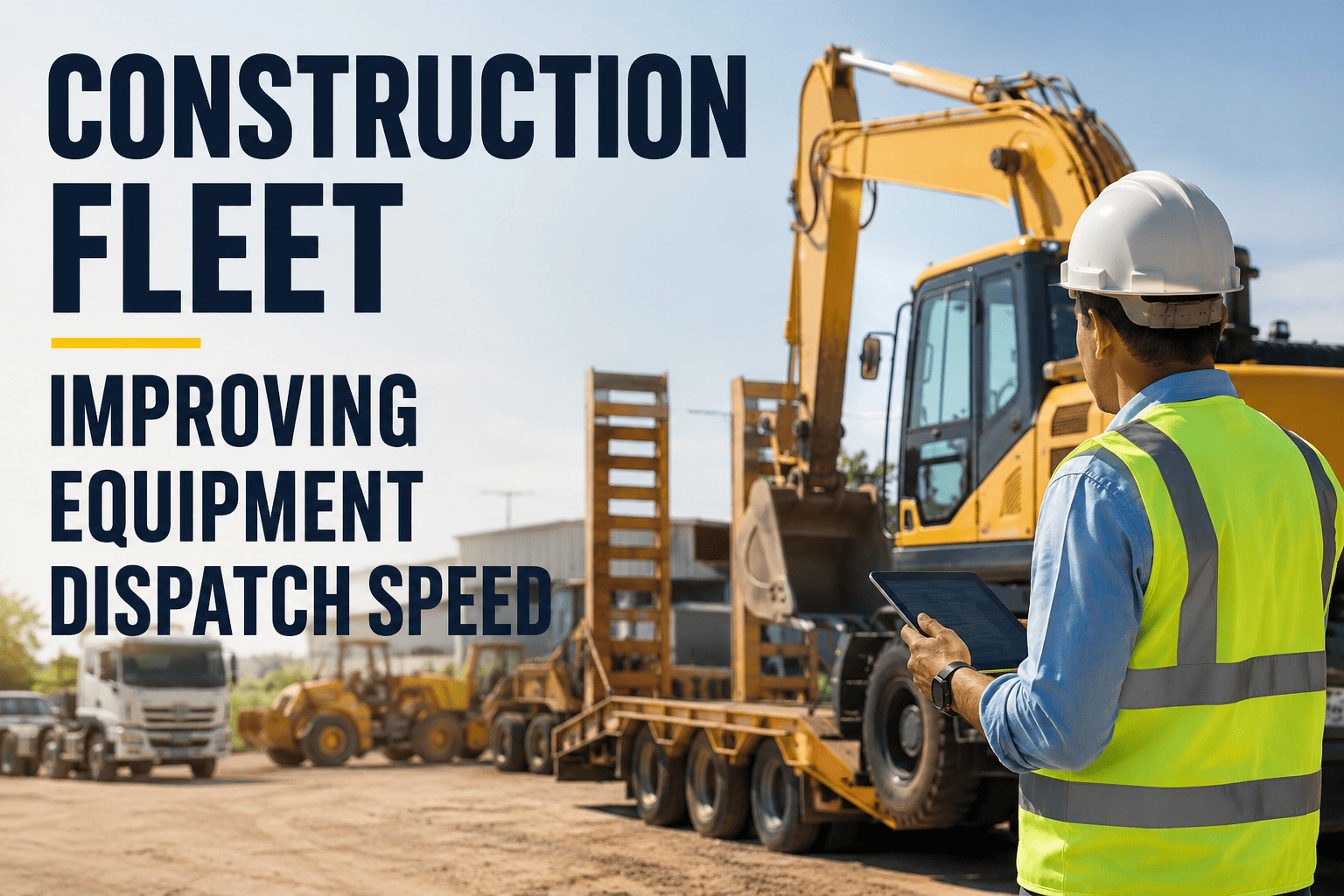
A heavy equipment tracking system for construction sites combines three technology layers: GPS for real-time location and geofencing, IoT sensors reading J1939 CAN bus data (engine hours, fault codes, fuel consumption, operating temperatures), and edge AI that processes sensor streams on-device to detect anomalies and predict failures before they cause breakdowns. Together these layers deliver theft prevention with 4x higher recovery rates, predictive maintenance that reduces unplanned downtime 40%, fuel savings of 35–42% through idle detection, and compliance documentation built automatically from machine operation data.
The Three Technology Layers: GPS, IoT, and Edge AI
Modern heavy equipment tracking systems aren't single technologies — they're stacks of three complementary layers, each solving a different category of construction fleet problem. Understanding what each layer contributes clarifies why all three are needed and what you lose when any one is missing.
Layer 1: GPS — Location and Security
GPS receivers in telematics devices update machine coordinates every 30–60 seconds during operation and every 4–8 hours at rest. GPS powers geofence boundary alerts, after-hours movement detection, theft recovery tracking, cross-site asset visibility, and GPS-confirmed billing documentation. On its own, GPS tells you where equipment is — it can't tell you anything about the machine's mechanical condition or whether it's about to fail.
Layer 2: IoT Sensors — Machine Health Data
IoT connectivity via J1939 CAN bus reads every diagnostic parameter the machine's ECU generates: engine hours, coolant temperature, oil pressure, hydraulic pressure, fuel consumption rate, battery voltage, fault codes, and load percentage — streamed continuously to the cloud platform. IoT data is what transforms a GPS tracker into a true equipment health monitoring system. Without this layer, you know where the machine is but not whether it's about to break down.
Layer 3: Edge AI — Predictive Intelligence
Machine learning models — trained on construction equipment failure patterns — run on collected IoT data streams to identify anomalies, trend degradations, and pre-failure signatures that no single threshold alert can catch. Edge AI identifies a coolant temperature creeping 2°F per week, a fuel consumption baseline drifting upward over 8 days, or an oil pressure slowly declining over 6 weeks — patterns invisible to human review but detectable 2–4 weeks before breakdown by AI processing continuous data streams.
GPS Tracking: Real-Time Location, Geofencing, and Theft Recovery
GPS is the foundation layer of any construction equipment tracking system — the capability that answers the most basic fleet management question: where is each machine right now? But construction-grade GPS tracking goes well beyond a dot on a map, delivering the geofencing, alert speed, and recovery tracking that turn location data into active theft prevention.
1
Geofence Boundary Alerts — Response Before Theft Completes
Fleet Rabbit geofences create virtual boundaries around each job site — triggering immediate mobile alerts to fleet managers when any machine crosses its boundary during unauthorized hours. Alert latency under 3 minutes from boundary crossing to fleet manager notification. This response window exists because GPS detected movement at the boundary, not because a crew member discovered an empty spot the following morning. After-hours movement detection operates continuously — every night, every weekend, every holiday — without requiring manual monitoring.
11:47 PM: Excavator #14 crosses Site B boundary heading north. Alert to fleet manager: "Excavator #14 — unauthorized boundary crossing, current coordinates [GPS link]. Last operator: Mike R. Contact: [site supervisor number]." Response initiated before machine reaches transport vehicle.
2
Live Recovery Tracking — 30-Second GPS Updates for Law Enforcement
For theft events that progress past the alert window, Fleet Rabbit provides law enforcement with real-time GPS coordinates updated every 30 seconds — enabling active pursuit and recovery rather than the "last known location before device went offline" data that passive trackers provide. Fleet Rabbit users achieve 4x higher recovery rates versus unmonitored fleets. GPS coordinates are shareable directly from the mobile app to responding officers without requiring law enforcement to access the platform themselves.
Update frequency: 30 secondsRecovery rate: 4x higherShareable: direct link to officers
3
Multi-Site Fleet Visibility — Every Machine, Every Site, One Dashboard
GPS tracking across a multi-site fleet gives fleet managers the cross-site visibility that prevents unnecessary rentals and enables rapid equipment reallocation. When a project manager requests a rental, the fleet manager checks GPS utilization data in real time — confirming whether owned machines are underutilized on other sites before approving rental spend. Utilization analytics on GPS-confirmed site presence and engine hours identifies machines running at below-45% utilization, surfacing reallocation opportunities worth $60,000–$180,000 annually in avoided rental costs for 20-machine fleets.
20-machine fleet, 4 active sites: fleet manager sees all 20 machines on one map, current utilization percentage per machine, which sites have underutilized assets, and pending rental requests — all in one 30-second dashboard review.
GPS + IoT + Edge AI Tracking
Real-Time Location, Health Monitoring, and Theft Recovery — One System
Fleet Rabbit combines GPS tracking, J1939 IoT sensor monitoring, and AI-powered anomaly detection in a single telematics device — delivering location security, predictive maintenance, and operational intelligence from one 2–4 hour installation per machine.
IoT Sensor Integration: What J1939 Data Reveals About Machine Health
The J1939 CAN bus is the internal communication network that connects every electronic component in a modern heavy machine — the same system that feeds the instrument cluster displays. Fleet Rabbit's telematics device reads this data stream continuously, capturing the six categories of machine health data that determine whether equipment stays productive or breaks down.
Engine Parameters: Temperature, Pressure, Load
Data captured: Coolant temperature, oil pressure, intake air temperature, exhaust temperature, and engine load percentage — updated every 30 seconds.
Why it matters: Coolant temperature trending upward 2–3°F per week over 6 weeks signals a cooling system issue developing before any fault code triggers. Oil pressure slowly declining over 60 hours indicates bearing wear beginning. These gradual trends are invisible without continuous IoT monitoring — visible only in retrospect after the breakdown that makes them obvious.
Failure prevented: Cylinder head replacement after undetected overheating: $8,000–$22,000. Cooling system repair at early detection: $400–$1,200. IoT trend monitoring prevents $7,600–$20,800 per event.
Real-Time Fault Code Capture and Translation
Data captured: All J1939 diagnostic trouble codes (DTCs) captured the moment they're generated — active codes, pending codes, and historical log with timestamps.
Why it matters: Without IoT connectivity, fault codes sit in the machine's ECU until a technician physically plugs in a scan tool — often days after the code first appeared. Fleet Rabbit captures every code immediately and translates raw J1939 hexadecimal codes into plain-language action instructions: "Engine coolant temp 18°F above normal — inspect cooling system before next shift."
Response speed difference: With IoT: fault code → supervisor alert in 60 seconds → same-shift response. Without IoT: fault code accumulates → discovered at next dealer service → machine operated 40–200 hours with developing issue.
Fuel Consumption Monitoring and Anomaly Detection
Data captured: Real-time fuel consumption rate, cumulative consumption per shift and project, idle time versus productive time ratio, and baseline consumption patterns per machine per job type.
Why it matters: A machine consuming 27% above its established baseline for 8 consecutive days has a developing mechanical issue — injector wear, turbocharger degradation, or air restriction — weeks before any fault code appears. Fleet Rabbit's fuel anomaly detection is the earliest predictive warning layer in the system, catching mechanical inefficiency 3–6 weeks before failure-stage symptoms emerge.
Dual value: Fuel monitoring saves $3,600–$5,200/year per machine through idle reduction, and catches pre-failure mechanical issues earlier than any other monitoring parameter.
Hydraulic System Pressure and Performance Data
Data captured: Hydraulic system pressure under load, response time monitoring, fluid temperature, and pump efficiency signals from ECU hydraulic management system.
Why it matters: Hydraulic pump degradation — the most expensive single failure category on excavators — progresses from "slightly reduced pressure" to "complete system failure" over 80–200 operating hours. IoT pressure monitoring identifies the gradual efficiency decline that precedes pump failure, enabling planned replacement at $2,800–$4,500 versus emergency circuit contamination repair at $12,000–$28,000.
Engine-hour integration: Hydraulic filter intervals tracked by exact engine hours — the only accurate basis for hydraulic maintenance scheduling on equipment that accumulates wear through load cycles, not distance.
Edge AI: How Machine Learning Turns Sensor Data into Failure Predictions
Raw IoT sensor data — numbers streaming from engine parameters, fuel sensors, and fault code monitors — becomes predictive intelligence when processed through machine learning models trained on construction equipment failure patterns. This is the edge AI layer that separates Fleet Rabbit from basic GPS trackers and simple threshold-alert telematics systems.
Baseline Learning and Anomaly Detection — Per Machine, Per Job Type
Fleet Rabbit's ML models establish normal operating baselines for each machine individually — accounting for equipment age, operating conditions, job type, and operator patterns. Anomaly detection flags deviations from the established baseline rather than from generic thresholds, which means the system can identify that a specific excavator's coolant temperature running 8°F above its personal baseline is significant — even if that temperature is still within the manufacturer's general normal range. Machine-specific baselines mature over 10–14 days of operation, with anomaly detection accuracy improving significantly from month 1 to month 3 as more operational history is captured.
Predictive Failure Alerts — 2–4 Weeks Before Breakdown
When a machine's multi-parameter data profile matches the pattern that historically precedes a specific failure type, Fleet Rabbit generates a predictive alert: the likely failure mode, estimated time-to-failure range, recommended inspection actions, and cost comparison between proactive repair and breakdown repair. Predictive alerts achieve 78–84% confirmed developing failure accuracy — most flagged machines, when inspected, show genuine developing issues that would have led to breakdown within the predicted window. This lead time converts emergency repairs ($9,500–$16,000 for a hydraulic pump call-out) into planned interventions ($2,800–$4,200 scheduled) at 3–5x lower cost.
Multi-Week Parameter Trend Analysis — Catching Slow Failures Threshold Alerts Miss
Single-point threshold alerts fire when a parameter exceeds a set limit — but the most expensive failures develop gradually over weeks, staying below alert thresholds until the damage is already severe. Edge AI trend analysis tracks parameter trajectories across weeks of continuous data: oil pressure declining 0.8 PSI per week, coolant temperature creeping upward 2°F per week, fuel consumption baseline drifting 4% above normal per week. These trajectories, invisible in any single data snapshot, are clearly predictive when analyzed as continuous time-series data. Trend-based alerts are generated when the trajectory indicates the parameter will reach a critical threshold within 2–4 weeks — providing the intervention window that threshold-only systems can't deliver.
Tracking System Performance: Measured Outcomes
4x
Higher Theft Recovery Rate with GPS Tracking
40%
Unplanned Downtime Reduction via IoT + AI
35–42%
Fuel Waste Reduction via IoT Idle Monitoring
2–4 wks
Advance Warning Before Predicted Failures
94%
PM Compliance with Engine-Hour IoT Tracking
$18,400
Annual Savings per Machine (All Layers)
Frequently Asked Questions: Heavy Equipment Tracking Systems
QWhat is the difference between a GPS tracker and a full IoT tracking system for construction equipment?
A GPS tracker connects to the machine's power circuit and reports location — typically every 5–15 minutes while moving. It tells you where the machine is and whether it moved last night. A full IoT tracking system connects to the machine's J1939 CAN bus and reads all diagnostic data the ECU generates: engine hours, fault codes, operating temperatures, fuel consumption, hydraulic pressure, and battery voltage — in addition to GPS location. The difference in value is large: GPS trackers prevent theft and show location. IoT tracking systems prevent breakdowns, reduce fuel waste, automate maintenance scheduling, generate compliance documentation, and enable the predictive AI layer that identifies failures 2–4 weeks before they occur. Fleet Rabbit operates at the full IoT level — not as a GPS tracker with a monthly fee.
QDoes Fleet Rabbit's tracking system work on all equipment brands?
Fleet Rabbit supports Cat, Komatsu, John Deere, Volvo, Hitachi, Doosan, Case, Liebherr, and all other major construction equipment brands through standard J1939 CAN bus connectivity. Mixed-brand fleets are unified on a single dashboard — all machines regardless of manufacturer visible in one view, one alert system, and one reporting platform. For machines manufactured before the J1939 standard became universal (approximately pre-2000 for most brands), Fleet Rabbit provides ignition-based runtime tracking and GPS that supports PM scheduling and asset security even without full diagnostic data access. Fleet Rabbit's implementation team confirms specific compatibility and capability for every machine in your fleet during the pre-installation assessment.
QHow does the tracking system handle remote sites with limited cellular coverage?
Fleet Rabbit devices buffer all data locally when cellular connectivity is unavailable — GPS positions, engine parameters, fault codes, and IoT sensor data are stored onboard and transmitted with original timestamps when connectivity resumes. No data is lost during coverage gaps. For consistently remote operations, satellite communication is available as an alternative to cellular, ensuring continuous data transmission in locations where 4G LTE is unavailable. Fleet Rabbit's implementation team assesses connectivity at each job site and recommends the appropriate communication configuration before hardware deployment.
QWhat insurance benefits come from deploying a GPS + IoT tracking system?
Most construction equipment insurance carriers offer 8–15% premium reductions for fleets with active GPS telematics monitoring — recognizing that GPS-tracked equipment has substantially higher theft recovery rates and lower total theft loss costs. For a 20-machine fleet with $4M in insured equipment value, a 10% premium reduction represents $12,000–$24,000 in annual insurance savings. Beyond premium reduction, IoT-documented maintenance records strengthen claim defensibility — demonstrated machine health history and regular maintenance documentation supports full replacement value claims and reduces insurer dispute exposure on equipment that experiences incidents. Premium reduction documentation requires proof of active monitoring across the fleet; Fleet Rabbit provides fleet coverage verification reports formatted for insurer submission.
Related Fleet Rabbit Resources
Complete plain-language guide to how construction telematics works — hardware to dashboard — including OEM vs. aftermarket comparison, the 7 use cases that generate the highest ROI, and 10 questions to ask any telematics vendor before purchase.
Deep-dive into Fleet Rabbit's 5-layer downtime prevention system — real-time fault code monitoring, engine-hour PM scheduling, fuel anomaly detection, parameter trend analysis, and maintenance action tracking. Includes the 6 most common failure modes and the 30-day implementation roadmap.
Comprehensive overview of all ten measurable benefits — from predictive maintenance and fuel savings to OSHA compliance and replacement decision support — with full ROI analysis and the combined financial impact across a 20-machine fleet.
Why odometer-based maintenance fails for heavy equipment — with per-machine breakdowns for excavators, dozers, graders, compactors, and loaders, and how IoT engine-hour tracking achieves the 94% PM compliance that calendar scheduling can never match.
Deploy GPS + IoT + Edge AI Tracking Across Your Fleet — Starting in Days
Fleet Rabbit combines all three tracking layers — GPS location and geofencing, J1939 IoT sensor monitoring, and AI failure prediction — in a single telematics device installed in 2–4 hours per machine with zero production disruption. Most fleets identify 2–4 developing issues in the first week of monitoring and recover full subscription investment within 45–75 days through maintenance savings alone.
Real-Time GPS Tracking
J1939 IoT Sensors
AI Failure Prediction
4x Theft Recovery Rate
40% Downtime Reduction
May 23, 2026
By Michael Finn
All Posts