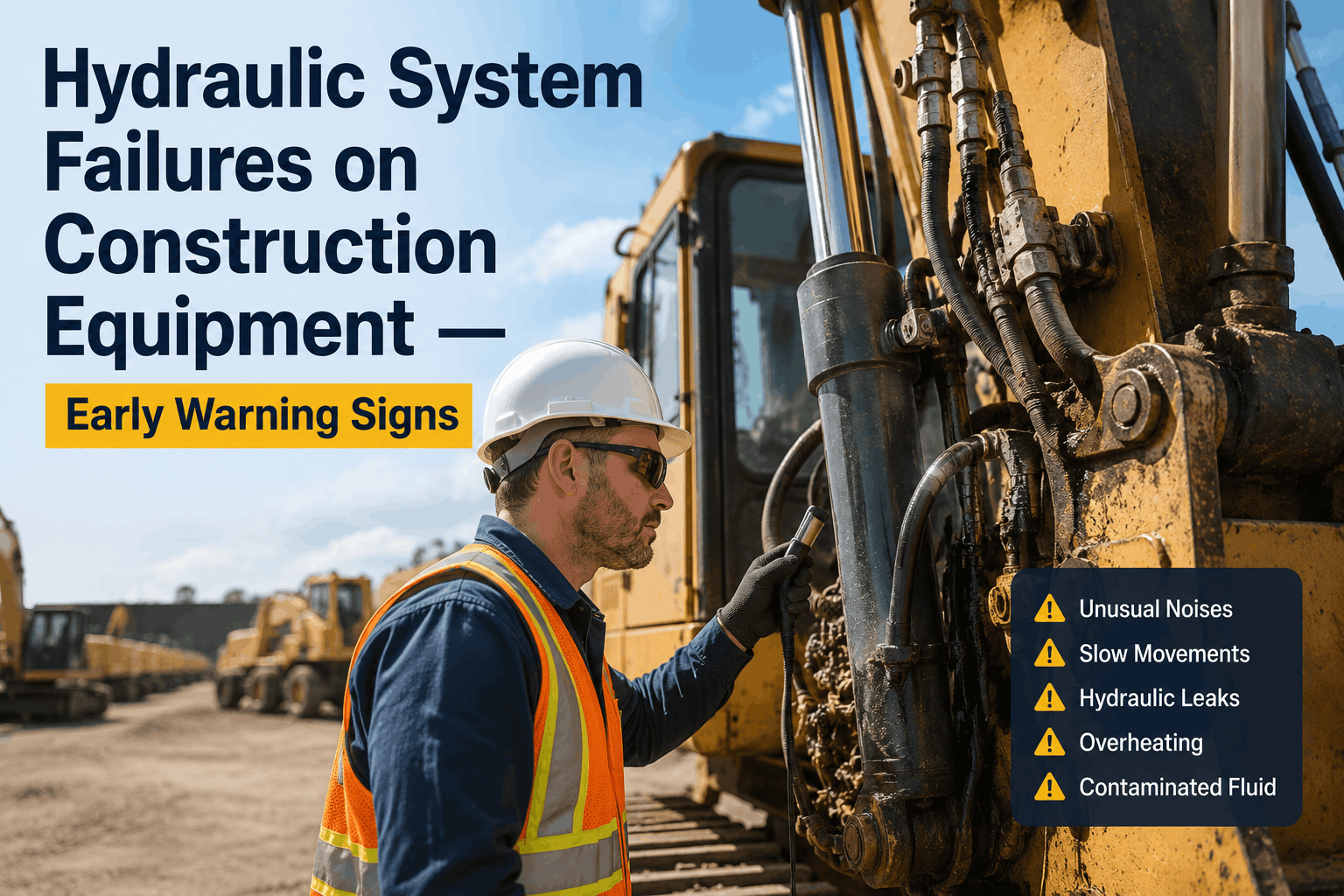
Hydraulic system failures are quietly destroying Western US construction fleet budgets — a Phoenix excavator losing pressure mid-dig, a Sacramento loader with contaminated fluid burning through seals, a Las Vegas grading fleet where slow pressure drift across four machines signals a $28,000 repair wave. Fleet Rabbit's IoT telematics platform layers hydraulic pressure sensors, temperature monitors, and fluid contamination alerts across excavators, loaders, dozers, and mixed heavy equipment fleets — OEM-agnostic, on-premise or cloud, with no equipment replacement required. Book a demo to see Fleet Rabbit's predictive hydraulic monitoring applied to your construction fleet.
Quick Answer
Hydraulic system failures cost Western US construction fleets $15,000–$35,000 per incident through unplanned pump replacements, cylinder rebuilds, and contamination-driven overhauls. Fleet Rabbit's telematics platform detects early warning signs via pressure sensors, temperature monitoring, and CAN bus data — flagging drift, cavitation, and fluid degradation weeks before catastrophic failure on California, Nevada, Arizona, and Oregon job sites.
The Hidden Cost: What Hydraulic Failures Do to a Western US Construction Fleet
A 20-unit heavy equipment fleet operating across California or Nevada job sites depends entirely on hydraulic integrity. A single undetected pump failure on a Cat 336 excavator costs $18,000–$32,000 in parts, labor, and downtime. Without continuous sensor-level monitoring, 70% of hydraulic failures arrive without warning — appearing as sudden breakdowns rather than the predictable drift patterns that preceded them by 3–6 weeks.
Pump Failure
$28K
avg repair cost, main hydraulic pump
Contamination
$9.4K
avg fluid system flush and seal replacement
Downtime Cost
$4.2K
per day, idle excavator on active site
Cylinder Rebuild
$6.8K
avg boom/stick cylinder overhaul cost
How Fleet Rabbit Detects Hydraulic Failure Warning Signs Across Mixed Equipment Fleets
Pressure & Temperature Sensors
Fleet Rabbit mounts inline hydraulic pressure transducers and fluid temperature sensors on excavators, loaders, dozers, and cranes. CAN bus data cross-validates pump load against pressure output, flagging cavitation, pressure drift, and thermal runaway. Compatible with Caterpillar, Komatsu, Volvo, Deere, and 40+ OEMs.
Edge AI Degradation Modeling
On-device AI builds each machine's hydraulic performance baseline by hour, load cycle, and ambient temperature. Deviations beyond threshold — 8% pressure drop at rated RPM, fluid temp exceeding 185°F, response lag on directional valves — trigger immediate failure classification before an alert fires to the fleet manager.
Works Offline — Remote Sites
Edge AI stores and processes sensor data locally on Nevada mining sites and Eastern Oregon timber roads with no cellular. Hydraulic alerts queue and deliver the moment connectivity returns. Iridium satellite modem integration available for permanently off-grid Western US sites where failures compound undetected for days.
The 5 Early Warning Signs Fleet Rabbit Catches Before Catastrophic Failure
Hydraulic Failure Detection Speed — Fleet Rabbit vs. Traditional Methods
Fleet Rabbit platform data, Western US construction fleets 2024–2025. Traditional inspection cycles miss 65–75% of early-stage hydraulic degradation entirely.
1
Pressure Drift Detection
Gradual pressure loss — 5–12% below rated system pressure at normal RPM — is the earliest signal of pump wear, relief valve creep, or internal bypass in cylinders. Fleet Rabbit tracks pressure continuously against each machine's calibrated baseline, flagging drift before it reaches the threshold where operator-visible performance degradation begins.
Arizona highway contractor, Cat 336: Fleet Rabbit detected 9% main pump pressure drift over 11 days. Pump inspected and resealed at $1,800. Avoided full pump replacement estimated at $24,000.
2
Thermal Runaway — Fluid Overheating
Hydraulic fluid operating above 180°F accelerates seal degradation, reduces viscosity, and varnishes valve spools. In Nevada summer conditions where ambient temps exceed 110°F, thermal runaway develops 3× faster than in moderate climates. Fleet Rabbit monitors fluid temperature in real time, correlating overheating events with duty cycle and ambient conditions to distinguish cooling system failure from overwork patterns.
Fluid temp monitoringCooling system correlationAmbient compensation
3
Cavitation Signatures
Cavitation — vapor bubble collapse inside the pump — generates a distinct vibration frequency and pressure instability pattern. Left undetected, cavitation destroys pump internals within 200–400 operating hours. Fleet Rabbit's accelerometer and pressure sensor array identifies cavitation signatures specific to each pump model, alerting fleet managers before internal scoring becomes irreversible.
Vibration analysisPressure instabilityPump-specific baselines
4
Contamination and Fluid Degradation
Particulate contamination above ISO 4406 cleanliness thresholds degrades valves and cylinders within weeks on dusty California and Nevada job sites. Fleet Rabbit integrates inline particle counters and fluid condition sensors, tracking ISO cleanliness codes in real time and triggering fluid change or filter replacement alerts before abrasive wear compounds into a system-wide failure event.
ISO 4406 monitoringParticle count trackingFilter life optimization
5
Response Lag and Cycle Time Drift
Increasing actuator response lag — boom raise time creeping from 3.8s to 5.1s over 30 days — signals internal bypass, worn directional valves, or pilot pressure loss. Fleet Rabbit tracks cycle time trends per machine and operator, separating mechanical degradation from operator behavior changes to deliver accurate failure predictions 2–4 weeks ahead of breakdown.
Oregon civil contractor, Komatsu PC490: Fleet Rabbit flagged 18% stick cylinder response lag over 3 weeks. Cylinder resealed at $2,400. Avoided full cylinder replacement at $9,800 and 6-day project delay.
Hydraulic Failure Prevention Platform
Catch Hydraulic Warning Signs Before They Become $35K Repairs — Free Trial, No Hardware Commitment
OEM-agnostic sensors. Installs on any brand in hours. Real-time pressure alerts, contamination monitoring, and predictive repair scheduling from day one.
$22K
Avg Repair Cost Avoided
3–6wk
Early Warning Lead Time
Capabilities #2–5: Contamination Tracking, Thermal Management, Cycle Analysis & Insurance Documentation
Capability #2: Real-Time Fluid Contamination Tracking — Stop Abrasive Wear Before It Compounds
The contamination problem: California and Nevada construction sites generate extreme airborne particulate. A loader operating on a Sacramento grading site can degrade hydraulic fluid from ISO 16/14/11 to 21/19/16 within 300 hours without continuous monitoring — accelerating valve and pump wear by 400%.
Fleet Rabbit tracks: Inline particle counters log ISO cleanliness codes continuously. Filter delta-pressure sensors monitor loading in real time. Alerts fire when contamination crosses thresholds specific to each machine's component tolerances.
Western US impact: Proactive fluid management driven by IoT data extends hydraulic component life 35–60% on high-dust Arizona and Nevada sites compared to fixed interval change schedules.
Capability #3: Hydraulic Thermal Management — Critical for Nevada and Arizona Summer Operations
The Western heat problem: Equipment operating in Phoenix or Las Vegas during July–September faces ambient temps that push hydraulic fluid 30–40°F higher than manufacturer thermal models assume. A Volvo EC380 running in 112°F ambient can reach critical fluid temperature within 90 minutes of continuous digging cycles.
Fleet Rabbit monitors: Fluid temperature, cooler inlet/outlet differential, and duty cycle data combine to predict thermal runaway 15–25 minutes ahead — giving operators and supervisors time to cycle down before seal damage begins.
Outcome: Thermal-triggered seal failures drop 70%+ in the first full summer season after Fleet Rabbit deployment on Western US fleets.
Capability #4: Hydraulic Cycle Time Analysis — Separate Mechanical Wear from Operator Behavior
The misdiagnosis problem: A service technician seeing slow boom response on a 2019 Cat 336 at a California job site quotes $14,000 for a pump replacement. Fleet Rabbit's cycle time trend data shows the slowdown correlates with a specific operator's technique change — not mechanical wear — saving the repair spend entirely.
Fleet Rabbit separates: Per-operator cycle baselines isolate mechanical degradation from technique variability. Trend analysis over 7–90 day windows identifies true wear progression versus behavioral changes or load condition differences.
Outcome: Accurate failure attribution eliminates unnecessary repairs averaging $8,000–$14,000 per misdiagnosed event across Western US fleets.
Capability #5: Hydraulic Failure Documentation for Insurance and Warranty Claims
Western US insurance context: California and Nevada heavy equipment insurers deny 35–55% of hydraulic failure claims citing insufficient maintenance documentation. Average denied claim involving a hydraulic pump or cylinder: $12,000–$28,000 per incident.
Fleet Rabbit provides: Sensor-timestamped pressure, temperature, and contamination logs with anomaly classification reports that meet major US carrier requirements — submitted directly from the dashboard to Zurich, AIG, and specialty construction underwriters.
Warranty benefit: Continuous IoT maintenance records support OEM warranty claims for premature hydraulic component failures, recovering costs that paper-based logs cannot document.
Before vs. After Fleet Rabbit Hydraulic Monitoring — 20-Unit Western US Fleet
Without Hydraulic IoT
Failure detection: Catastrophic breakdown
Pressure drift caught: After operator complaint
Contamination tracking: Scheduled interval only
Thermal events: Post-damage discovery
Insurance claims approved: 45–65%
Avg repair cost per event: $15K–$35K
With Fleet Rabbit IoT
Failure detection: 3–6 weeks before failure
Pressure drift caught: Within 60 seconds of threshold
Contamination tracking: Continuous ISO code logging
Thermal events: 15–25 min predictive alert
Insurance claims approved: 85–95%
Avg repair cost per event: Under $3K (early intervention)
3–6wk
Early Warning Lead Time
88%
Catastrophic Failure Reduction
$22K
Avg Repair Cost Avoided
60%
Component Life Extension
6–12%
Insurance Premium Reduction
Frequently Asked Questions: Hydraulic Failure Prevention for Construction Fleets
QCan Fleet Rabbit detect hydraulic warning signs on older equipment without factory sensors?
Yes. Fleet Rabbit's inline pressure transducers and temperature sensors mount externally on hydraulic supply and return lines — no factory sensor required. For pre-2000 equipment with no CAN bus access, the sensor array provides standalone pressure and thermal tracking. A 1998 Komatsu PC200 and a 2024 Cat 395 run side-by-side in the same hydraulic health dashboard.
QHow early can Fleet Rabbit detect a failing hydraulic pump before breakdown?
Fleet Rabbit typically flags hydraulic pump degradation 2–6 weeks before catastrophic failure using pressure drift, volumetric efficiency decline, and cavitation signatures. The specific lead time depends on failure mode — thermal seal degradation often provides 3–4 weeks of warning while sudden contamination events may provide 5–10 days. In either case, early intervention repairs average 85–90% less than post-failure replacements.
QHow does hydraulic monitoring work on remote Nevada and Arizona sites with no cellular?
Fleet Rabbit's edge AI continues recording and analyzing hydraulic sensor data locally when cellular is unavailable. Critical alerts — pressure collapse, thermal runaway, severe contamination — queue and deliver the moment connectivity returns. For permanently remote locations, Fleet Rabbit supports Iridium satellite integration for real-time alert delivery with no cellular dependency.
QHow long does installation take across a mixed California fleet?
A Fleet Rabbit technician installs hydraulic pressure sensors, temperature monitors, and telematics on 4–6 machines per day. A 20-unit mixed fleet is fully live in 4–5 days. Western US teams cover California, Nevada, Arizona, Oregon, Washington, and Colorado — with no equipment downtime required during sensor mounting.
Related Fleet Rabbit Resources
AI-driven fault prediction and automated maintenance scheduling that prevents mid-project breakdowns — the reliability layer IoT sensor data powers across excavators, loaders, and cranes.
The four AI capabilities transforming fleet operations — real-time GPS, predictive health monitoring, dynamic route optimization, and delivery performance analytics — with ROI data for each.
Real-time utilization tracking, idle reduction analytics, and fleet right-sizing data that reduce total heavy equipment operating cost for Western US contractors.
How GPS hardware, IoT sensors, and cloud analytics combine to deliver real-time heavy equipment visibility, predictive maintenance, and operational intelligence.
Stop Hydraulic Failures Before They Cost Your Fleet $35K — See Fleet Rabbit in Action
Fleet Rabbit's OEM-agnostic telematics platform delivers real-time pressure drift alerts, contamination monitoring, thermal management, cycle time analysis, and insurance-ready documentation across your Western US construction fleet. On-premise or cloud. Any brand. Full ROI in 45 days.
OEM-Agnostic3–6 Week WarningTamper-Proof LogsOn-Premise Option45-Day ROI
May 30, 2026
By Lebron
All Posts