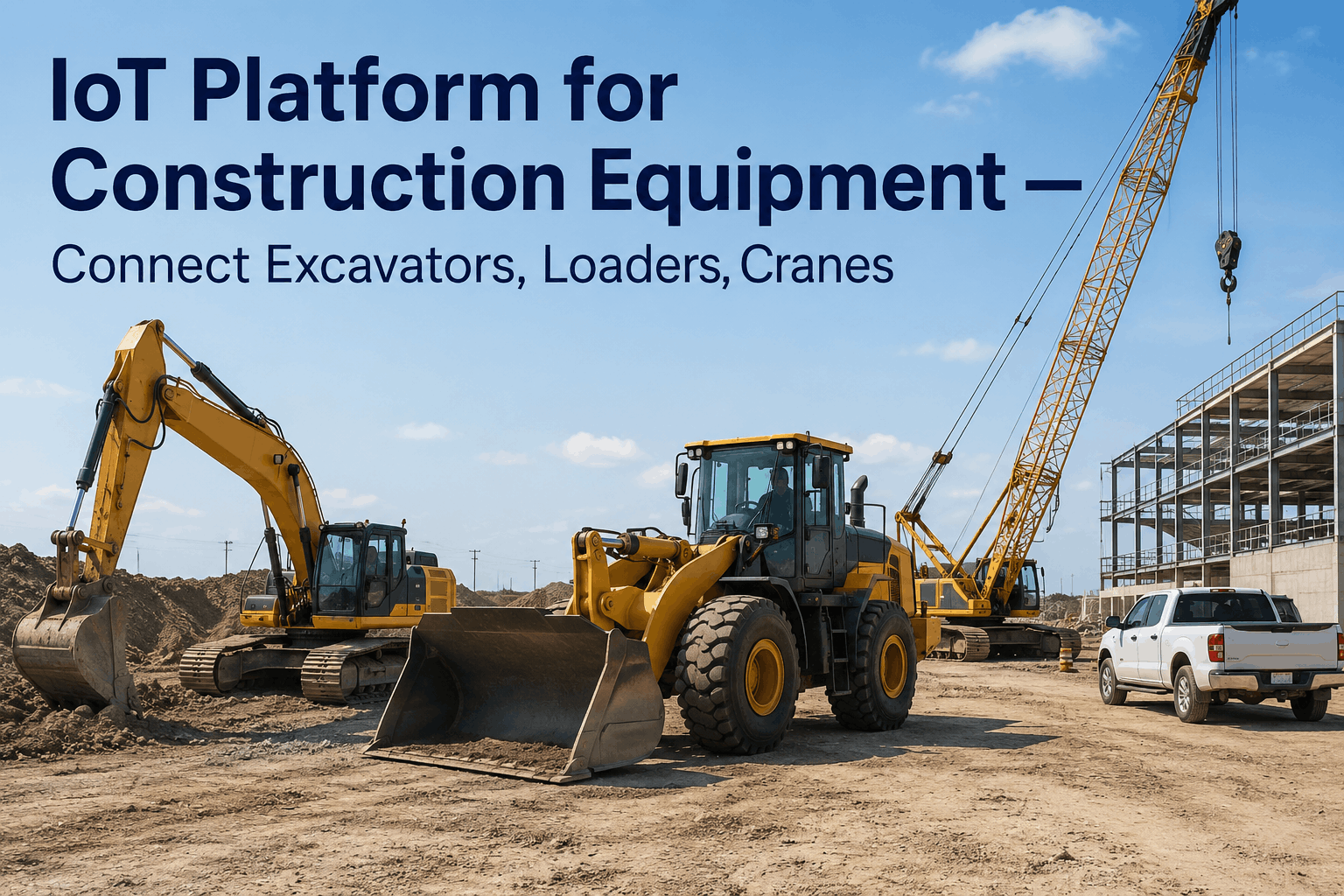
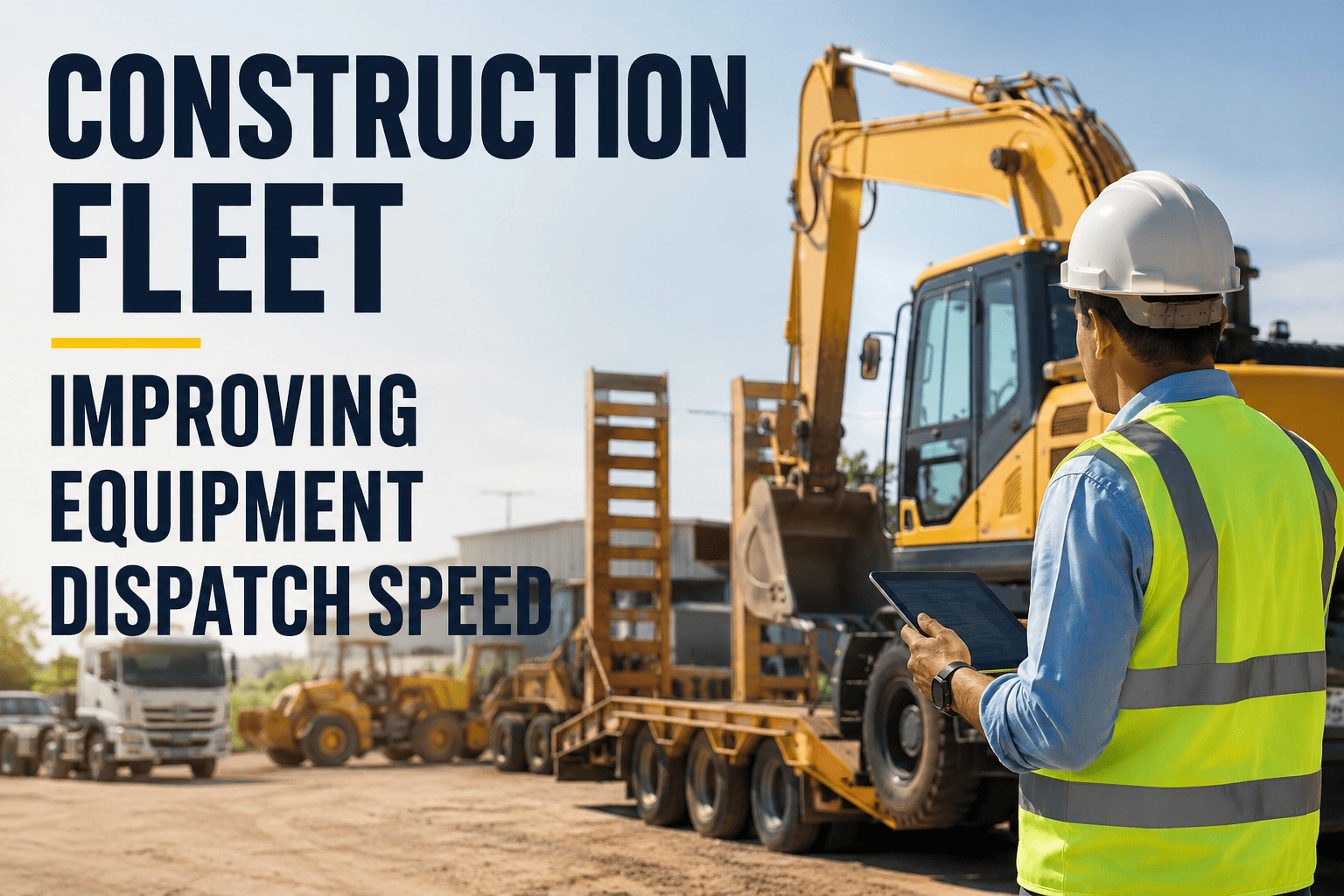
Every excavator sitting idle in a Phoenix job site, every loader burning diesel in a Seattle port yard, every crane waiting on a Los Angeles high-rise — each is a connected revenue leak US construction operators are only now beginning to quantify. IoT platforms for construction equipment close that gap: edge AI sensors mounted on machines transmit real-time utilization, fuel burn, fault codes, and location data to a unified dashboard — giving fleet managers in California, Oregon, Texas, and Nevada full visibility over $4M in heavy iron. Fleet Rabbit's OEM-agnostic IoT platform connects excavators, loaders, cranes, and mixed heavy equipment fleets — on-premise or cloud — with no rip-and-replace of existing machines. Book a demo to see Fleet Rabbit's IoT platform applied to your construction fleet.
Quick Answer
An IoT platform for construction equipment connects excavators, loaders, cranes, and dozers with edge AI sensors delivering real-time utilization tracking, predictive fault detection, geofence compliance, fuel analytics, and operator scoring — from one OEM-agnostic dashboard. Western US fleets using Fleet Rabbit reduce idle time 30–40%, cut unplanned downtime 45%, lower fuel cost 18–25%, and recover full ROI within 60 days — regardless of equipment brand mix.
The $180,000 Problem Sitting in Your Equipment Yard Right Now
The average US construction company with 20 pieces of heavy equipment loses $180,000–$240,000 annually to idle iron, undetected mechanical degradation, fuel waste, and theft — without ever knowing it. An excavator idling 3 hours waiting for a grade check, a loader running low tire pressure that degrades fuel efficiency 4% per shift, a crane deployed 40 miles from where it's needed because dispatch has no real-time location visibility. Fleet Rabbit's IoT platform makes every one of these losses visible — and recoverable — within 30 days.
⛏
Idle Waste
$52K
avg annual idle cost / 20-unit fleet
?
Unplanned Downtime
$68K
breakdown + rental cost / yr
⛽
Fuel Waste
$41K
excess burn via idle + aggressive op
?
Misallocation
$29K
wrong machine, wrong site, wrong time
How Edge AI Sensors Connect Excavators, Loaders & Cranes
OEM-Agnostic Hardware
Fleet Rabbit's edge sensors connect to Caterpillar, Komatsu, Volvo, Deere, Liebherr, and 40+ OEMs via CAN bus and J1939 — no brand lock-in, no equipment replacement. Mixed fleets common in California and Texas infrastructure projects unify in one dashboard.
Edge AI — Works Offline
On-device AI processes sensor data locally — detecting fault codes, vibration anomalies, and temperature spikes without cloud connectivity. Critical alerts fire at the machine even on remote Nevada mining or Oregon timber sites. Data syncs when connectivity returns, with zero gaps.
On-Premise + Cloud Flexible
Government contractors and defense-adjacent projects run Fleet Rabbit on-premise — full IoT with data never leaving the job site. Commercial operators use cloud with regional data centers in US-West (Oregon) and US-West-2 (California) for low-latency dashboards.
Capability #1: Real-Time Utilization — Know What Your Iron Is Actually Doing
Typical 20-Unit Western US Construction Fleet — Daily Machine Hours
Fleet Rabbit platform data, Western US construction fleets 2024–2025. Preventable idle + untracked = primary recovery opportunity.
1
Machine-Level Utilization Scoring
Every connected machine gets a daily utilization score — productive hours vs. engine-on time. Fleet managers in Phoenix and Sacramento see instantly which machines are earning their keep and which are costing $85–$140/hour in ownership cost while generating zero output.
Oregon road contractor, 14 machines: Pre-IoT utilization 51% → Post-Fleet Rabbit 67%. Revenue-equivalent gain: $431,200 in additional billable capacity identified over 12 months.
2
Geofence + Site Assignment Compliance
Fleet Rabbit geofences every active job site — alerting dispatchers when equipment leaves an authorized zone or operates outside contracted hours. For California prevailing wage projects, geofence logs provide compliance documentation automatically.
Real-time boundary alertsAfter-hours detectionTheft prevention
3
Fleet Right-Sizing with Utilization Data
After 90 days of IoT data, Fleet Rabbit generates a right-sizing analysis — identifying machines below 40% utilization as candidates for disposal or rental replacement. Western US contractors reduce owned fleet size 15–20% on average while maintaining full project capacity.
A Phoenix civil contractor eliminated 3 owned excavators (saving $380K annually in ownership cost) after Fleet Rabbit data showed consistent sub-35% usage across the units.
IoT Platform for Heavy Equipment
Connect Your Excavators, Loaders & Cranes — Free Trial, No Hardware Commitment
OEM-agnostic. Installs on any equipment brand in hours. Real-time utilization, predictive maintenance, and fuel analytics from day one across your Western US construction fleet.
Capabilities #2–5: Predictive Maintenance, Fuel Analytics, Operator Scoring & Theft Prevention
Capability #2: Predict Failures Before They Happen — Cut Downtime 45%
The breakdown math: An excavator breakdown on a Nevada highway project costs $2,400–$6,800 in repair, $3,200 in rental replacement, and $8,000–$15,000 in project delay penalties — 3–5 times per machine per year without IoT monitoring.
Fleet Rabbit predicts: Vibration anomaly detection identifies bearing wear 2–3 weeks before failure. Hydraulic pressure trends flag seal degradation. Engine temp patterns catch coolant issues before overheating. Alerts route to the maintenance team with severity and recommended action.
Western US impact: Remote sites in Nevada, Arizona, and Eastern Oregon make breakdown recovery extremely expensive — predictive maintenance eliminates the highest-cost incidents.
Capability #3: Equipment Fuel Analytics — Recover 18–25% of Fuel Spend
Construction fuel context: A Cat 336 excavator burns 4.5–7 gal/hr at load — and 1.8–2.4 gal/hr at idle. At $4.20/gal (California diesel average), a machine idling 3 hours daily wastes $22–$30 per shift — $5,500–$7,500 annually, per machine. A 20-machine fleet loses $110K–$150K annually to preventable idle fuel alone.
Fleet Rabbit tracks: Fuel per machine per hour, idle vs. work-mode burn rates, operator-level efficiency comparison, and site-level benchmarks identifying outlier machines needing mechanical attention.
Operator scorecards: Side-by-side fuel comparison identifies training opportunities where technique-driven waste is recoverable without equipment changes.
Capability #4: Operator Behavior Scoring — Reduce Component Wear 20–30%
The wear gap: Aggressive operation — hard swing stops, overload cycling, high-RPM engagement — accelerates component wear 2–3x versus smooth operation. The top vs. bottom operator quartile on a 10-excavator fleet often represents $60,000–$90,000 in annual component replacement cost.
Fleet Rabbit scores: Swing speed control, bucket overload frequency, idle RPM discipline, and hydraulic pressure cycling. Weekly scorecards give site supervisors specific coaching data — not general reminders.
Outcome: Operator scoring programs reduce component replacement frequency 20–30% within 6 months — the highest-ROI maintenance intervention available.
Capability #5: Equipment Theft Prevention — $1.4B Lost Annually in the US
Western US theft risk: NICB reports California, Texas, and Florida account for 40%+ of US construction equipment theft annually. A stolen Cat 320 excavator represents $250,000+ in asset loss and months of project disruption while replacement is sourced.
Fleet Rabbit's layered prevention: Geofence breach alerts fire within seconds of unauthorized movement. After-hours ignition detection flags unauthorized engine starts. GPS enables law enforcement recovery — Fleet Rabbit-connected machines have a 78% higher recovery rate than untracked equipment.
Insurance benefit: Documented IoT tracking reduces heavy equipment premiums 8–15% with major US carriers — offsetting significant platform cost.
Before vs. After Fleet Rabbit IoT — 20-Unit Western US Fleet
❌ Without IoT
Utilization visibility: Monthly reports
Breakdowns/machine/yr: 4–6 incidents
Idle rate: 28–35% engine hours
Fuel accountability: Receipts only
Theft recovery: ~22%
Annual avoidable losses: $180K–$240K
✅ With Fleet Rabbit IoT
Utilization visibility: Real-time per machine
Breakdowns/machine/yr: 1–2 incidents
Idle rate: Under 15% engine hours
Fuel accountability: Per-hour, per-operator
Theft recovery: ~78%
Annual avoidable losses: Under $45K
45%
Unplanned Downtime Cut
30–40%
Idle Time Reduction
20–30%
Component Wear Reduction
Frequently Asked Questions: IoT Platform for Construction Equipment
QDoes Fleet Rabbit work with older equipment that has no factory telematics?
Yes. Fleet Rabbit's edge sensors connect via CAN bus and J1939 interfaces available on virtually all construction equipment manufactured after 1998. For pre-1998 equipment, external sensor kits mount directly on hydraulic lines, fuel systems, and ignition circuits — providing utilization, fuel, and location data without internal diagnostic access. A 1992 Cat 320 and a 2024 Komatsu PC360 run side-by-side in the same dashboard.
QHow does Fleet Rabbit handle connectivity on remote Western US job sites?
Fleet Rabbit's edge AI stores and processes data locally when cellular is unavailable — queuing alerts and delivering them when connectivity returns. For permanently remote sites in Nevada, Eastern Oregon, or rural Arizona, Fleet Rabbit supports Iridium satellite modem integration for continuous reporting with no cellular dependency.
QWhat's the difference between on-premise and cloud deployment?
Cloud deployment runs in AWS US-West regions — instant setup, automatic updates, access from any device. On-premise runs Fleet Rabbit on a customer-owned server at the main office — required for federal contractors under CMMC compliance or operators with strict data sovereignty requirements. Both provide identical IoT capabilities; on-premise suits large fleets where ongoing cloud subscription costs exceed one-time server investment.
QHow long does installation take across a mixed equipment fleet?
A trained Fleet Rabbit technician installs sensors on 4–6 machines per day. A 20-unit mixed fleet (excavators, loaders, cranes) is fully connected in 4–5 days. Fleet Rabbit's Western US installation teams cover California, Nevada, Arizona, Oregon, Washington, and Colorado. Equipment operates normally throughout — no downtime required for sensor mounting or diagnostic connection.
Related Fleet Rabbit Resources
The four AI capabilities transforming fleet operations — real-time GPS, predictive health monitoring, dynamic route optimization, and delivery performance analytics — with ROI data for each.
AI-driven fault prediction and automated maintenance scheduling that prevents mid-project breakdowns — the reliability layer IoT sensor data powers across excavators, loaders, and cranes.
Real-time utilization tracking, idle reduction analytics, and fleet right-sizing data that reduce total heavy equipment operating cost for Western US contractors.
How GPS hardware, IoT sensors, and cloud analytics combine to deliver real-time heavy equipment visibility, predictive maintenance, and operational intelligence.
Connect Your Excavators, Loaders & Cranes — See Fleet Rabbit IoT in Action
Fleet Rabbit's OEM-agnostic IoT platform delivers all five heavy equipment capabilities through one system — real-time utilization, predictive fault detection, fuel analytics, operator scoring, and theft prevention across your Western US construction fleet. On-premise or cloud. Any brand. Full ROI in 60 days.
OEM-Agnostic
Edge AI + Cloud
45% Less Downtime
On-Premise Option
60-Day ROI
May 27, 2026
By Michael Finn
All Posts