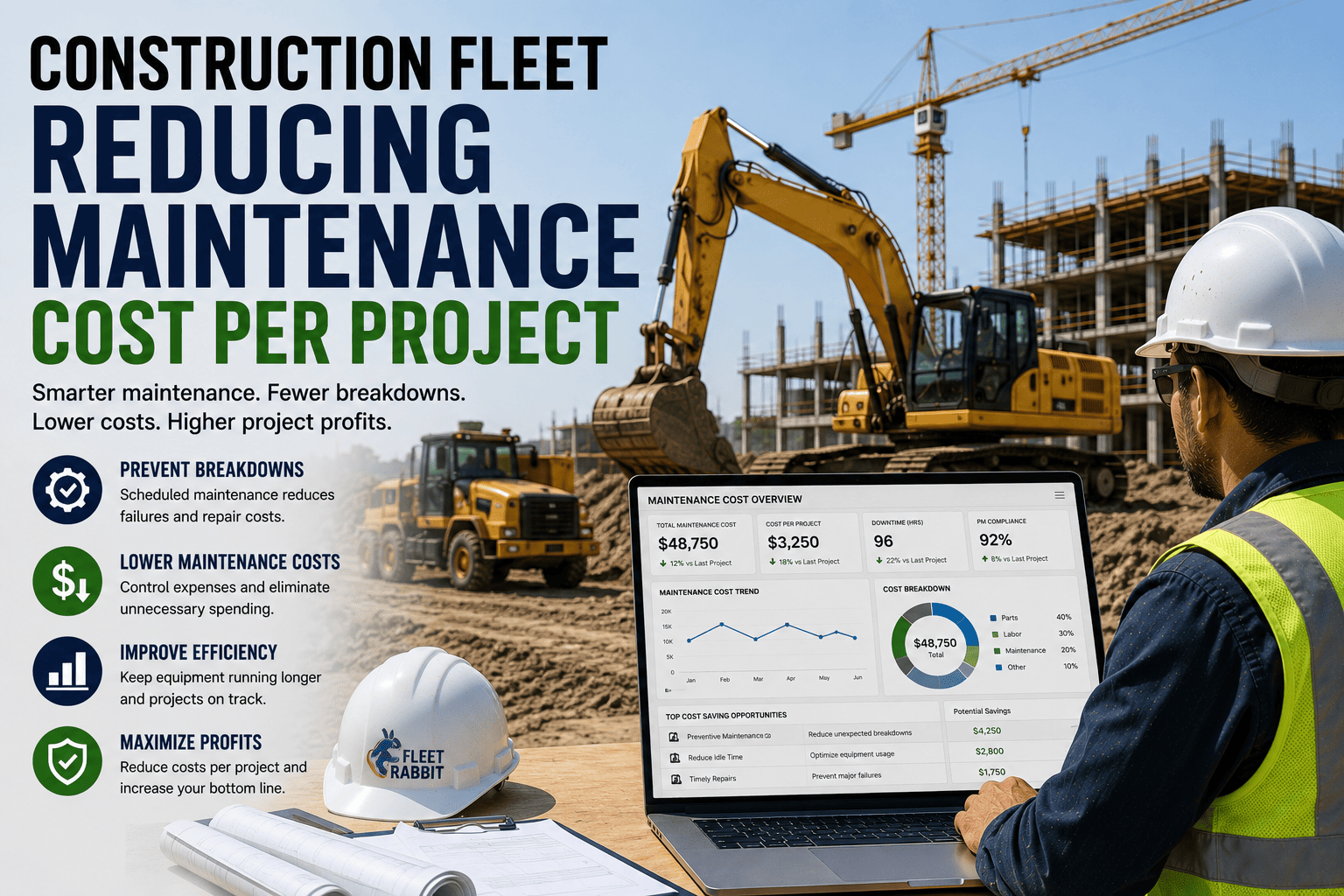
Construction equipment operators face more safety hazards per shift than almost any other role on a job site — struck-by incidents, tip-overs, caught-between events, falls from equipment, and exposure to moving machinery components. OSHA reports that heavy equipment operations account for approximately 25% of all construction fatalities annually. Yet most construction companies still manage operator safety with paper inspection forms that get stuffed in glove boxes, verbal safety briefings with no documentation, and reactive incident investigation after injuries occur. FleetRabbit's fleet management technology shifts operator safety from reactive to proactive — digital pre-start inspections that prevent unsafe equipment from operating, real-time alerts that catch dangerous conditions before they cause injuries, operator qualification enforcement that ensures only trained personnel operate specific equipment, and permanent safety documentation that protects both operators and companies during OSHA investigations. Book a safety technology demo with FleetRabbit.
FleetRabbit Operator Safety
How to Manage Construction Operator Safety with Fleet Management Technology
How digital inspections, real-time monitoring, operator qualification tracking, and automated safety alerts protect construction equipment operators — reducing incidents, ensuring OSHA compliance, and creating audit-ready safety documentation.
25%Construction Fatalities from Equipment
75%Incidents Preventable with Pre-Checks
$14K+Average OSHA Safety Citation
Real-TimeSafety Alert Response
The 5 Operator Safety Failures That Technology Eliminates
Most equipment-related injuries on construction sites trace back to five systemic failures — all of which are preventable with proper fleet management technology. These aren't equipment failures; they're process failures that paper-based systems cannot catch consistently across multiple operators, multiple sites, and multiple shifts.
01
Operating Uninspected Equipment
OSHA requires pre-shift inspections on all industrial equipment before operation. Paper inspection forms have completion rates below 60% on most construction sites — operators skip inspections when running late, when forms aren't available, or when they assume "it was fine yesterday." Uninspected equipment operates with unknown defects: failed brakes, inoperative backup alarms, broken seat belts, hydraulic leaks near hot components, and cracked ROPS structures. FleetRabbit's digital inspection system tracks completion rates per operator per shift — equipment cannot be assigned or dispatched until inspection is submitted. Completion rates jump from 55–60% (paper) to 94–98% (digital) within 30 days of deployment.
02
Unqualified Operators on Equipment
Operating equipment without proper training and certification is an OSHA violation and a leading cause of tip-over incidents, struck-by events, and property damage. On busy construction sites with multiple subcontractors, verifying that every operator holds current qualifications for every piece of equipment they touch is nearly impossible with paper tracking. FleetRabbit maintains a digital qualification matrix — CDL status, NCCCO crane certifications, equipment-specific training records, medical evaluations, and drug testing compliance — and blocks assignment of operators to equipment types not covered by their verified credentials. When a certification expires, the system immediately restricts that operator from the affected equipment category.
03
Known Defects Left Unrepaired
An operator reports a brake problem on a paper inspection form. The form sits on a clipboard in the foreman's trailer until someone eventually reads it — sometimes hours, sometimes days later. During that delay, other operators continue using the equipment with the known brake defect. FleetRabbit eliminates this gap entirely: when an operator flags a safety-critical defect during a digital inspection, the system immediately generates a work order, notifies the fleet manager, and changes the equipment status to "out of service" — preventing any operator from being assigned to that machine until the defect is repaired and verified. Response time drops from 4–48 hours (paper) to under 15 minutes (digital).
04
No Safety Equipment Verification
Fire extinguishers with expired charges, missing first aid kits, non-functional seat belts, disconnected backup alarms, and defeated safety interlocks are common on construction equipment — because nobody systematically checks them. Paper inspection forms list "safety equipment" as a single checkbox that operators tick without actually verifying each item. FleetRabbit's inspection templates break safety equipment into individual mandatory checkpoints — each requiring specific verification: fire extinguisher gauge in green zone, seat belt latches and releases, backup alarm audible, horn functional, all lights operational. Mandatory photo fields for key safety items provide visual proof of compliance that paper checkboxes cannot match.
05
No Incident Trend Analysis
Paper incident reports get filed and forgotten — nobody analyses patterns across multiple incidents to identify systemic causes. The same type of near-miss happens three times in two months on different equipment, but without data aggregation nobody connects the pattern. FleetRabbit captures every incident, near-miss, and inspection defect in a searchable database — enabling trend analysis by equipment type, operator, site, defect category, and time period. When the system detects recurring defect patterns (e.g., brake complaints increasing across a specific equipment model), it alerts the fleet manager to investigate a potential fleet-wide issue before it causes an injury.
Digital Pre-Start Inspections: The Foundation of Operator Safety
The pre-start inspection is the single most effective safety intervention in construction fleet management — catching defects before they cause injuries. But effectiveness depends entirely on two factors: completion rate (are inspections actually being done?) and quality (are operators actually checking each item, or just ticking boxes?). FleetRabbit addresses both with technology that paper forms cannot replicate.
Custom Templates Per Equipment Type
A crane inspection differs fundamentally from a dump truck inspection. FleetRabbit supports unlimited custom inspection templates — each tailored to the specific safety checkpoints for that equipment category. Excavator templates include boom and stick condition, hydraulic hose routing, track tension, and swing brake. Crane templates include wire rope condition, load chart verification, outrigger pad placement, and anti-two-block device testing. Equipment-specific templates catch defects that generic "check brakes, check fluids" paper forms miss entirely because they don't prompt for the right items.
Mandatory Photo Evidence
FleetRabbit inspection templates include mandatory photo fields for critical safety items — operators must photograph the fire extinguisher gauge, seat belt condition, tire condition, or any other specified item before the inspection can be submitted. Photo requirements eliminate "check-the-box-without-looking" behaviour that plagues paper forms. When an OSHA inspector asks "how do you verify operators actually inspect safety equipment?" — timestamped, GPS-tagged photos provide definitive proof that paper signatures cannot match.
Automatic Defect Escalation
When an operator identifies a defect during inspection, FleetRabbit classifies it by severity and routes it appropriately. Safety-critical defects (failed brakes, inoperative seat belt, cracked ROPS) immediately flag the equipment as out-of-service and notify the fleet manager via push notification. Moderate defects (minor hydraulic weep, light bulb out) generate work orders for repair within 24–48 hours. Minor defects (cosmetic damage, low washer fluid) are logged for next scheduled service. This tiered response ensures critical safety issues get immediate attention while routine items don't overwhelm the maintenance queue.
Completion Rate Monitoring
FleetRabbit tracks inspection completion rates by operator, by equipment, by site, and fleet-wide — with configurable targets (typically 95%+). Operators who consistently skip inspections are identified within days, not months. Site superintendents receive daily completion reports showing which equipment was operated without a completed inspection that shift. This visibility creates accountability that paper-based systems — where nobody knows completion rates until someone physically counts forms — simply cannot provide.
FleetRabbit Safety Platform
Digital Inspections. Real-Time Alerts. Operator Qualification Tracking. Complete Safety Documentation.
FleetRabbit transforms operator safety from reactive incident response to proactive hazard prevention — catching defects before they cause injuries, ensuring only qualified operators touch equipment, and creating the audit-ready safety documentation that protects your company during OSHA investigations.
From the Field
"In our first year on FleetRabbit, inspection completion rates went from 58% to 97%. More importantly, we caught 340+ safety defects that would have gone unreported on paper forms — including 23 critical findings like failed brakes, cracked ROPS welds, and inoperative seat belts that could have caused serious injuries. Our recordable incident rate dropped 42% in the same period. The correlation is undeniable: when operators actually inspect equipment before every shift, and defects actually get repaired before the next operator uses the machine, injuries go down. FleetRabbit made both of those things happen consistently across all 14 of our active project sites."
Director of Safety
·
ENR Top 200 General Contractor — 220 Assets — 14 Active Sites
Frequently Asked Questions
QCan FleetRabbit prevent an operator from starting equipment that hasn't been inspected?
FleetRabbit doesn't physically prevent engine start — but it creates a documented gap that is visible in real time. If an operator uses equipment without completing a pre-start inspection, the system flags the non-compliance immediately to the site superintendent and fleet manager. Equipment dispatching workflows can be configured to require inspection completion before assignment confirmation. This creates accountability that eliminates uninspected operation within weeks of deployment — most sites reach 95%+ compliance within 30 days.
QHow does FleetRabbit handle operator certifications across multiple subcontractors?
FleetRabbit supports unlimited user profiles with qualification tracking per operator regardless of employer. General contractors can require subcontractor operators to have FleetRabbit profiles with verified certifications before they are permitted to operate site equipment. Certification expiry dates trigger automatic alerts 60 days before lapse — giving subcontractors time to renew before their operators lose assignment eligibility. This is particularly critical for crane operations where NCCCO certification lapses create immediate OSHA exposure.
QWhat safety reports does FleetRabbit generate for OSHA compliance?
FleetRabbit generates comprehensive safety reporting including: inspection completion rates by operator and equipment, defect frequency by type and severity, defect resolution time tracking, operator qualification status and certification expiry, incident and near-miss logs with investigation notes, and safety trend analysis across customisable time periods. All reports are exportable as PDF or CSV and can be generated in under 60 seconds during an OSHA audit — providing the documentation that inspectors specifically request during construction site compliance reviews.
QDoes the mobile inspection app work offline on remote construction sites?
Yes. FleetRabbit's mobile app works fully offline — operators complete inspections with photos, flag defects, and submit findings without cell signal or Wi-Fi. All data syncs automatically when connectivity is restored. Offline inspections retain full timestamp and photo capability, ensuring safety documentation is not compromised by remote site conditions. This is essential for pipeline, highway, wind farm, and mountain infrastructure projects where connectivity is unreliable or non-existent.
FleetRabbit Operator Safety Technology
Protect Your Operators. Protect Your Company. Every Shift. Every Machine. Every Site.
FleetRabbit delivers the complete operator safety technology stack — digital inspections, qualification tracking, real-time defect alerts, incident analysis, and OSHA-ready documentation. Prevent injuries before they happen, ensure compliance without paperwork, and build a safety culture that scales across your entire fleet.
Digital Inspections
Qualification Tracking
Real-Time Alerts
Incident Analysis
OSHA Compliance
April 30, 2026
By Michael
All Posts