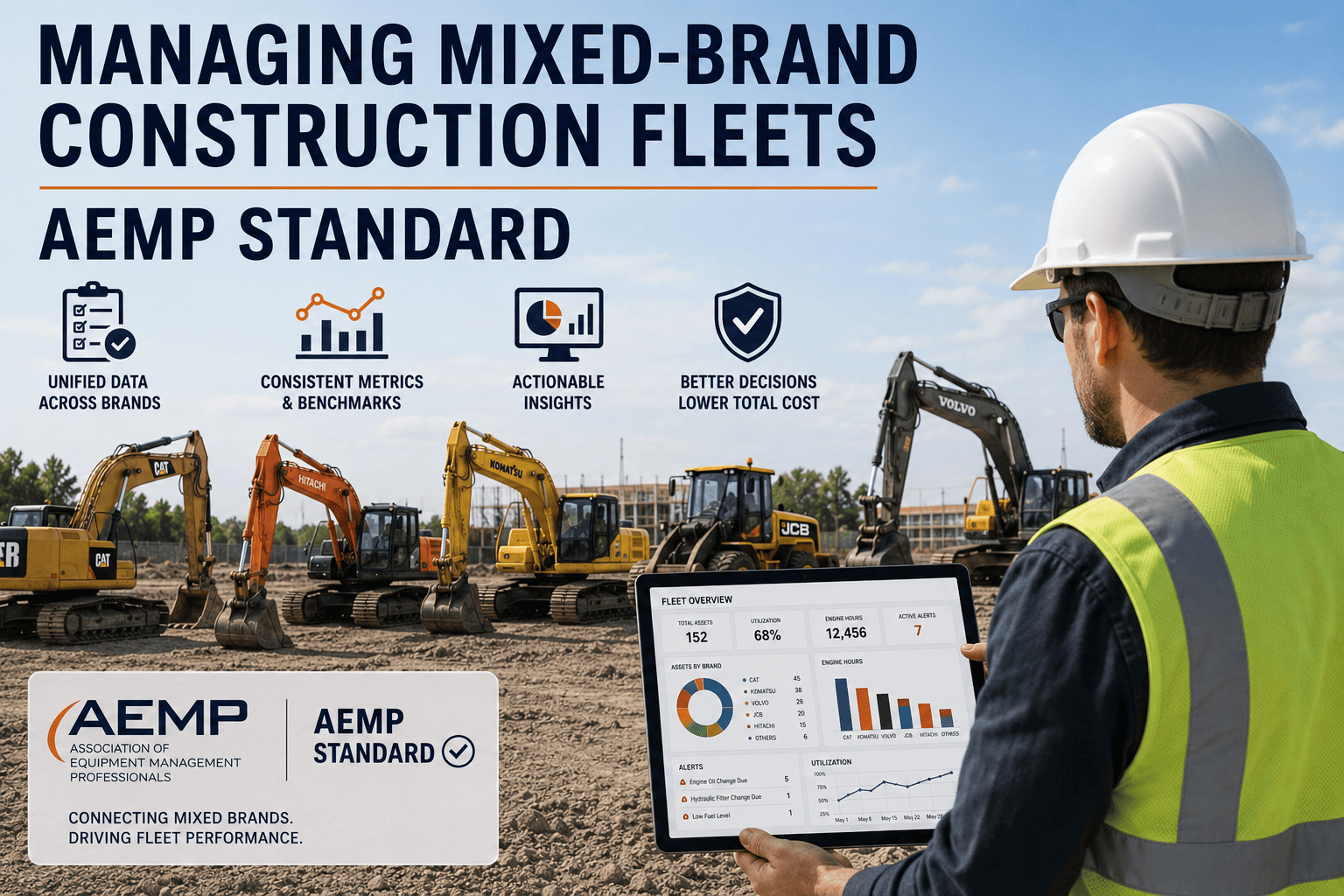
A contractor running Caterpillar excavators, Komatsu dozers, and John Deere loaders is really running three separate data systems that were never designed to talk to each other. Before 2010, that was simply the cost of owning a mixed-brand fleet. Today, a single data standard called AEMP quietly solves this problem for thousands of construction fleets, and most equipment managers have never heard its full story.
The AEMP standard, developed by the Association of Equipment Management Professionals and formalized internationally as ISO 15143-3, defines a common data format for engine hours, fuel, location, and machine status across manufacturers. It lets a fleet platform read Caterpillar, Komatsu, John Deere, and Volvo telematics feeds through the same structure, so mixed-brand fleets can be managed from one dashboard instead of one portal per brand.
Life Before And After A Shared Data Standard
Before AEMP, every manufacturer's telematics data followed its own private structure, and comparing an hour reading from one brand to another meant manually reformatting spreadsheets. The standard changed the mechanics of the data itself, not just the dashboard sitting on top of it.
Without A Shared Standard
Each OEM portal formats engine hours, fuel, and fault data differently. Comparing brands means exporting separate files and reconciling them by hand. Every new integration requires a custom connector built brand by brand.
With The AEMP Standard
Engine hours, location, and fuel data follow the same field names and structure across brands. A platform built once against AEMP can read Cat, Komatsu, Deere, and Volvo feeds without a separate connector for each manufacturer.
How The AEMP Standard Came To Exist
The Association of Equipment Management Professionals introduced the first version of this specification in 2010, aiming to bring order to what was, at the time, a fragmented landscape of proprietary telematics formats. The goal was straightforward: define one common way to describe machine data so fleet software would not need a separate translator for every manufacturer.
2010: The First Public Specification
AEMP published version 1.0, establishing the earliest common structure for exchanging basic machine data like hours and location between telematics providers and fleet systems.
2016: AEMP 2.0 For Commercial Deployment
The standard was refined into version 2.0, extending the data model and making it practical for broader commercial use across OEM telematics platforms.
2020: Formalized As ISO 15143-3
The specification was submitted to the International Organization for Standardization and became ISO 15143-3, giving it global, vendor-neutral standing rather than remaining an industry-only convention.
That progression is why the standard is referred to by three names depending on who you ask: AEMP, AEMP 2.0, and ISO 15143-3. All three point to the same underlying data model, and it is this model that platforms like FleetRabbit read from when unifying a mixed-brand fleet.
The Data Points AEMP Standardizes
The standard has grown to cover close to twenty data elements, giving fleet software a consistent set of fields to pull from any compliant OEM system regardless of brand.
Because every compliant OEM system reports these same fields in the same structure, a fleet manager comparing a Caterpillar excavator's idle time to a Komatsu dozer's idle time is looking at genuinely comparable numbers, not two different formats forced into the same spreadsheet column.
FleetRabbit reads AEMP-standardized data directly from Cat, Komatsu, John Deere, and Volvo telematics systems, so your entire mixed-brand fleet appears in one place. Book a demo to see it built around your equipment list.
How Fleet Platforms Put The Standard To Work
1. Connect To Each OEM's AEMP Endpoint
Manufacturers such as Caterpillar, John Deere, Komatsu, and Volvo each expose their telematics data through an AEMP-compliant web service that a fleet platform can request data from directly.
2. Normalize Every Feed Into One Model
Because every feed follows the same field structure, engine hours and location from different brands can be merged into a single data model without brand-specific translation logic.
3. Present One Unified Fleet View
Once normalized, every machine appears side by side in the same dashboard, regardless of which manufacturer built it or which portal its data originally lived in.
4. Extend Coverage As Needed
Because the standard is vendor neutral, adding a new manufacturer to a mixed fleet does not require building an entirely new integration from scratch, it means reading the same standardized fields from a new source.
Fleet managers with equipment spread across several manufacturers can sign up and connect their existing OEM telematics accounts without waiting on a custom integration project for each brand.
Why This Matters More As Fleets Get More Mixed
Construction fleets rarely stay single-brand for long. Equipment gets added through purchases, rentals, and acquisitions, and each new machine often arrives with a different manufacturer's telematics system attached. A shared data standard is what keeps that growing mix manageable instead of turning into a new portal every time a different-brand machine joins the fleet.
No Per-Brand Rebuild
Adding a new manufacturer to the fleet does not require a new dashboard or a new login habit for the team.
Genuine Comparisons
Utilization, idle time, and fuel data mean the same thing across brands, so cross-fleet comparisons are actually valid.
Future-Proof Growth
Fleets that expand into new equipment brands stay compatible with the same platform instead of needing a replacement system.
Vendor Independence
Because the standard is global and OEM-neutral, fleet data is not locked to any single manufacturer's proprietary format.
Whether your fleet is two brands today or five brands next year, FleetRabbit reads standardized telematics data from every major manufacturer, so growth never means another login.
Frequently Asked Questions
The AEMP standard already lets Caterpillar, Komatsu, John Deere, and Volvo speak the same data language. FleetRabbit reads it directly, turning a mixed-brand fleet into one simple, unified dashboard.