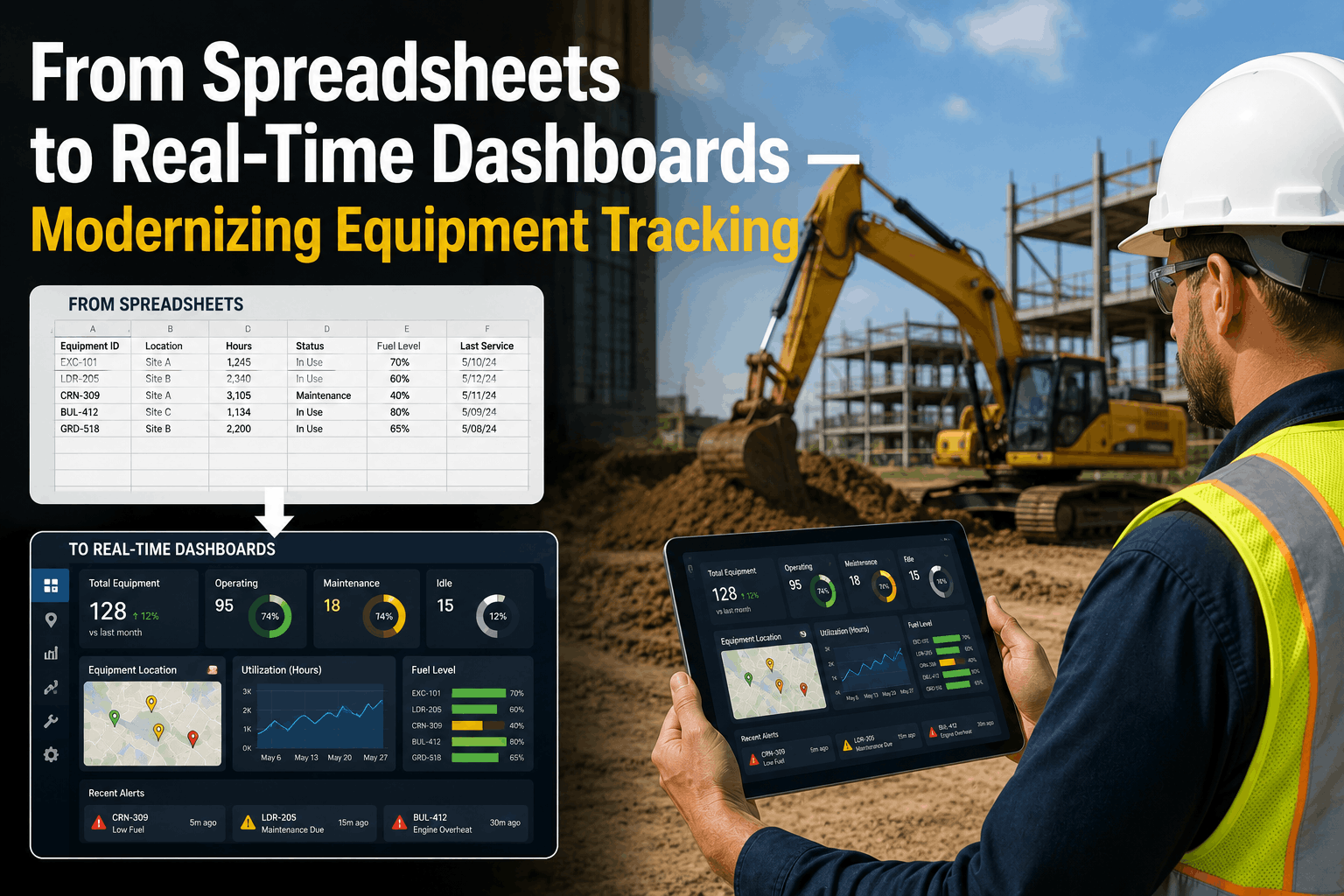
From Spreadsheets to Real-Time Dashboards — Modernizing Equipment Tracking
Spreadsheet-based equipment tracking is quietly costing Western US contractors thousands each month — a Portland civil firm losing billable hours to manual log reconciliation, a Phoenix infrastructure contractor unable to locate machines across three active sites, a Sacramento GC whose maintenance schedule lives in a shared Excel file nobody trusts. Fleet Rabbit's IoT telematics platform replaces spreadsheets with real-time dashboards across excavators, loaders, dozers, and mixed heavy equipment fleets — OEM-agnostic, on-premise or cloud, with migration support from day one. Book a demo to see Fleet Rabbit's real-time equipment tracking applied to your construction fleet.
Quick Answer
Western US construction fleets running spreadsheet-based equipment tracking lose 6–14 hours per week to manual data entry, miss 40–60% of utilization insights, and respond to breakdowns reactively. Fleet Rabbit's real-time dashboard platform replaces static logs with live GPS, utilization heatmaps, automated maintenance triggers, and cross-site equipment visibility — giving California, Nevada, Arizona, and Oregon contractors decision-ready data without a single manual entry.
The Hidden Cost of Spreadsheet Equipment Tracking in Western US Fleets
A 15-unit fleet operating across California or Nevada job sites generates 300–500 data points per week. A spreadsheet captures maybe 30% of that, always a day late, and requires a dedicated person to compile what GPS sensors would log automatically.
Manual Entry Hours
9 hrs
avg weekly admin / 15-unit fleet
Missed Breakdowns
$4.2K
avg monthly reactive repair premium
Idle Asset Cost
$3.1K
untracked idle time per month
Audit Failures
$1.8K
compliance gaps and penalties
The Migration Playbook: Spreadsheets to Real-Time Dashboards in 4 Phases
Time to Value — Spreadsheet Migration vs. Full Dashboard Deployment
Day 1 Quick Wins
Live GPS
Week 1–2
Utilization Baseline
Week 3–4
Maintenance Triggers
Day 30–45
Full ROI Achieved
Fleet Rabbit platform data, Western US construction fleets 2024–2025. Most fleets recover platform cost within the first billing cycle.
1
Phase 1: Hardware Install and Data Baseline (Days 1–5)
Fleet Rabbit technicians mount OEM-agnostic telematics units on 4–6 machines per day — no downtime, no dealer involvement. GPS, engine hours, fuel flow, and CAN bus data stream to the dashboard immediately. Within 48 hours, fleet managers have a live equipment map replacing the whiteboard they've maintained manually for years.
Arizona highway contractor, 22 machines: Fleet Rabbit was fully installed and live in 4 days. The project manager said it was the first time in 6 years he knew where every machine was without making a phone call.
2
Phase 2: Utilization and Idle Benchmarking (Week 1–2)
Fleet Rabbit's dashboard automatically builds a utilization baseline — hours worked, idle percentage, fuel burn per productive hour, and site-level deployment efficiency. The first week's data alone typically surfaces 2–4 machines running above 35% idle time that the spreadsheet never flagged.
Engine hours from the telematics feed trigger automated maintenance reminders based on OEM service intervals. The spreadsheet maintenance tab — manually updated, frequently wrong — is replaced by a live service queue that fires alerts 20 hours before a machine is due, not after it breaks down on a Nevada or Arizona remote site.
OEM interval syncAutomated alertsService queue
4
Phase 4: Cross-Site Reporting and Compliance Automation (Week 3–4)
Fleet Rabbit consolidates all site data into a single reporting layer — utilization by project, cost per machine hour, fuel consumption by site, and compliance-ready equipment logs. The weekly report that previously took 3–4 hours to compile from spreadsheets generates automatically every Monday morning.
Nevada civil contractor, 6 active sites: Eliminated 11 hours of weekly admin time. First CalTrans audit after migration passed with zero documentation deficiencies — first time in 4 years.
Equipment Tracking Platform
Replace Your Spreadsheets with Live Equipment Dashboards — Free Trial, No Hardware Commitment
OEM-agnostic sensors. Installs on any brand in hours. Real-time GPS, utilization heatmaps, and automated maintenance triggers from day one.
Dashboard Features That Replace 5 Separate Spreadsheet Tabs
01
Live GPS Map
Feature #1: Real-Time Fleet Map — Replace the Location Whiteboard
The gap: A location log updated once daily by a site foreman is wrong by the time anyone reads it. On a 5-site California fleet, 20–30% of equipment location entries contain errors at any moment.
Fleet Rabbit delivers: A live GPS map showing every machine's position, site assignment, engine status, and last movement timestamp — updated every 30 seconds. Site transfers trigger automatic geofence alerts with no manual entry.
Impact: Nevada contractors report eliminating 4–6 daily "where is that machine?" phone calls within the first week.
02
Utilization Heatmap
Feature #2: Utilization Heatmap — Surface Idle Iron Instantly
The gap: A manually entered hour log tells you how long the machine ran, not whether it was doing productive work. Idle engine hours and productive work hours look identical on a spreadsheet.
Fleet Rabbit delivers: Color-coded utilization heatmaps by machine, site, and shift — distinguishing productive run time from idle. Machines running above 30% idle surface automatically on the dashboard alert panel.
Impact: Oregon and Washington contractors identify 2–3 right-sizing opportunities per quarter, returning underutilized equipment and avoiding unnecessary rental extensions.
03
Maintenance Queue
Feature #3: Automated Maintenance Queue — End the Overdue Service Cycle
The gap: A maintenance tab manually updated by a fleet coordinator misses entries when the coordinator is on site, captures wrong hour readings, and provides zero advance warning.
Fleet Rabbit delivers: Engine hours feed directly into OEM-matched service interval tables. The maintenance queue updates automatically and fires alerts 20 hours before a service interval is due — time to schedule without emergency mobilization.
Impact: Phoenix-area contractors report a 65% reduction in unplanned downtime within 60 days of migrating from spreadsheet maintenance logs.
04
Compliance Logs
Feature #4: Immutable Compliance Logs — Audit-Ready Without Preparation
The gap: California prevailing wage audits and Nevada OSHA inspections require equipment records that are timestamped, machine-matched, and tamper-proof. A spreadsheet fails all three — cells are editable and timestamps are manual.
Fleet Rabbit delivers: Write-once sensor logs with cryptographic timestamps, GPS coordinates, operator credentials, and machine IDs. Export directly from the dashboard in the format required by CalTrans, OSHA, and major Western US bonding agencies.
Outcome: 85–95% first-pass audit compliance versus 40–60% with manual records.
Before vs. After Fleet Rabbit — 15-Unit Western US Construction Fleet
Without Real-Time Dashboard
Equipment location: Phone calls, daily log
Utilization visibility: Hours only, no idle split
Maintenance triggers: Manual calendar reminders
Compliance records: Editable spreadsheet
Weekly admin time: 8–12 hours
Audit pass rate: 40–60%
With Fleet Rabbit Dashboard
Equipment location: Live GPS, 30-second update
Utilization visibility: Productive vs. idle split, heatmap
Maintenance triggers: Automated, 20 hrs advance
Compliance records: Immutable sensor logs
Weekly admin time: Under 1 hour
Audit pass rate: 85–95%
9 hrs
Weekly Admin Recovered
65%
Unplanned Downtime Cut
$7.1K
Avg Monthly Recovery
95%
Audit Pass Rate
30s
GPS Update Frequency
45
Days to Full ROI
Frequently Asked Questions: Migrating to Fleet Dashboards
Yes. Fleet Rabbit's onboarding team imports existing engine hour logs, maintenance records, and equipment rosters from Excel or CSV format during setup. Historical data is mapped to each machine in the dashboard so your maintenance baseline and warranty tracking carries forward without re-entry.
QWhat if we run older equipment with no factory telematics?
Fleet Rabbit's hardware is fully OEM-agnostic. Inline sensors and a universal telematics gateway mount on any machine regardless of age or brand — a 1998 Cat D8 and a 2024 Komatsu PC360 run side by side in the same dashboard. No factory telematics or CAN bus required for basic GPS, engine hours, and fuel tracking.
QHow does Fleet Rabbit handle remote Nevada or Arizona sites with poor cellular?
Fleet Rabbit's edge AI processes and stores telematics data locally when cellular is unavailable. Data syncs automatically when connectivity returns. For permanently remote locations, Fleet Rabbit supports Iridium satellite integration for continuous real-time visibility across Nevada mining corridors and Eastern Oregon timber sites.
QHow long does a full migration take for a 20-machine California fleet?
Fleet Rabbit installs hardware on 4–6 machines per day with zero equipment downtime. A 20-unit fleet is fully live in 4–5 days. The dashboard is pre-configured before the technician arrives — day one ends with a live equipment map. Western US coverage includes California, Nevada, Arizona, Oregon, Washington, and Colorado.
The four AI capabilities transforming fleet operations — real-time GPS, predictive health monitoring, dynamic route optimization, and delivery performance analytics — with ROI data for each.
AI-driven fault prediction and automated maintenance scheduling that prevents mid-project breakdowns — the reliability layer IoT sensor data powers across excavators, loaders, and cranes.
Real-time utilization tracking, idle reduction analytics, and fleet right-sizing data that reduce total heavy equipment operating cost for Western US contractors.
How GPS hardware, IoT sensors, and cloud analytics combine to deliver real-time heavy equipment visibility, predictive maintenance, and operational intelligence.
Modernize Your Equipment Tracking — See Fleet Rabbit's Real-Time Dashboard in Action
Fleet Rabbit's OEM-agnostic telematics platform replaces spreadsheets with live GPS maps, utilization heatmaps, automated maintenance queues, and compliance-ready audit logs across your Western US construction fleet. On-premise or cloud. Any brand. Full ROI in 45 days.