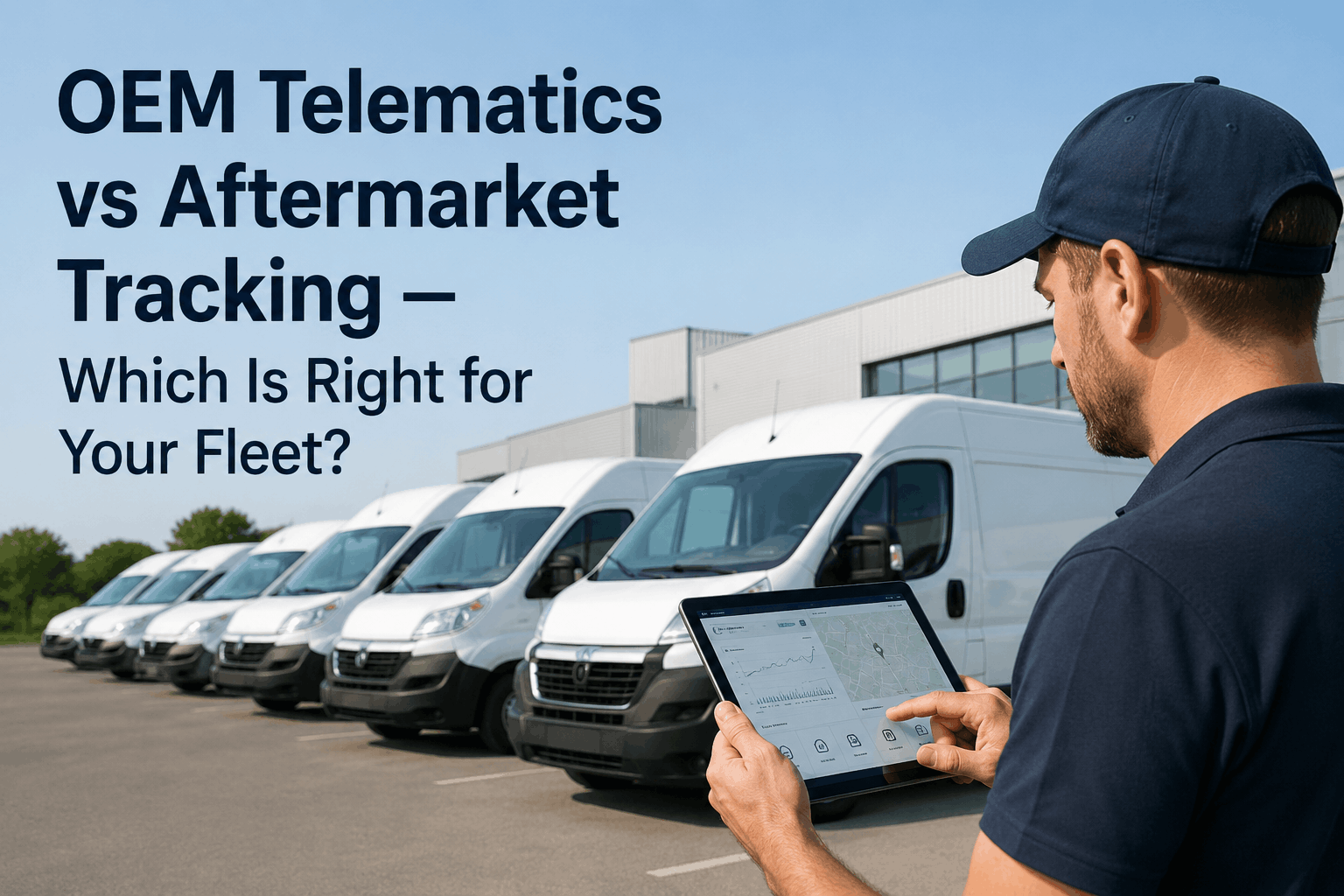
Every construction fleet manager buying a new excavator, motor grader, or articulated dump truck faces the same telematics decision within the first week of ownership: use the manufacturer's built-in telematics system, install an aftermarket tracking device, or attempt to run both simultaneously. The answer sounds straightforward until you are managing a fleet of 30 machines spanning six equipment brands, each with its own proprietary telematics portal, its own data schema, its own subscription renewal date, and its own definition of what constitutes an engine hour. OEM telematics delivers deep, native integration with a single manufacturer's equipment. Aftermarket tracking delivers consistent data and unified visibility across every brand, every age, and every equipment type in a mixed fleet. The right answer depends entirely on your fleet composition, your data priorities, and whether you need one portal for one brand or one portal for everything. FleetRabbit integrates both OEM telematics feeds and aftermarket device data into a single unified fleet intelligence platform — so the choice becomes an architecture decision, not a vendor lock-in problem. Book a fleet telematics integration demo with FleetRabbit.
FleetRabbit Fleet Intelligence
OEM Telematics vs Aftermarket Tracking — Which Is Right for Your Fleet?
OEM telematics vs aftermarket tracking — pros, cons and costs compared. Mixed-fleet reality, AEMP standard explained. Make the right call — how construction fleet managers choose between manufacturer-native telematics, aftermarket GPS and sensor devices, and unified integration platforms that consolidate both data sources into one fleet intelligence view.
6+Average Equipment Brands in a Mid-Size Construction Fleet
AEMP 2.0Industry Standard for OEM Telematics Data Exchange
$15–$45Monthly Per-Machine OEM Telematics Subscription Range
40%Of Fleet Assets Typically Too Old for Factory OEM Telematics
What OEM Telematics Actually Provides
OEM telematics systems — Caterpillar's VisionLink, Komatsu's SmartConstruction, John Deere's JDLink, Volvo's ActiveCare Direct, Hitachi's ConSite, and their equivalents across every major manufacturer — are factory-fitted telematics hardware integrated directly with the equipment's engine control unit, hydraulic control system, and onboard diagnostics bus. Because the telematics hardware is designed alongside the machine it monitors, OEM systems access data depths that aftermarket devices cannot replicate without manufacturer cooperation: proprietary fault code libraries with manufacturer-specific diagnostic guidance, hydraulic system performance parameters, boom and attachment sensor data, and service interval tracking tied directly to the equipment's own maintenance management system. For a single-brand fleet, this depth is genuinely valuable. For a six-brand mixed fleet, it means six separate portals, six separate subscription invoices, and six incompatible data formats that cannot be consolidated without a third-party integration layer.
OEM Telematics Strengths
Where Manufacturer-Native Data Wins
Factory hardware integration provides access to proprietary fault code libraries with manufacturer-specific diagnostic guidance that generic OBD readers cannot decode. Hydraulic system performance parameters, swing torque data, boom force measurements, and attachment sensor feeds are available only through OEM telematics on most equipment categories. Service interval tracking integrates directly with the manufacturer's recommended maintenance schedule — alerts are generated against the OEM's own PM framework, not a generic interval template. Warranty claim support is strengthened by OEM telematics records, as manufacturer service networks accept their own data natively without format conversion disputes.
OEM Telematics Weaknesses
Where the Single-Brand Model Breaks Down
Every manufacturer uses proprietary data formats, proprietary APIs, and proprietary portal interfaces — none of which are interoperable without deliberate integration work. A fleet running Caterpillar, Komatsu, and Volvo equipment needs three separate logins, three separate subscription renewals, and three separate alert configurations to achieve the same visibility that one aftermarket platform delivers across all three brands simultaneously. OEM telematics is also unavailable on equipment manufactured before approximately 2010–2014 depending on brand, leaving older but fully operational assets entirely invisible to the OEM system. Subscription costs compound across brands without delivering consolidated reporting.
Aftermarket Tracking Strengths
Where Brand-Agnostic Devices Win
A single aftermarket tracking device and platform works identically on a 2008 Caterpillar 320 excavator and a 2024 Komatsu PC390 — same data format, same portal, same alert logic, same reporting. Mixed fleets spanning multiple brands, multiple ages, and multiple equipment categories achieve unified visibility without managing parallel systems. Aftermarket devices also capture asset types that OEM telematics never covers: trailers, generators, compressors, light towers, fuel bowsers, concrete mixers, and any other towable or non-powered asset that needs location and utilisation tracking. Installation and subscription costs are typically lower than equivalent OEM telematics across a multi-brand fleet.
The AEMP Standard: Where OEM and Aftermarket Data Can Meet
The Association of Equipment Management Professionals (AEMP) Telematics Standard — now at version 2.0 — is the industry's attempt to solve the OEM data fragmentation problem by defining a common API schema for telematics data exchange. Under AEMP 2.0, participating OEM manufacturers expose a standardised data feed covering engine hours, fuel consumption, location, fault codes, and idle time through a common REST API format that third-party fleet management platforms can consume without manufacturer-specific integration work. Caterpillar, Komatsu, John Deere, Volvo, Doosan, Hitachi, and over 20 other manufacturers have committed to AEMP 2.0 compliance — making it the most important interoperability standard in construction fleet technology. FleetRabbit's OEM integration layer uses AEMP 2.0 feeds as its primary OEM data ingestion pathway, consolidating manufacturer telematics alongside aftermarket device data in one unified platform without requiring separate manufacturer portal access for day-to-day fleet management.
01
AEMP 2.0 Data Fields Covered
The AEMP 2.0 standard defines a common schema for the data elements most critical to construction fleet management: cumulative engine hours, fuel consumption (cumulative and rate), GPS location and heading, equipment identification (VIN, serial number, model), idle hours, fault code events with severity classification, and distance travelled. These fields are sufficient for PM scheduling, utilisation reporting, fuel cost accounting, and basic fault monitoring — covering the majority of day-to-day fleet management decisions without requiring access to the deeper proprietary data that remains behind manufacturer API walls. FleetRabbit ingests AEMP 2.0 feeds from all participating manufacturers automatically once fleet credentials are configured.
02
AEMP 2.0 Limitations to Understand
AEMP 2.0 standardises a baseline data set — it does not expose the full depth of OEM proprietary data. Manufacturer-specific fault code diagnostic guidance, hydraulic system performance parameters, attachment sensor data, and OEM service recommendation logic all remain in proprietary manufacturer APIs that require separate integration agreements. Update frequency under AEMP 2.0 varies by manufacturer — some push data every 15 minutes, others update hourly or on ignition events only. For fleets where real-time position and sub-15-minute sensor data are critical, aftermarket devices installed alongside OEM telematics provide the higher update frequency that AEMP feeds do not consistently deliver.
03
Proprietary OEM API Integration
Beyond AEMP 2.0, FleetRabbit maintains direct proprietary API integrations with major OEM telematics platforms for fleets that need deeper data access. Caterpillar VisionLink, Komatsu SmartConstruction, and John Deere Operations Center integrations expose extended fault code libraries, hydraulic performance data, and OEM maintenance schedule synchronisation not available through the AEMP standard feed. These integrations require manufacturer-issued API credentials and in some cases OEM dealer authorisation — FleetRabbit's onboarding team coordinates the credential setup process as part of fleet deployment to minimise the administrative overhead on the fleet manager.
04
Data Reconciliation Across Sources
When a machine has both an OEM telematics system and an aftermarket device installed, FleetRabbit's data reconciliation layer merges both data streams into a single asset record — using OEM engine hours as the authoritative PM trigger source where available, aftermarket GPS as the higher-frequency position source, and flagging discrepancies between the two systems for fleet manager review. Hour-count discrepancies between OEM and aftermarket sources exceeding 5% over a 30-day period trigger an automatic reconciliation alert, since meter discrepancies affect PM scheduling accuracy and, in some jurisdictions, equipment resale value documentation.
FleetRabbit Telematics Integration
OEM Feeds. Aftermarket Devices. AEMP 2.0. Every Brand. One Fleet Intelligence Platform.
FleetRabbit consolidates OEM telematics data, AEMP 2.0 manufacturer feeds, and aftermarket tracking devices into one unified construction fleet platform — eliminating the multi-portal management burden of mixed-brand fleets while preserving the depth of manufacturer-native data where it matters most.
The Mixed-Fleet Reality: Why Most Contractors Need Both
The theoretical debate between OEM telematics and aftermarket tracking resolves quickly when confronted with the actual composition of a working construction fleet. Surveys of mid-size construction contractors consistently show fleets spanning four to eight equipment brands, asset ages ranging from under two years to over fifteen, and non-powered asset categories — trailers, generators, compressors, fuel bowsers — that no OEM telematics system covers. In this environment, the choice is not OEM versus aftermarket. It is how to extract value from existing OEM telematics subscriptions already paid for, while filling coverage gaps with aftermarket devices on older machines and non-powered assets, and consolidating everything into one management interface that does not require fleet managers to toggle between four manufacturer portals during a morning asset check.
New Equipment
Factory-fitted OEM telematics active from delivery — use AEMP 2.0 feed or proprietary API to pull data into FleetRabbit. No aftermarket device required unless real-time position frequency or sensor depth exceeds what OEM feed provides. Retain OEM portal access for warranty claim support and manufacturer service network integration
Older Equipment
Equipment manufactured before OEM telematics era — typically pre-2010 — requires aftermarket device for any tracking capability. J1939 CAN bus access available on most diesel equipment from 2000 onwards provides engine hour, fault code, and basic health data through aftermarket gateway. GPS, geofencing, and utilisation reporting added regardless of equipment age or brand
Non-Powered Assets
Trailers, generators, light towers, compressors, fuel bowsers, and other towable or stationary assets have no OEM telematics option. Battery-powered aftermarket trackers with 2–5 year battery life provide GPS location, geofence monitoring, and movement alerts for the asset categories that represent significant capital value but are typically invisible to fleet management systems entirely
Rented Equipment
Short-term and long-term rental equipment arrives with OEM telematics active but rental company access credentials — not contractor access. Aftermarket devices installed on rented equipment give contractors independent tracking visibility, utilisation verification against rental invoices, and geofence monitoring without depending on rental company data sharing arrangements that vary by supplier and contract terms
Cost Comparison: OEM Telematics vs Aftermarket Over a Fleet Lifecycle
Telematics cost comparisons between OEM and aftermarket systems are frequently distorted by evaluating only the per-machine monthly subscription rate rather than total cost of ownership across the fleet lifecycle. OEM telematics subscriptions typically range from $15 to $45 per machine per month depending on manufacturer, data tier, and regional pricing — but this cost applies only to OEM-supported equipment, requires separate subscriptions per manufacturer, and provides no coverage for older machines or non-powered assets. A true cost comparison must account for the full asset inventory, the multi-portal management overhead, and the integration costs required to achieve consolidated reporting across multiple OEM systems.
01
OEM Telematics True Cost Model
A 30-machine fleet spanning three brands — 12 Caterpillar, 10 Komatsu, 8 Volvo — running OEM telematics at mid-tier subscription rates incurs $540–$1,350 per month across three separate subscriptions. Add portal management overhead (time spent toggling between three interfaces, reconciling conflicting data formats, maintaining three separate alert configurations) and the effective cost per consolidated insight is substantially higher than the subscription line item suggests. Older equipment outside OEM coverage remains untracked, creating the asset visibility gap that aftermarket devices fill at additional cost on top of existing OEM subscriptions.
02
Aftermarket Tracking Total Cost Model
Aftermarket tracking device hardware costs range from $150 to $600 per unit depending on capability tier — basic GPS-only trackers at the low end, full telematics gateways with CAN bus integration, multi-sensor support, and edge processing at the high end. Monthly subscription costs for aftermarket platforms typically range from $20 to $50 per asset including cellular data, platform access, and support. The critical distinction is that one subscription covers all asset types — powered equipment, older machines, non-powered trailers, and rented equipment — from one portal with one invoice, eliminating the parallel subscription overhead of multi-OEM management.
03
Hidden Cost: Portal Management Overhead
Fleet managers operating multi-brand fleets with separate OEM portals consistently report spending 45–90 minutes per day navigating between manufacturer systems to compile a complete picture of fleet status — time that a unified platform reduces to under 10 minutes for the same information. At a conservative $35/hour fully-loaded rate for a fleet manager, 60 minutes of daily portal overhead costs $750 per month in labour before any subscription fees are considered. This overhead cost is rarely included in OEM vs aftermarket cost comparisons but represents the most immediate and recoverable cost component for multi-brand fleet operations.
04
FleetRabbit Integration: Eliminating the Either/Or Choice
FleetRabbit's unified platform eliminates the cost penalty of managing OEM and aftermarket systems separately. Existing OEM telematics subscriptions feed into FleetRabbit via AEMP 2.0 or proprietary API — their data appears alongside aftermarket device data in one consolidated view without requiring separate OEM portal access for daily operations. Fleets retain OEM telematics for warranty support and manufacturer service integration while gaining unified reporting, cross-brand PM scheduling, and full asset coverage across older machines and non-powered assets that OEM systems leave untracked.
From the Field
"We had been running three OEM telematics portals for about four years — Cat, Komatsu, and Volvo — because our fleet grew through equipment purchases from whoever had the best deal rather than a single-brand strategy. Every morning I was logging into three different systems to check what was happening across 22 machines, and our older gear — 7 machines — was completely off the radar because they pre-dated factory telematics on those models. We were also renting two telehandlers on a rolling basis with no visibility at all. After switching to FleetRabbit, we kept our OEM subscriptions running for the Cat and Komatsu equipment because we needed those for warranty purposes, but we stopped logging into the manufacturer portals daily — FleetRabbit pulls all that data in via AEMP and shows it alongside our aftermarket-tracked older machines and the rented telehandlers in one place. The morning asset check went from 80 minutes across three portals to under 10 minutes. The older machines surfaced utilisation patterns we had never seen before — two of them were being used less than 20% of the time while we were paying rent on the telehandlers every day they sat on site."
Fleet Manager
·
Civil & Commercial Contractor — 29-Machine Fleet — Multi-Brand
Decision Framework: Choosing the Right Telematics Strategy
The OEM versus aftermarket decision reduces to four questions that every fleet manager can answer about their own operation. Work through each question sequentially — the answers will point to one of four clear strategy outcomes without requiring a detailed technology evaluation that delays the decision for months while asset visibility gaps continue costing money every week.
Question 1
How many equipment brands are in your fleet? One brand with modern equipment: OEM telematics may be sufficient as a primary system. Two or more brands, or any equipment older than 10–12 years: a unified aftermarket platform with OEM integration is the only way to achieve consolidated fleet visibility without chronic multi-portal management overhead
Question 2
Do you track non-powered assets? Trailers, generators, compressors, fuel bowsers, and light towers require aftermarket battery trackers — no OEM telematics option exists for these categories. If non-powered assets represent more than 15% of your capital equipment inventory by value, aftermarket tracking is a necessity regardless of how you handle powered equipment
Question 3
Do you need real-time position updates faster than 15-minute intervals? AEMP 2.0 OEM feeds update as infrequently as once per hour on some manufacturers. If dispatch decisions, theft response, or safety monitoring require position updates faster than 15 minutes, aftermarket devices installed alongside or instead of OEM telematics provide the update frequency that AEMP feeds do not consistently guarantee
Question 4
Are you locked into OEM subscriptions already paid for? If existing OEM subscriptions are active and cancellation penalties apply, the pragmatic answer is to integrate them into a unified platform via AEMP rather than replacing them. FleetRabbit's AEMP integration adds aftermarket coverage for untracked assets while extracting value from existing OEM subscriptions — eliminating the sunk cost dilemma of switching entirely before subscription periods expire
Frequently Asked Questions
QWill installing an aftermarket tracking device void my equipment's OEM warranty?
In most jurisdictions, aftermarket device installation does not void equipment warranty provided the installation does not physically modify the equipment's electrical system beyond connecting to existing diagnostic ports. J1939 OBD port connections — the most common aftermarket telematics installation method — are read-only connections that do not write data to the equipment's ECU and are generally considered warranty-neutral. Hardwired power connections tapped to existing fuse blocks or battery connections are similarly standard practice. FleetRabbit recommends confirming the specific installation method with your equipment dealer before installation on machines still under manufacturer warranty, and retaining installation records documenting that the connection method was non-invasive. Some manufacturers have explicit policies permitting AEMP-compliant third-party telematics devices — these policies are worth confirming with your dealer representative.
QCan FleetRabbit consolidate data from OEM telematics and aftermarket devices on the same machine?
Yes. FleetRabbit's data reconciliation layer supports dual-source asset records where both an OEM telematics feed and an aftermarket device are present on the same machine. The platform uses configurable source priority rules — typically OEM engine hours as the authoritative PM trigger, aftermarket GPS as the primary position source for its higher update frequency — and merges both streams into a single asset health and location record. Discrepancies between the two sources exceeding configurable thresholds generate reconciliation alerts for fleet manager review. This dual-source configuration is particularly common during fleet transitions where OEM subscriptions are still active but aftermarket devices have been added for higher-frequency tracking or sensor capability not available through the OEM feed.
QHow long does it take to connect existing OEM telematics accounts to FleetRabbit via AEMP 2.0?
AEMP 2.0 connection setup requires fleet manager credentials for each manufacturer's telematics portal and a one-time API authorisation that grants FleetRabbit read access to the fleet's equipment data. For manufacturers with fully implemented AEMP 2.0 APIs — Caterpillar, Komatsu, John Deere, Volvo, Doosan — the connection is typically active within 24–48 hours of credential entry, with historical data backfilled for the period permitted by the manufacturer's API retention policy (typically 90 days). FleetRabbit's onboarding team coordinates the AEMP connection process for each manufacturer in the fleet, handles any manufacturer-specific authorisation steps that differ from the standard AEMP flow, and validates data ingestion before marking the integration live. Total elapsed time from onboarding kickoff to consolidated fleet data in the platform is typically 3–5 business days for a fleet with up to four OEM brands.
FleetRabbit Telematics Integration
OEM Telematics. Aftermarket Devices. AEMP 2.0. Every Brand. Every Age. One Platform.
FleetRabbit eliminates the multi-portal management burden of mixed-brand construction fleets — consolidating OEM telematics feeds, AEMP 2.0 manufacturer data, and aftermarket tracking devices into one unified fleet intelligence platform with one login, one PM schedule, one alert system, and one source of truth for every asset in your fleet.
AEMP 2.0 Integration
OEM API Feeds
Aftermarket Devices
Mixed-Fleet Unified View
Data Reconciliation
May 22, 2026
By John Mark
All Posts