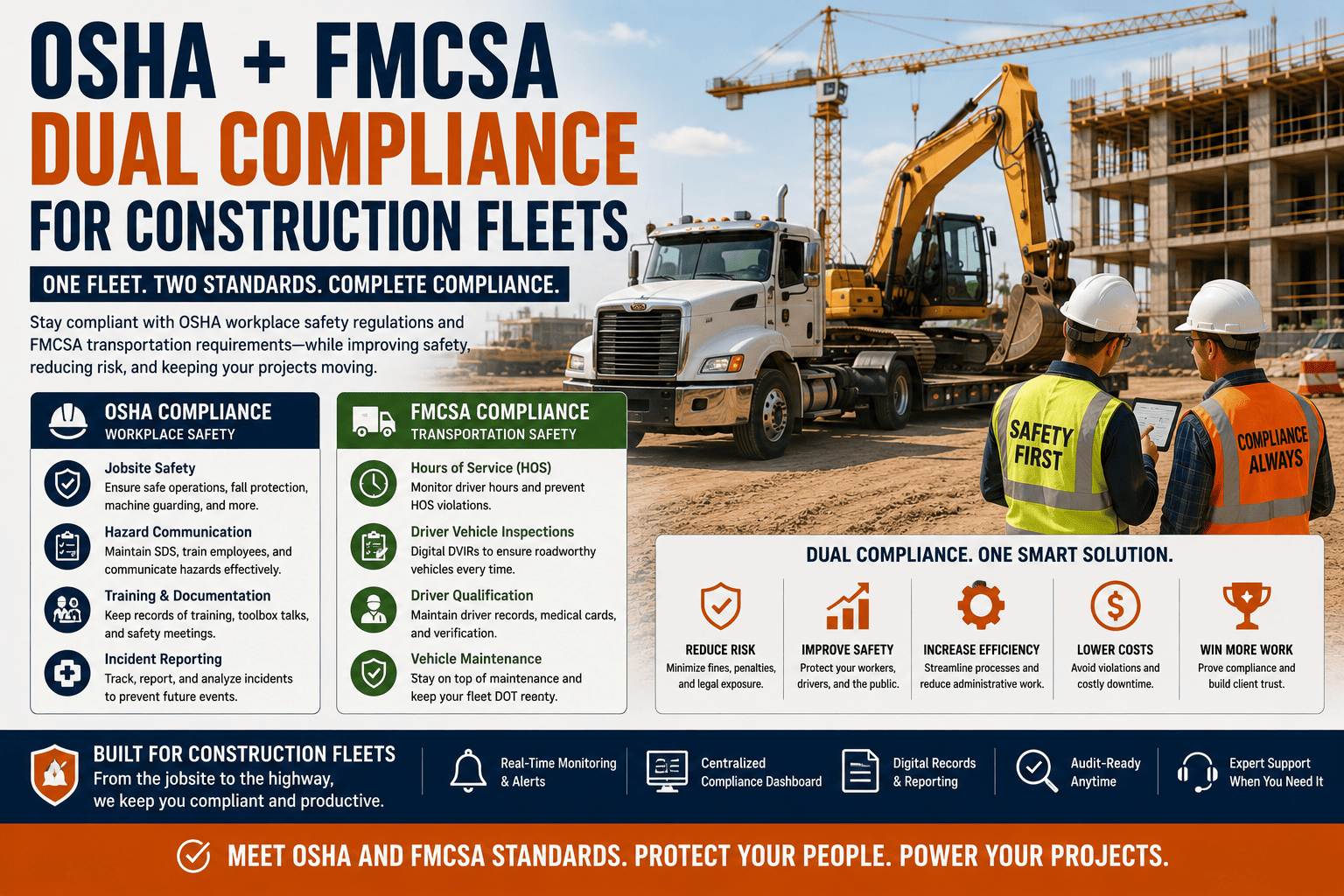
A dump truck driver leaves the yard at 6 a.m., drives to the job site, backs up to the grading crew, dumps a load, and heads back for another. That single routine covers two completely different regulatory worlds. The drive itself falls under FMCSA. The moment that truck rolls onto the job site and the driver steps out to help position the load, OSHA takes over. Most construction fleets know one of these frameworks well and treat the other as an afterthought, and that gap is exactly where citations happen.
FMCSA governs driver qualifications, hours of service, and vehicle maintenance on public roads, while OSHA governs employee safety the moment work happens off the highway, in a yard, a shop, or on an active job site. Most construction fleets are subject to both agencies simultaneously, often within the same shift, and serious OSHA violations now carry base penalties starting at 16,131 dollars per occurrence in 2026.
Why One Truck Answers to Two Regulators
The jurisdiction split comes down to a single legal principle: OSHA is only preempted from a specific hazard when another federal agency, like FMCSA, is actively regulating that exact condition. On a public highway, FMCSA regulates the hazards of driving, so OSHA steps back. The instant that truck is on a job site, in a yard, or in a maintenance shop, none of those FMCSA protections apply to what is happening there, and OSHA's full workplace safety authority kicks back in.
This is not a theoretical distinction. A driver fueling a truck in the yard, a mechanic performing a brake inspection in the shop, and a laborer helping position a dump truck on an active grading site are all under OSHA jurisdiction in that moment, even though the same truck and the same driver were under FMCSA rules twenty minutes earlier on the drive over.
The Line That Moves Every Time the Truck Does
Unlike most regulatory questions, this one is not about the type of vehicle or the type of business, it is about physical location and activity at any given moment. The same dump truck can cross the jurisdictional line several times in a single shift: FMCSA on the highway, OSHA in the yard for a pre-trip check, FMCSA again on the drive to the site, then OSHA again the moment the driver steps out to help direct the pour.
FMCSA Territory vs OSHA Territory, Side by Side
Understanding which agency applies to which moment of a construction fleet's day is the foundation of closing the compliance gap. The table below breaks down the split by activity, since that is exactly how an auditor or inspector will look at your operation.
| Activity or Location | Governing Agency | What Gets Checked | Reporting Deadline If Injury Occurs |
|---|---|---|---|
| Driving on Public Highway | FMCSA | Driver qualification, hours of service, vehicle maintenance | Not an OSHA reportable event outside a work zone |
| Active Construction Work Zone | OSHA | Fall protection, traffic control, worker positioning | 8 hours for fatality, 24 hours for hospitalization |
| Yard or Terminal | OSHA | Forklift certification, PPE, hazard communication | 8 hours for fatality, 24 hours for hospitalization |
| Maintenance Shop | OSHA | Lockout/tagout, PPE, walking and working surfaces | 8 hours for fatality, 24 hours for hospitalization |
| Loading or Unloading On-Site | OSHA | Fall protection, equipment interlocks, worker positioning | 8 hours for fatality, 24 hours for hospitalization |
| Intrastate Hauling (gravel, concrete, sand) | OSHA (even on the road) | General workplace safety standards apply throughout | Standard OSHA timelines apply |
FleetRabbit keeps driver qualification files, HOS records, and vehicle maintenance for FMCSA alongside yard safety training, injury logs, and equipment certifications for OSHA, so nothing falls into the gap between the road and the site. You can sign up free and see both compliance pictures in one place.
The Five Gaps Where Construction Fleets Get Cited
Most compliance failures in construction fleets are not the result of ignoring a rule outright, they happen because a team focused entirely on one agency's requirements assumes the other side is automatically covered. These are the gaps that show up most often.
Building a Fleet Program That Covers Both
The strongest construction fleet safety programs stop treating OSHA and FMCSA as competing priorities and instead build one integrated system that tracks both simultaneously. That means driver qualification files, HOS logs, and DVIR records for the road, sitting alongside forklift certifications, hazard communication documentation, and OSHA 300 logs for the yard and shop, all cross-referenced against the same roster of employees and equipment.
Matching Credentials to the Right Activity
A crane operator moving a mobile crane between sites on a public road may need no CDL at all under the FMCSA off-road equipment exemption, but still needs a valid OSHA crane certification the moment that equipment starts operating on site. Verifying both credentials, rather than assuming one implies the other, is exactly the kind of dual check that closes this specific gap.
Training That Reflects Where Employees Actually Work
Forklift operators need refresher training every three years under 29 CFR 1910.178, and retraining after any accident, near-miss, or observed unsafe operation, independent of anything tracked in a driver's DOT file. Building a training calendar that tracks both DOT renewal dates and OSHA certification cycles side by side prevents either one from quietly lapsing while attention is focused on the other.
FleetRabbit tracks CDLs, medical certificates, and DVIRs alongside forklift certifications, crane credentials, and OSHA injury logs, flagging expirations before either agency finds the gap first. Reach out and book a demo to see how your fleet's dual compliance picture looks today.
Frequently Asked Questions
Key Takeaways
Construction fleets do not get to choose between OSHA and FMCSA, they answer to both, often within the same shift and sometimes within the same hour. The fleets that stay out of trouble are the ones that stop treating the road and the site as separate compliance problems and instead track driver qualifications, maintenance records, forklift certifications, and injury logs together, in one system that reflects where a truck and its crew actually are at any given moment. Closing that gap is far less expensive than discovering it during an inspection.
FleetRabbit tracks FMCSA driver and vehicle requirements alongside OSHA workplace safety documentation in one always-current system, so your construction fleet stays covered whether a truck is on the highway or on the job site. Start your free trial today with no credit card required, or book a demo to see both compliance pictures in one dashboard.