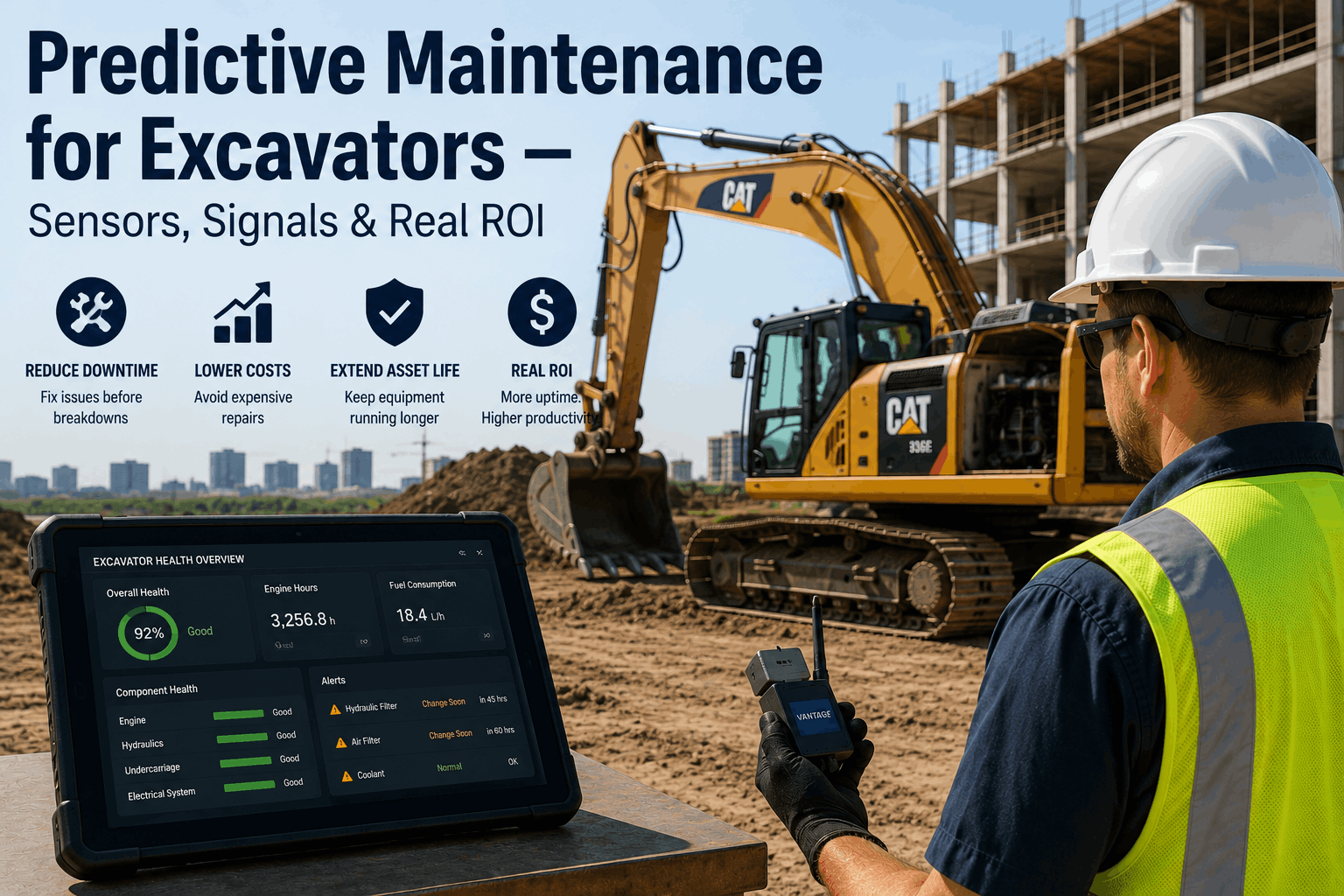
Excavator hydraulic failures don't announce themselves — a Sacramento grading crew loses a full shift when a swing motor burns out at 6 AM, a Phoenix demolition contractor replaces a $14,000 main pump that showed warning signs for three weeks, an Oregon road crew watches a Cat 336 go down mid-pour because oil analysis wasn't in the maintenance workflow. Fleet Rabbit's predictive maintenance platform layers pressure sensors, thermal monitoring, oil analysis integration, and CAN bus telemetry across excavators, dozers, and mixed heavy fleets — OEM-agnostic, no equipment replacement required. Book a demo to see Fleet Rabbit's predictive maintenance applied to your excavator fleet.
Quick Answer
Predictive maintenance for excavators monitors pump pressure, swing motor temperature, hydraulic oil condition, and undercarriage wear in real time — catching failures 2–6 weeks before breakdown. Fleet Rabbit's IoT platform cuts excavator downtime 40–60%, reduces emergency repair costs by $18,000–$42,000 per machine annually, and delivers full ROI in under 60 days for Western US contractors running Cat, Komatsu, Volvo, Deere, and Hitachi fleets.
Why Excavators Fail — And What Sensors Catch First
A 30-ton excavator operating on a California highway project burns through 6–9 gallons of diesel per hour while cycling hydraulic pressure across four independent circuits. The main pump, swing motor, travel motors, and boom cylinders each degrade on separate timelines — and none of them fail cleanly. Pressure drops precede pump failure by 3–5 weeks. Thermal spikes in the swing motor predict bearing failure 10–18 days out. Oil viscosity breakdown signals cylinder seal failure before any external leak appears.
Hydraulic Pump Failure
$14K
avg repair + downtime cost, Western US
Swing Motor Failure
$9.2K
avg bearing + seal replacement
Undercarriage Wear
$22K
full track replacement, undetected
Unplanned Downtime
$3.8K
avg cost per idle shift, California fleet
How Fleet Rabbit Monitors Excavator Health Across Western US Fleets
Hydraulic Pressure Sensors
Inline pressure transducers on main pump supply and return lines track PSI in real time against OEM-spec baselines. A Cat 390 running at 4,800 PSI nominal that drops to 4,200 PSI over 12 operating hours triggers a pump degradation alert — not a breakdown call. Compatible with Cat, Komatsu, Volvo, Deere, Hitachi, and 40+ OEMs.
Swing Motor Thermal Monitoring
NTC thermistors mounted on swing motor housings detect heat signatures 15–20°C above ambient baseline — the early indicator of bearing wear and seal degradation. Western US summer conditions in Phoenix and Las Vegas make swing motor overheating 3× more likely; Fleet Rabbit temperature thresholds auto-adjust for ambient conditions.
Oil Analysis Integration
Fleet Rabbit integrates with laboratory oil analysis providers — particle count, viscosity index, and metal contamination data feed directly into each machine's health profile. When a Komatsu PC360 shows elevated iron content two weeks before its scheduled service, the platform flags early bearing wear and auto-schedules the work order.
Signal #1: Hydraulic Pump Pressure — The Lead Indicator
Excavator Failure Warning Lead Time — Fleet Rabbit Sensor Detection vs. Traditional Methods
Fleet Rabbit platform data, Western US construction fleets 2024–2025. Pressure-based detection provides the longest actionable window before catastrophic failure.
1
Pump Pressure Baseline Establishment
Fleet Rabbit spends the first 40 operating hours learning each excavator's pressure signature — idle, light load, full dig cycle, and travel. The AI baseline accounts for operator style, site elevation (Denver vs. Sacramento), and ambient temperature. Any sustained deviation beyond ±8% triggers a staged alert before damage compounds.
Nevada mining contractor, Komatsu PC490: Fleet Rabbit detected a 340 PSI drop on the main pump circuit over 6 days. Pump replaced at $4,200 during scheduled downtime — avoided a $16,800 catastrophic failure and 4-day site shutdown.
2
CAN Bus Cross-Validation
Fleet Rabbit reads engine load percentage, RPM, and hydraulic demand from the CAN bus simultaneously with sensor data. A pressure drop under full engine load reads differently than the same drop at idle — false positive rates drop below 3% because the AI validates context before firing a maintenance alert.
Engine load correlationRPM validationContext-aware alerts
3
Automated Work Order Generation
When a pump pressure alert clears the validation threshold, Fleet Rabbit automatically generates a work order, assigns it to the fleet's maintenance scheduler, and flags the machine's next available service window. California contractors running CalTrans-compliant maintenance logs get automatic documentation with no manual entry.
Oregon civil contractor, 14 excavators: Automated work orders reduced maintenance scheduling lag from 8.4 days to 1.1 days — catching 6 hydraulic failures in advance during the first 90 days of deployment.
Predictive Maintenance Platform
Stop Reactive Repairs Across Your Western US Excavator Fleet — Free Trial, No Hardware Commitment
OEM-agnostic sensors. Installs on any excavator brand in hours. Real-time pressure, thermal, and oil health monitoring from day one.
$28K
Avg Annual Savings / Machine
Signals #2–5: Swing Motor, Undercarriage, Oil Health & Structural Fatigue
Signal #2: Swing Motor Temperature — Catch Bearing Failure Before It Propagates
The failure pattern: Swing motor bearings in Phoenix and Las Vegas excavators operating through 110°F summers degrade 40% faster than Pacific Northwest units. A thermal spike of 22°C above baseline on a Volvo EC380 predicts bearing failure within 12 operating days — long enough to plan, too short to ignore.
Fleet Rabbit detects: Continuous thermal monitoring with ambient-adjusted baselines distinguishes summer load heat from failure-mode heat signatures. Swing motor alerts include estimated failure window and recommended service action.
Western US impact: Arizona and Nevada contractors see 3× higher swing motor failure rates — IoT thermal monitoring eliminates the replacement cycle that costs $9,200 per event.
Signal #3: Undercarriage Wear Monitoring — Prevent the $22K Replacement
The cost math: Full undercarriage replacement on a 30-ton excavator runs $18,000–$26,000. Catching sprocket wear at 60% life versus 100% saves $8,000–$12,000 in collateral damage — rollers, idlers, and track shoes fail in sequence when wear goes unmonitored on California rocky terrain.
Fleet Rabbit monitors: Travel motor load signatures and vibration sensors detect asymmetric wear patterns between left and right undercarriage circuits. Unusual resistance on one travel motor indicates uneven track tension or sprocket wear — flagged before secondary components fail.
Outcome: Sacramento contractors running excavators on decomposed granite report 55% reduction in undercarriage replacement costs after 18 months on Fleet Rabbit monitoring.
Signal #4: Hydraulic Oil Condition — The Invisible Degradation Signal
The contamination problem: Western US construction sites — California dust, Nevada alkali flats, Oregon volcanic soil — accelerate hydraulic oil contamination 2–3× compared to manufacturer intervals. A 4,000-hour oil change schedule becomes a $14,000 pump failure on a Phoenix demo site where filter bypass occurs at hour 3,200.
Fleet Rabbit integrates: Oil analysis lab results from Polaris Laboratories, Blackstone, and other major Western US providers feed automatically into each machine's health profile. Viscosity index, water contamination, and particle count data trigger dynamic service interval adjustments — not calendar-based guesses.
Compliance benefit: CalTrans and NDOT equipment operators with documented oil analysis records qualify for extended service intervals — reducing oil change costs 20–30% fleet-wide.
Signal #5: Boom & Arm Fatigue Monitoring — Prevent Weld Cracking Before Liability
The liability exposure: A California excavator arm weld failure mid-cycle creates OSHA recordable incidents and liability claims that dwarf the $3,400 repair cost. Fatigue monitoring is underdeployed — fewer than 12% of Western US excavator fleets track structural load cycles against manufacturer fatigue limits.
Fleet Rabbit monitors: Load cycle counters cross-referenced against OEM structural fatigue limits flag high-stress operating patterns. Excavators used for rock breaking, demolition, or compaction — duty cycles outside standard spec — receive accelerated structural inspection alerts automatically.
Insurance benefit: Documented structural fatigue monitoring reduces heavy equipment liability premiums 8–14% with major Western US construction insurers.
Before vs. After Fleet Rabbit Predictive Maintenance — 15-Unit Western US Excavator Fleet
Without Predictive Maintenance
Failure detection: After breakdown
Pump failures caught early: Under 15%
Avg repair cost per event: $14,000–$22,000
Unplanned downtime per machine: 18–32 hrs/year
Service interval basis: Calendar / operator report
Annual maintenance cost: $38,000–$62,000 / machine
With Fleet Rabbit IoT
Failure detection: 2–6 weeks before failure
Pump failures caught early: 88%+ of events
Avg repair cost per event: $3,800–$6,200
Unplanned downtime per machine: Under 4 hrs/year
Service interval basis: Sensor-driven, dynamic
Annual maintenance cost: $14,000–$22,000 / machine
88%
Pump Failures Caught Early
$28K
Avg Annual Savings / Machine
3–5 Wks
Pump Failure Lead Time
8–14%
Insurance Premium Reduction
Frequently Asked Questions: Predictive Maintenance for Excavators
QDoes Fleet Rabbit work on older excavators without factory telematics?
Yes. Fleet Rabbit's pressure transducers, thermistors, and vibration sensors mount externally — no factory telematics required. A 2003 Komatsu PC200 and a 2024 Cat 336 XE run side-by-side in the same predictive maintenance dashboard. For machines without CAN bus access, the sensor array provides standalone health monitoring.
QHow does Fleet Rabbit handle remote Nevada and Arizona sites with poor cellular?
Fleet Rabbit's edge AI processes and stores sensor data locally when cellular is unavailable. Alerts queue and deliver the moment connectivity returns. For permanently remote Western US sites — Nevada mining operations, Eastern Oregon timber roads — Iridium satellite modem integration provides real-time alert delivery with no cellular dependency.
QCan the platform distinguish between normal wear and a developing failure?
Yes — this is the core function of Fleet Rabbit's on-device AI. The baseline learning period (40 operating hours) establishes each machine's normal pressure, thermal, and vibration signature. Alerts only fire when deviation exceeds the validated threshold for that specific machine, operator, and duty cycle — not against a generic OEM spec sheet. False positive rates run below 3% in Western US fleet deployments.
QHow long does installation take on a California or Nevada job site?
A Fleet Rabbit technician installs sensors and connects telematics on 3–5 excavators per day with no equipment downtime. A 15-unit fleet is fully live in 3–5 days. Western US installation teams cover California, Nevada, Arizona, Oregon, Washington, and Colorado — with same-week scheduling available for most locations.
Related Fleet Rabbit Resources
The four AI capabilities transforming fleet operations — real-time GPS, predictive health monitoring, dynamic route optimization, and delivery performance analytics — with ROI data for each.
AI-driven fault prediction and automated maintenance scheduling that prevents mid-project breakdowns — the reliability layer IoT sensor data powers across excavators, loaders, and cranes.
Real-time utilization tracking, idle reduction analytics, and fleet right-sizing data that reduce total heavy equipment operating cost for Western US contractors.
How GPS hardware, IoT sensors, and cloud analytics combine to deliver real-time heavy equipment visibility, predictive maintenance, and operational intelligence.
Stop Reactive Excavator Repairs — See Fleet Rabbit Predictive Maintenance in Action
Fleet Rabbit's OEM-agnostic telematics platform delivers real-time pump pressure monitoring, swing motor thermal alerts, oil health integration, undercarriage wear tracking, and structural fatigue flags across your Western US excavator fleet. On-premise or cloud. Any brand. Full ROI in 60 days.
OEM-Agnostic2–6 Week Lead TimeEdge AI On-DeviceOn-Premise Option60-Day ROI
May 28, 2026
By John Mark
All Posts