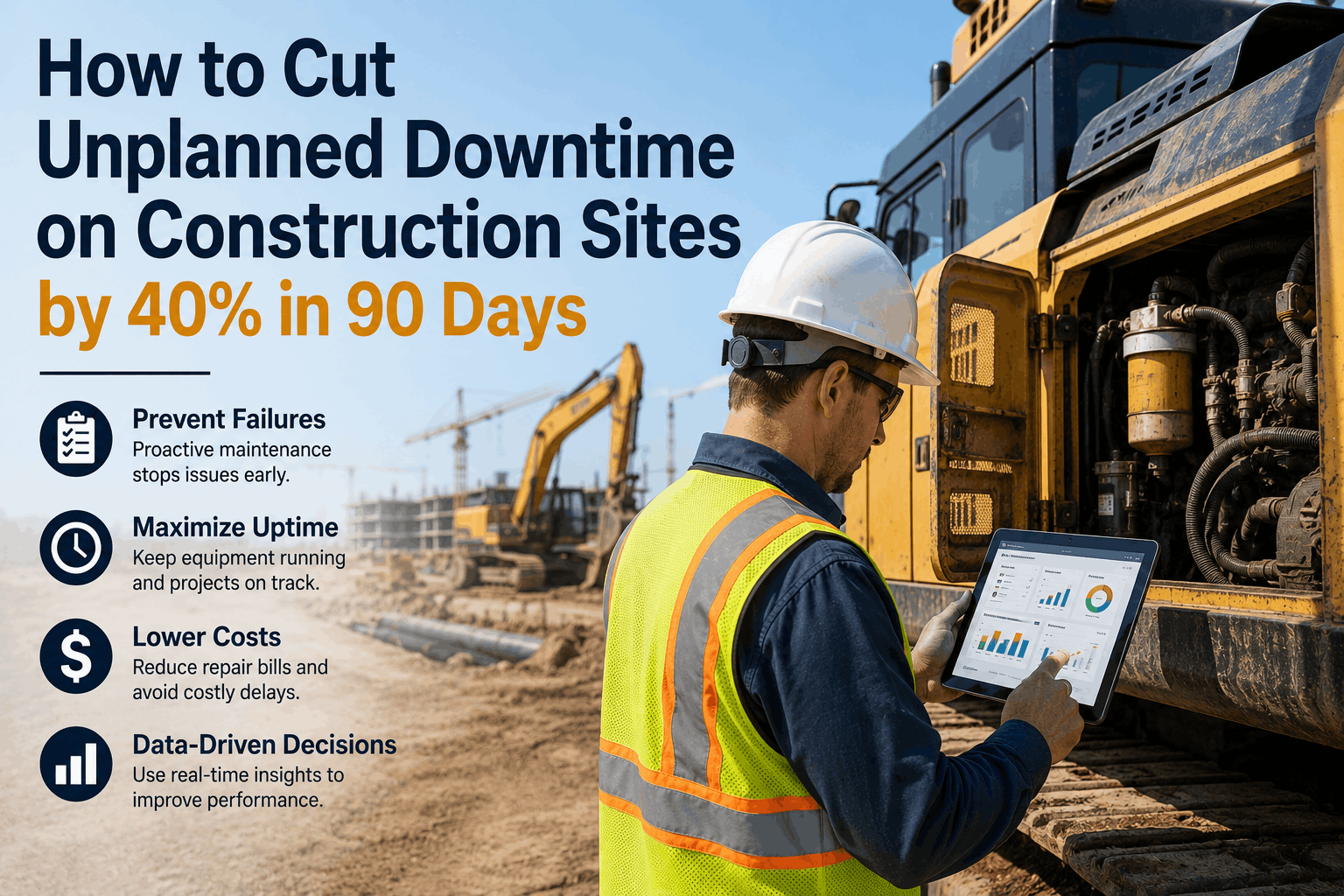
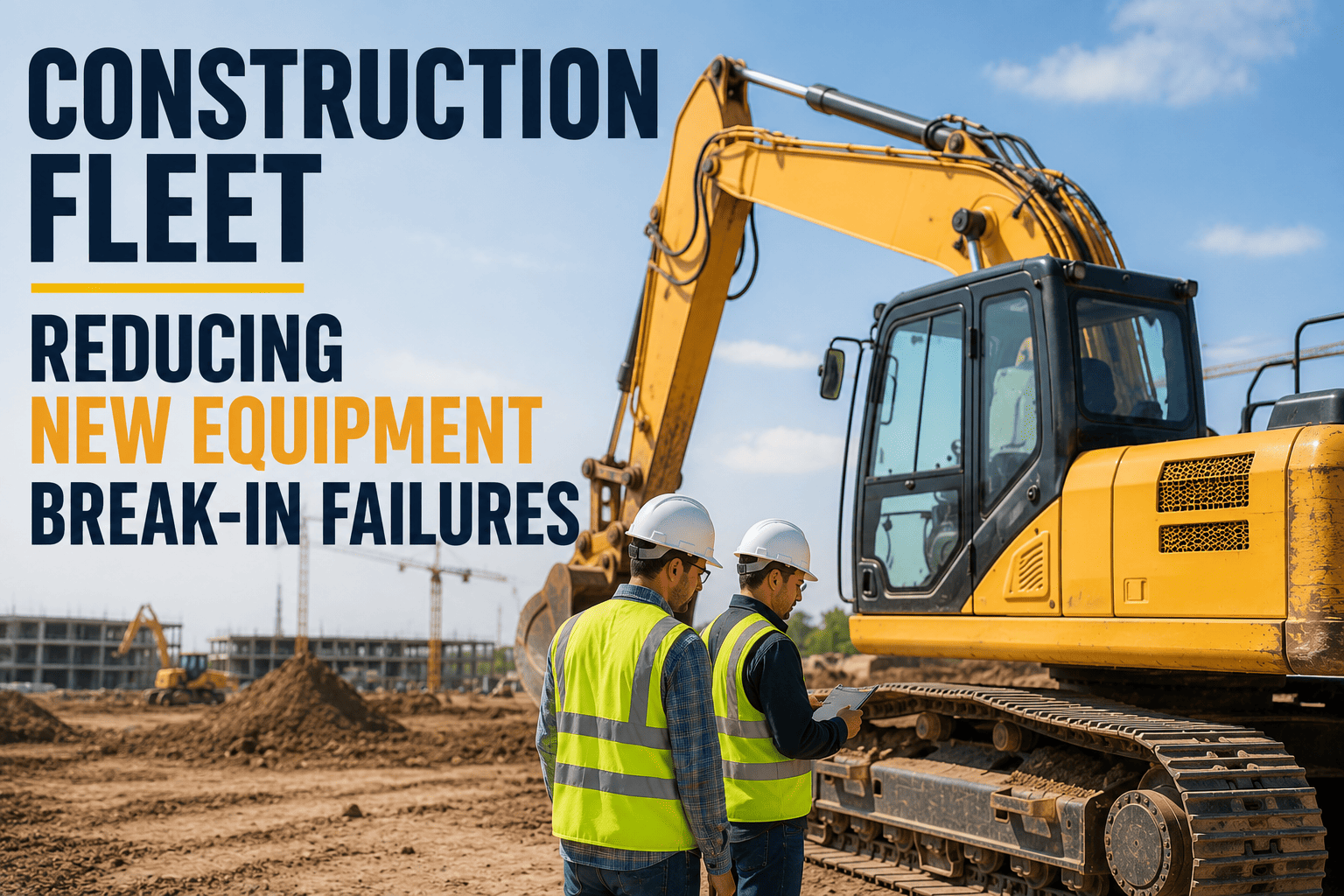
Unplanned equipment downtime is the silent budget-killer on Western US construction sites — a Phoenix dozer sidelined 11 hours waiting on a hydraulic seal, a Sacramento excavator with a missed service interval triggering a mid-pour failure, a Las Vegas grading fleet losing $18,000 in a week to cascading breakdowns across three active sites. Fleet Rabbit's IoT telematics platform layers predictive maintenance sensors, real-time fault alerts, and automated service scheduling across excavators, loaders, dozers, and mixed heavy equipment fleets — OEM-agnostic, on-premise or cloud, with no equipment replacement required. Book a demo to see Fleet Rabbit's downtime reduction playbook applied to your construction fleet.
Quick Answer
Western US construction fleets cut unplanned downtime 40% within 90 days by combining IoT fault detection, predictive maintenance scheduling, and operator accountability. Fleet Rabbit's telematics platform monitors engine health, hydraulic pressure, and component wear in real time — firing alerts before failures occur across California, Nevada, Arizona, and Oregon job sites.
What Unplanned Downtime Actually Costs a Western US Construction Fleet
A 20-unit heavy equipment fleet operating across California or Nevada job sites loses 14–22 productive hours per machine per month to unplanned breakdowns. At $180–$340/hr loaded machine cost, a single mid-project excavator failure erases $3,000–$6,000 in margin before the repair bill arrives — before delay penalties, crew idle time, and subcontractor rebooking costs compound the damage.
Idle Crew Cost
$4.2K
avg per breakdown / union crews
Emergency Repair
$3.1K
premium parts & after-hours labor
Schedule Penalties
$2.8K
delay damages, CalTrans projects
Mobilization Cost
$1.6K
haul-in of replacement equipment
The 90-Day Playbook: Three Phases to 40% Downtime Reduction
Days 1–14: Baseline Audit & Sensor Deploy
Fleet Rabbit technicians install IoT sensors and CAN bus integration at 4–6 machines per day. The platform builds individual health baselines — engine temps, hydraulic pressures, DEF levels, hours-to-service — across every unit before proactive alerts begin firing.
Days 15–45: Alert Calibration & Quick Wins
Real-time fault alerts begin catching pre-failure conditions — overheating hydraulics on a Nevada dozer, a Sacramento loader's air filter trending toward shutdown. Early wins typically recover 15–20% of unplanned downtime before the predictive layer fully activates.
Days 46–90: Predictive Scheduling & Full ROI
With 30+ days of machine-specific data, Fleet Rabbit's AI projects component replacement windows 2–3 weeks ahead — scheduling maintenance during planned downtime instead of emergency callouts. By day 90, fleets report 38–44% reduction in unplanned breakdown hours fleet-wide.
Capability #1: Real-Time Fault Detection — Stop Failures Before They Happen
Downtime Reduction by Detection Method — Western US Construction Fleets
Fleet Rabbit platform data, Western US construction fleets 2024–2025. Results across California, Nevada, Arizona, and Oregon mixed heavy equipment fleets.
1
Multi-Parameter Machine Health Monitoring
Fleet Rabbit monitors 40+ data points per machine — coolant temperature, oil pressure, hydraulic pressure, DEF level, air filter restriction, and hours-to-service. CAN bus integration cross-validates readings against engine load to eliminate false positives. Compatible with Caterpillar, Komatsu, Volvo, Deere, and 40+ OEMs.
Arizona highway contractor, 14 machines: Fleet Rabbit flagged a rising coolant temperature trend on a Cat 320 excavator 38 hours before the thermostat failed. Planned swap during lunch break — zero unplanned downtime on a $2.1M pour schedule.
2
Graduated Alert Severity — Warning Before Critical
Fleet Rabbit fires three-tier alerts: Advisory (trending toward threshold), Warning (schedule service within 48 hrs), and Critical (immediate shutdown risk). Alerts route by site manager hierarchy — the Phoenix alert goes to the Phoenix supervisor, not Sacramento — with escalation if no acknowledgment within a configurable window.
Three-tier severitySite-based routingAuto-escalation
3
Works Offline — Nevada Mining Sites, Oregon Timber Roads
Edge AI stores and processes all machine health data locally when cellular is unavailable. Alerts queue and deliver the moment connectivity returns. Iridium satellite modem integration available for permanently off-grid Western US sites — no gap in fault detection regardless of location.
Oregon civil contractor, 6 remote sites: Eliminated 4 unplanned breakdowns in first 60 days — 3 caught by offline edge alerts that delivered on reconnection before operators reached the machines.
Predictive Maintenance Platform
Cut Unplanned Downtime 40% Across Your Western US Construction Fleet — Free Trial, No Hardware Commitment
OEM-agnostic sensors. Installs on any brand in hours. Real-time fault alerts, predictive scheduling, and full equipment health visibility from day one.
Capabilities #2–5: Predictive Scheduling, Operator Behavior, Parts Inventory & Compliance
Capability #2: AI-Driven Maintenance Windows — Plan It Before It Breaks
The reactive trap: Western US fleets miss 30–45% of service intervals during high-utilization phases — machines run past oil change and hydraulic fluid windows until failure forces a stop.
Fleet Rabbit predicts: Machine-specific AI models project replacement windows 2–3 weeks ahead based on actual hours, load cycles, and operating conditions. Service work orders auto-generate and route to the shop.
CA compliance: CARB Tier 4 records auto-populate from IoT data — no manual compilation before audits.
Capability #3: Operator Behavior Scoring — Close the Human-Caused Failure Gap
The operator impact: Hard hydraulic cycling and improper warm-up routines accelerate component wear 25–40%. Without data, fleet managers can't distinguish machine-caused from operator-caused failures.
Fleet Rabbit scores: Per-operator metrics — idle abuse, overspeed, hydraulic stress cycles — tied to health outcomes and delivered weekly to supervisors with machine and operator IDs.
Outcome: Behavior-linked coaching reduces operator-caused wear events 60%+ within 45 days across California and Nevada fleets.
Capability #4: Predictive Parts Ordering — End the Emergency Parts Run
The parts delay: On Arizona and Nevada remote sites, emergency parts runs add 6–18 hours to repair time — a $400 seal becomes a $3,200 downtime event when the nearest dealer is 90 miles away.
Fleet Rabbit integrates: Predictive maintenance windows trigger automated parts pre-orders 2 weeks ahead. Integration with major dealer networks — Caterpillar, Komatsu, Volvo — delivers parts to the yard before the machine needs them.
Impact: Fleets running Fleet Rabbit parts integration reduce parts-delay downtime 70%+ — the component arrives before the window, not after the failure.
Capability #5: Regulatory & Warranty Compliance — Protect Your Coverage
Western US compliance: California CARB, Nevada DEQ, and Oregon DEQ require documented Tier 4 maintenance intervals. Manual logs fail audits 35–55% of the time — triggering equipment removal and schedule collapse.
Fleet Rabbit documents: Every service event is timestamped, GPS-located, and IoT-verified. Warranty records auto-generate in OEM-required formats — protecting manufacturer warranty on Caterpillar, Komatsu, and Volvo units.
Result: IoT-documented maintenance reduces warranty claim denials 80%+ with major OEMs.
Before vs. After Fleet Rabbit — 20-Unit Western US Construction Fleet, 90 Days
Without Predictive IoT
Unplanned downtime: 14–22 hrs/machine/month
Failure detection: Operator reports breakdown
Service scheduling: Calendar-based, missed 30–45%
Parts availability: Emergency orders, 6–18 hr delay
Compliance docs: Paper logs, 35–55% fail rate
Monthly downtime cost: $18,000–$42,000
With Fleet Rabbit IoT
Unplanned downtime: Under 9 hrs/machine/month
Failure detection: 38 hrs before failure avg
Service scheduling: AI-predicted, 95%+ on-interval
Parts availability: Pre-ordered, on-site before service
Compliance docs: Auto-generated, audit-ready
Monthly downtime cost: Under $9,000
38hrs
Avg Pre-Failure Alert
60%
Operator Wear Reduction
70%
Parts Delay Elimination
Frequently Asked Questions: Cutting Construction Equipment Downtime
QDoes Fleet Rabbit work on older equipment without factory telematics?
Yes. Fleet Rabbit's IoT sensors mount externally on engine and hydraulic systems — no factory telematics required. A 1998 Cat D8 and a 2024 Komatsu PC490 run side-by-side in the same predictive maintenance dashboard. For pre-CAN bus machines, the sensor array provides standalone health monitoring without OEM integration.
QHow accurate are failure predictions on Nevada and Arizona remote sites?
Fleet Rabbit's machine-specific AI achieves 87–93% accuracy on component failure prediction within a 2-week window after 30 days of baseline data. Remote site conditions — heat cycles, dust, variable loads — are factored into each machine's model individually. False positive rates stay below 4%, avoiding unnecessary maintenance interventions.
QHow does the 90-day timeline work across multiple California job sites?
Days 1–14 cover sensor installation and baseline capture (4–6 machines/day, no equipment downtime). Days 15–45 deliver real-time fault alerts and the first quick wins — typically 15–20% downtime reduction. Days 46–90 activate the predictive layer as machine-specific models mature. Full 40% reduction is measured at day 90 across the fleet.
QCan Fleet Rabbit integrate with our existing service shop and parts ordering system?
Yes. Fleet Rabbit integrates via API with major fleet maintenance platforms including Fleetio, EquipmentWatch, and custom ERP systems. Work orders generated by the predictive engine push directly to your shop management system with machine ID, fault data, and recommended parts list — no double-entry required.
Related Fleet Rabbit Resources
The four AI capabilities transforming fleet operations — real-time GPS, predictive health monitoring, dynamic route optimization, and delivery performance analytics — with ROI data for each.
AI-driven fault prediction and automated maintenance scheduling that prevents mid-project breakdowns — the reliability layer IoT sensor data powers across excavators, loaders, and cranes.
Real-time utilization tracking, idle reduction analytics, and fleet right-sizing data that reduce total heavy equipment operating cost for Western US contractors.
How GPS hardware, IoT sensors, and cloud analytics combine to deliver real-time heavy equipment visibility, predictive maintenance, and operational intelligence.
Cut Unplanned Downtime 40% Across Your Construction Fleet — See Fleet Rabbit in Action
Fleet Rabbit's OEM-agnostic telematics platform delivers real-time fault detection, predictive maintenance scheduling, operator accountability, parts pre-ordering, and compliance documentation across your Western US construction fleet. On-premise or cloud. Any brand. Full ROI in 90 days.
OEM-Agnostic40% Downtime Cut90-Day ROIOn-Premise OptionPredictive AI
May 30, 2026
By Michael Finn
All Posts