An excavator starts overheating mid-shift at a remote site. A few hours later the hydraulic pressure drops without warning. By the next morning the machine is out of service, technicians are being rushed in, and the project timeline is already slipping. This sequence plays out on construction sites constantly, and in almost every case, the machine was quietly signaling trouble long before anyone noticed.
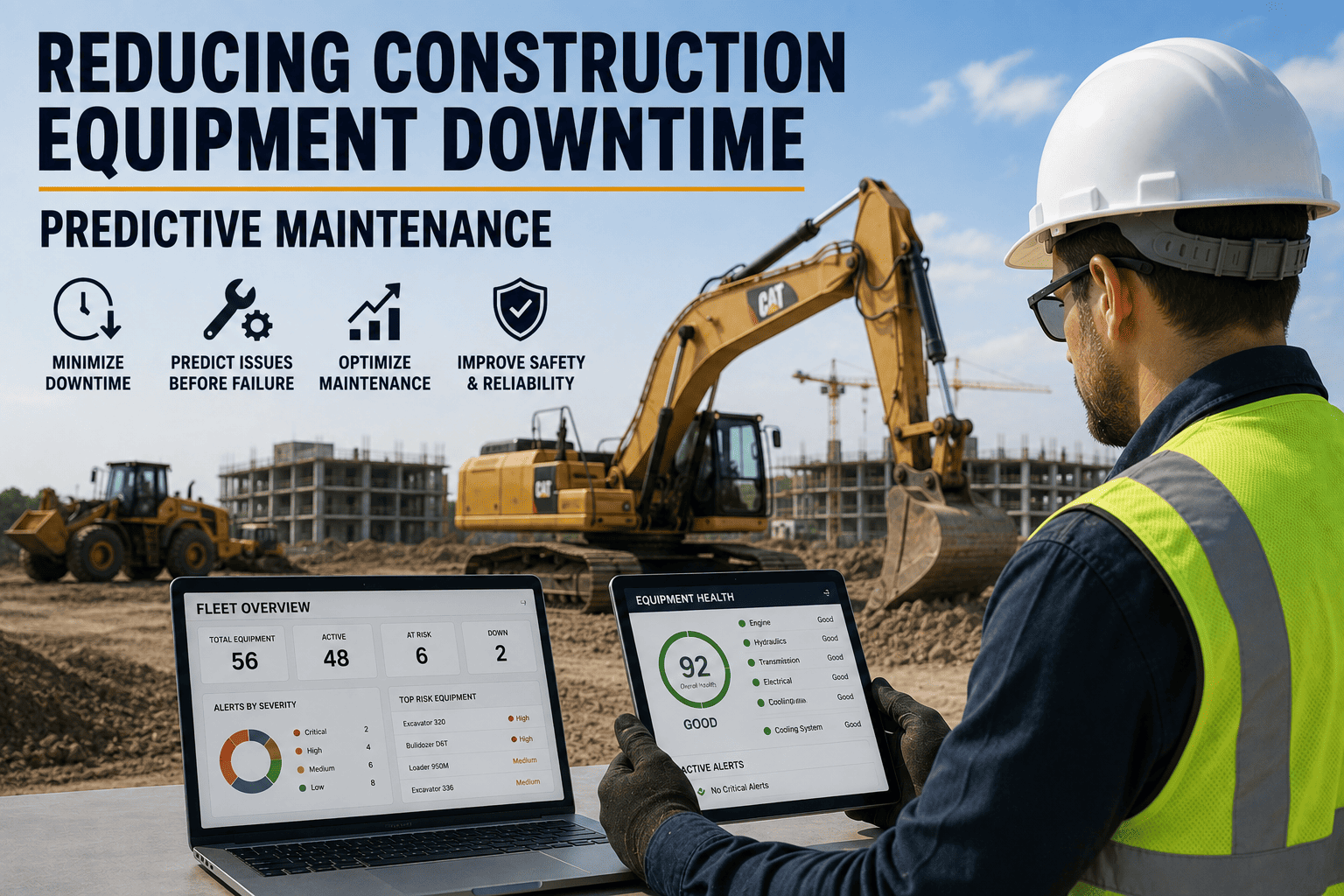
Predictive maintenance reduces construction equipment downtime by reading live telematics data, such as hydraulic pressure, engine temperature, and fault codes, to flag developing failures 200 to 400 hours before they happen. Fleets using this approach typically cut unplanned downtime by 30 to 50 percent, compared to industry-wide unplanned downtime rates that otherwise sit between 20 and 30 percent.
What Unplanned Downtime Actually Costs A Fleet
Construction equipment downtime rarely announces itself as a single number. It shows up as lost productivity, idle crews, rental equipment brought in to cover the gap, and a project schedule that keeps sliding. Industry-wide, unplanned downtime consumes an estimated 20 to 30 percent of heavy equipment operating time, and a single unplanned breakdown commonly runs into tens of thousands of dollars once repair costs, mobilization, and project delay are added together.
Reactive, Preventive, Or Predictive: The Downtime Gap
Not every maintenance strategy produces the same downtime outcome, and the difference between them is larger than most fleet managers expect.
Reactive maintenance leaves a fleet exposed to failures with zero advance notice. Preventive maintenance improves on that by servicing on a schedule, but it still risks missing developing problems between service dates. Predictive maintenance closes that gap by watching the machine's actual condition continuously, which is what allows fleets running it to cut unplanned downtime by roughly 30 to 50 percent compared to the reactive baseline.
FleetRabbit monitors your equipment's real-time condition and flags developing failures before they turn into a shop visit. Book a demo to see your downtime numbers modeled against this shift.
How Predictive Maintenance Actually Works
1. Pull Live Data Off The Machine
Most equipment built after 2015 already broadcasts hydraulic pressure, engine temperature, fuel consumption, and fault codes continuously through factory telematics, so the raw signal is usually already available without new hardware.
2. Compare It Against The Machine's Own Baseline
Rather than judging every machine against a generic threshold, models compare live readings to that specific asset's established operating pattern under similar load and conditions, which is what surfaces subtle drift that fixed thresholds miss.
3. Flag Developing Failures Early
When a parameter signature matches a known pre-failure pattern, an alert is generated well before the problem becomes visible on the surface, often 200 to 400 hours ahead of an actual breakdown.
4. Convert The Alert Into A Work Order
An alert sitting unread in a dashboard prevents nothing. The final step routes the finding directly into a scheduled work order with parts and technician time arranged in advance.
Fleets with equipment already running factory telematics can sign up and start reading this data immediately, since the infrastructure is typically already in place.
Why Hydraulic Systems Deserve Special Attention
Hydraulic failures account for roughly 45 percent of all major excavator breakdowns, making them the single largest source of unplanned downtime on most construction fleets. The encouraging part is that a large majority of these failures give detectable warning signs 2 to 6 weeks ahead of a catastrophic breakdown, through pressure variance, contamination, and pump output decay that can all be monitored continuously.
Pressure Variance Tracking
Gradual drops in hydraulic pressure output often precede pump failure by weeks, giving a clear window to intervene.
Contamination Monitoring
Since fluid contamination is behind the majority of hydraulic component breakdowns, tracking fluid condition catches the root cause early.
Temperature Trend Alerts
Coolant and hydraulic temperature trending above baseline under comparable load is one of the earliest signals of a developing problem.
Scheduled Instead Of Emergency
Catching these signals early turns a six-figure emergency hydraulic repair into a planned service appointment at a fraction of the cost.
FleetRabbit tracks pressure variance, fluid condition, and temperature trends continuously, giving your team weeks of notice instead of a mid-project surprise.
Frequently Asked Questions
FleetRabbit reads your equipment's real-time condition, flags developing failures 200 to 400 hours in advance, and turns every warning sign into a scheduled repair instead of a project delay.