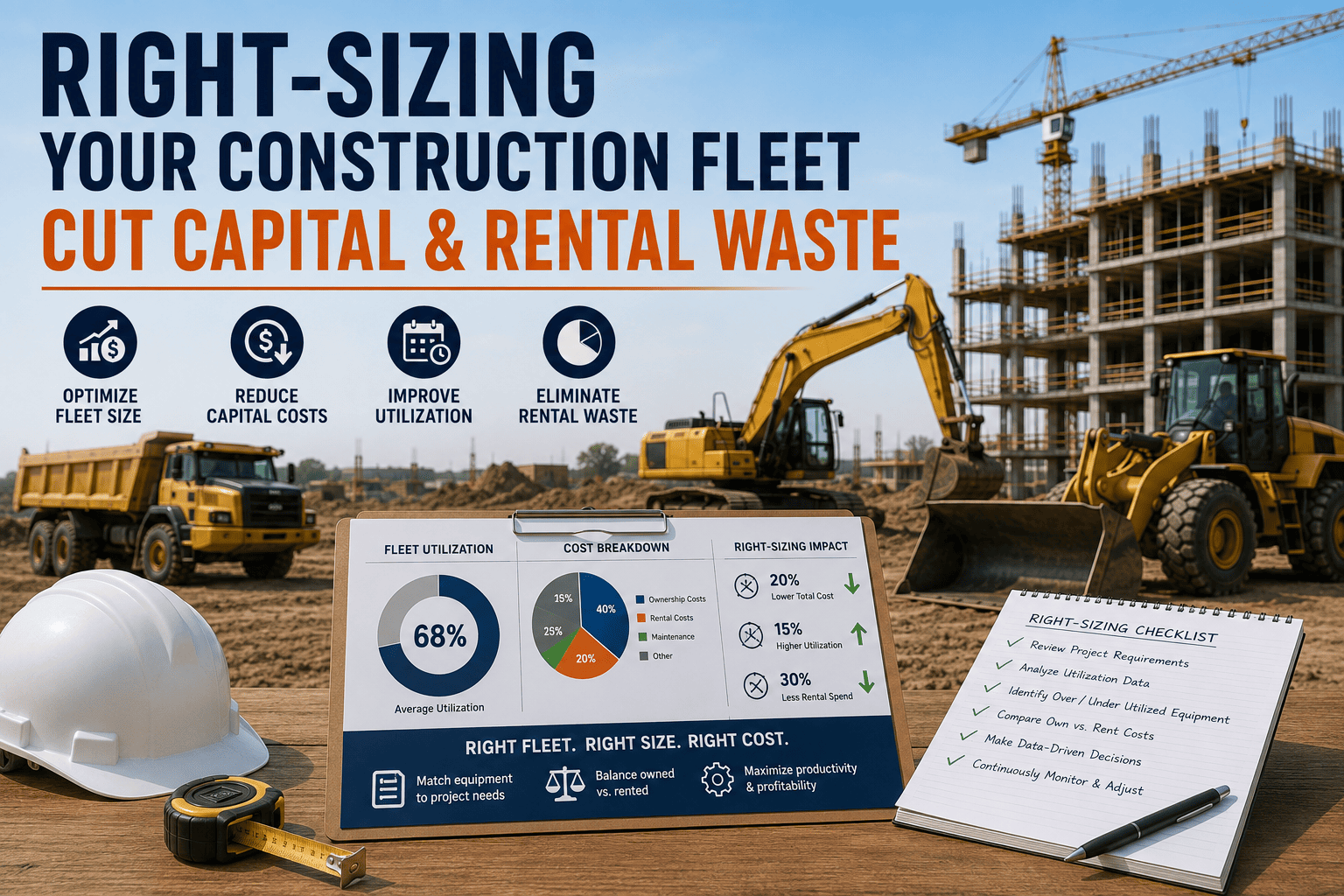
Two fleets can lose money in exactly opposite ways. One is carrying a yard full of machines that barely turn a wheel, paying depreciation and insurance on iron that just sits there. The other is chasing every job with rental trucks because it never bought enough of its own equipment, handing rental markups to someone else month after month. Both are the same problem wearing different clothes — a fleet that doesn't match the actual project pipeline. Right-sizing is the fix, and it starts with knowing your utilization numbers instead of guessing at them.
Most fleet managers use 60 to 70 percent utilization as the break-even point between owning and renting a piece of equipment. Machines running below that threshold are usually costing more to own than to rent, while machines consistently above 75 to 80 percent utilization are strong candidates for purchase. Getting this mix wrong ties up capital in idle iron or leaks cash to rental markups on machines you use constantly.
The Two Ways a Fleet Gets the Size Wrong
Over-fleeted companies hold on to machines "just in case," reasoning that a paid-off asset costs nothing to keep around. In practice, an idle machine still accrues insurance, storage, minor maintenance, and value loss from age even when the meter barely moves. Under-fleeted companies swing the other way, relying on rental yards to cover shortfalls on machines they actually need year-round, paying a rental premium for equipment that would have been cheaper to own outright. Neither mistake shows up clearly on a monthly budget. Both show up as slowly shrinking margin at year end.
Too much idle capital
Sweet spot for most asset classes
Leaking cash to rentals
Signals You're Carrying Too Much Iron
A machine sitting below 55 percent utilization across several projects is rarely a coincidence. Watch for units parked in the yard between jobs for weeks at a time, equipment kept "as a spare" that hasn't run in months, and a fleet age creeping upward because nothing gets sold off. Each of these quietly inflates your ownership cost per hour, since fixed costs like depreciation and insurance get spread across fewer and fewer working hours.
Signals You're Under-Fleeted
The opposite pattern shows up as recurring rental line items for the same equipment category on project after project, crews waiting on deliveries because owned units are already committed elsewhere, and rental spend that keeps climbing even though your project volume is flat. If a machine class is consistently running above 80 to 85 percent utilization and you're still calling the rental yard, that's usually cheaper solved by buying.
Stop Guessing Which Machines to Buy or Drop
FleetRabbit tracks time utilization, engine hours, and cost per hour for every machine across every jobsite, so right-sizing decisions come from your own data instead of a gut feeling. You can start a free trial and see your utilization spread today, or book a demo to walk through a right-sizing review with our team.
Utilization Benchmarks by Equipment Class
There is no single "correct" utilization number across a mixed fleet. A demolition contractor might run excavators at 80 percent, while a utility contractor doing intermittent specialty work is healthy at half that. Benchmark against your own asset categories rather than an industry-wide average.
| Equipment Class | Healthy Utilization Range | Below Range Suggests | Above Range Suggests |
|---|---|---|---|
| Core Earthmoving (Excavators, Dozers) | 60 to 80 percent | Overbought for current pipeline | Add a unit or accept rental overflow |
| Haul Trucks | 65 to 80 percent | Routes or dispatch need review | Strong candidate for purchase |
| Specialty / Attachment Equipment | 30 to 55 percent | Normal for intermittent-use gear | Rental may be cheaper long-term |
| Backup / Standby Units | 40 to 60 percent | Reasonable — flexibility has value | May no longer be a true backup unit |
| Support Vehicles (Service, Pickup) | 65 to 85 percent | Fleet larger than crew needs | Add capacity before it bottlenecks crews |
A Three-Step Right-Sizing Process
Own, Rent, or Lease: Matching the Tool to the Job
Right-sizing isn't only about how many machines you have — it's about which acquisition method fits each category. Core machines that run daily and appear in nearly every project are usually cheaper to own once utilization clears the 60 to 70 percent break-even point. Equipment needed for a single long-duration project, or gear you'll only use once or twice a year, is typically cheaper through rental, since you avoid carrying depreciation, storage, and insurance on an asset that spends most of the year idle.
When Leasing Splits the Difference
Leasing sits between the two, useful for a defined multi-year job that calls for equipment outside your normal fleet mix, or when you want current, well-maintained machines without a full purchase commitment. A blended approach — a core owned fleet, a rental layer for peaks and specialty work, and leases for defined projects — is how many established contractors keep their equipment mix flexible without overcommitting capital.
What Right-Sizing Actually Saves You
The payoff shows up on both sides of the ledger. Selling or redeploying chronically underused machines frees up capital that's currently sitting as depreciating iron in the yard, and it removes ongoing insurance, storage, and minor maintenance costs on equipment that wasn't earning its keep. On the other side, converting a recurring rental expense into an owned asset once utilization crosses the break-even point removes the rental markup you've been paying every month, often for years, on a machine you were always going to need.
Fleets that review their mix quarterly using real utilization data, rather than an annual budget exercise built on assumptions, catch these shifts while they're small instead of after a year of compounding waste. If you want a clearer read on where your own fleet sits before making a purchase or disposal decision, you can book a demo and bring your current equipment list.
Frequently Asked Questions
Match Your Fleet To The Work You Actually Have
Stop carrying idle machines and stop overpaying for rentals on equipment you use every week. FleetRabbit gives you asset-level utilization data so every buy, sell, or rent decision is backed by real numbers. Sign up to see your fleet's utilization spread, or book a demo to walk through a right-sizing review with our team.