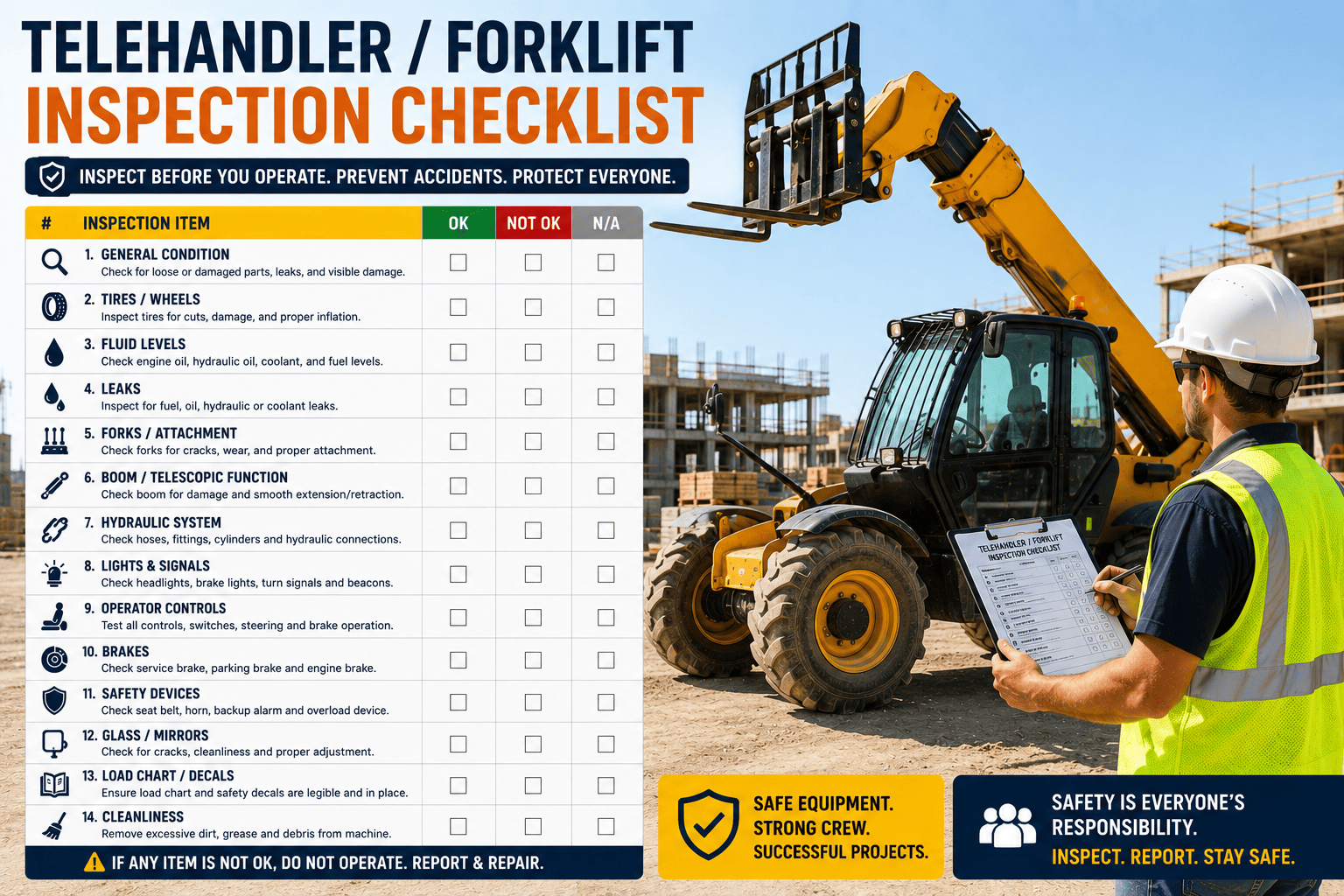
A telehandler extends its boom to place a pallet on the third floor of a job site, exactly the reach that makes it so useful, and exactly the moment its stability margin is at its thinnest. Telehandlers account for a disproportionate share of construction site fatalities, and tip-overs are the leading cause among them. Almost every one of those incidents traces back to something a proper pre-shift inspection was built to catch: an uncalibrated load moment system, an undeployed stabilizer, a load chart nobody actually read.
A telehandler and rough-terrain forklift inspection checklist covers forks and carriage, the telescoping boom and stabilizer system, hydraulics, tires and undercarriage, and the load moment or safe-load indicator system, completed before every shift under OSHA 29 CFR 1926.602. Analysis of tip-over incidents shows a large share involve exceeding rated capacity, operating on slopes, or a defeated stability system, all of which a thorough pre-start check is specifically designed to catch before the machine ever lifts a load.
Why Telehandlers Fail Differently Than a Standard Forklift
A standard counterbalance forklift has a fixed vertical mast and a predictable stability triangle. A telehandler replaces that mast with a telescoping boom that extends forward and up, which means its rated lifting capacity actively decreases as the boom extends or rises. That single design difference is why a telehandler checklist has to cover boom position and load charts in a way a warehouse forklift checklist never needs to.
Where the Tip-Over Risk Actually Concentrates
Incident analysis on telehandler tip-overs points to a small number of repeat causes: a meaningful share involve exceeding rated capacity according to the load chart, a portion occur specifically on slopes beyond a few degrees, and others trace back to a stability or leveling system that was bypassed or not deployed. None of these are mechanical surprises. They're checklist items.
Why "It Looked Fine" Isn't Good Enough
A telehandler can look perfectly stable sitting still on a job site. The stability margin only gets tested once the boom extends and the load moves outward, which is exactly why load charts, level indicators, and stabilizer interlocks need to be verified before the lift, not assumed to be fine because the machine looks normal parked.
The Core Zones of a Telehandler Pre-Shift Check
A complete inspection moves through the machine's distinct systems in order, so nothing gets missed under time pressure.
Forks & Carriage
Tine spread, bend, wear, and heel cracks checked against removal criteria. A cracked or bent fork changes the load's actual center of gravity without any obvious warning.
Boom & Stabilizers
Stabilizer or outrigger deployment, the interlock that should prevent boom operation without them extended, and visible wear or cracking at boom pivot points.
Hydraulics & Tires
Hydraulic fluid level and condition checked cold, hoses and cylinders for leaks, and tire tread pattern and pressure, since rough-terrain tires face heavier abuse than warehouse units.
Load Moment & Level Systems
The load moment indicator alarm tested daily, level indicator accuracy confirmed, and the load chart itself checked for legibility and readability before the first lift.
Zone Five: Cab, Controls, and Function Test
With the walk-around complete, start the machine and confirm the horn, lights, reversing alarm, wipers, and steering mode all respond correctly, and test both service and parking brakes before the telehandler leaves its parked position.
Standardize Every Telehandler Inspection Across Your Fleet
FleetRabbit's digital telehandler checklist walks operators through forks, boom, hydraulics, stability systems, and load chart verification, with photo documentation on every flagged item. Sign up to build your inspection workflow in minutes, or book a demo to see it running first.
Reading the Load Chart Isn't Optional Paperwork
A load chart is a legal document, not a reference suggestion. It defines exactly how much a telehandler can lift at a given boom angle and extension distance, and rated capacity drops sharply the further and higher the boom reaches. A significant share of documented tip-overs trace directly back to exceeding rated capacity, which almost always means the operator either didn't consult the chart or misjudged the actual weight being lifted.
Confirming Understanding, Not Just Presence
A legible, undamaged load chart mounted in the cab means nothing if the operator hasn't been trained to read it against the specific boom position for that lift. Part of a proper inspection routine includes confirming the chart is legible and that boom angle and extension markings are intact and readable, not just present.
Standard Forklift vs. Telehandler Inspection Focus
Both machines share a lot of common ground, but a telehandler's reach and boom geometry add inspection points a standard counterbalance forklift simply doesn't need.
| Inspection Area | Standard Counterbalance Forklift | Telehandler / Rough-Terrain Unit |
|---|---|---|
| Stability system | Fixed stability triangle, mast tilt for load control | Load moment indicator, stabilizers or outriggers, boom angle sensors |
| Load chart | Single capacity rating at standard lift height | Variable capacity by boom angle and extension distance |
| Terrain and tires | Smooth warehouse floors, standard tread | Uneven ground, slopes, aggressive tread checked for embedded debris |
| Governing standard | 29 CFR 1910.178 | 29 CFR 1926.602, ANSI B56.6, annual third-party certification |
What OSHA and ANSI Actually Require
Telehandlers are Class VII powered industrial trucks and fall under a layered set of requirements. Daily visual inspections with documented findings are required before each shift under 29 CFR 1926.602, alongside industry-recognized 56-point inspection criteria under ANSI B56.6 covering load charts, stability systems, and attachments. Some jurisdictions add their own requirements on top, including additional periodic inspections beyond the federal minimum.
Why the Documentation Matters as Much as the Check Itself
A completed inspection that isn't documented is difficult to prove ever happened. Records should include the operator's name, the date and time, any deficiencies found, corrective action taken, and supervisor verification, kept on file for the retention period required in your jurisdiction.
Getting a Standardized Checklist Running Across Mixed Equipment
Fleets running a mix of telehandlers, rough-terrain forklifts, and standard counterbalance units don't need three separate paper systems to stay compliant. A digital checklist configured once per equipment type can guide each operator through the correct zones for that specific machine, tag critical failures as do-not-operate automatically, and keep every inspection record organized and ready for an audit. If you want to see that setup running before rolling it out across your fleet, booking a demo is the fastest way to judge the fit.
Frequently Asked Questions
Stop Tip-Over Risk Before the Boom Ever Extends
A telehandler that looks fine parked can still be one uncalibrated indicator or one bypassed stabilizer away from a serious incident. FleetRabbit standardizes telehandler and forklift inspections across your whole fleet with a full digital audit trail. Sign up for a free trial or book your demo today.