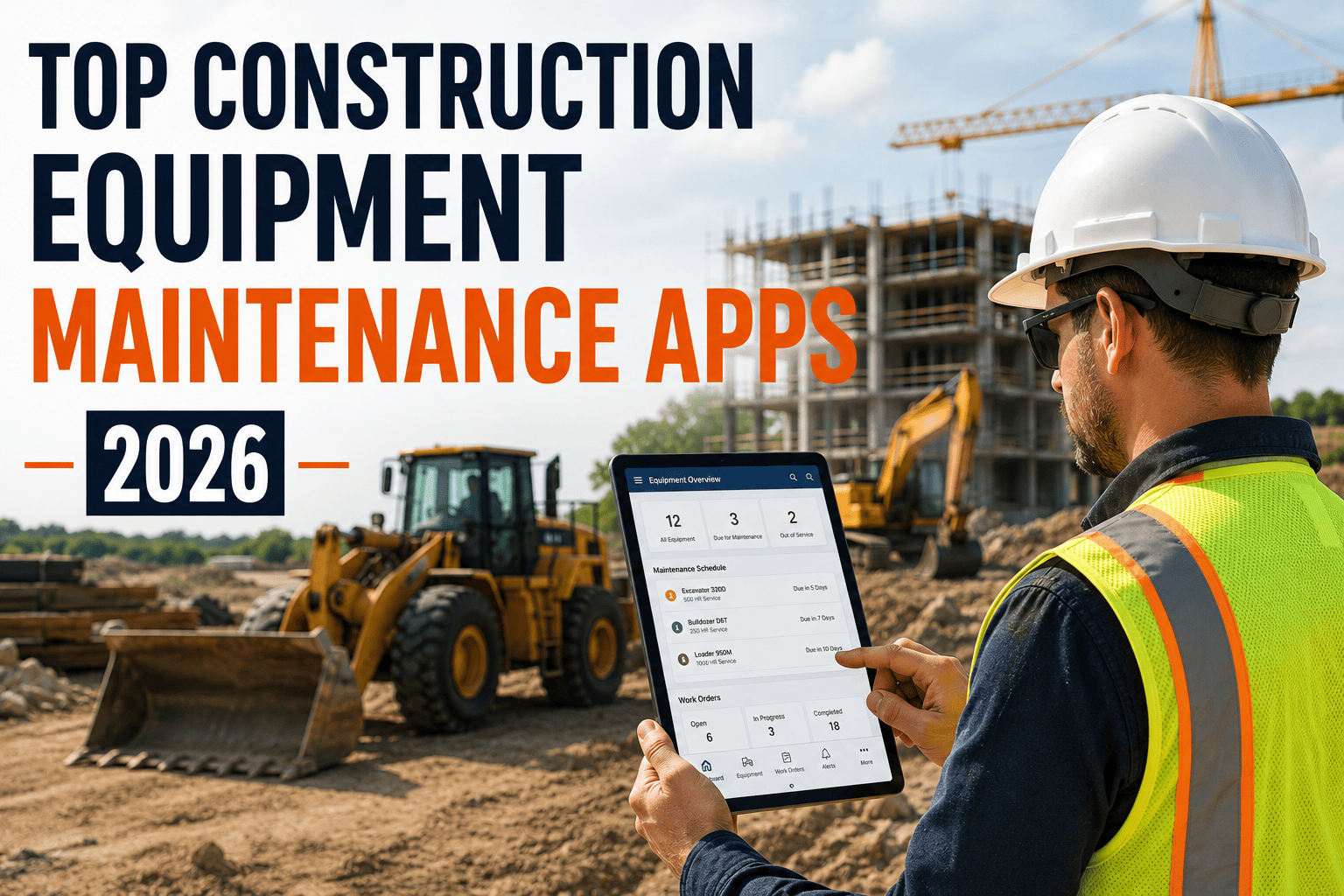
Top Construction Equipment Maintenance Apps for Mixed Fleets 2026

top-construction-equipment-maintenance-apps-2026

Your excavator runs on Cat Product Link. Your dozer reports through Komatsu KOMTRAX. Your loader lives inside John Deere JDLink. Three machines, three logins, three completely different dashboards, and a maintenance manager who has to piece together "what needs service this week" by manually checking each one. This is the daily reality for most construction fleets, and it is exactly why mixed-fleet maintenance apps have become one of the fastest-growing categories in construction technology heading into 2026.

Quick Answer

A construction equipment maintenance app for mixed fleets pulls engine hours, fault codes, and service data from every OEM portal, whether Cat, Komatsu, Deere, Volvo, or JCB, into one dashboard and schedules preventive maintenance from actual operating hours instead of a calendar guess. The best platforms cut catastrophic breakdowns significantly and save fleet managers hours every week that used to disappear into switching between portals. FleetRabbit unifies 15 or more telematics sources into a single maintenance workflow built for exactly this problem.

One Dashboard
Every Brand, One Screen
See Cat excavators, Komatsu dozers, and Deere loaders side by side instead of logging into three separate OEM portals every morning.
Engine Hours
Maintenance Triggered By Real Usage
Service is scheduled from actual operating hours pulled straight from the machine, not from a calendar that ignores how hard a machine actually worked.
Early Warning
Catch Faults Before They Fail
Fault codes from every OEM's ECU surface in one place, giving your team days of advance warning instead of finding out when the machine stops running.

The Mixed Fleet Maintenance Problem

Almost no construction fleet runs a single brand. A typical roster mixes Cat excavators, Komatsu dozers, Volvo loaders, JCB backhoes, and John Deere compact equipment, each shipped with its own proprietary telematics portal. Toggling between five to eight separate systems to piece together a single maintenance picture costs fleet managers real hours every week, and it is time spent reconciling dashboards instead of actually fixing equipment.

The cost of that fragmentation goes beyond wasted hours. Fault codes buried in a portal nobody checks daily turn into full breakdowns days later. Engine hour data that lives in three different formats gets missed or miscalculated. And a meaningful share of most fleets, particularly older machines from before 2015, have no factory telematics at all, creating blind spots where a fleet manager has zero visibility into location, hours, or health.

Why a Single-Brand Tool Cannot Solve This

Relying on the OEM's own app works fine until your second brand shows up on the job site. From that point forward, a single-brand tool actively works against you, forcing your team to manually reconcile data formats, units, and maintenance intervals across systems that were never designed to talk to each other.

The AEMP Standard Changed the Game

Most major manufacturers, including Cat, Komatsu, Volvo, and Deere, now support the AEMP 2.0 data exchange standard, which defines a common schema for location, engine hours, fuel, and fault codes across brands. A modern maintenance app built on this standard can pull data from your entire mixed fleet into one consistent view without needing separate integrations for every manufacturer.

Stop Logging Into Five Different Portals
One Dashboard For Every Brand You Run

FleetRabbit pulls engine hours, fault codes, and service data from Cat, Komatsu, Deere, Volvo, JCB, and more into a single maintenance workflow. See what needs service this week across your entire fleet in seconds, not thirty minutes of tab-switching.

15+
Telematics Sources Unified
80%
Fewer Catastrophic Failures

Must-Have Features in a Mixed Fleet Maintenance App

A maintenance app that only tracks one brand well is not built for a real construction fleet. Compare any platform against the capabilities below before you commit to it.

Feature What It Does Why Mixed Fleets Need It
Multi-OEM Integration Connects directly to Cat Product Link, Komatsu KOMTRAX, Deere JDLink, Volvo CareTrack, and more Eliminates separate logins and manual data reconciliation across brands
Engine Hour PM Scheduling Triggers service tiers automatically at set hour thresholds pulled from the machine Matches maintenance timing to actual wear instead of a fixed calendar date
Fault Code Alerts Surfaces engine and hydraulic fault codes from any brand in one alert feed Gives your team days of advance warning instead of a surprise breakdown
Aftermarket GPS Support Adds tracking and hour logging to older machines without factory telematics Closes the visibility gap on pre-2015 equipment that makes up a large share of most fleets
Defect to Work Order Flow Turns a flagged inspection issue directly into an assigned, trackable work order Keeps repairs from falling through the cracks between the field and the shop
Cost Per Operating Hour Combines maintenance, parts, downtime, and fuel into one cost figure per machine Reveals which brand and which machine are actually the best investment

How Hour-Based Maintenance Tiers Actually Work

Instead of one blanket maintenance schedule, modern apps trigger service at defined hour milestones, light service around 250 hours for fluids and filters, a deeper check near 500 hours for belts and adjustments, and a comprehensive service at 1,000 or more hours. Each brand reports these hours differently, which is exactly why normalizing them into one consistent schedule matters so much for a mixed fleet.

Calendar Fallback for Low-Utilization Equipment

Not every machine racks up hours quickly. A generator or backup loader sitting mostly idle still needs a maintenance floor, so a well-built app applies a calendar-based fallback alongside hour triggers, ensuring nothing gets skipped just because it was not used much this quarter.

What Unified Maintenance Actually Saves You

The value here is not just convenience, it shows up directly on the balance sheet. Fleets that unify mixed-brand telematics into one maintenance view catch critical alerts in hours instead of days, and early fault detection alone prevents a large share of the catastrophic failures that would otherwise take a machine out of service for a full repair cycle. Shop capacity gets planned weeks ahead instead of reacting to surprise breakdowns pulled off active job sites.

Turning Data Into Fleet Decisions

Once your maintenance data is unified, it starts answering bigger questions too. Which brand actually delivers the lowest cost per operating hour on your sites? Which machines are sitting underutilized and could be reassigned or sold? Those are the questions a single OEM portal was never built to answer, and they are exactly what a mixed-fleet maintenance app makes visible for the first time.

Let Engine Hours Run Your Maintenance Schedule
Preventive Maintenance That Actually Prevents

FleetRabbit automates PM triggers from real operating hours across every brand you run, flags defects straight into work orders, and shows you cost per operating hour by machine and by manufacturer. See your whole mixed fleet in one place today.

35-45%
Downtime Reduction
3-5 yrs
Extended Asset Life
Mixed Fleet Maintenance Construction Equipment App Engine Hour PM OEM Telematics Integration Preventive Maintenance Fleet Downtime Reduction

Frequently Asked Questions

QWhat is a construction equipment maintenance app
It is software that pulls telematics data, engine hours, and fault codes from construction machinery, often across multiple manufacturers, into one dashboard to automate preventive maintenance scheduling and track repairs.
QCan one app really support Cat, Komatsu, and Deere equipment together
Yes. Most major manufacturers now support the AEMP 2.0 data standard, which lets a maintenance app pull location, engine hours, and fault codes from every brand into a single, consistently formatted dashboard.
QWhat about older equipment without factory telematics
Aftermarket GPS trackers and manual hour logging through a mobile app close that gap, giving fleet managers visibility into pre-2015 machines that would otherwise sit outside the maintenance system entirely.
QHow does engine hour based maintenance differ from calendar maintenance
Calendar maintenance services a machine on a fixed date regardless of how much it actually worked. Engine hour based maintenance triggers service at real usage milestones, so a heavily used machine gets serviced sooner than one that sat mostly idle.
QDoes unifying telematics actually reduce breakdowns
Fleets that consolidate fault code alerts across brands into one feed catch developing issues days earlier, which significantly cuts down on machines failing unexpectedly mid-project.
QHow do I get started with FleetRabbit
You can connect your existing OEM telematics accounts and start seeing a unified maintenance schedule within minutes. Start a free trial to explore the dashboard, or book a demo to walk through your specific mixed fleet setup.
Heavy Equipment Software Contractor Maintenance App Fleet Maintenance Scheduling Construction CMMS Equipment Service Tracking AEMP Integration

Bringing It All Together

Mixed fleets are the norm, not the exception, and the maintenance apps built to handle them are quickly becoming as important as the equipment itself. A platform that pulls Cat, Komatsu, Deere, Volvo, and every other brand you run into one hour-based maintenance schedule turns a weekly scavenger hunt across five portals into a single glance at one dashboard. That is not a small convenience, it is the difference between catching a fault code on Monday and towing a machine off the job site on Friday.

Bring Your Whole Mixed Fleet Into One View

FleetRabbit unifies telematics from every major OEM into one maintenance dashboard, so preventive service runs on real engine hours instead of guesswork, no matter what brand is parked on your job site. Get started today, no credit card required.
Multi-OEM Integration Engine Hour PM Fault Code Alerts Unified Dashboard Downtime Reduction

July 3, 2026 By John
All Posts

Top Construction Equipment Maintenance Apps for Mixed Fleets 2026

top-construction-equipment-maintenance-apps-2026

Your excavator runs on Cat Product Link. Your dozer reports through Komatsu KOMTRAX. Your loader lives inside John Deere JDLink. Three machines, three logins, three completely different dashboards, and a maintenance manager who has to piece together "what needs service this week" by manually checking each one. This is the daily reality for most construction fleets, and it is exactly why mixed-fleet maintenance apps have become one of the fastest-growing categories in construction technology heading into 2026.

Quick Answer

A construction equipment maintenance app for mixed fleets pulls engine hours, fault codes, and service data from every OEM portal, whether Cat, Komatsu, Deere, Volvo, or JCB, into one dashboard and schedules preventive maintenance from actual operating hours instead of a calendar guess. The best platforms cut catastrophic breakdowns significantly and save fleet managers hours every week that used to disappear into switching between portals. FleetRabbit unifies 15 or more telematics sources into a single maintenance workflow built for exactly this problem.

One Dashboard
Every Brand, One Screen
See Cat excavators, Komatsu dozers, and Deere loaders side by side instead of logging into three separate OEM portals every morning.
Engine Hours
Maintenance Triggered By Real Usage
Service is scheduled from actual operating hours pulled straight from the machine, not from a calendar that ignores how hard a machine actually worked.
Early Warning
Catch Faults Before They Fail
Fault codes from every OEM's ECU surface in one place, giving your team days of advance warning instead of finding out when the machine stops running.

The Mixed Fleet Maintenance Problem

Almost no construction fleet runs a single brand. A typical roster mixes Cat excavators, Komatsu dozers, Volvo loaders, JCB backhoes, and John Deere compact equipment, each shipped with its own proprietary telematics portal. Toggling between five to eight separate systems to piece together a single maintenance picture costs fleet managers real hours every week, and it is time spent reconciling dashboards instead of actually fixing equipment.

The cost of that fragmentation goes beyond wasted hours. Fault codes buried in a portal nobody checks daily turn into full breakdowns days later. Engine hour data that lives in three different formats gets missed or miscalculated. And a meaningful share of most fleets, particularly older machines from before 2015, have no factory telematics at all, creating blind spots where a fleet manager has zero visibility into location, hours, or health.

Why a Single-Brand Tool Cannot Solve This

Relying on the OEM's own app works fine until your second brand shows up on the job site. From that point forward, a single-brand tool actively works against you, forcing your team to manually reconcile data formats, units, and maintenance intervals across systems that were never designed to talk to each other.

The AEMP Standard Changed the Game

Most major manufacturers, including Cat, Komatsu, Volvo, and Deere, now support the AEMP 2.0 data exchange standard, which defines a common schema for location, engine hours, fuel, and fault codes across brands. A modern maintenance app built on this standard can pull data from your entire mixed fleet into one consistent view without needing separate integrations for every manufacturer.

Stop Logging Into Five Different Portals
One Dashboard For Every Brand You Run

FleetRabbit pulls engine hours, fault codes, and service data from Cat, Komatsu, Deere, Volvo, JCB, and more into a single maintenance workflow. See what needs service this week across your entire fleet in seconds, not thirty minutes of tab-switching.

15+
Telematics Sources Unified
80%
Fewer Catastrophic Failures

Must-Have Features in a Mixed Fleet Maintenance App

A maintenance app that only tracks one brand well is not built for a real construction fleet. Compare any platform against the capabilities below before you commit to it.

Feature What It Does Why Mixed Fleets Need It
Multi-OEM Integration Connects directly to Cat Product Link, Komatsu KOMTRAX, Deere JDLink, Volvo CareTrack, and more Eliminates separate logins and manual data reconciliation across brands
Engine Hour PM Scheduling Triggers service tiers automatically at set hour thresholds pulled from the machine Matches maintenance timing to actual wear instead of a fixed calendar date
Fault Code Alerts Surfaces engine and hydraulic fault codes from any brand in one alert feed Gives your team days of advance warning instead of a surprise breakdown
Aftermarket GPS Support Adds tracking and hour logging to older machines without factory telematics Closes the visibility gap on pre-2015 equipment that makes up a large share of most fleets
Defect to Work Order Flow Turns a flagged inspection issue directly into an assigned, trackable work order Keeps repairs from falling through the cracks between the field and the shop
Cost Per Operating Hour Combines maintenance, parts, downtime, and fuel into one cost figure per machine Reveals which brand and which machine are actually the best investment

How Hour-Based Maintenance Tiers Actually Work

Instead of one blanket maintenance schedule, modern apps trigger service at defined hour milestones, light service around 250 hours for fluids and filters, a deeper check near 500 hours for belts and adjustments, and a comprehensive service at 1,000 or more hours. Each brand reports these hours differently, which is exactly why normalizing them into one consistent schedule matters so much for a mixed fleet.

Calendar Fallback for Low-Utilization Equipment

Not every machine racks up hours quickly. A generator or backup loader sitting mostly idle still needs a maintenance floor, so a well-built app applies a calendar-based fallback alongside hour triggers, ensuring nothing gets skipped just because it was not used much this quarter.

What Unified Maintenance Actually Saves You

The value here is not just convenience, it shows up directly on the balance sheet. Fleets that unify mixed-brand telematics into one maintenance view catch critical alerts in hours instead of days, and early fault detection alone prevents a large share of the catastrophic failures that would otherwise take a machine out of service for a full repair cycle. Shop capacity gets planned weeks ahead instead of reacting to surprise breakdowns pulled off active job sites.

Turning Data Into Fleet Decisions

Once your maintenance data is unified, it starts answering bigger questions too. Which brand actually delivers the lowest cost per operating hour on your sites? Which machines are sitting underutilized and could be reassigned or sold? Those are the questions a single OEM portal was never built to answer, and they are exactly what a mixed-fleet maintenance app makes visible for the first time.

Let Engine Hours Run Your Maintenance Schedule
Preventive Maintenance That Actually Prevents

FleetRabbit automates PM triggers from real operating hours across every brand you run, flags defects straight into work orders, and shows you cost per operating hour by machine and by manufacturer. See your whole mixed fleet in one place today.

35-45%
Downtime Reduction
3-5 yrs
Extended Asset Life
Mixed Fleet Maintenance Construction Equipment App Engine Hour PM OEM Telematics Integration Preventive Maintenance Fleet Downtime Reduction

Frequently Asked Questions

QWhat is a construction equipment maintenance app
It is software that pulls telematics data, engine hours, and fault codes from construction machinery, often across multiple manufacturers, into one dashboard to automate preventive maintenance scheduling and track repairs.
QCan one app really support Cat, Komatsu, and Deere equipment together
Yes. Most major manufacturers now support the AEMP 2.0 data standard, which lets a maintenance app pull location, engine hours, and fault codes from every brand into a single, consistently formatted dashboard.
QWhat about older equipment without factory telematics
Aftermarket GPS trackers and manual hour logging through a mobile app close that gap, giving fleet managers visibility into pre-2015 machines that would otherwise sit outside the maintenance system entirely.
QHow does engine hour based maintenance differ from calendar maintenance
Calendar maintenance services a machine on a fixed date regardless of how much it actually worked. Engine hour based maintenance triggers service at real usage milestones, so a heavily used machine gets serviced sooner than one that sat mostly idle.
QDoes unifying telematics actually reduce breakdowns
Fleets that consolidate fault code alerts across brands into one feed catch developing issues days earlier, which significantly cuts down on machines failing unexpectedly mid-project.
QHow do I get started with FleetRabbit
You can connect your existing OEM telematics accounts and start seeing a unified maintenance schedule within minutes. Start a free trial to explore the dashboard, or book a demo to walk through your specific mixed fleet setup.
Heavy Equipment Software Contractor Maintenance App Fleet Maintenance Scheduling Construction CMMS Equipment Service Tracking AEMP Integration

Bringing It All Together

Mixed fleets are the norm, not the exception, and the maintenance apps built to handle them are quickly becoming as important as the equipment itself. A platform that pulls Cat, Komatsu, Deere, Volvo, and every other brand you run into one hour-based maintenance schedule turns a weekly scavenger hunt across five portals into a single glance at one dashboard. That is not a small convenience, it is the difference between catching a fault code on Monday and towing a machine off the job site on Friday.

Bring Your Whole Mixed Fleet Into One View

FleetRabbit unifies telematics from every major OEM into one maintenance dashboard, so preventive service runs on real engine hours instead of guesswork, no matter what brand is parked on your job site. Get started today, no credit card required.

Multi-OEM Integration Engine Hour PM Fault Code Alerts Unified Dashboard Downtime Reduction

July 3, 2026 By John
All Posts

Share This Story, Choose Your Platform!

Latest Posts

Scroll