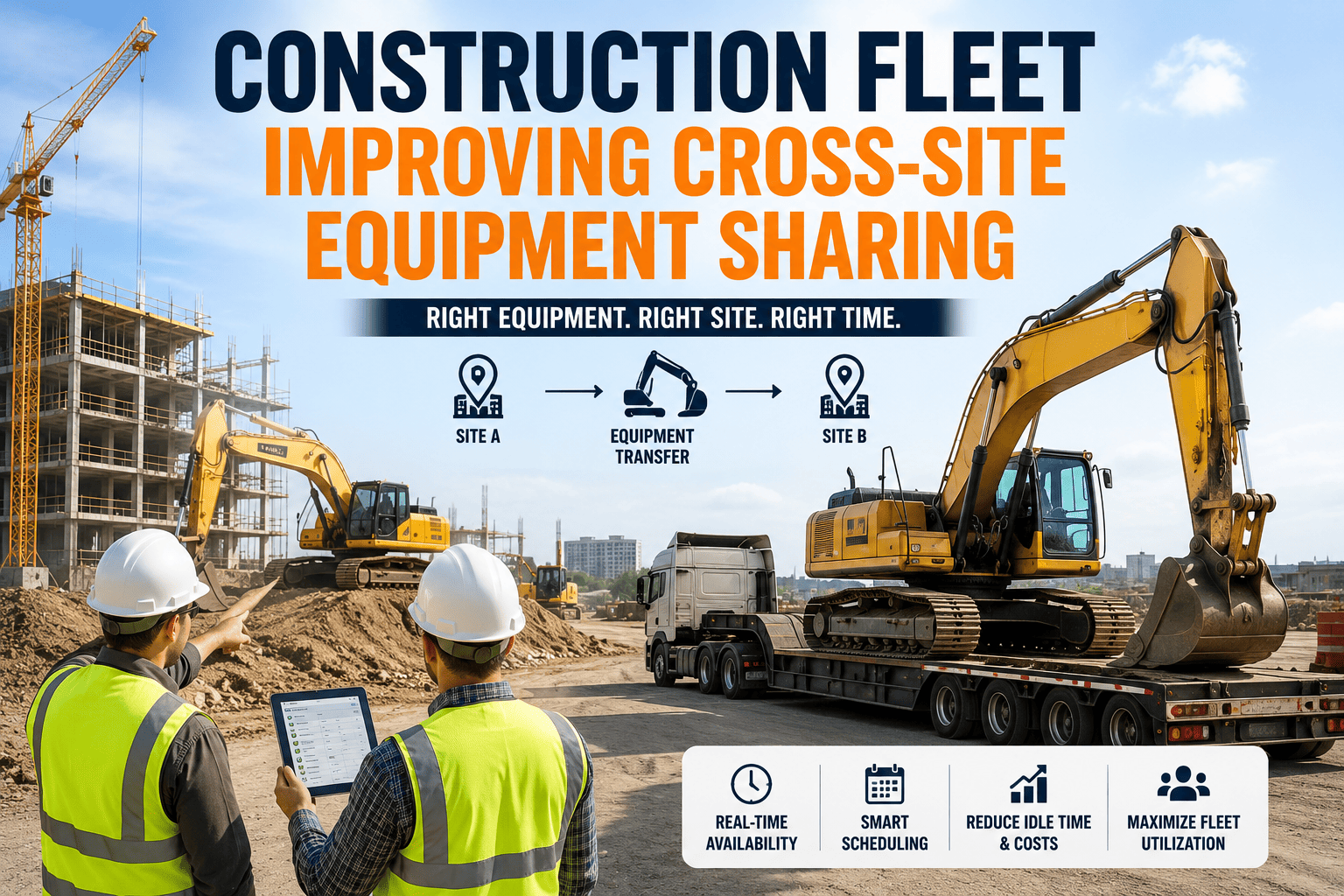
Construction equipment tracking across multiple job sites is one of the most expensive unsolved problems in western U.S. construction operations — yet most mid-size contractors still rely on manual check-out logs, driver memory, and phone calls to locate a $180,000 excavator sitting idle three sites away. In the U.S. West — California, Arizona, Nevada, Colorado, and the Pacific Northwest — where project distances span hours and equipment fleets run 30–80 assets across concurrent sites, untracked equipment doesn't just create cost overruns. It kills project timelines. Fleet Rabbit's fleet management and delivery analytics platform gives construction operations centralized asset dashboards, automated transfer workflows, and real-time site-level utilization data to eliminate equipment idle time and keep every asset earning. Book a demo to see Fleet Rabbit's equipment tracking applied to your job sites.
Quick Answer
Tracking construction equipment across multiple job sites requires four interconnected systems: real-time GPS asset location, centralized utilization dashboards, structured equipment transfer workflows, and predictive reallocation scheduling. Western U.S. contractors using integrated tracking platforms reduce equipment idle time 30–45%, cut inter-site transfer delays 50–65%, and recover $80,000–$240,000 annually in previously untracked idle asset cost. Fleet Rabbit's platform centralizes all job site equipment data so project managers allocate assets based on actual utilization, not assumptions.
Why Multi-Site Equipment Tracking Fails — and What It Costs Western Contractors
A single job site equipment problem is a logistics issue. A multi-site equipment problem is a revenue leak. Western U.S. contractors running 3–12 concurrent sites face compounding location uncertainty: equipment that moved last Tuesday may be on-site, in transit, at a yard, or in a shop — with no single source of truth.
The Location Certainty Gap
Manual check-in systems produce location snapshots — not live data. In western markets where sites span 40–120 miles, a mislocation event means a 2–4 hour transit delay minimum, plus idle equipment cost on the wrong site while crews wait on the right one.
The Real Cost of Idle Equipment
A tracked excavator costs $210–$320/day in ownership and operating cost whether it moves or not. Western U.S. construction equipment averages only 55–65% utilization across multi-site fleets. For a 25-unit fleet, that's $1.2M–$2.8M in annual underutilization cost at current ownership rates.
Why Centralized Tracking Changes the Math
GPS-integrated asset tracking combined with centralized dashboards gives project managers real-time utilization rates per asset, per site, and per project — enabling reallocation decisions based on data rather than memory. Western contractors with centralized tracking report average equipment utilization rising from 58% to 79% within 60 days.
Equipment Tracking Benchmarks: Western U.S. Construction Markets
Utilization benchmarks vary by equipment class and project type. The table below reflects 2025 competitive performance standards for multi-site fleets across western U.S. markets.
Fleet Type / Market
Target Util.
Transfer Time
Location Lag
Idle Cost/Day
CA Large Contractor (30+ units)
75–82%
<4 hrs
<15 min
$180–$310
AZ / NV Regional Fleet
70–78%
4–8 hrs
<30 min
$160–$280
Pacific NW (WA / OR)
68–76%
4–10 hrs
<30 min
$150–$260
CO / Mountain West
65–74%
6–12 hrs
<60 min
$140–$250
Multi-State Contractor (4+ states)
72–80%
<6 hrs
<15 min
$170–$300
5 Root Causes of Multi-Site Equipment Tracking Failure
Equipment tracking failures in western U.S. construction operations concentrate around five systematic gaps that centralized tracking platforms directly resolve.
1
No Real-Time Location Visibility Across Sites
Manual systems produce stale snapshots. A compactor logged at Site C Monday may have moved Tuesday with no update. Managers making reallocation decisions on stale data routinely dispatch transport for equipment that's already moved or broken down elsewhere.
Fleet Rabbit GPS on a 34-unit Phoenix fleet: location query time dropped from 47 minutes (phone-based) to 90 seconds (dashboard). Mis-dispatched transport events fell from 6.2/month to 0.4/month in 45 days.
2
Siloed Site-Level Data With No Cross-Site View
When each superintendent manages their own equipment log, no one sees fleet-wide utilization. A Las Vegas site hoarding a rarely-used generator doesn't know a Sacramento site is renting one at $380/day. Cross-site visibility eliminates rental redundancy that inflates fleet cost 15–25%.
Idle hoarding: $8–22K/month avgRental redundancy: 15–25% fleet costCross-site visibility eliminates both
3
Unstructured Equipment Transfer Workflows
Transfers managed via text or verbal handoff create documentation gaps that compound across projects. No transfer record means no utilization accountability, no maintenance trigger on relocation, and no data for future planning. For DOT-regulated western markets, undocumented equipment moves also create regulatory exposure.
Structured digital transfer workflows with automated documentation reduce transfer coordination time 50–65% and eliminate the compliance gaps that oral handoff systems create.
4
Reactive Reallocation Driven by Crisis, Not Data
Without utilization data, reallocation happens when a site goes critical — not when data indicates underperformance. Reactive transfers cost 2–4x more in transport, and the receiving site typically needed the asset 3–5 days before the request was made.
5
No Geofence Alerts or Unauthorized Movement Detection
Equipment theft costs western U.S. contractors $400M+ annually. Without geofence boundaries, equipment moved off-site isn't detected until it's missing from a job. Automated alerts notify project managers of unauthorized movement within minutes — not days.
Geofence-enabled fleets recover 85–95% of unauthorized movements before the asset leaves the region — eliminating the insurance and replacement cost spikes undetected theft produces.
Equipment Tracking + Fleet Analytics
Track Every Asset Across Every Site — In Real Time
Fleet Rabbit centralizes equipment location, utilization, and transfer workflows across all your job sites — so reallocation decisions are data-driven, not guesswork.
30–45%
Idle Time Reduction
6 Systems That Enable Multi-Site Equipment Tracking
Tracking construction equipment across western U.S. job sites requires six integrated capabilities that attack idle time, location uncertainty, and transfer delays simultaneously.
Real-Time Asset Location Dashboard
Live GPS tracking for every asset — excavators to light towers — on a centralized site map. Location queries that previously took 30–50 minutes resolve in under 2 minutes with zero phone calls.
Per-Site Utilization Rate Monitoring
Engine-hour and movement tracking generates utilization rates per asset, per site, and per project week. Assets below utilization thresholds surface automatically for reallocation review before idle cost compounds over weeks.
Digital Equipment Transfer Workflows
Structured transfer requests — with condition documentation, maintenance checks, and receiving-site confirmation — replace phone handoffs. Every transfer is logged automatically, creating the asset history western U.S. contractors need for DOT compliance and project cost accounting.
Site Geofencing and Unauthorized Movement Alerts
Configurable boundaries per job site trigger instant alerts when equipment exits outside authorized hours. California, Nevada, and Arizona rank top-5 for construction equipment theft — geofence detection is a direct insurance and replacement cost reduction tool.
Predictive Reallocation Scheduling
Utilization trend data flags reallocation opportunities 5–10 days before they become urgent — enabling planned transfers with standard transport scheduling instead of emergency moves at 2–3x cost. Proactive reallocation reduces transport costs 25–35%.
Maintenance Trigger on Transfer or Idle Detection
Equipment flagged for transfer automatically generates a maintenance check work order — ensuring assets don't move sites with unreported service issues. Transfers become condition-verified, reducing the breakdown-at-receiving-site events that add 2–4 day delays to tight project schedules.
How to Build a Multi-Site Equipment Tracking Framework
Effective equipment tracking across western U.S. job sites requires a structured implementation sequence. Deploying tracking before establishing utilization baselines produces dashboards, not decisions.
Establish Utilization Baselines by Asset Class
Before reallocating anything, measure actual utilization rates per asset class across each site for 2–3 weeks. Most western U.S. contractors discover their highest-cost equipment — cranes, large excavators — runs at 52–61% utilization, not the 75–80% assumed in project budgeting. Fleet Rabbit generates these baselines automatically from GPS and engine-hour data from week one.
Prioritize High-Value and High-Theft-Risk Assets First
Start with assets above $80,000 replacement value, assets with over 35% idle time in baseline data, and asset classes with high theft rates in your operating region. In California and Nevada, skid steers, compact track loaders, and mini excavators top the theft registry — prioritizing these delivers the fastest combined utilization and security ROI.
Set Utilization Targets Against Western Market Standards
Internal improvement metrics are misleading without competitive context. California large contractors targeting 75–82% utilization operate differently than Colorado mountain-west fleets targeting 65–74%. Benchmarking against your specific market and equipment class — not national averages — sets realistic targets and surfaces the gap tracking automation is actually closing.
Multi-Site Equipment Tracking Results: What Western Contractors Achieve
30–45%
Idle Time Reduction
50–65%
Faster Transfer Coordination
18–24%
Fleet Utilization Increase
25–35%
Lower Transport Costs
85–95%
Unauthorized Move Recovery
30–60 days
Typical Full ROI Timeline
Frequently Asked Questions: Construction Equipment Tracking
QWhat is the best way to track construction equipment across multiple job sites?
The most effective multi-site equipment tracking combines real-time GPS asset location, a centralized utilization dashboard, structured digital transfer workflows, and automated geofence alerts. For western U.S. contractors, the priority is cross-site visibility — knowing not just where an asset is, but what its utilization rate is relative to other sites and whether reallocation would improve fleet performance. Platforms like Fleet Rabbit integrate all four systems, replacing the phone-call-and-spreadsheet approach that leaves 35–45% of fleet capacity underutilized.
QHow much does idle construction equipment cost western U.S. contractors?
At average equipment ownership and operating costs, western U.S. construction assets cost $140–$320 per day whether running or idle. Fleets averaging 35–45% idle time — typical for multi-site operations without centralized tracking — absorb $1.2M–$2.8M annually per 25-unit fleet. Centralized tracking consistently raises utilization from 55–65% to 74–82% within 60–90 days, recovering $400,000–$900,000 in previously idle asset cost annually.
QHow does equipment tracking integrate with project scheduling in construction?
Effective equipment tracking connects asset utilization data directly to project timelines — flagging reallocation opportunities 5–10 days before they become critical, and sequencing transfers around project phase schedules rather than reacting to site emergencies. Fleet Rabbit's platform syncs equipment availability data to project dashboards, so project managers see upcoming asset conflicts before they delay a phase — not after a superintendent calls to report a stall.
Track Every Asset Across Every Site — See Fleet Rabbit's Equipment Tracking in Action
Fleet Rabbit's platform delivers real-time GPS location, utilization dashboards, digital transfer workflows, and geofence alerts across all your western U.S. job sites — reducing idle time and keeping your highest-value assets earning. Most contractors achieve full ROI within 30–60 days.
30–45% Less Idle Time
Real-Time GPS Tracking
Digital Transfer Workflows
Geofence Theft Alerts
Predictive Reallocation
May 27, 2026
By Lebron
All Posts