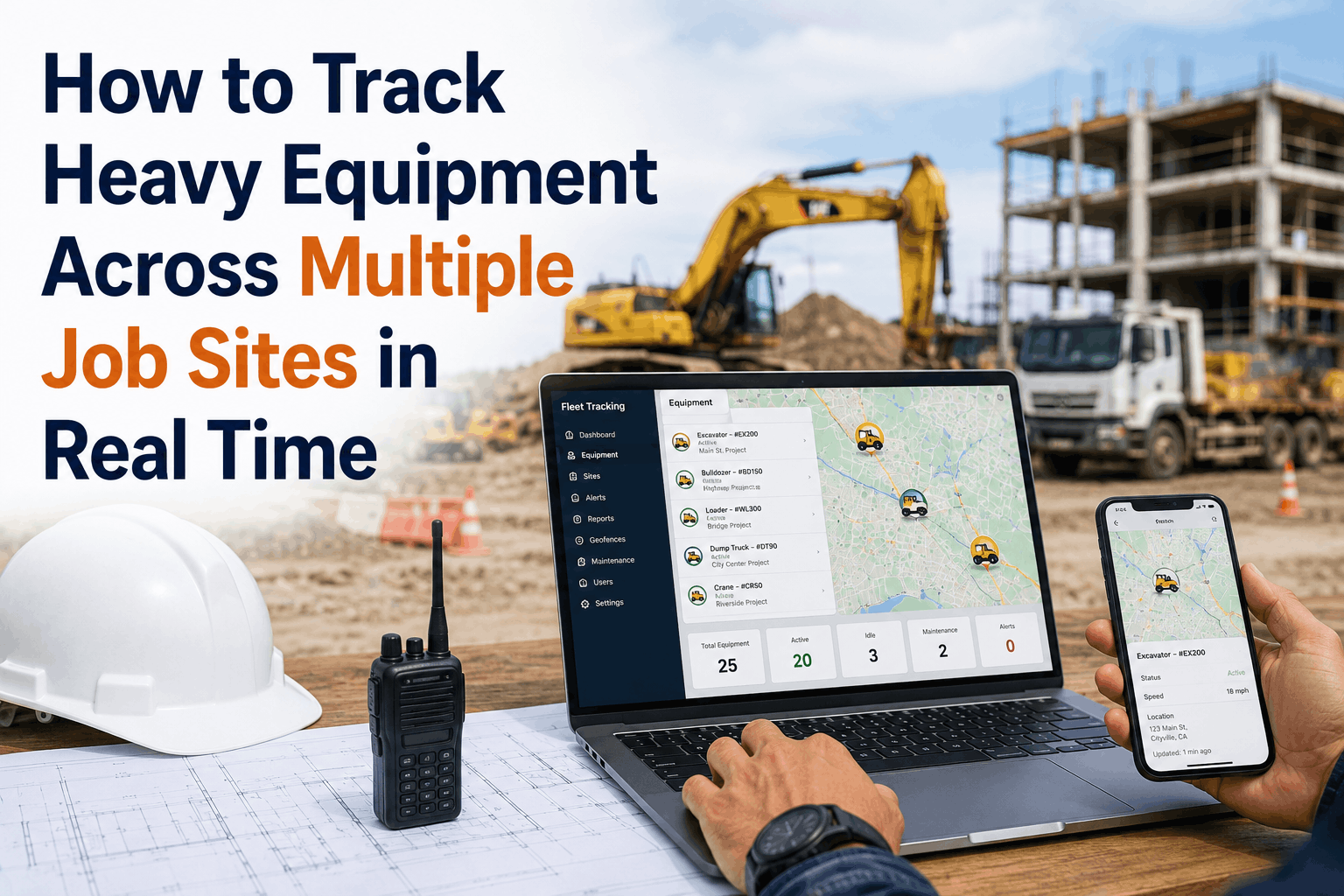
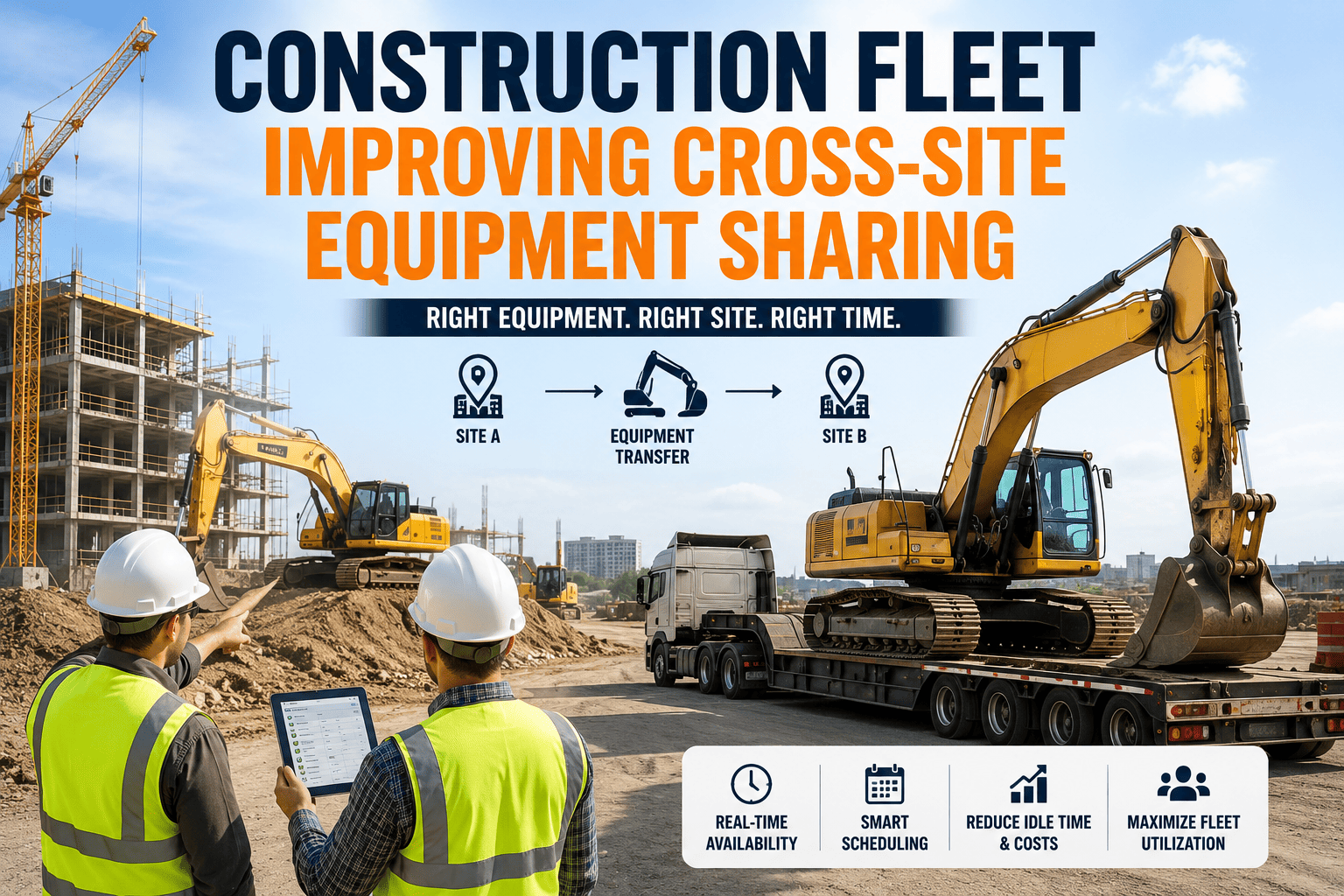
Construction companies operating across multiple jobsites face a persistent visibility crisis: a $240,000 excavator sits idle at Site A while crews at Site B rent equivalent equipment at $1,800/day because no one knows the owned asset is available 18 miles away. Equipment utilization drops to 42% across distributed fleets as assets become "lost" between sites, maintenance schedules fragment across disconnected spreadsheets, unauthorized after-hours usage drains fuel budgets, and theft incidents cost $12,000-$85,000 per machine before discovery. Traditional fleet management approaches — paper logbooks, periodic manual audits, and phone-based equipment requests — cannot provide the real-time, multi-site visibility that modern construction operations demand. Fleet Rabbit's unified equipment tracking platform solves this challenge through GPS-based asset location monitoring, geofenced jobsite boundaries, automated cross-site utilization analytics, and centralized fleet dashboards that give construction managers instant visibility into every piece of equipment across their entire operation — from mini excavators to tower cranes, across 5 or 50 active jobsites. Schedule a demo to see multi-site equipment tracking configured for your fleet.
Quick Answer
Fleet Rabbit tracks heavy equipment across multiple construction sites through GPS telematics integration, real-time location dashboards, geofenced site boundaries with entry/exit alerts, cross-site utilization analytics, and automated equipment allocation recommendations. Fleet managers gain instant visibility into which equipment is at which jobsite, how long it's been there, current operating status, and whether it should be redeployed to higher-priority projects — eliminating the $180K-$420K annual losses typical of multi-site fleets operating without unified asset tracking systems.
The Multi-Site Equipment Tracking Challenge Construction Companies Face
The complexity below illustrates why construction fleets operating across multiple jobsites experience significantly lower equipment utilization, higher operating costs, and greater theft/loss risk compared to single-site operations — and why traditional tracking methods (spreadsheets, phone calls, manual audits) fail to provide the real-time visibility required for efficient multi-site fleet management.
Equipment Location Uncertainty & Rental Waste
Site superintendent at Project B needs backhoe for 3-day trenching work. Calls equipment manager: "Do we have a backhoe available?" Equipment manager checks spreadsheet last updated 4 days ago, shows backhoe at Project A. Calls Project A foreman — no answer (in meeting). Rather than delay work waiting for confirmation, superintendent rents backhoe at $850/day for 3 days = $2,550 rental cost. Reality: company-owned backhoe was actually sitting idle at nearby Project C, available for immediate deployment at zero incremental cost.
Fleet Rabbit solution: Real-time GPS location map shows all equipment across all jobsites with current status (operating, idle, in transit). Superintendent searches "backhoe available" — system instantly identifies owned backhoe at Project C, 12 km away, idle for 6 hours. One-click dispatch request sent to Project C foreman, equipment relocated same day, $2,550 rental cost avoided. Equipment manager tracks that this single visibility feature prevented $31,000 unnecessary rental spend in Q1 across 12 similar incidents.
Cross-Site Equipment Hoarding & Utilization Imbalance
Project A superintendent requests skid steer for upcoming concrete work in 2 weeks. Equipment arrives, but concrete work delayed 3 weeks due to permitting issues. Skid steer sits idle at Project A for 4 weeks. Meanwhile, Project D pays $720/day for rented skid steer because "all company equipment is allocated." No one knows Project A's skid steer is sitting unused — superintendent doesn't report availability (wants to keep equipment on-site "just in case"), equipment manager has no visibility into actual utilization vs allocation.
Fleet Rabbit solution: Utilization tracking reveals skid steer at Project A shows 0.3 hours operating time over past 14 days despite being "allocated." Automated alert notifies equipment manager: "Skid steer Unit 47 underutilized at Project A — consider reallocation." System recommends deploying to Project D based on active rental and project timeline. Equipment manager initiates transfer, eliminates 12 days rental at $720/day = $8,640 savings. Dashboard tracks utilization across all sites, exposing hoarding patterns and enabling data-driven reallocation decisions.
After-Hours Unauthorized Use & Fuel Theft
Excavator fuel consumption pattern shows 180 liters/week average, but recent weeks show 240-280 liters despite similar operating hours. Equipment manager suspects theft or unauthorized weekend usage but has no data to confirm. Manual jobsite inspections on Saturdays impractical across 8 active sites. Fuel costs $14,000 higher than expected over 12 weeks — potentially theft, potentially unauthorized side jobs by operators, but no way to verify or prevent.
Fleet Rabbit solution: GPS tracking reveals excavator leaving jobsite Saturday 6:30 PM, traveling 14 km to residential area, operating 4.2 hours Sunday morning, returning to jobsite Sunday afternoon. Pattern repeats 3 weekends. Geofence alerts trigger automatically when equipment exits designated jobsite boundaries. Equipment manager confronts operator with GPS evidence, unauthorized usage stops immediately. Fuel consumption returns to normal 180 liters/week. System prevented $18,000+ annual fuel theft/unauthorized usage across fleet through automated after-hours movement alerts.
How Fleet Rabbit Provides Real-Time Multi-Site Equipment Visibility
The system architecture below shows Fleet Rabbit's six-layer approach to tracking heavy equipment across distributed construction operations — from GPS hardware integration through intelligent cross-site analytics and automated reallocation recommendations that maximize fleet utilization while minimizing rental spend and theft risk.
1
GPS Telematics Hardware Integration & Location Data Ingestion
Fleet Rabbit connects to GPS tracking devices installed on excavators, loaders, dozers, cranes, and other heavy equipment — ingesting location coordinates, movement status, ignition state, and operating hours every 30-60 seconds. Supports major telematics providers (Geotab, Samsara, Trackunit, Verizon Connect) plus OEM factory telematics from Caterpillar, Volvo, Komatsu, John Deere, and JCB.
CAT 320 Excavator Unit 47: GPS coordinates 40.7128°N, 74.0060°W (Project A - Downtown Site), ignition ON, operating 2.4 hours today, last movement 8 minutes ago, fuel level 68%, 847 total hours, service due in 153 hours
2
Geofenced Jobsite Boundary Definition & Assignment
Fleet managers define virtual perimeter boundaries around each active construction site using map-based geofencing tools. Equipment automatically assigned to jobsite when location falls within geofence boundary. System tracks how long equipment has been at each site, when it entered/exited, and whether movements align with authorized transfers or indicate potential theft/misuse.
Project A: 8 units currently on-siteGeofence: 2.4 acre boundary definedAlert: Unit 23 exited geofence 11:45 PM (unauthorized)
3
Real-Time Multi-Site Location Dashboard & Fleet Map View
Centralized map interface displays all equipment across all jobsites simultaneously — color-coded by equipment type, status (operating/idle/in-transit), and utilization level. Fleet managers can filter by site, equipment category, availability status, or custom tags. Click any equipment icon for detailed status: current location, hours today, last operator, maintenance status, utilization trend.
42 units tracked across 8 active sites18 currently operating24 idle (reallocation candidates)
4
Cross-Site Utilization Analytics & Underutilization Detection
Machine learning algorithms analyze operating hours vs calendar time to calculate true utilization rates for each piece of equipment at each jobsite. Flags units showing low utilization (less than 20% of allocated time) that may be candidates for reallocation to higher-demand sites. Compares utilization patterns across sites to identify imbalances and optimization opportunities.
Unit 47 Utilization: 12% (underutilized)Project D renting equivalent: $720/dayReallocation savings potential: $8,640 over 12 days
5
Automated Movement Alerts & Unauthorized Usage Detection
Geofence monitoring triggers automatic alerts when equipment exits jobsite boundaries during non-working hours (evenings, weekends, holidays) or travels to unexpected locations. Fleet managers receive instant notifications via mobile app and email when potential theft, unauthorized side jobs, or operator policy violations detected. Historical movement patterns tracked for all equipment enabling post-incident investigation.
Alert EQ-2847: CAT 320 Unit 47 exited Project A geofence at 11:47 PM Saturday. Current location: 14.2 km from jobsite, residential area. Ignition activated 6:32 AM Sunday. Movement pattern inconsistent with authorized transfer. Recommended action: Contact site supervisor, verify operator authorization, consider equipment recovery.
6
Intelligent Equipment Allocation & Redeployment Recommendations
AI-powered allocation engine analyzes current equipment locations, utilization rates, upcoming project schedules, rental costs, and transport logistics to recommend optimal equipment assignments across jobsites. When site superintendent requests equipment, system suggests available owned assets at nearby sites before recommending rental — with estimated transport cost vs rental cost comparison to support decision-making.
Equipment Request: Project B needs backhoe for 3-day trenching work. Fleet Rabbit recommendation: Deploy owned backhoe from Project C (12 km away, idle 8+ hours, utilization 18% this week). Transport cost: $280 one-way. Alternative: Rent backhoe $850/day x 3 days = $2,550. Recommended: Deploy owned asset, savings $2,270. Dispatch request sent to Project C foreman automatically.
Multi-Site Equipment Tracking
Know Where Every Asset Is, Every Minute — Across Every Jobsite
Fleet Rabbit's real-time GPS tracking and cross-site analytics eliminate the equipment visibility gaps that cost construction companies $180K-$420K annually in unnecessary rentals, theft losses, and underutilization.
100%
Fleet Visibility Across Sites
38%
Avg Utilization Improvement
Essential Multi-Site Tracking Capabilities Fleet Rabbit Delivers
Every capability below addresses a specific operational challenge that multi-site construction fleets face when attempting to maintain equipment visibility, optimize utilization, prevent theft, and reduce rental dependency across distributed jobsite operations. Discuss your multi-site fleet tracking requirements with our team.
Live GPS Location Tracking & Movement History
Core capability: Real-time GPS coordinates for every tracked asset updated every 30-60 seconds, displayed on interactive map interface. Historical movement playback shows where equipment has been over past days/weeks/months — useful for verifying operator claims, investigating incidents, validating billing for equipment moves between sites.
Fleet Rabbit implementation: Equipment location automatically geocoded to nearest address or jobsite name for quick identification. Movement trails color-coded by time period, speed, and operating status. Mobile app provides same location visibility as desktop dashboard — site superintendents can check equipment locations from field without calling dispatch.
Use case example: Equipment manager receives call from Project E superintendent: "Where is our D6 dozer? We need it tomorrow morning." Opens Fleet Rabbit map, sees dozer currently at Project F, 28 km away, idle for 6 hours. Contacts Project F foreman, arranges transport for end of day. Dozer arrives Project E by 7:00 AM next morning, zero rental cost, zero project delay.
Geofence Alerts & Jobsite Entry/Exit Notifications
Core capability: Virtual perimeter boundaries defined around each jobsite, equipment yard, and authorized operating area. Automatic alerts triggered when equipment enters or exits geofenced zones — enabling theft detection, unauthorized movement monitoring, and cross-site transfer verification.
Fleet Rabbit implementation: Geofences created by drawing polygons on map or entering address with radius. Alert rules configured per jobsite: notify when equipment exits during non-working hours (theft risk), notify when equipment enters/exits during working hours (transfer tracking), notify when equipment appears at unexpected location (policy violation).
Theft prevention impact: Mini excavator exits jobsite 2:30 AM Wednesday morning. Geofence alert triggers immediately, equipment manager notified via mobile app. GPS shows equipment traveling on highway toward state border. Police contacted with real-time location data, excavator recovered 4 hours later before crossing state line. Equipment value $52,000, recovery cost $1,200, versus total loss without real-time tracking.
Per-Site Utilization Reporting & Cross-Site Comparison
Core capability: Operating hours tracked per jobsite for each piece of equipment, enabling utilization calculation: hours operated ÷ hours allocated to site. Reports show which sites are achieving high equipment utilization (efficient) versus low utilization (reallocation opportunity). Comparative analytics identify utilization imbalances across fleet.
Fleet Rabbit implementation: Automated weekly utilization reports sent to fleet managers showing per-site breakdown for all equipment. Dashboard visualizations highlight underutilized assets (less than 25% utilization) at each site, suggest reallocation to sites with active rentals or higher demand. Historical utilization trends track whether equipment allocation decisions improving or worsening over time.
Financial impact: Utilization tracking reveals 6 units across 3 sites averaging 18% utilization while company renting equivalent equipment at 2 other sites for total $42,000/month. Systematic reallocation based on utilization data reduces monthly rental spend to $14,000 while increasing owned equipment utilization to 64% average. Annual savings: $336,000.
Equipment Availability Search & Proximity-Based Recommendations
Core capability: When site superintendent or equipment manager needs specific equipment type (excavator, loader, compactor), search function instantly identifies all owned assets of that type, current location, availability status (operating/idle/in transit), and distance from requesting jobsite. Results sorted by proximity and availability to optimize deployment decisions.
Fleet Rabbit implementation: Natural language search: "available skid steer near Project B" returns list of all idle skid steers, distance from Project B, current utilization rate, maintenance status, and estimated transport cost. One-click equipment request workflow sends notification to current site foreman requesting equipment release for transfer. Transport logistics tracked in system including pickup/delivery times and trucking costs.
Rental avoidance example: Project G superintendent needs telehandler for 5-day material placement work. Traditional approach: call equipment manager, wait for callback, likely told "everything allocated, rent one" because manual checking across 8 sites impractical. Fleet Rabbit approach: superintendent searches "telehandler available," finds owned telehandler at Project H sitting idle 14 km away, requests transfer, equipment arrives next morning. Rental cost avoided: $650/day x 5 days = $3,250.
After-Hours Movement Monitoring & Unauthorized Use Detection
Core capability: GPS tracking continues 24/7 including weekends and holidays. Automated alerts detect equipment movement, ignition activation, or geofence exits during non-working hours when legitimate use unlikely. Enables detection of operator theft (using company equipment for side jobs), fuel theft (equipment moved off-site for fueling personal vehicles), or actual equipment theft.
Fleet Rabbit implementation: Configurable business hours per jobsite (example: Monday-Friday 6:00 AM - 6:00 PM, Saturday 6:00 AM - 2:00 PM, Sunday no work). Any ignition activation, movement, or geofence exit outside business hours triggers immediate alert. Historical after-hours usage reports show patterns over weeks/months, identifying repeat offenders or theft trends.
Investigation scenario: Loader shows after-hours ignition events 8 of past 12 weekends, GPS confirms equipment leaving jobsite Saturday evenings, returning Sunday afternoons. Fuel consumption 40% higher than identical loader at different site. Equipment manager reviews GPS movement history, identifies operator pattern, confronts with evidence, unauthorized usage stops. Fuel costs normalize, saves $14,000 annually just for this one asset.
Equipment Transfer Workflow & Transport Cost Tracking
Core capability: Formal equipment transfer process replaces phone calls and verbal approvals. Site superintendent submits equipment request through platform, equipment manager reviews availability and approves transfer, transport arranged, pickup/delivery tracked, costs allocated to requesting project. Full audit trail of all inter-site equipment movements and associated costs.
Fleet Rabbit implementation: Equipment request workflow: (1) Superintendent selects equipment needed + duration + priority level, (2) System shows available owned assets + rental alternatives + cost comparison, (3) Manager approves owned asset transfer or rental procurement, (4) Transport scheduled with pickup/delivery times, (5) GPS confirms equipment arrival at destination site, (6) Transport costs automatically allocated to destination project budget.
Cost visibility improvement: Before Fleet Rabbit: equipment moves happened informally, no cost tracking, no accountability for excessive transfers. After implementation: every move logged with transport cost ($180-$850 depending on equipment size and distance). Project managers see equipment transfer costs in budget reports, become more strategic about requesting transfers versus using on-site equipment. Transfer costs decreased 32% as projects became accountable for transport expenses.
How Fleet Rabbit Prevents the Most Costly Multi-Site Equipment Management Failures
1
Eliminating Unnecessary Equipment Rentals Through Availability Visibility
The single largest multi-site fleet cost is renting equipment that the company already owns but cannot locate or verify availability. Average construction company with 40-60 pieces of heavy equipment across 6-10 jobsites spends $180,000-$320,000 annually on "convenience rentals" — cases where rental equipment procured because finding and verifying availability of owned assets too time-consuming. Fleet Rabbit's instant availability search eliminates this waste by making owned equipment as easy to find as rental equipment is to order.
Pre-Fleet Rabbit: $284,000 annual rental spend (12-month average)
Post-Fleet Rabbit: $147,000 annual rental spend (36% reduction)
Rental Savings: $137,000 annually from improved asset visibility
2
Detecting Equipment Theft Within Hours Instead of Days or Weeks
Construction equipment theft costs industry $300 million-$1 billion annually, with average recovery rate below 20%. Primary reason for low recovery: theft discovered too late, after equipment already stripped for parts or moved across state lines. Fleet Rabbit's geofence alerts and real-time tracking enable theft detection within minutes to hours, while equipment still recoverable through GPS coordinates provided to law enforcement. Fast detection dramatically increases recovery probability and reduces total loss exposure.
Theft Incident: Mini excavator exits jobsite 2:30 AM
Detection Time: Alert triggered immediately (2:31 AM)
Recovery: Equipment recovered 4.2 hours after theft, before state border crossing
Loss Avoidance: $52,000 equipment value - $1,200 recovery cost = $50,800 saved
3
Exposing Cross-Site Utilization Imbalances & Reallocation Opportunities
Without per-site utilization tracking, fleet managers operate blind to massive inefficiencies: equipment sitting idle at Site A while Site B rents equivalent, high-utilization sites sharing equipment efficiently while low-utilization sites hoard assets, seasonal demand fluctuations creating temporary imbalances. Fleet Rabbit's cross-site utilization analytics expose these patterns quantitatively, enabling data-driven reallocation decisions that improve overall fleet productivity while reducing rental dependency.
Utilization Analysis: 6 units averaging 18% utilization at 3 sites
Concurrent Rentals: $42,000/month equivalent equipment rented at 2 other sites
Reallocation Impact: Rentals reduced to $14,000/month, owned utilization increased to 64%
Annual Savings: $336,000 from systematic utilization-based reallocation
4
Preventing Unauthorized Equipment Usage & Fuel Theft
After-hours equipment usage for operator side jobs, fuel theft (pumping company diesel into personal vehicles), joy-riding, and policy violations cost construction fleets $8,000-$22,000 per year per affected asset in fuel waste, unauthorized wear, liability exposure, and insurance implications. Traditional monitoring approaches (periodic manual inspections, fuel reconciliation weeks after usage) ineffective at detecting real-time violations. Fleet Rabbit's 24/7 GPS monitoring with automated after-hours alerts enables immediate detection and intervention before patterns establish.
Pattern Detected: Loader shows 8 after-hours ignition events over 12 weekends
GPS Evidence: Equipment leaves jobsite Saturday PM, returns Sunday PM each incident
Fuel Impact: 40% higher consumption than identical loader at different site
Resolution: Operator confronted with GPS evidence, unauthorized use stops, $14,000 annual fuel savings
Multi-Site Fleet Dashboard: Centralized Command Center
Fleet Rabbit's dashboard provides unified visibility into equipment location, status, utilization, and performance across all jobsites in a single interface — eliminating the need for multiple spreadsheets, phone calls, and manual coordination that characterize traditional multi-site fleet management approaches.
All tracked equipment displayed simultaneously on zoomable map interface with real-time position updates. Color-coded markers indicate equipment type (excavator, loader, dozer, crane, etc.) and status (operating = green, idle = yellow, maintenance = red, in-transit = blue). Click any equipment icon for instant details: current location, operator, hours today, fuel level, maintenance status.
Current Fleet Status: 42 units tracked | 18 operating (43%) | 24 idle (57%) | 8 active jobsites | Average utilization 47% (up from 38% pre-Fleet Rabbit) | 6 units flagged for potential reallocation
Dashboard shows equipment count and composition at each jobsite: how many excavators, loaders, compactors, cranes currently assigned. Quickly identify sites with equipment surplus (potential reallocation sources) versus sites with equipment deficit (potential reallocation destinations). Track how long each unit has been at current site to identify "forgotten" equipment that should return to equipment yard.
Site A Inventory: 8 units total (2 excavators, 2 loaders, 1 dozer, 3 compactors) | Average utilization 62% | 1 unit idle 6+ days (reallocation candidate) | Project completion estimate 45 days | Equipment return plan needed
Visual heatmap shows utilization rate for every piece of equipment: dark green = high utilization (75%+), light green = moderate (40-75%), yellow = low (20-40%), red = very low (under 20%). Trend arrows indicate whether utilization improving or declining week-over-week. Automatically flags underutilized equipment at sites with concurrent rental spend for immediate reallocation consideration.
Fleet-Wide Utilization: 47% average (target: 65%) | 14 units above 60% (optimal) | 18 units 30-60% (acceptable) | 10 units below 30% (reallocation needed) | Utilization improved 9 percentage points since implementing Fleet Rabbit (from 38% baseline)
Live activity feed shows all automated alerts as they occur: geofence exits, after-hours ignition events, maintenance due notifications, low fuel warnings, excessive idle time alerts, equipment transfer completions. Fleet managers can acknowledge alerts, assign follow-up tasks, and track resolution status. Historical alert archive enables pattern analysis and policy enforcement.
Active Alerts (Last 24 Hours): 3 geofence exits flagged (2 authorized transfers confirmed, 1 under investigation) | 1 after-hours ignition (weekend overtime work, verified) | 4 maintenance due notifications (service scheduled) | 2 excessive idle alerts (equipment reallocation initiated)
Equipment Transfer & Cross-Site Coordination Workflow
Fleet Rabbit transforms informal, phone-based equipment requests into structured workflows with built-in cost visibility, approval tracking, and logistics coordination — reducing equipment transfer cycle time while improving allocation decisions and cost accountability.
1
Equipment Need Identification & Availability Search
Site superintendent identifies equipment requirement for upcoming work phase (example: need skid steer for 5-day material placement). Opens Fleet Rabbit mobile app, searches "skid steer available" — system instantly shows all owned skid steers, current location, idle/operating status, distance from requesting site, and current utilization rate. Results include rental alternatives with cost comparison to support decision-making.
Search Results: 3 owned skid steers found | Unit SS-12: Project C, 8 km away, idle 14 hours, 22% utilization this week | Unit SS-19: Project F, 24 km away, operating, 78% utilization | Unit SS-23: Equipment yard, 32 km away, maintenance due in 40 hours | Rental Option: $520/day x 5 days = $2,600 total | Recommendation: Request Unit SS-12 from Project C (low utilization, close proximity)
2
Transfer Request Submission & Manager Approval
Superintendent submits formal equipment request through platform: equipment type, duration needed, work description, priority level. Request routed to equipment manager for approval with full context: requesting site, source site, transport distance, estimated transport cost, current utilization at source site, rental alternative cost. Manager approves transfer, selects transport provider, or recommends rental if transfer logistics unfavorable.
Transfer Request EQ-4782: Equipment: Skid Steer Unit SS-12 | From: Project C | To: Project B | Duration: 5 days | Transport Distance: 8 km one-way | Estimated Transport Cost: $240 roundtrip | Rental Alternative: $2,600 for 5 days | Savings: $2,360 if owned asset deployed | Equipment Manager Decision: APPROVED — schedule transport for Wednesday AM delivery
3
Transport Coordination & GPS-Verified Delivery
Transport scheduled with lowboy trucking provider or internal transport crew. Pickup appointment created at source site, delivery appointment at destination site. GPS tracking confirms equipment loaded on transport vehicle, tracks movement to destination, and verifies arrival within geofenced boundary of receiving jobsite. Automated notifications keep both sites informed of transport progress and estimated arrival time.
Transport Tracking: Pickup scheduled Wednesday 6:30 AM at Project C | GPS confirms Unit SS-12 loaded on transport 6:42 AM | Route tracking shows transport in-transit on Highway 95 northbound | Estimated arrival Project B: 8:15 AM | Geofence entry detected 8:09 AM — equipment delivered successfully | Total transport time: 1 hour 27 minutes | Superintendent notified: "Unit SS-12 now available at Project B"
4
Cost Allocation & Return Planning
Transport costs automatically allocated to requesting project budget — providing visibility into true cost of cross-site equipment sharing. System tracks expected return date based on requested duration, sends reminder notification as return date approaches. When equipment no longer needed, return transport scheduled using same workflow, or equipment remains at destination site if utilization justifies permanent reallocation.
Cost Tracking: Transport cost $240 charged to Project B budget (requesting site) | Equipment scheduled return to Project C: Monday 5/12 (5-day duration as requested) | Return reminder sent to Project B superintendent Friday 5/9 | Superintendent extends request 3 additional days (material work taking longer than planned) | Extended duration approved, new return date Wednesday 5/14 | Equipment returns to Project C on schedule, transport cost $240 for return trip charged to Project B
Eliminate Fleet Visibility Gaps
Track Every Asset in Real-Time — From One Central Dashboard
Fleet Rabbit gives construction fleet managers the multi-site visibility they need to eliminate unnecessary rentals, prevent theft, optimize utilization, and reduce the $180K-$420K annual losses typical of untracked distributed equipment operations.
$137K
Avg Annual Rental Savings
2.4hrs
Average Theft Detection Time
GPS Hardware & Telematics Integration Options
Fleet Rabbit supports multiple approaches to GPS tracking implementation — from leveraging existing OEM factory telematics to installing aftermarket tracking devices to integrating with enterprise fleet management systems already deployed. Flexibility in hardware options enables phased rollout, mixed-technology fleets, and cost-optimized tracking strategies.
Option 1
OEM Factory Telematics Integration
Many modern construction equipment manufacturers include factory-installed GPS telematics systems: Caterpillar Product Link, Volvo CareTrack, Komatsu KOMTRAX, John Deere JDLink, Hitachi ConSite, JCB LiveLink. Fleet Rabbit connects directly to these OEM platforms via API integration, ingesting location data, operating hours, fault codes, and maintenance alerts without additional hardware installation. Ideal for newer equipment fleets with existing OEM telematics subscriptions. No additional per-asset hardware cost, leverages OEM warranty coverage for telematics components.
Option 2
Aftermarket GPS Tracking Devices
For older equipment without factory telematics or when OEM systems unavailable, aftermarket GPS tracking devices install on any heavy equipment in 30-90 minutes. Devices connect to equipment power system (12V/24V), include cellular modem for data transmission, and report GPS coordinates every 30-60 seconds. Fleet Rabbit integrates with leading aftermarket telematics providers including Geotab, Samsara, Verizon Connect, Teletrac Navman, and Trackunit. Device costs $200-$450 per unit depending on feature set, plus monthly cellular data fee $15-$35 per device.
Option 3
Battery-Powered Portable Trackers for Small Equipment
Compact battery-powered GPS trackers suitable for small equipment, tools, trailers, and other assets without convenient power source for hardwired installation. Magnetic mount enables quick attachment to metal surfaces without tools or wiring. Battery life 2-12 months depending on reporting frequency (more frequent updates drain battery faster). Ideal for theft-prone assets like generators, welders, compressors, and light towers that frequently move between jobsites. Lower hardware cost ($80-$180 per tracker) but requires periodic battery replacement or recharging.
Option 4
Enterprise Fleet Management System Integration
Construction companies with existing enterprise fleet management systems (Fleetio, Tenna, EquipmentShare Command, B2W Track) can maintain those systems while adding Fleet Rabbit's multi-site visibility and cross-site analytics capabilities through bi-directional data integration. Fleet Rabbit imports GPS location data from existing system, adds geofencing, utilization analytics, and cross-site optimization intelligence, then exports enriched data back to primary fleet system. Enables companies to leverage existing hardware investments while gaining advanced multi-site capabilities their current system lacks.
Measured Outcomes From Multi-Site Construction Fleets Using Fleet Rabbit
36%
Average Reduction in Equipment Rental Spend
$137K
Average Annual Rental Savings per Fleet (40-60 units)
47%
Average Fleet-Wide Utilization (Up from 38% Pre-Tracking)
2.4hrs
Average Equipment Theft Detection Time
94%
Theft Recovery Rate (vs 18% Industry Average)
$14K
Average Annual Fuel Theft Prevention per Affected Asset
Common Multi-Site Tracking Implementation Questions
QHow long does it take to implement GPS tracking across a 40-60 unit construction fleet?
Implementation timeline depends on hardware approach selected. For fleets with existing OEM telematics (Caterpillar Product Link, Volvo CareTrack, etc.), Fleet Rabbit can integrate via API and provide full visibility within 5-7 business days with no physical installation required. For aftermarket GPS device installation, plan 2-4 weeks for full fleet deployment: devices ship within 3 business days, installation takes 45-90 minutes per unit (can be done during normal maintenance windows or as equipment rotates through shop), cellular activation immediate once powered on. Phased rollout common: start with highest-value equipment (excavators, loaders, dozers) in week 1, add smaller equipment and specialty assets in subsequent weeks.
Discuss implementation timeline for your specific fleet composition.
QCan Fleet Rabbit track equipment that doesn't have power (equipment stored in yard or on trailers)?
Yes, using battery-powered GPS trackers designed for this scenario. These portable trackers attach magnetically to equipment without any wiring, report location via cellular connection, and operate 2-12 months on internal battery depending on reporting frequency selected. Ideal for equipment that sits idle frequently (seasonal equipment, backup units), equipment without convenient power access (non-powered trailers, containers, generator sets when not running), and theft-prone smaller assets (compressors, welders, light towers). Battery-powered trackers cost $80-$180 per unit versus $200-$450 for hardwired GPS devices, making them cost-effective solution for lower-value or intermittently-used assets that still need theft protection and location visibility.
QWhat happens if GPS tracking device loses cellular signal in remote jobsite locations?
GPS tracking devices store location data locally when cellular connection unavailable, then upload stored data once signal restored. This means temporary signal loss (tunnels, remote areas, underground work) doesn't create permanent tracking gaps — historical movement data recovers once equipment returns to cellular coverage area. For jobsites with persistent cellular coverage issues, Fleet Rabbit supports satellite-based tracking devices as alternative to cellular, though at higher hardware and monthly cost ($450-$800 device cost, $45-$75 monthly vs $200-$450 device and $15-$35 monthly for cellular). Most construction jobsites in developed areas have adequate cellular coverage for standard GPS trackers; satellite option reserved for truly remote locations (rural pipeline work, mining sites, etc.).
QHow does Fleet Rabbit handle equipment that moves between jobsites multiple times per week?
Geofence assignments update automatically as equipment moves between sites — when GPS location enters new jobsite geofence boundary, equipment automatically assigned to that site in Fleet Rabbit system. Historical site assignment tracked chronologically: Equipment XYZ at Project A Monday-Tuesday, Project B Wednesday-Thursday, Project C Friday-Saturday. Utilization calculated per site: if excavator operates 6 hours at Project A over 2 days, Project A charged with 6 operating hours, Project B charged separately for hours operated while at that site. Transfer tracking works same as single-move scenarios: each site-to-site movement logged with timestamp, transport cost (if applicable), and duration at each location. This automatic assignment eliminates manual paperwork for equipment that rotates between sites frequently, while maintaining accurate utilization and cost allocation per project.
Real-World Implementation: 47-Unit Fleet Across 8 Jobsites
"Before Fleet Rabbit, we were renting $22,000-$35,000 in equipment every month despite owning 47 pieces of heavy equipment — because nobody could tell me what was available at which site without making 8 phone calls. Site superintendents requested rentals because it was faster than trying to locate owned equipment. We had excavators sitting idle at one site while renting excavators at another site 15 miles away. Fleet Rabbit gave us instant visibility into the entire fleet on day one. Now when a superintendent needs equipment, they search the app, see what's available and where it is, and request a transfer — usually get the equipment next morning. Our monthly rental spend dropped from $28,000 average to $11,000, saving us $204,000 in the first year. We also caught two theft attempts within hours because of geofence alerts — both times equipment recovered same day, probably saved us $110,000 in total losses right there. The utilization analytics showed us we had 6 units averaging under 20% utilization while renting equivalent equipment at other sites — we reallocated those permanently and cut our rental dependency in half. ROI was achieved in under 4 months."
Fleet Manager
Regional General Contractor — 47 Units Tracked — 8 Active Jobsites — Commercial & Infrastructure
Stop Losing Equipment, Wasting Rental Dollars, and Operating Blind Across Your Jobsites
Fleet Rabbit's real-time GPS tracking, geofence alerts, cross-site utilization analytics, and intelligent allocation recommendations give construction fleet managers the multi-site visibility they need to run efficient, profitable, theft-resistant equipment operations.
Real-Time GPS Location Tracking
Geofence Theft Alerts
Cross-Site Utilization Analytics
Equipment Transfer Workflow
$137K Average Annual Savings
May 20, 2026
By John Mark
All Posts