An OSHA inspector does not usually ask whether your crew inspects equipment. They ask you to prove it. In 2026, that single distinction is deciding which construction fleets walk away with a clean visit and which ones walk away with a citation. The rules on the books have not changed as dramatically as the headlines suggest, but how OSHA enforces them, and what it expects fleet managers to produce on the spot, absolutely has.
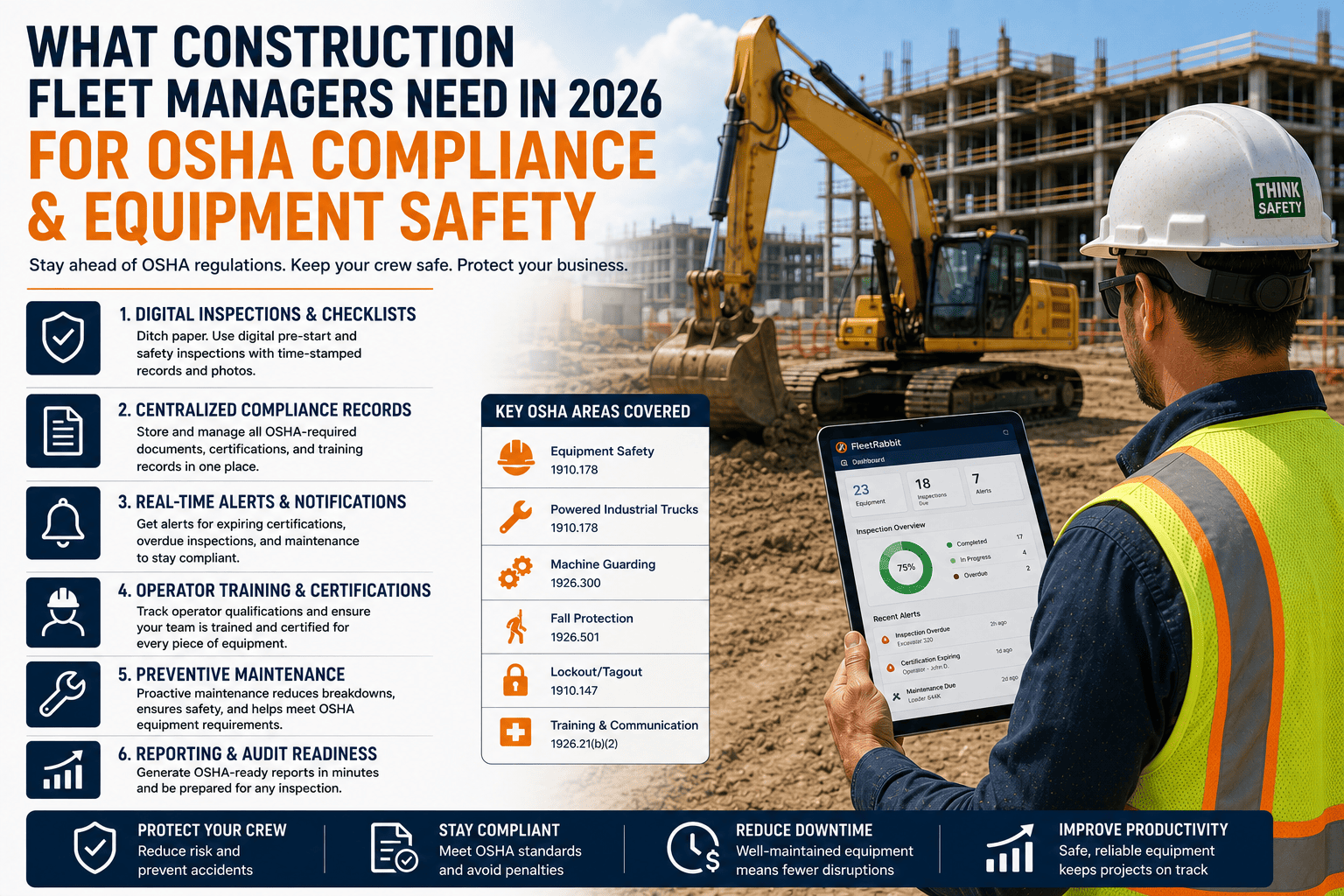
OSHA's 2026 enforcement priorities for construction fleets center on documentation, not just inspection. Inspectors increasingly expect timestamped, retrievable records proving inspections occurred, defects were fixed, and operators were properly certified, especially for cranes, aerial lifts, and excavation equipment. Serious violations can now reach 16,550 dollars, with willful or repeated violations reaching 165,514 dollars. FleetRabbit helps fleet managers meet these documentation demands with automated inspections, certification tracking, and audit-ready records that are pullable in seconds, not searched for in a filing cabinet.
What Actually Changed For Construction Fleets In 2026
The core equipment rules under 29 CFR Part 1926 remain largely intact. What has shifted is how aggressively OSHA verifies compliance and how little patience inspectors have for gaps in the paperwork behind an inspection program.
Inspections Are Now Document-Driven
Inspectors arriving on site increasingly expect proof: dates and timestamps showing when a check happened, the name and qualifications of the person who performed it, a record of any defect found, and evidence that the equipment was repaired before it returned to service. Missing documentation is consistently the single most common finding on construction equipment audits, even when the underlying inspection actually took place.
Crane And Aerial Lift Requirements Draw The Sharpest Scrutiny
Cranes require shift, monthly, and annual inspections, each with a qualified inspector's signature, and missing any tier of that record has ranked among OSHA's most frequently cited construction violations for years running. Aerial lift operators must be able to demonstrate competency and be authorized in writing, and OSHA's recent updates emphasize practical demonstrations of skill rather than a written test alone.
Penalty Structures Have Grown Sharper Teeth
Under the current penalty framework, serious violations can reach 16,550 dollars, failure-to-abate penalties can accrue at the same rate per day, and willful or repeated violations can climb to 165,514 dollars. A single missing crane record or an unverifiable operator certification can now carry a real financial consequence well beyond the cost of the inspection itself.
FleetRabbit keeps every inspection, certification, and repair record in one place so you can pull complete equipment histories in seconds. You can sign up for free to see your own fleet's compliance gaps, or book a demo to walk through it with our team.
2026 Penalty Ranges Fleet Managers Should Know
Understanding what a gap actually costs helps put the documentation requirement into perspective. These figures reflect the current OSHA penalty structure for construction operations.
| Violation Type | Typical Penalty Range | Common Trigger |
|---|---|---|
| Serious Violation | Up to 16,550 dollars per violation | Missing or incomplete pre-shift inspection records |
| Failure To Abate | Up to 16,550 dollars per day | A cited hazard that is not corrected within the required timeframe |
| Willful Or Repeated | Up to 165,514 dollars per violation | Knowingly operating without required inspections or certifications |
| Crane Documentation Gap | Averages in the low five figures per citation | Missing monthly or annual crane inspection records |
| Work Stoppage Risk | 25,000 to 75,000 dollars per day | Equipment pulled from service during an active project |
How To Prepare Your Fleet Before An Inspector Shows Up
Preparing for 2026 enforcement is less about learning new rules and more about closing the documentation gaps that already exist in most fleets. A focused, practical approach gets you there without overhauling your entire safety program overnight.
Step 1: Centralize Every Inspection And Certification Record
Scattered paper forms and spreadsheets across multiple job sites are the fastest way to fail a documentation request. A single, searchable system for inspections, defects, repairs, and operator certifications removes that risk entirely.
Step 2: Track Operator Certification Expirations Automatically
Crane operators need current third-party certification, and aerial lift operators need documented, written authorization. Losing track of an expiration date is one of the easiest and most avoidable ways to draw a citation.
Why Manual Tracking Falls Behind
Certifications and inspection intervals rarely expire on convenient schedules, and a fleet relying on memory or a wall calendar will eventually miss one, usually right before an audit.
Why Automated Alerts Close The Gap
Automated tracking flags an expiring certification or an overdue inspection well before it becomes a compliance failure, giving fleet managers time to act instead of reacting to a citation.
Step 3: Make Records Instantly Retrievable On Site
OSHA's current guidance treats records as compliant only if they are readily accessible, meaning producible on request, not somewhere in a filing cabinet at another location. A cloud-based system that any authorized manager can pull up from a phone or tablet meets that bar consistently.
Fleets that get ahead of these expectations are not just avoiding fines, they are building a safety program that holds up under real scrutiny. Contractors who sign up for FleetRabbit typically start by consolidating existing inspection and certification data into a single dashboard before their next scheduled audit.
Compliance in 2026 is decided by what you can prove, not just what you did. FleetRabbit keeps inspections, certifications, and repair records in one audit-ready system so your fleet is never caught searching for paperwork.