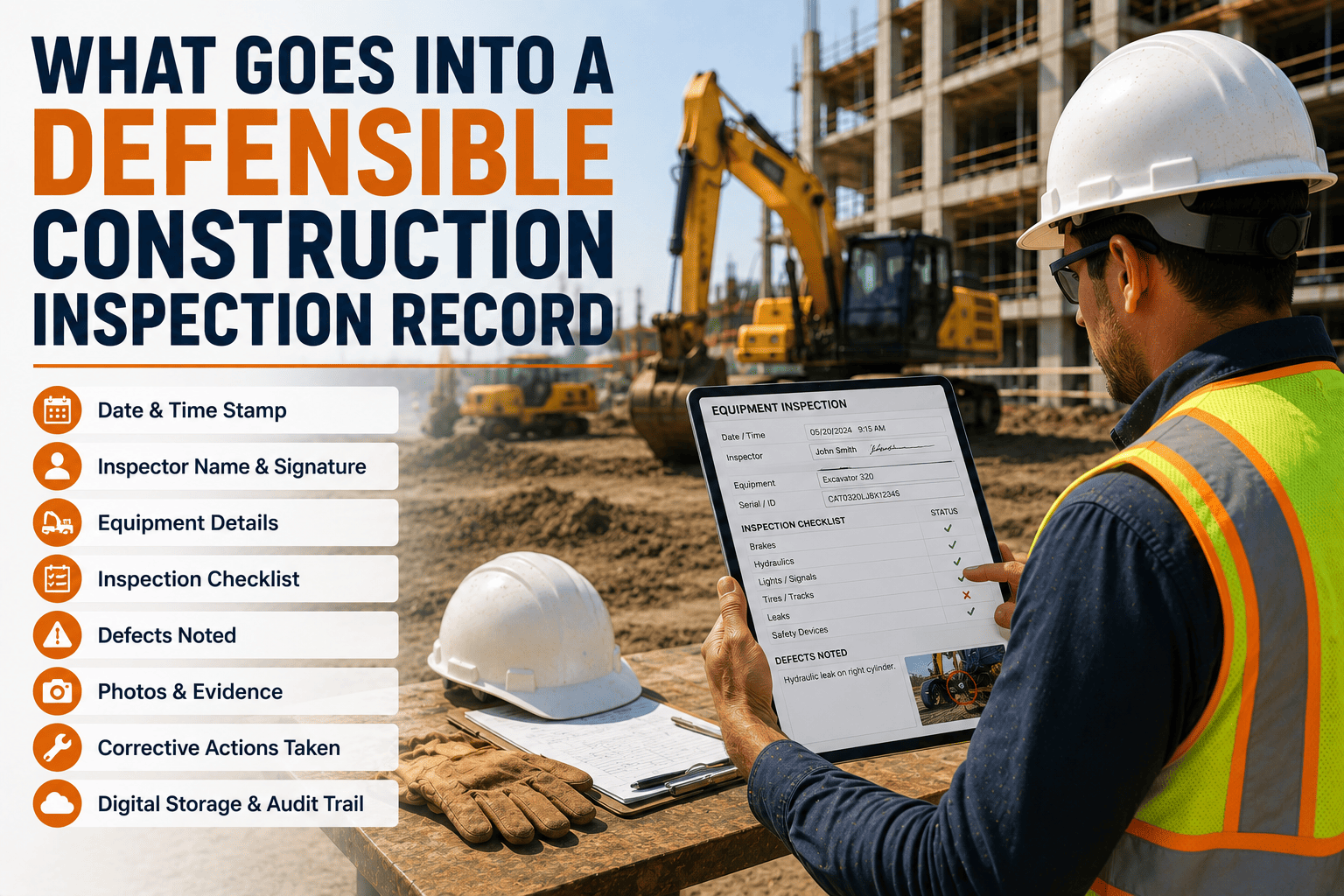
Something failed on the job site, and now everyone wants to see the paperwork. An insurance adjuster, an OSHA inspector, or an attorney is asking the same question in different words: prove the equipment was checked and prove it was safe to run. A signed paper form with a date scrawled at the top rarely survives that conversation. What actually holds up is a record built from several specific pieces of evidence, not just a signature saying "inspected."
A defensible construction equipment inspection record needs more than a checked box and a signature. It needs a timestamp from a trusted source, photo evidence of the actual equipment, a verified inspector identity, a documented link from any defect found to the repair that closed it, and a record that can be pulled up and searched instantly, not dug out of a truck folder. FleetRabbit captures every one of these elements automatically on every inspection, building an audit trail that holds up under OSHA review, insurance claims, or legal scrutiny.
The Five Elements Of A Record That Actually Holds Up
Regulators, insurers, and courts do not treat every digital record as equal. A record earns the label defensible only when it can answer specific questions on demand: who did this, when, on what equipment, and what happened next.
Why A Signature Alone Is Not Enough
A Signed Paper Form Only Proves A Pen Touched Paper
A paper checklist with a name at the bottom tells you that someone was willing to sign it. It does not tell you the equipment was actually looked at, when the check really happened, or whether any defect found afterward was ever repaired. That gap is exactly what falls apart under real scrutiny.
Some Digital Records Are Just A Digital Version Of The Same Problem
Not every app-based inspection is automatically defensible either. A basic digital log that records only a checkbox and a device timestamp is closer to what auditors call a vanity log, something that looks official but cannot answer the harder questions asked during a dispute. The difference between a log and a defensible record comes down to whether every one of the five elements above is actually captured, every time, without depending on the operator to remember an extra step.
FleetRabbit captures timestamps, photos, inspector identity, and defect-to-repair history on every single inspection, with nothing left for an operator to remember. You can sign up for free to see it running on your own equipment, or book a demo to walk through a real audit request.
What Each Element Actually Proves
Every piece of a defensible record answers a different question. Missing any single piece leaves a gap that an inspector, adjuster, or attorney can use against you.
| Record Element | What It Proves | Risk If Missing |
|---|---|---|
| Trusted Timestamp | Exactly when the inspection happened, not just a date written by hand | Cannot prove the inspection occurred before the equipment was used |
| Photo Evidence | The physical condition of the equipment at the moment of the check | Reduced to your word against theirs during a dispute |
| Verified Identity | Which specific person performed the inspection | A shared device or generic sign-off cannot be tied to one accountable person |
| Defect-To-Repair Link | That a found issue was actually fixed before the machine returned to service | Looks like the defect was noticed and then ignored |
| Instant Retrievability | That your records exist and can be produced under real time pressure | Treated as if no inspection ever happened |
Where A Defensible Record Actually Protects You
During An OSHA Inspection
Inspectors ask for dates, names, defects found, and proof of corrective action. A record with all five elements answers every question in the room instead of sending someone to search a filing cabinet.
During An Insurance Claim Or Legal Dispute
After an incident, the question shifts from what happened to what you can prove. A complete inspection history with photos and verified sign-offs is the strongest evidence a fleet can bring to that conversation.
What A Weak Record Looks Like In Practice
A stack of paper forms, some blank fields, a few illegible signatures, and no way to confirm a flagged defect was ever repaired. This is the record most fleets discover they have only after something goes wrong.
What A Strong Record Looks Like In Practice
A searchable history for every machine, each entry backed by a timestamp, a photo, a named inspector, and a closed-out repair trail that can be exported in minutes.
Contractors who sign up for FleetRabbit typically discover just how many gaps existed in their old paper trail the first time they try to pull a complete history for a single machine.
A defensible inspection record is not a nice-to-have, it is the difference between a clean audit and a costly dispute. FleetRabbit builds every element of that record automatically, on every inspection, for every machine.