A wheel loader doesn't fail like other machines. Its biggest risks aren't hidden inside an engine bay, they're sitting in plain sight: a center pivot with a quarter of all loader fatalities tied to it, tires that cost thousands of dollars each to replace, and a bucket edge that wears down every single shift it works. A ten to fifteen minute pre-operation walk-around is what catches these before they turn into an injury, a blown budget, or a machine parked for a week waiting on parts.
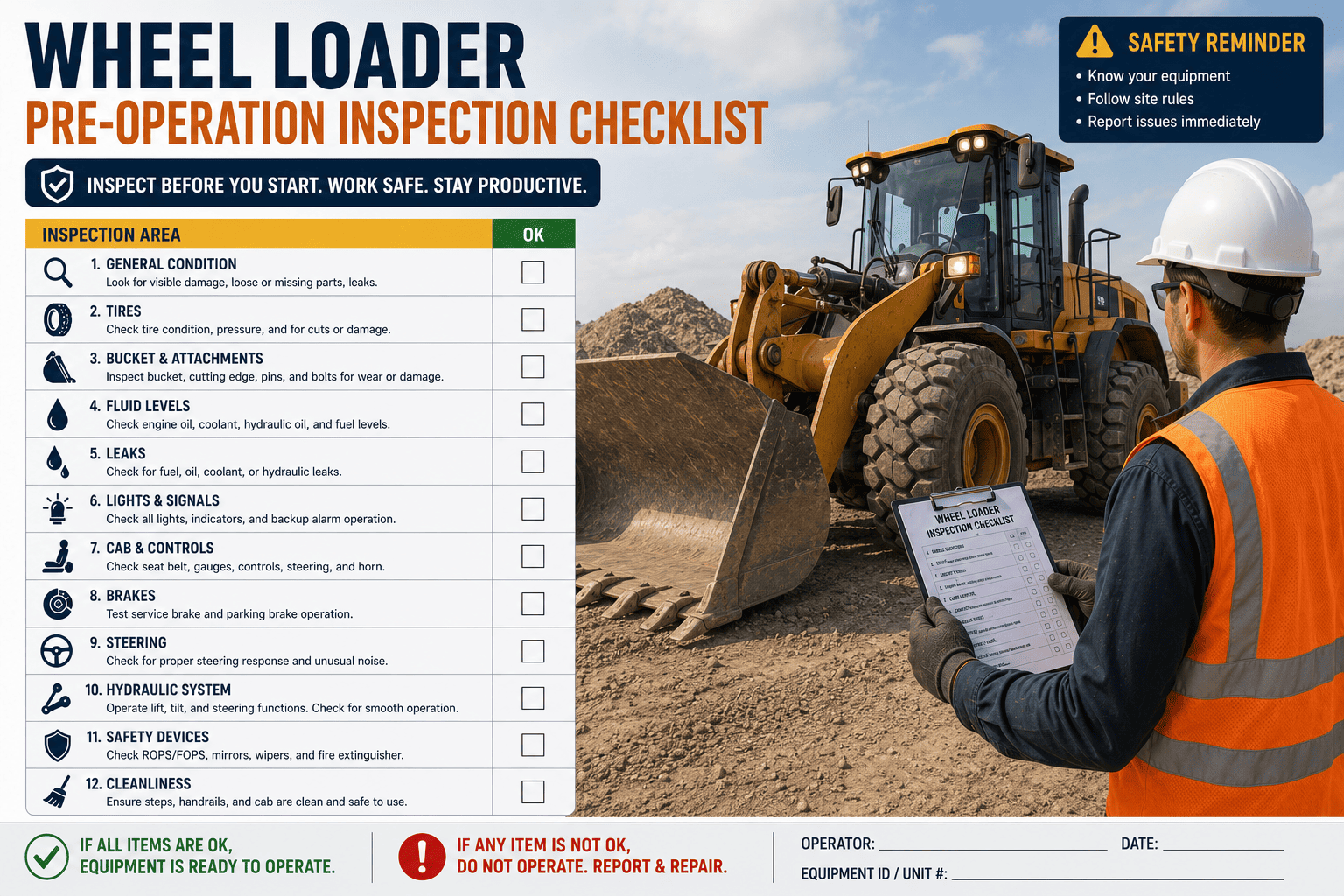
A wheel loader pre-operation inspection covers a 360-degree walk-around for leaks and damage, fluid levels, tire condition and pressure, the center articulation joint for play, the bucket and cutting edge for wear, hydraulic hoses and cylinders, and cab safety systems including brakes, lights, and the backup alarm. It should take 10 to 15 minutes with the engine cold, before the machine ever moves.
The Wheel Loader Pre-Operation Checklist By Zone
Work the same clockwise pattern every time, engine cold, before the machine leaves the yard. Consistency is what catches the small stuff that a random glance misses.
Walk-Around, Fluids, And Frame
Circle the loader looking for hydraulic oil, engine oil, or coolant puddles underneath, and check the frame and welds for stress cracks around boom mounts and axle mounts. Confirm engine oil, coolant, hydraulic fluid, and fuel are at proper levels, and check that steps, handrails, and access points are clear of mud, ice, or grease before anyone climbs into the cab.
Tires And Wheels
Check tire pressure against manufacturer specification, look for cuts, bulges, or embedded debris in the tread, and confirm wheel nuts are tight. If the loader runs foam-filled tires, check the valve cap seal instead of pressure, since foam-filled tires won't go flat but still wear and can fail structurally.
Articulation Joint
Get underneath the cab to the center pivot and check for up-and-down play in the top and bottom pins. Confirm grease zerks are present and show signs of recent lubrication, since dry pins accelerate wear dramatically. Any noticeable movement here is not a minor finding, it's the single point most closely tied to loss of steering control on a loaded machine.
Bucket And Linkage
Starting at the front, check for missing or loose bucket teeth, then inspect the cutting edge for remaining height and the shell for cracks, dents, or wear-through. Move to the lift arms and check for cracks or structural damage, inspect the tilt cylinders for leaks, and if a quick coupler is fitted, verify it's fully locked with safety pins engaged before working under load.
Cab And Safety Systems
Test the service and parking brakes, confirm steering response and articulation lock pin if fitted, and verify all lights, the horn, and the backup alarm function correctly. Fasten the seatbelt, confirm mirrors and any backup camera are clean, and check that the fire extinguisher is present and charged.
FleetRabbit walks operators through tires, articulation, bucket, and safety systems in the correct order, captures a photo at every defect, and routes critical findings straight to your maintenance team before the loader ever moves.
Why The Articulation Joint Deserves Its Own Look
Most equipment risk lives inside a hydraulic system or an engine bay. A wheel loader's biggest structural risk is the pivot that lets it steer, sitting right underneath the cab where it's easy to walk past. If the machine has been working rough, uneven, or rocky ground, that joint tells the story fastest of any component on the loader.
| What You Notice | What It Likely Means | Action |
|---|---|---|
| Up-and-down play in top or bottom pin | Pin or bushing wear from extended rough-terrain use | Tag out of service, do not operate under load |
| Squeaking during turns | Dry grease zerks, metal-on-metal contact beginning | Lubricate immediately and monitor closely at next inspection |
| Grease visible around the joint | Seal wear allowing lubricant to escape | Document with photo, schedule seal inspection |
| Steering feels loose or delayed | Advanced pin wear affecting control response | Tag out of service immediately, do not operate |
What Skipping Tire Checks Actually Costs
Tires are the most expensive consumable on a wheel loader by a wide margin, and they're also one of the fastest checks in the entire walk-around. A cut caught early is a scheduled swap. A cut ignored is a blowout, a stranded machine, and a full-price emergency replacement.
| Finding | Cost If Caught Early | Cost If Missed |
|---|---|---|
| Sidewall cut or bulge | Scheduled tire replacement, one wheel | Blowout, roadside call, possible rim damage too |
| Chronic underinflation | Simple air-up and pressure log adjustment | Accelerated wear across the set, early full replacement |
| Loose wheel nuts | Torque check, a few minutes with a wrench | Wheel separation risk, potential structural rim damage |
| Embedded debris in tread | Removed during walk-around, no cost | Slow puncture leading to unexpected flat mid-shift |
Fleets that catch these findings on the daily walk-around instead of after a failure consistently spend less per year on tires than fleets that treat inspection as optional. If you want to see how this checklist runs as a guided mobile workflow instead of a paper form, you can book a demo with FleetRabbit and walk through it on your own fleet's loaders.
FleetRabbit stores every completed loader inspection with a timestamp, GPS location, and photo evidence tied to the asset's full service history. Audit-ready, every shift, every machine.
Key Takeaways
A wheel loader's biggest risks aren't hidden, they're right where a rushed operator walks past them every morning. Ten to fifteen minutes checking the articulation joint, tires, and bucket cutting edge is the difference between routine maintenance and a five-figure surprise, or worse, an incident tied to a pivot that had been showing play for weeks.
If your loader inspections still depend on a paper form that's easy to skip on a busy morning, it's worth seeing the guided version. Sign up for FleetRabbit to put this exact checklist on every operator's phone, or book a demo to see how defects on tires, buckets, and the articulation joint route straight to maintenance the moment they're found.
FleetRabbit turns this wheel loader checklist into a guided mobile inspection, with photo capture on every defect and a permanent, audit-ready record for every machine you run.