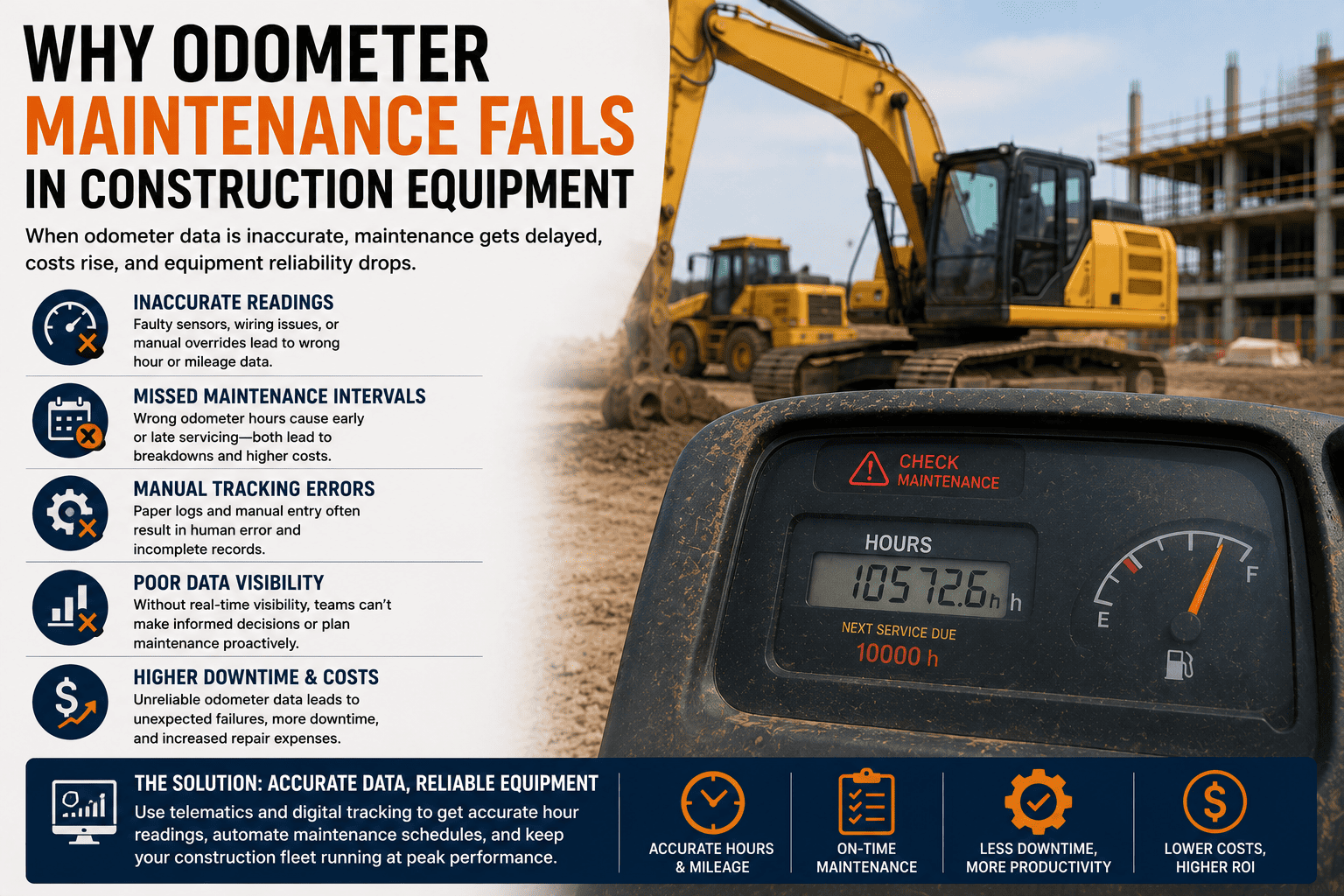
A dump truck can sit almost still all day, bucket loader running, hydraulics straining, engine turning at full load, and its odometer barely moves. Meanwhile the manufacturer's service sticker still says "next oil change at 5,000 miles." By the time that truck crosses the mileage line, the oil has already broken down twice over. This is the quiet, expensive trap that odometer-based maintenance sets for construction fleets, and it is why so many engines fail years before they should.
Construction equipment wears out based on engine hours and workload, not distance traveled. A machine can run for 250 hours under heavy load and hydraulic strain while the odometer shows almost nothing. Scheduling maintenance by miles instead of engine hours lets oil, filters, and hydraulic fluid degrade far past safe limits, causing avoidable engine and transmission failures. FleetRabbit replaces guesswork with engine-hour and condition-based maintenance scheduling built specifically for equipment that idles, lifts, digs, and pumps more than it drives.
The Hidden Wear Construction Equipment Accumulates Without Miles
Every engine has a wear budget, and that budget is spent in hours of operation, not distance covered. On a highway truck, hours and miles track each other closely because the vehicle is almost always moving at a steady speed. Construction equipment breaks that relationship completely. A backhoe digging a trench, a compactor rolling the same stretch of ground repeatedly, or a crane holding a load in position all burn through engine hours while the odometer stays nearly frozen. Oil additives break down from heat cycles and combustion byproducts regardless of whether the machine ever leaves the job site.
Why Oil Breaks Down Even When the Machine Barely Moves
Idling and low-speed, high-load work generate incomplete combustion, and unburned fuel and soot end up in the oil. At low road speeds oil never reaches the temperature needed to burn off moisture and blow-by gases, so contamination builds up faster per hour than it would during steady highway driving. That means an excavator with 300 engine hours and only 40 miles on record can have oil in worse condition than a delivery van with 8,000 miles on the clock.
Why Hydraulic and Drivetrain Components Follow the Same Pattern
Hydraulic pumps, final drives, and undercarriage components on construction machines wear based on operating cycles and load, not distance. A skid steer running eight hours a day on a demolition site accumulates hydraulic fluid contamination and seal wear at a pace that has nothing to do with how far it physically traveled between tasks.
FleetRabbit pulls engine hours, idle time, and load data directly from your equipment and turns it into accurate, automatic service schedules. You can start your free trial today or book a demo to see it running on your own fleet data.
Odometer Miles Versus Engine Hours At A Glance
Comparing the two measurements side by side makes the gap obvious. Highway trucks and construction equipment simply do not behave the same way, which is exactly why using one universal maintenance rule across a mixed fleet leaves some vehicles over-serviced and others dangerously under-serviced.
| Factor | Odometer-Based Approach | Engine-Hour Based Approach |
|---|---|---|
| What It Measures | Distance the vehicle has physically traveled | Total time the engine has actually been running |
| Accuracy For Idling Equipment | Very poor, records almost nothing during idle or PTO work | Accurate, captures every hour the engine is under load |
| Typical Oil Change Trigger | Every 5,000 to 7,500 miles regardless of workload | Every 250 to 500 engine hours depending on duty cycle |
| Risk Of Missed Service | High for equipment that works hard but drives little | Low because service is tied to real operating time |
| Best Suited For | Long-haul trucks with steady highway mileage | Excavators, loaders, compactors, cranes, generators |
How To Move Your Fleet From Odometer To Engine-Hour Scheduling
Switching your maintenance program does not require replacing your equipment or your process overnight. It requires the right data source and a clear sequence for putting engine hours in the driver's seat.
Step 1: Confirm Which Machines Are Idle-Heavy
Pull operating data on every asset and compare recorded hours against recorded miles. Machines with disproportionately high hours relative to distance are the ones odometer schedules are failing right now.
Step 2: Set Hour-Based Triggers For Oil, Filters, And Hydraulics
Replace fixed mileage intervals with hour thresholds, typically 250 to 500 hours for engine oil on diesel equipment, and shorter intervals for hydraulic fluid on high-cycle machines like excavators and skid steers.
Step 3: Automate The Trigger So Nothing Gets Missed
Manual hour-meter checks get skipped on busy job sites. Automated tracking through telematics removes that risk entirely by generating a work order the moment a threshold is crossed.
Why Manual Tracking Quietly Fails
Paper logs and dashboard hour meters depend on someone remembering to check them. Once a fleet grows past a handful of machines, hour tracking by hand becomes the first thing that slips.
What Automated Tracking Adds Instead
Continuous, condition-based data means maintenance teams see accumulating hours in real time and can plan service around job schedules instead of reacting to a warning light in the field.
What Happens When Fleets Keep Using Miles Anyway
Fleets that stay on odometer schedules for idle-heavy equipment tend to discover the problem the expensive way, through a failed engine or a seized hydraulic pump rather than through a planned service call. Oil that should have been changed at 300 hours gets changed at what the odometer suggests is due, often two or three times later than it should be. Sludge builds, bearings wear, and turbochargers take on damage that a fresh service could have prevented entirely. Warranty claims can also be denied when a manufacturer calculates true engine hours and finds a mismatch with reported mileage, leaving the fleet to cover a major repair out of pocket.
Getting ahead of this pattern is far less costly than fixing it afterward. Fleets that sign up for FleetRabbit typically start by connecting existing telematics data so engine hours flow in automatically, with no manual entry required from operators or technicians.
Mileage tells you where a truck has been. Engine hours tell you how hard it has actually worked. FleetRabbit replaces guesswork with real, condition-based maintenance scheduling so nothing gets serviced too late or too early.