AI agents are transforming fleet operations from reactive management to intelligent automation. In 2026, these digital partners handle scheduling, coordinate workflows, predict failures, and automate routine decisions—compressing response times from hours to seconds. With fleets reporting up to 89% accident reductions and 40% maintenance cost savings, the question isn't whether to adopt AI agents, but how quickly you can implement them. Sign up for FleetRabbit to start your AI-powered fleet transformation.
Lead the AI Fleet Revolution in 2026
Join forward-thinking fleet operators using AI agents to cut costs, prevent accidents, and automate workflows. Get started with intelligent fleet management today.
Frequently Asked Questions
What are AI agents and how do they work in fleet operations?
AI agents are autonomous software systems that understand goals, reason over your fleet data, take actions across multiple systems, and learn from outcomes—all while keeping humans in control of critical decisions. Unlike traditional fleet software that requires manual queries and interpretation, AI agents proactively manage operations. Sign up for FleetRabbit to experience AI-powered fleet management:
Traditional Software vs. AI Agents
- Wait for commands
- Display data dashboards
- Require manual interpretation
- Respond after problems occur
- Work in isolated systems
- Understand operational goals
- Reason and make decisions
- Take autonomous actions
- Predict and prevent issues
- Coordinate across systems
Core AI Agent Capabilities for Fleets:
- Autonomous Reasoning agents understand context, weigh options, and recommend actions based on operational constraints
- Multi-System Coordination a single agent queries telematics, updates TMS, schedules maintenance, and notifies customers
- Predictive Intelligence AI models forecast failures, risks, and scheduling needs weeks in advance
- Self-Correction agents learn from outcomes and continuously improve their decision-making
- Human-in-the-Loop critical decisions still require human approval while routine tasks run automatically
What's the difference between AI copilots and AI agents?
This distinction represents the most significant AI shift in 2026: copilots suggest, agents act. Understanding this difference helps fleet managers choose the right technology approach for their operations. Book a demo to see both technologies in action:
The Evolution from Assistance to Autonomous Action
AI Copilots (2024-2025)
Draft reports, suggest routes, summarize data—but leave humans fully in control of execution
AI Agents (2026+)
Plan workflows, call tools, take actions, and self-correct—only asking for human approval when needed
Example: How an AI Agent Handles a Delivery Delay
How does predictive maintenance work with AI in 2026?
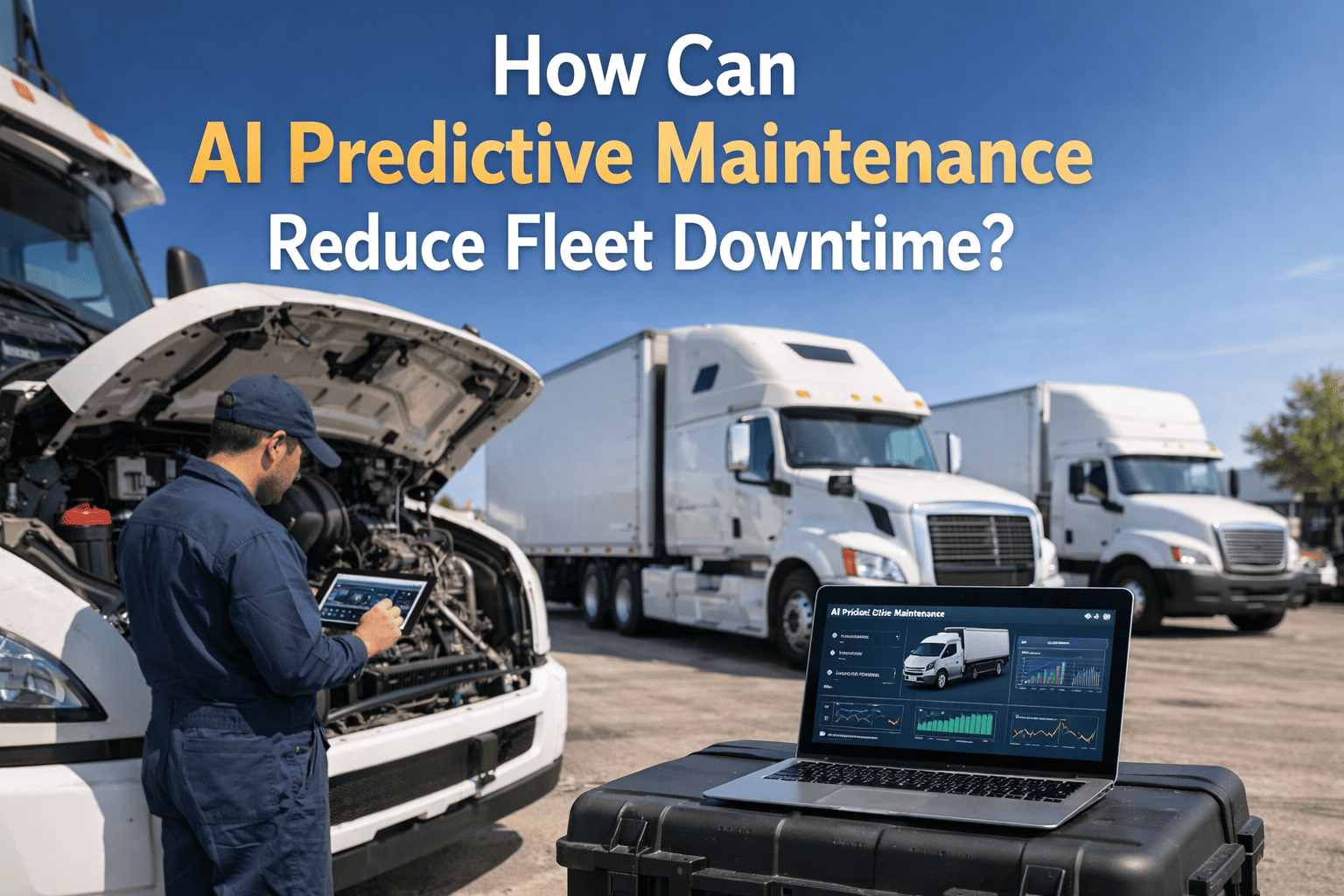
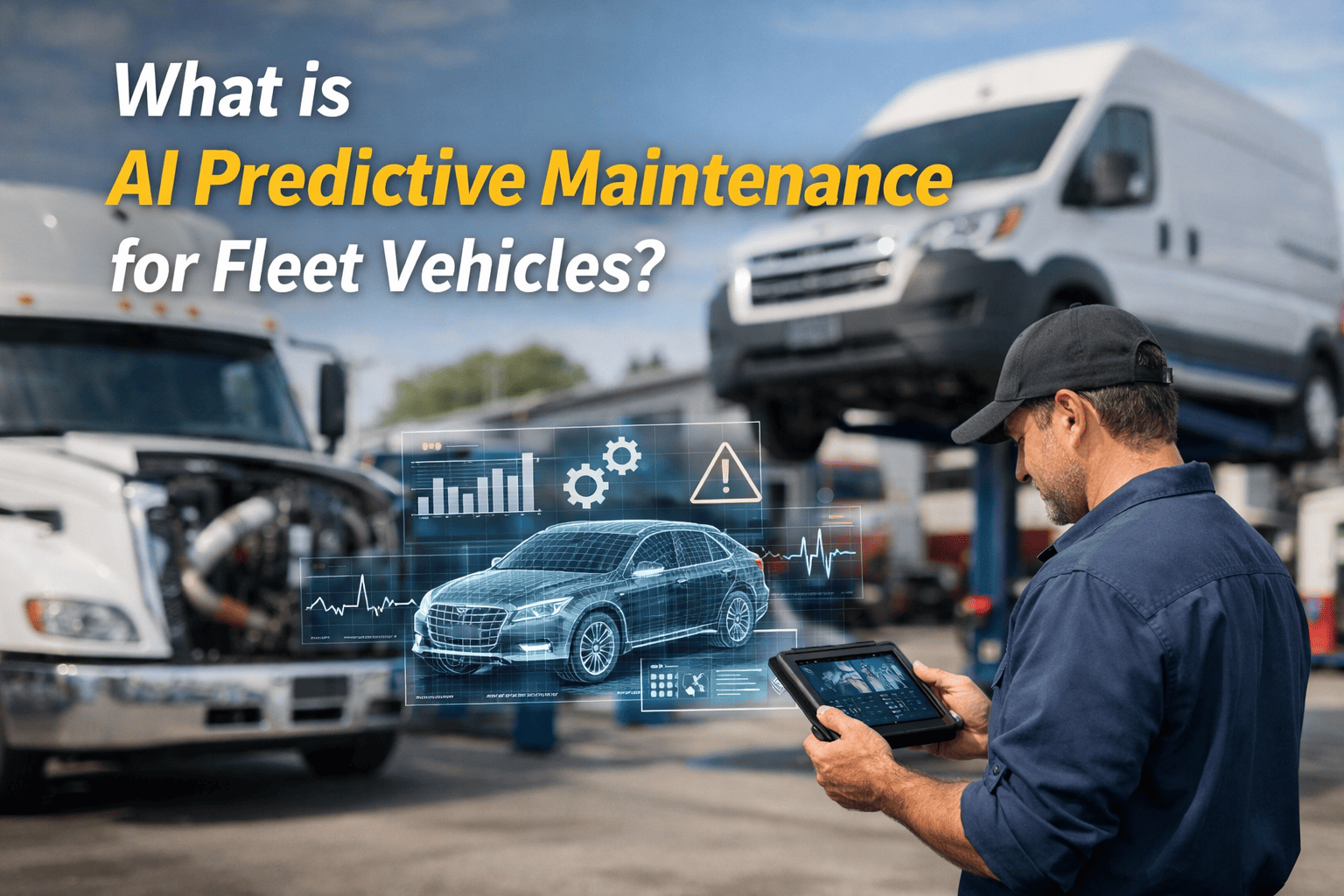
Predictive Maintenance 2.0 represents the shift from "interesting technology" to "business infrastructure." In 2026, 65% of maintenance teams plan to use AI, yet only 27% currently do—that gap is where competitive advantage lives. Fleets operationalizing AI-powered predictive maintenance report 25-40% maintenance budget reductions. Sign up to start your predictive maintenance transformation:
Predictive Maintenance Impact Analysis
| Maintenance Approach | Breakdown Rate | Parts Cost | Downtime Impact | Annual Savings |
|---|---|---|---|---|
| Reactive (Fix when broken) | High | +40-60% rush fees | Unpredictable | Baseline |
| Preventive (Scheduled) | Medium | Standard pricing | Planned windows | 15-20% |
| Predictive AI (2026) | Low | Bulk discounts | Near-zero unplanned | 25-40% |
What AI Predictive Maintenance Does Differently:
- Component-Level Prediction AI forecasts which specific part will fail, when it will fail, and confidence level
- Automated Parts Procurement failure predictions trigger automatic ordering weeks in advance at standard pricing
- AI Copilot Diagnostics guides technicians through repairs, suggests troubleshooting steps, estimates repair times
- Fleet-Wide Pattern Analysis correlates readings across your entire fleet to identify degradation curves
- Cold-Start Failure Detection requires 100+ voltage samples per second—data only available through high-frequency OEM integration
How is OEM telematics data powering AI fleet intelligence?
Over 90% of vehicles manufactured in 2026 ship with factory-embedded telematics. This revolution means rich diagnostic data streams directly from the factory—without aftermarket devices or installation downtime. But raw data isn't intelligence; the competitive advantage comes from AI that interprets what vehicles are actually saying. Book a demo to see OEM data integration in action:
OEM Telematics Revolution - Key Facts:
Benefits of OEM Telematics + AI Integration:
- Zero Hardware Costs new vehicles come pre-installed with telematics—no aftermarket devices needed
- Deeper Data Access factory integration provides engine diagnostics, battery health, tire signals, and EV charging status
- Multi-Brand Unification platforms aggregate data from Ford, GM, Volvo, Stellantis, Mercedes-Benz into single dashboards
- Higher AI Accuracy 100+ samples per second enables predictions that standard telematics cannot support
- Major OEM Partnerships Geotab integrates with Volvo, Ford, GM, Stellantis, Mercedes-Benz, Rivian, and VW
How do AI agents improve fleet safety and reduce accidents?
AI-powered safety systems have moved from reactive recording to proactive prevention. Fleets using comprehensive AI safety solutions achieve 73-92% crash rate reductions—nearly double the improvement of basic camera systems. The 2026 breakthrough is seamless integration between driver monitoring and road awareness systems. Sign up to implement AI safety systems:
AI Safety Performance Statistics:
- 98.5% accuracy in close-following detection across fleets using AI-powered analytics
- 99% accuracy in cellphone usage detection with real-time driver alerts
- 89% reduction in accidents for fleets with full AI safety implementation
- 73% crash reduction over 30 months with dual-facing cameras and coaching
- 92% reduction in preventable accidents (Coach USA case study)
- 7:1 ratio of near-collision warnings to actual collisions, providing early intervention opportunities
AI Safety Technology Stack in 2026:
- Driver Monitoring Systems (DMS) detect fatigue, distraction, phone use, and seat belt violations in real-time
- Advanced Driver Assistance (ADAS) provides forward collision, lane departure, and tailgating warnings
- Predictive Collision Alerts give drivers up to 100 extra feet of reaction time at 60 mph
- Automated Coaching instant in-cab feedback reinforces safe habits without manager intervention
- Risk Prediction AI identifies behavioral patterns that predict future incidents before they occur
Reduce Accidents by Up to 89% with AI Safety
FleetRabbit's AI-powered safety platform detects risks before they become accidents. Get real-time alerts, automated coaching, and measurable safety improvements.
What autonomous workflows can AI agents handle in 2026?
AI agents are graduating from isolated tasks to end-to-end workflow ownership. Multi-agent systems now collaborate across planning, compliance, and customer service to complete complex operations without manual coordination:
AI Agent Workflow Automation Examples
Maintenance Orchestration
AI detects anomaly, predicts failure timeline, orders parts, schedules service window, reassigns routes, and updates compliance logs automatically.
Safety Incident Response
System detects collision, alerts management, captures video evidence, notifies insurance, files first notice of loss, and schedules driver coaching.
Compliance Management
Agent monitors HOS status, predicts violations, suggests route adjustments, files required reports, and maintains audit-ready documentation.
Dispatch Optimization
AI analyzes traffic, weather, driver fatigue, and delivery windows to continuously optimize routes and rebalance workloads in real-time.
Will AI agents replace fleet managers and dispatchers?
No. AI handles cognitive load and pattern detection while humans continue making judgment calls, coaching drivers, and managing exceptions. The 2026 reality is that AI agents amplify human capabilities rather than replace them:
How AI Changes Fleet Roles:
- Fleet Managers shift from data wrangling to strategic decision-making and exception handling
- Dispatchers evolve from route planning to customer relationship management and complex problem-solving
- Safety Managers move from reviewing hours of footage to coaching high-risk drivers identified by AI
- Maintenance Teams transition from reactive firefighting to planned, predictive service execution
- Technicians get AI copilots that reduce diagnostic time and improve first-time fix rates
The Human-AI Partnership Reality:
- Gartner predicts 40% of enterprise applications will embed AI agents by end of 2026
- New roles emerging around agent supervision, orchestration, and governance
- Hybrid systems produce better outcomes than either humans or AI alone
- AI reduces burnout by eliminating repetitive cognitive tasks that exhaust skilled workers
What ROI can fleets expect from AI agent implementation?
AI-powered fleet management delivers measurable returns across multiple operational areas. Well-designed pilots typically show results within 6-12 weeks, with safety improvements appearing within days of deployment. Schedule a consultation to calculate your potential ROI:
AI Fleet Implementation ROI Timeline
| Improvement Area | Typical Impact | Time to Results | ROI Range |
|---|---|---|---|
| Safety (harsh events, speeding) | 73-89% reduction | Days to weeks | 21-30% insurance savings |
| Maintenance costs | 25-40% reduction | 2-3 months | $1,500-2,500/vehicle/year |
| Downtime prevention | 40-60% reduction | 2-3 months | Varies by operation |
| Manager review time | 90% reduction | Immediate | Labor cost savings |
| Customer satisfaction | Better ETAs | Weeks | Retention improvement |
How do I get started with AI agents for my fleet?
You don't need to transform everything at once. Start with one workflow, one pilot, one measurable goal. The fleets that document success in 2026 build the foundation for 2027 and beyond. Sign up for FleetRabbit to begin your AI journey:
AI Fleet Implementation Roadmap
Foundation (Week 1-2)
- Inventory existing OEM telematics capabilities
- Activate dormant OEM data services
- Establish data quality baselines
Pilot (Week 3-8)
- Connect OEM APIs to analytics platform
- Deploy AI safety monitoring on pilot vehicles
- Measure baseline vs. AI-assisted performance
Scale (Week 9-16)
- Expand to predictive maintenance workflows
- Enable automated coaching programs
- Integrate compliance and dispatch automation
Optimize (Ongoing)
- Refine AI models based on your fleet data
- Expand agent autonomy in proven workflows
- Document ROI for stakeholder reporting
Start Your AI Fleet Transformation Today
The window for "wait and see" is closing. Fleets that act in 2026 build competitive advantages that compound over time. Get started with a focused pilot that proves ROI.