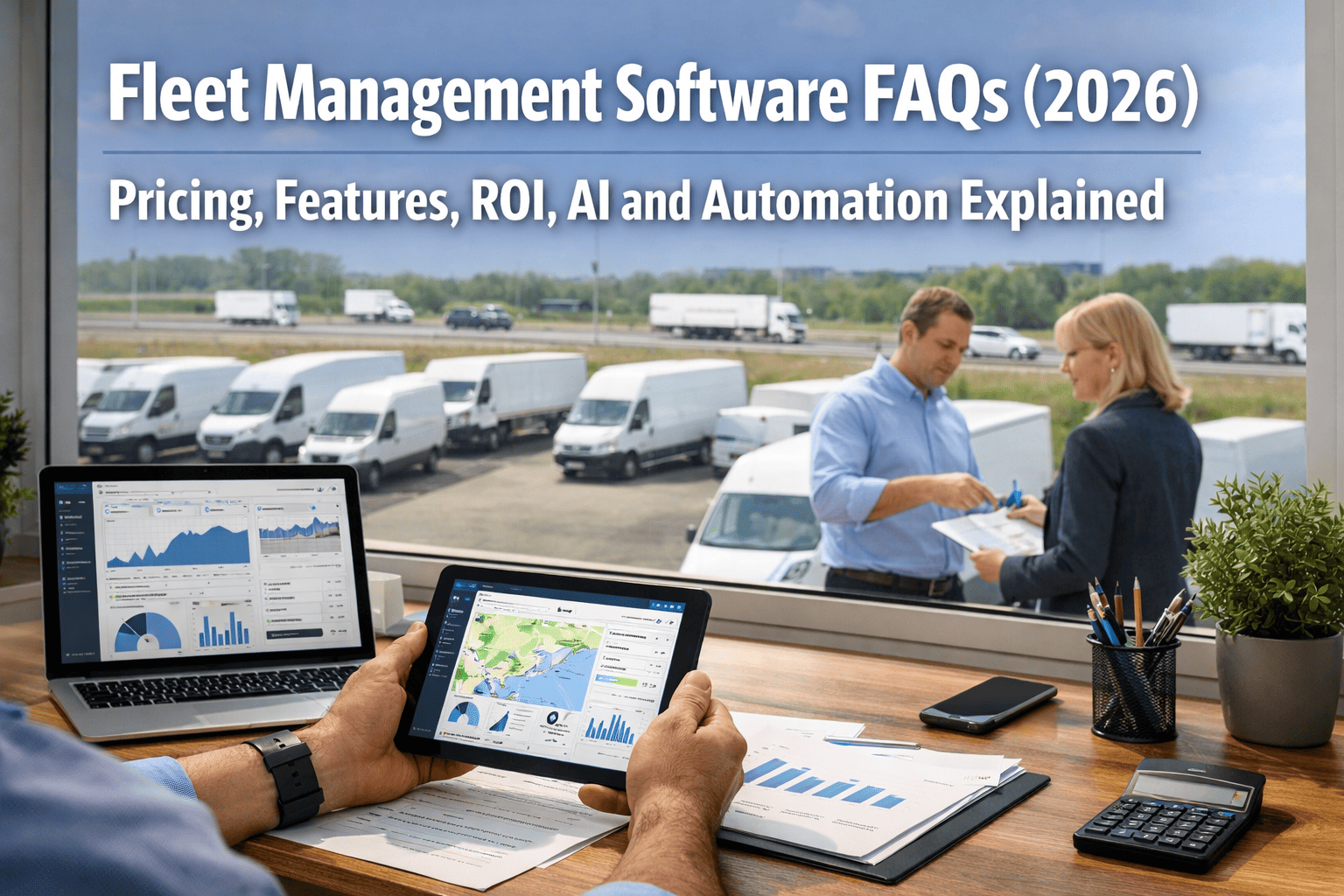
Fleet management software has evolved from a nice-to-have into an operational necessity for trucking, logistics, and transportation companies of all sizes. This FAQ guide answers the most searched questions about fleet management software in 2026 — from pricing and ROI to AI capabilities and implementation. Sign up for FleetRabbit to experience modern fleet management firsthand.
Purpose-Built for Modern Fleet Operations
FleetRabbit combines GPS tracking, maintenance management, compliance automation, and AI-powered analytics in one unified platform.
Frequently Asked Questions
What is fleet management software and what does it do?
Fleet management software is a comprehensive digital platform that centralizes vehicle and driver operations into a single system — replacing spreadsheets, paper logs, and disconnected tools with real-time visibility across your entire fleet.
Core Capabilities
GPS Tracking
Real-time location, route history, geofencing alerts
Maintenance
Preventive scheduling, work orders, parts tracking
Compliance
Digital DVIRs, ELD integration, audit-ready records
How much does fleet management software cost?
Fleet management software typically costs $15–$45 per vehicle per month for standard packages. Enterprise solutions with advanced AI features range from $50–$100+ per vehicle.
Cost Example: 50-Vehicle Fleet
Most fleets recover this investment within 3-6 months through fuel savings and reduced breakdowns.
What ROI can I expect from fleet management software?
Fleet management software delivers 15-25% reduction in overall fleet costs, with most companies achieving payback within 3-6 months.
ROI Breakdown by Category
What features should I look for in fleet management software?
Prioritize solutions with real-time tracking, maintenance management, compliance automation and analytics that integrate with your existing systems.
Essential Features
GPS & Telematics
Real-time tracking, geofencing, idle monitoring
Maintenance
Preventive scheduling, work orders
Compliance
Digital DVIRs, ELD, HOS tracking
Analytics
Dashboards, KPIs, trend analysis
Fuel Management
Consumption tracking, theft detection
Driver Safety
Behavior scoring, coaching tools
How does AI improve fleet management software?
AI transforms fleet management from reactive tracking to proactive optimization — predicting maintenance needs, optimizing routes, and identifying safety risks before they become problems.
AI Applications
- Predictive Maintenance: Forecasts failures 2-4 weeks ahead, reducing downtime 35%
- Route Optimization: Reduces fuel consumption 10-15% using traffic and weather data
- Safety Scoring: Identifies high-risk behaviors, reduces accidents 20-30%
- Anomaly Detection: Spots unusual fuel consumption and unauthorized use
How long does implementation take?
Small fleets (under 25 vehicles) can be operational within 1-2 weeks. Enterprise deployments with custom integrations typically require 4-12 weeks.
Week 1-2
Account setup, hardware installation, initial training
Week 2-4
Data migration, workflow configuration, pilot testing
Week 4-6
Full deployment, advanced training, process refinement
Week 6-12
Custom integrations, optimization, ongoing support
What integrations should fleet management software support?
Key integrations include ELD/telematics devices, accounting software, fuel cards, dispatch systems, and ERP platforms.
Essential Integration Categories
- Telematics & ELD: Samsara, Geotab, Motive, Platform Science
- Accounting & ERP: QuickBooks, Sage, NetSuite, SAP
- Fuel Cards: WEX, Fuelman, Comdata, EFS
- Dispatch & TMS: McLeod, TMW, Trimble, Omnitracs
How does fleet management software improve DOT compliance?
Fleet management software automates compliance documentation, tracks driver qualifications, and maintains audit-ready records that satisfy DOT, FMCSA, and state regulations.
Compliance Impact
Fewer Violations
DVIR Completion
Audit Time Saved
What's the difference between fleet management software and TMS?
Fleet management software focuses on vehicles, maintenance, and driver operations. TMS handles load planning, carrier selection, and freight optimization. Many companies use both.
Fleet Management
GPS tracking, maintenance, driver safety, compliance, fuel management, asset lifecycle
Vehicle & Driver OperationsTMS
Load planning, carrier selection, freight billing, shipment tracking, rate management
Freight & LogisticsCloud-based or on-premise: Which should I choose?
Cloud-based fleet management is the dominant choice in 2026 — lower upfront costs, automatic updates, and anywhere access. On-premise suits organizations with strict data sovereignty requirements.
5-Year TCO Comparison (100 vehicles)
What training is required?
Effective training requires 2-4 hours for drivers (mobile app, inspections) and 8-16 hours for managers (full platform configuration).
Drivers: 2-4 hrs
Mobile app, inspections, defect reporting
Managers: 8-12 hrs
Dashboards, scheduling, compliance
Admins: 12-16 hrs
Configuration, integrations, analytics
What support should I expect from fleet software vendors?
Quality vendors provide phone, email, chat, and self-service resources. Critical issues should be resolved within 1-4 hours, standard requests within 24-48 hours.
Support Quality Indicators
Satisfaction Score
Critical Response
Uptime SLA
Start Optimizing Your Fleet Today
FleetRabbit provides everything you need to manage vehicles, drivers, maintenance, and compliance in one platform.