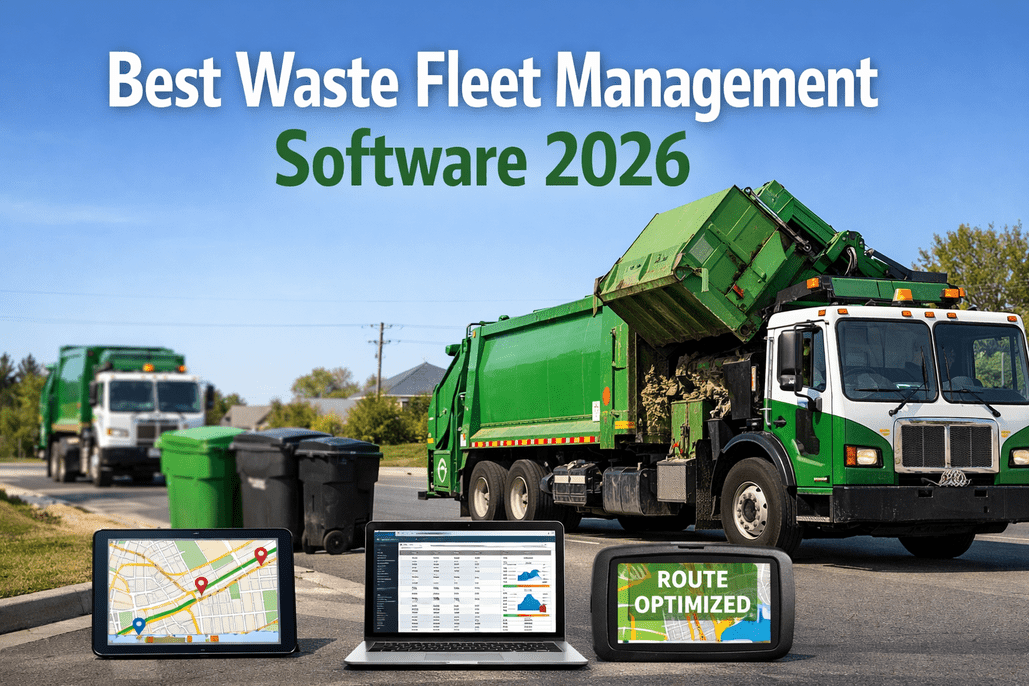
The waste collection industry in the United States is an $86.1 billion market served by nearly 20,000 businesses — and every single one runs on trucks. Managing these fleets demands specialized software that goes beyond generic fleet tracking: waste operations need route optimization for stop-density patterns, container tracking with RFID, hydraulic system monitoring for compactors and loaders, and maintenance schedules calibrated to extreme duty cycles. The global garbage truck market is valued at $15.9 billion in 2025 and projected to reach $24.8 billion by 2035. We evaluated the top platforms based on waste-specific features, route optimization, maintenance management, integration ecosystem, and value. Here are the 10 best options for 2026. Try FleetRabbit free for digital DVIRs and maintenance management purpose-built for heavy-duty waste fleets.
Not all waste fleet software is created equal. This comparison highlights which platforms cover waste-specific needs versus general fleet management features:
Selecting the right software depends on your operation type, fleet size, and which pain points are most critical. Here's a decision framework:
What makes waste fleet software different from generic fleet management?
Waste fleet management software is built around operational challenges that generic fleet platforms simply weren't designed to handle. A standard fleet tracking system might give you GPS dots on a map and basic maintenance reminders — but waste operations demand far more specialized capabilities. First, route optimization for waste collection is fundamentally different from delivery routing. A residential garbage truck may complete 800-1,200 stops in a single shift, navigating one-way streets, cul-de-sacs, and seasonal volume changes where recycling runs every other week and yard waste is only collected April through November. Waste-specific routing algorithms account for stop-density patterns, truck turning radius on residential streets, landfill/transfer station proximity, and the need to balance routes by time rather than just distance. Second, waste trucks have equipment that generic platforms don't monitor — hydraulic compactors, lift arms (front-load, side-load, rear-load), cable/winch assemblies on roll-off trucks, PTO-driven systems, and vacuum/sweeper mechanisms. Software like FleetRabbit's HVI platform includes inspection checklists specifically covering these components, tracking hydraulic pressure trends, compactor cycle counts, and lift arm wear patterns. Third, waste operations need container-level asset tracking. Roll-off operators must know where every container is, how long it's been on-site, and when it's due for swap. Residential operations track individual bins via RFID tags for service verification — proving to municipalities that each address was serviced. Finally, waste-specific compliance includes EPA hazardous waste manifesting, OSHA confined space protocols for landfill equipment, DOT weight limits at scale houses, and local franchise agreement reporting that generic fleet tools don't support.
How much does waste fleet management software cost in 2026?
Pricing for waste fleet management software varies dramatically depending on the platform tier, fleet size, and modules selected. Understanding the cost structure helps you budget accurately and avoid surprises. At the entry level, basic fleet tracking and digital DVIR platforms like FleetRabbit and Motive typically cost $20-$50 per vehicle per month. These platforms provide essential capabilities — mobile inspections, preventive maintenance scheduling, work order management, and GPS tracking — without requiring expensive hardware or long-term contracts. FleetRabbit offers a free trial with no credit card required, making it easy to validate value before committing. Mid-tier connected operations platforms like Samsara and Geotab with telematics hardware typically cost $30-$60 per vehicle per month, often with a hardware purchase or lease ($100-$300 per device). These platforms add AI dash cameras ($200-$400 per unit), ELD compliance, driver behavior analytics, and asset tracking — capabilities that larger waste fleets need for safety and liability management. Enterprise waste ERP platforms like AMCS and Routeware represent the premium tier, with annual subscriptions typically starting at $50,000+ based on fleet size, modules, and implementation scope. These platforms encompass route optimization, fleet maintenance, customer management, billing, scale house operations, and sustainability reporting in a single integrated system. Implementation can take 6-12 months and add $25,000-$100,000+ in professional services costs. The investment makes sense for large operations (100+ trucks) where the operational integration delivers transformative efficiency. Specialized routing engines like RouteSmart use enterprise custom pricing that varies by fleet size, typically ranging from $50,000-$200,000+ annually for large municipal operations. The ROI justification is the 20-30% reduction in route miles, which translates directly to fuel savings, reduced vehicle wear, and fewer driver hours. When budgeting, also account for hardware costs (GPS devices, cameras, RFID readers), training time, and the ongoing data/cellular connectivity fees that most platforms charge separately.
How does route optimization work specifically for garbage truck fleets?
Route optimization for waste collection is one of the most computationally complex routing problems in logistics — significantly harder than delivery routing. A single residential collection route might include 800-1,200 stops that must be sequenced to minimize total driving distance while respecting dozens of real-world constraints. These constraints include one-way streets and turn restrictions in residential areas, truck weight limits on certain roads and bridges, timing windows where certain neighborhoods or commercial areas can be serviced, the need to balance routes by estimated time (not just distance) so all drivers finish at roughly the same time, landfill or transfer station proximity and operating hours (trucks must dump when full, adding unproductive transit), seasonal collection variations (yard waste in spring/summer, leaf collection in fall), and the requirement that trucks service both sides of a street efficiently (avoiding unnecessary U-turns with 40-foot vehicles). Advanced platforms like RouteSmart and AMCS Route Optimizer use GIS-based algorithms that model actual street networks rather than simple point-to-point distances. They account for vehicle turning radius, service side requirements (which side of the street the bin is on), and the topography that affects fuel consumption on hilly terrain. Dynamic re-optimization is another critical feature — when a truck breaks down at 10 AM, the system needs to reassign its remaining 400 stops across other trucks in minutes, not hours. Similarly, when a new service request comes in (missed pickup complaint, emergency dumpster pull), the dispatcher needs to insert that stop into the nearest appropriate truck's remaining route without disrupting the overall plan. The measurable impact is substantial: RouteSmart consistently delivers 20-30% reductions in miles driven for waste fleets, which translates to 15-25% fuel savings, proportional reductions in tire and brake wear, and often allows operations to cover the same territory with fewer trucks. For a 50-truck municipal operation spending $2 million annually on fuel, a 20% route optimization improvement represents $400,000 in annual fuel savings alone — before accounting for reduced maintenance and labor costs.
Can I use multiple waste fleet software platforms together?
Yes — and in fact, most successful waste operations run a carefully selected stack of specialized tools rather than relying on a single platform for everything. The reason is simple: no single software product leads in every category. A platform that excels at route optimization may have weak maintenance management, and a best-in-class DVIR tool probably doesn't handle waste billing. The key to a successful multi-platform strategy is choosing tools with open APIs and proven integration partnerships. Here's what effective waste fleet tech stacks typically look like. For small fleets (10-25 trucks): FleetRabbit for digital DVIR and maintenance management + a basic GPS tracking system. This covers your compliance and maintenance needs without overcomplicating operations. Total cost: approximately $30-$60/vehicle/month. For mid-size fleets (25-100 trucks): FleetRabbit for inspections and maintenance + Geotab or Samsara for telematics and driver behavior + Soft-Pak or a billing platform for customer management. The telematics platform feeds vehicle data into your maintenance system automatically, while the billing system handles the business side. Total cost: approximately $60-$120/vehicle/month. For large fleets (100+ trucks): AMCS or Routeware as the operational backbone (routing, billing, CRM) + FleetRabbit or AMCS Fleet Maintenance for specialized maintenance/DVIR + Samsara or Motive for AI safety cameras. Enterprise platforms handle the complex integration, while specialized tools provide depth where the all-in-one falls short. Total cost: varies widely based on enterprise contract terms. The critical integration points to verify before purchasing are: Does the telematics platform push odometer and engine hour data to the maintenance system automatically? Can the DVIR platform receive vehicle fault codes from the telematics hardware? Does the routing system integrate with the GPS tracking to show real-time route completion? Can the billing system receive service verification data (proof of pickup) from the field? If these data flows work seamlessly, your multi-platform stack will function as a unified system. If they require manual data re-entry, you'll lose much of the efficiency you're paying for.
What ROI should I expect from waste fleet management software?
The return on investment from waste fleet management software is typically among the highest of any technology investment a waste hauler can make, with most fleets seeing full payback within 3-6 months. The ROI comes from multiple compounding sources. Fuel cost reduction (15-30%): Route optimization eliminates unnecessary miles, idle time management reduces fuel burned at collection points, and driver behavior monitoring curbs aggressive acceleration and excessive speeding. For a 50-truck waste fleet spending $500,000-$1 million annually on fuel, even a 15% reduction represents $75,000-$150,000 in annual savings. Maintenance cost reduction (20-35%): Digital inspections catch problems early — a hydraulic leak detected during a morning DVIR costs $200 to fix at the depot versus $5,000+ for a roadside failure that also disrupts an entire day's collection schedule. Preventive maintenance scheduling ensures oil changes, brake inspections, and hydraulic fluid services happen on time, preventing the cascading failures that lead to expensive unplanned repairs. One regional waste hauler with 150 trucks reported 32% lower maintenance costs after implementing HVI's fleet management system. Downtime reduction (25-40%): Every hour a garbage truck is out of service costs the operation in missed collections, customer complaints, and penalty fees on municipal contracts. Predictive maintenance and real-time vehicle health monitoring keep trucks running. AMCS Fleet Maintenance claims over 93% uptime for its customers. For a waste hauler where each truck generates $500-$1,000/day in revenue, reducing downtime from 15% to 8% across a 50-truck fleet could recover $300,000-$600,000 annually. Labor efficiency (10-20%): Optimized routes mean drivers complete the same work in fewer hours, reducing overtime costs. Digital DVIRs save 15-20 minutes per driver per day compared to paper inspections. Automated dispatch eliminates hours of manual route planning. For a fleet with 50 drivers averaging $25/hour, saving just 30 minutes per driver per day equals $162,500 in annual labor savings. Customer retention and contract compliance: Service verification (GPS-stamped proof of collection at each address) reduces missed-pickup complaints by 40-60%, protecting municipal contracts that can be worth millions annually. When you add these together, a mid-size waste fleet typically sees $500,000-$1,500,000 in annual savings from a technology investment of $100,000-$300,000 — a 3:1 to 5:1 return ratio that compounds year over year as the fleet refines its operations using accumulated data.
Are electric garbage trucks changing software requirements in 2026?
Yes, the electrification of waste collection fleets is fundamentally reshaping what fleet management software needs to do. Several global cities have announced pilot programs and large-scale rollouts of electric garbage trucks, and the trend is accelerating as the $15.9 billion garbage truck market increasingly favors low-emission alternatives. Electric refuse vehicles are particularly well-suited for waste collection because the duty cycle — frequent stops and starts in urban areas — is exactly where electric motors excel and diesel engines are least efficient. Regenerative braking recaptures energy during the constant stopping that defines residential collection, extending range significantly. BYD, for example, has deployed over 18,000 electric commercial vehicles in China, and companies like GreenWaste in California have reported saving approximately 6,000 gallons of diesel per electric truck annually. But electric waste trucks create entirely new software requirements that legacy platforms weren't built to handle. Battery state of charge monitoring becomes mission-critical — a garbage truck that runs out of charge with 200 stops remaining creates a service disaster. Software needs to predict range consumption based on route profile (hills, stop frequency, load weight) and alert dispatchers before a truck enters a "point of no return" where it can't complete its route and return to the depot. Charging schedule optimization is another major challenge. A waste fleet that returns 30 electric trucks to the depot at 3 PM can't simply plug them all in simultaneously — the electrical demand would overwhelm depot infrastructure and trigger massive demand charges from the utility. Smart charging software staggers charging across the overnight window, prioritizing trucks with early-morning routes and taking advantage of off-peak electricity rates that can be 40-60% cheaper. Mixed-fleet management creates complexity because most waste operations won't go 100% electric overnight. Software must manage diesel, CNG/RNG, and electric trucks together — with powertrain-specific inspection checklists, different maintenance intervals (electric trucks need far less engine maintenance but require high-voltage system inspections), and separate cost-per-mile calculations for each energy source. Platforms like Samsara and Geotab already support EV fleet monitoring, while AMCS has integrated electric vehicle data into its enterprise waste platform. FleetRabbit's DVIR templates adapt to vehicle powertrain type, ensuring electric waste trucks receive appropriate inspections for their battery thermal management systems, charging ports, and regenerative braking calibration rather than irrelevant diesel-specific checks.
What are the biggest challenges in managing a waste collection fleet?
Waste collection fleet management involves a unique combination of operational challenges that make it one of the most demanding sectors in commercial transportation. Understanding these challenges helps explain why generic fleet software often falls short and specialized waste platforms exist. The driver shortage crisis is arguably the most pressing challenge. The American Trucking Association estimates a 78,000-driver shortfall in the collection fleet, with annual turnover topping 95% at some firms. Waste collection driving is physically demanding (early morning starts, exposure to weather and odors, repetitive arm/hydraulic control operation), and the residential stop-and-go pattern is mentally exhausting. Software that reduces driver workload — through optimized routes that minimize total drive time, in-cab navigation that eliminates guesswork, and digital inspections that replace tedious paperwork — directly addresses retention. Equipment durability is another constant battle. Garbage trucks operate in the harshest conditions any commercial vehicle faces: constant stop-start cycles (1,000+ times per shift), heavy loads that stress frames and suspensions, corrosive waste materials that attack body and hydraulic components, and tight urban maneuvering that destroys tires, brakes, and steering systems. A rear-loader compactor cycles its hydraulic system hundreds of times daily under extreme pressure. Without proactive maintenance tracking (hydraulic fluid analysis, compactor cycle counting, lift arm stress monitoring), equipment failures cascade quickly. Route disruption management is a daily reality. Streets get closed for construction, trucks break down mid-route, drivers call in sick, special pickup requests come in throughout the day, and weather events change everything. The dispatcher needs software that can rebalance the remaining work across available trucks in real time — not an hour later when the damage is done. Municipal contract compliance adds another layer of complexity. Most municipal waste contracts include strict service level agreements: 95%+ on-time collection rates, response time limits for missed-pickup complaints, tonnage reporting requirements, and sometimes diversion rate targets for recycling and composting. Failure to meet these metrics triggers penalties that can reach thousands of dollars per incident — and persistent failures risk contract termination. Software that provides GPS-verified service completion, automated exception reporting, and real-time SLA dashboards is essential for protecting contract revenue. Finally, safety liability in residential areas creates enormous risk. Garbage trucks operating in neighborhoods with children playing, cyclists, pedestrians, and parked cars on both sides face accident exposure that most commercial fleets never encounter. A single serious pedestrian accident can cost $1-$5 million in liability. AI-powered dash cameras and driver behavior monitoring aren't luxury features for waste fleets — they're critical risk management tools.
How does digital DVIR work for garbage trucks and waste vehicles?
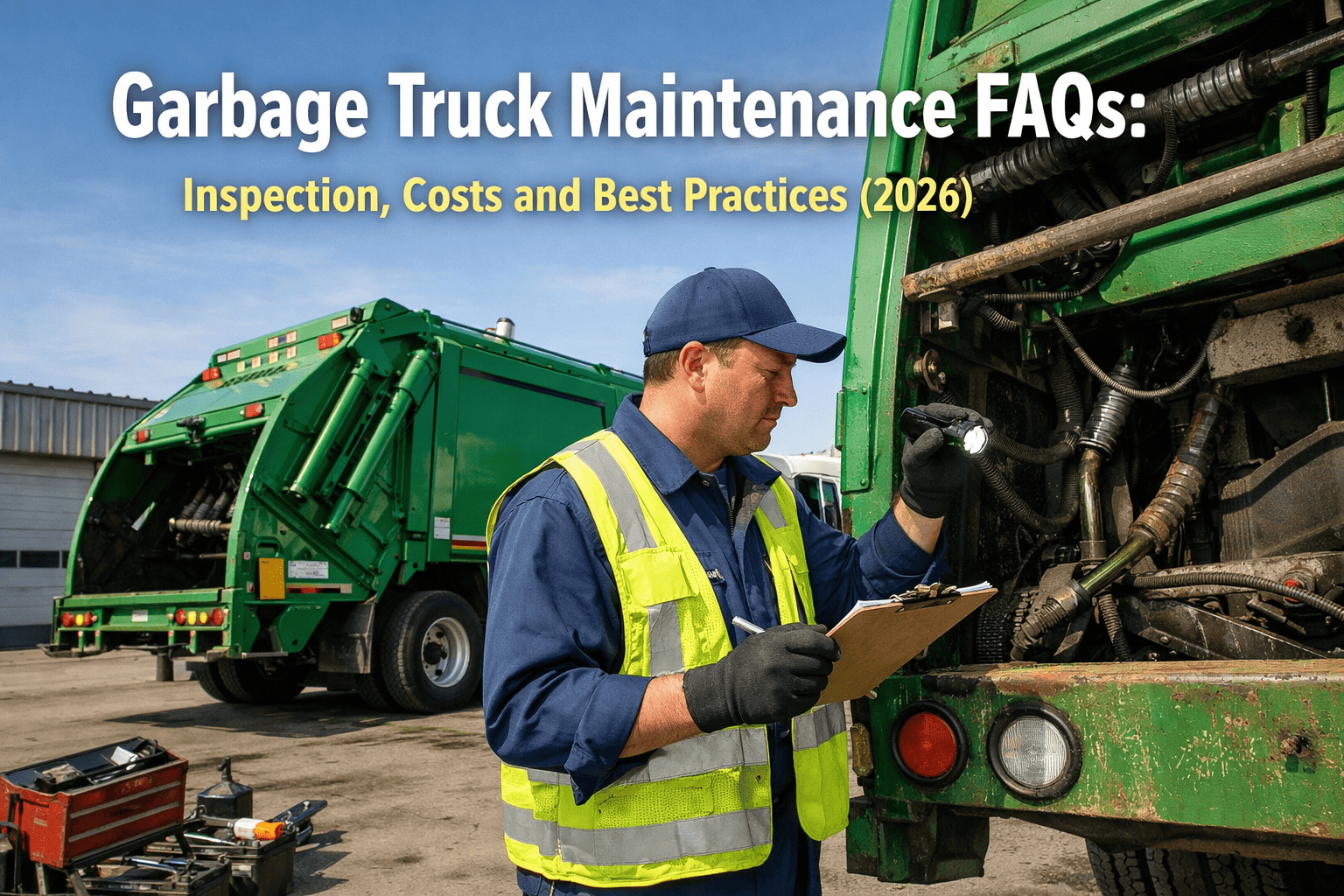
Digital DVIR (Driver Vehicle Inspection Report) replaces the traditional paper-based pre-trip and post-trip inspection process with a mobile app-driven workflow that's faster, more accurate, and creates an auditable digital record. For waste vehicles specifically, the inspection requirements go far beyond what a standard commercial truck needs because garbage trucks have complex hydraulic, compactor, and lifting systems that must be inspected before every shift. Here's how a digital DVIR works in practice for a waste fleet. Before the shift starts, the driver opens the FleetRabbit or HVI mobile app and selects their assigned vehicle. The app automatically loads the correct inspection checklist for that vehicle type — a rear-loader gets different items than a roll-off truck or a street sweeper. For a typical rear-loader, the inspection covers standard CDL items (brakes, tires, lights, mirrors, wipers, horn, emergency equipment) plus waste-specific items: hydraulic fluid level and leak check, compactor blade condition and movement test, hopper area for damage or obstructions, packer panel operation and safety interlocks, body lift cylinders and mounting hardware, tailgate latch mechanism and seal integrity, residential cart tipper arm operation and grip pads, backup camera and proximity sensors, and body/frame for corrosion or structural cracks. For each item, the driver taps pass, fail, or needs attention. Failed items can include photo documentation — a driver photographs a hydraulic leak, cracked lift arm, or damaged compactor blade, which attaches to the inspection record with GPS coordinates and timestamp. This visual evidence eliminates the "he said, she said" disputes that plague paper inspections and gives technicians diagnostic information before the truck even arrives at the shop. Critical defects (brake failure, hydraulic system leak, safety interlock malfunction) trigger automatic escalation — the fleet manager, dispatcher, and maintenance supervisor are instantly notified, and the system can prevent the truck from being dispatched until the defect is resolved. This is crucial for DOT compliance, where operating a vehicle with known critical defects carries significant penalties. The entire process takes under 5 minutes on a mobile device compared to 15-20 minutes for paper inspections. Over a fleet of 50 drivers, that's 8-12 hours of saved labor per day — plus the elimination of illegible handwriting, lost forms, and the filing/storage burden of thousands of paper inspections. All inspection data flows into the fleet management system, where it feeds predictive maintenance algorithms. If the same hydraulic item is marked "needs attention" on three consecutive inspections, the system automatically generates a work order — catching the problem before it becomes a breakdown.
What compliance and safety regulations must waste fleet software support?
Waste fleet operations fall under a complex web of federal, state, and local regulations that fleet management software must help track and enforce. Failure to maintain compliance can result in fines, contract penalties, operational shutdowns, and significant liability exposure. DOT/FMCSA regulations apply to waste collection vehicles just as they do to any commercial motor vehicle. This includes Hours of Service (HOS) compliance tracked through ELDs (electronic logging devices), pre-trip and post-trip DVIR requirements under 49 CFR 396.11, annual vehicle inspections and documentation, CDL driver qualification file management, and drug/alcohol testing program record-keeping. Platforms like Motive and Samsara include integrated ELD modules, while FleetRabbit's digital DVIR system specifically satisfies the inspection documentation requirements with timestamp-verified, GPS-located, photo-documented records that hold up to DOT audit. OSHA regulations are particularly stringent for waste operations due to the industry's high injury rate. Waste collection consistently ranks among the most dangerous occupations in America. Software should support safety training documentation and certification tracking, incident reporting and investigation workflows, vehicle safety equipment inspection verification (backup cameras, proximity alarms, strobe lights), PTO lockout/tagout procedures for hydraulic systems, and confined space entry protocols for landfill and transfer station equipment. EPA regulations affect waste fleets in several ways: emissions compliance for diesel trucks (particularly DPF and SCR system monitoring), hazardous waste manifesting and chain-of-custody documentation for certain waste streams, stormwater management and spill prevention at maintenance facilities and transfer stations, and emerging PFAS regulations that affect both waste handling and landfill operations. The North America solid waste management market is increasingly shaped by EPR (Extended Producer Responsibility) statutes like California's SB 54, which create reporting requirements that waste haulers must support with accurate data. Municipal franchise agreements often impose additional requirements beyond federal and state regulations: service level agreements (95%+ on-time collection), diversion rate targets for recycling and composting programs, fleet emissions standards (some cities mandate CNG or electric trucks), noise restrictions (collection hours limited in residential areas), and detailed reporting on tonnage by waste stream, route performance, and customer complaints. Software that automates compliance reporting — pulling data from DVIRs, telematics, route completion records, and scale house weights into formatted reports — saves dozens of administrative hours per month and dramatically reduces the risk of missed deadlines or inaccurate submissions that trigger regulatory penalties.
How do I implement waste fleet management software without disrupting operations?
Implementing new fleet management software in a waste operation that runs 6-7 days a week with zero tolerance for service disruption requires careful planning and a phased approach. Rushing a full deployment across every truck and driver simultaneously is the most common cause of implementation failure. Phase 1: Pilot group (2-4 weeks). Start with 3-5 trucks and your most tech-friendly drivers. Install hardware (GPS devices, cameras, RFID readers as applicable) and configure the software with your specific vehicle types, inspection checklists, and route data. Run the new system alongside your existing processes — drivers complete both paper and digital inspections during this phase. This parallel operation validates that the software captures everything your operation needs before you eliminate the old system. FleetRabbit's approach is particularly well-suited for this phase because it requires no hardware installation — drivers download the mobile app and start inspecting immediately. Phase 2: Expand and customize (2-4 weeks). Based on pilot feedback, refine inspection checklists (add waste-specific items your drivers identified as missing), adjust maintenance alert thresholds, and configure escalation rules. Expand to 15-25% of the fleet. Train maintenance technicians on the work order system. Begin importing historical maintenance records so the system has baseline data for predictive analytics. Phase 3: Full rollout (4-8 weeks). Deploy across the remaining fleet in waves — typically one depot or operational division at a time. Designate "super users" at each location who can assist struggling drivers. Transition fully away from paper processes once each wave has demonstrated proficiency. Set up dashboards for managers and integrate with existing telematics, billing, and ERP systems. Phase 4: Optimization (ongoing). With 2-3 months of operational data, begin leveraging analytics: identify trucks with highest maintenance costs, routes with worst fuel efficiency, drivers with the most inspection failures, and parts with shortest life cycles. This data-driven refinement phase is where the real ROI compounds. Critical success factors include executive sponsorship (drivers won't adopt new tools if supervisors don't enforce usage), adequate training time (15-30 minutes per driver for basic DVIR apps, 2-4 hours for comprehensive platforms), mobile device availability (company-provided tablets or BYOD policy with the app), and cellular/WiFi coverage at depots and along routes. The biggest risk factor is trying to change too many things simultaneously. If you're implementing new DVIR software, new route optimization, and new billing at the same time, the combined change management burden will overwhelm your team. Prioritize the highest-impact pain point first — for most waste fleets, that's either maintenance/inspection (reducing breakdowns) or routing (reducing fuel/labor costs) — and build from there.
Start With What Matters Most: Keeping Trucks Running
For most waste fleets, unplanned breakdowns are the #1 cost driver. FleetRabbit's digital DVIRs and predictive maintenance catch problems before they strand a truck — no contracts, no hardware required.