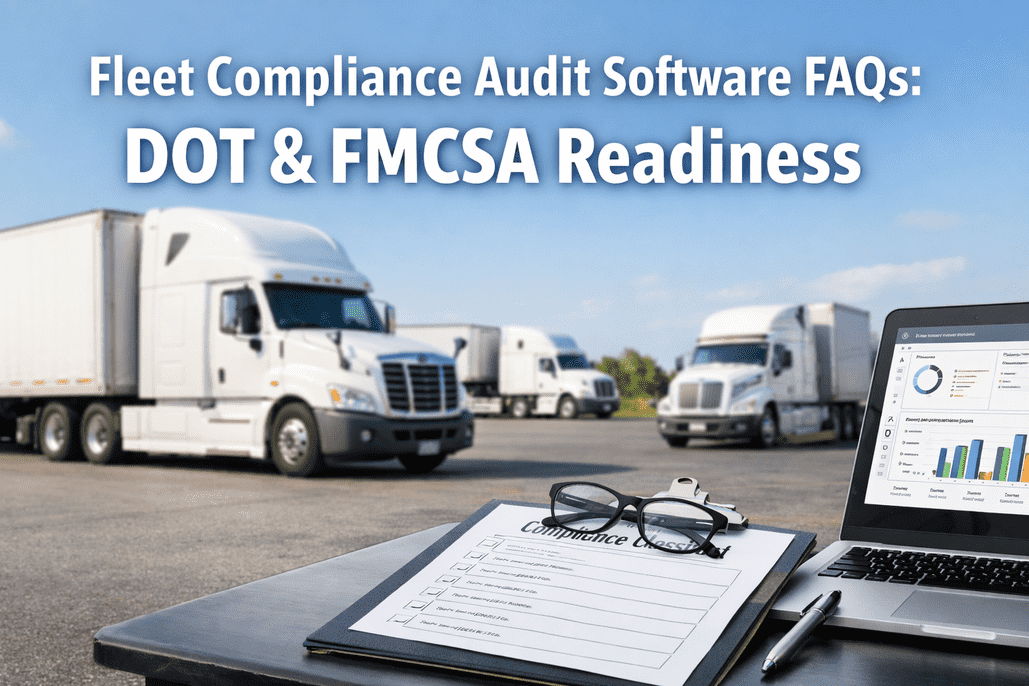
Only 7% of motor carriers pass DOT audits without a single violation — and the remaining 93% face fines averaging over $5,000 per case, out-of-service orders, or worse. In 2026, FMCSA enforcement is intensifying with an overhauled CSA scoring system, stricter Drug and Alcohol Clearinghouse enforcement, removed ELD devices requiring immediate replacement, and new electronic DVIR clarifications. A single compliance gap can trigger fines up to $19,277 for operating an out-of-service vehicle, CDL revocations, and devastating impacts on insurance rates and shipper relationships. This FAQ guide answers the most common fleet compliance and DOT audit questions so you can identify gaps before an auditor does. Sign up for FleetRabbit to digitize inspections, maintenance records, and compliance documentation in one audit-ready platform.
Frequently Asked Questions
What exactly is a DOT audit and what does FMCSA look for?
A DOT audit is a formal review conducted by the Federal Motor Carrier Safety Administration (FMCSA) to determine whether a motor carrier is meeting federal safety and compliance standards. During an audit, investigators request and examine specific compliance documents across multiple safety categories — and missing or incomplete records in any critical area can result in fines, downgraded safety ratings, or loss of operating authority.
Types of DOT Audits
New Entrant Safety Audit
Conducted within first 12 months of activating authority. Verifies basic safety systems are in place: driver qualification, drug/alcohol testing, HOS/ELD, maintenance, insurance, and accident tracking. Failing can trigger corrective action or put your authority at risk.
Compliance Review
In-depth investigation examining all safety systems. Common triggers include poor SMS scores, high crash rates, high-profile accidents, or citizen complaints. Results in safety rating: Satisfactory, Conditional, or Unsatisfactory.
Focused Investigation
Targets specific compliance areas flagged by data — such as HOS patterns, vehicle maintenance gaps, or drug/alcohol testing deficiencies. Narrower scope than full compliance review but can still result in penalties.
Six Compliance Zones Auditors Examine
Driver Qualification Files (DQF)
Applications, MVRs, medical certificates, road test documentation, employment history verification. Missing DQF documents account for nearly 12% of all FMCSA violations.
Hours of Service / ELD Records
ELD data integrity, RODS accuracy, supporting documents (BOLs, fuel receipts, toll records). Must retain ELD records and backup for 6 months.
Vehicle Inspection and Maintenance
DVIRs, annual periodic inspections (49 CFR 396 Appendix A), repair documentation, and defect-to-repair closure loop. Largest violation category by volume.
Drug and Alcohol Testing / Clearinghouse
Pre-employment, random, post-accident, and reasonable-suspicion testing. Clearinghouse queries now required before CDL issuance/renewal. Violations cost up to $5,833 per occurrence.
Insurance and Authority Filings
Active insurance filings, BOC-3 process agent designation, UCR registration, MCS-150 biennial updates. Operating without required insurance is a critical failure point.
Accident Register and Safety Policies
Must maintain accident register even with zero crashes. Written safety policies, driver training records, and hazmat documentation (if applicable).
Auditors typically start with three critical piles: HOS/ELD records, the driver qualification file with renewals and queries, and inspection-to-repair documentation that shows defects actually got fixed. Carriers that can pull these records within five minutes demonstrate the systematic compliance auditors want to see. Schedule a FleetRabbit demo to see how digital compliance management works.
What are the most common DOT violations and how much do they cost?
Through June 2025, FMCSA conducted 8,340 investigations resulting in over 50,000 violations. Understanding which violations occur most frequently — and the financial penalties they carry — helps fleet managers prioritize compliance efforts where they matter most:
The financial impact extends well beyond the fine itself. Carriers with a Conditional safety rating receive higher insurance rates, are paid less by brokers, get restricted loads, and lose quality driver applicants. On average, motor carriers paid over $27 million in fines collectively each year, with the average fine per case exceeding $5,000. It typically takes 20 clean inspections to offset the CSA impact of one bad inspection.
What documents must be in a Driver Qualification File (DQF)?
Driver Qualification Files are the foundation of fleet compliance — and the area where carriers most frequently fail audits. Over the past five years, FMCSA investigators issued more than 62,000 DQF-related violations, making file issues one of the most common and most preventable compliance problems. Here's exactly what goes in each file:
Required DQF Documents (49 CFR §391.51)
Carriers using digital compliance platforms can pull complete DQF documentation in under 90 seconds — compared to the hours-long scramble common with paper-based systems. Sign up for FleetRabbit to organize inspections, maintenance records, and compliance documentation in one searchable, audit-ready system.
What is changing with CSA scores in 2026 and how does it affect my fleet?
The CSA Safety Measurement System is undergoing its most significant overhaul since 2010, with full enforcement beginning February 2026. These changes fundamentally restructure how carriers are scored, prioritized for interventions, and evaluated by shippers and insurers:
Major CSA Overhaul Changes (February 2026)
BASICs Reorganized into Compliance Groups
The traditional 7 BASIC categories are being restructured. Controlled Substances/Alcohol violations are absorbed into Unsafe Driving. Vehicle Maintenance splits into two categories: standard maintenance and "Driver Observed" violations detectable during walk-around inspections.
Severity Weighting Simplified
FMCSA replaced the complex 1-10 severity scale with a two-tier system: Out-of-Service violations receive weight of 2, all other violations receive weight of 1. Simpler but potentially more impactful per OOS event.
Violation Codes Consolidated
Over 2,000 individual violation codes consolidated into approximately 100 broader violation groups. Makes scoring more predictable but means individual violations may impact scores differently than before.
Percentile Smoothing Introduced
New median benchmarks prevent sudden percentile jumps when carriers move between safety event groups. Aims to make scoring more stable and fair for carriers with changing fleet sizes.
Why CSA Scores Matter for Your Bottom Line
How should carriers prepare for a DOT audit?
The key principle of audit preparation is simple: if you can't produce the document within five minutes, it might as well not exist. Carriers that build compliance into daily operations — rather than scrambling when an audit is announced — consistently outperform those that treat compliance as a periodic exercise.
Audit Preparation Action Plan
Conduct a Mock Audit
Walk through every compliance zone as an auditor would. Pull DQF files randomly — can you locate all required documents within 48 hours? Check ELD data against supporting documents. Verify every vehicle has current annual inspection documentation and DVIR-to-repair closure proof.
30-Minute Compliance Sweep
Review driver records for expiring medical certificates or CDLs. Check that DVIRs are being completed and defects have documented repairs. Verify ELD data accuracy. This single habit prevents most audit failures.
Check CSA SMS Dashboard
Review your Safety Measurement System scores monthly (updated by FMCSA monthly). Challenge any incorrect inspection data through the DataQs dispute process with clear evidence: ELD records, photos, witness accounts.
Full Internal Mock Audit
Conduct comprehensive quarterly mock audits covering all six compliance zones. Verify drug/alcohol testing rates meet minimums (50% for drugs, 10% for alcohol annually). Confirm Clearinghouse queries are current for all CDL drivers.
Calendar-Year Renewals and Reviews
Complete UCR registration by December 31. Conduct annual MVR reviews for all drivers. Verify MCS-150 biennial update. Ensure all vehicles have current annual periodic inspections. Review and update written safety policies.
What are the critical failure points that will automatically fail a DOT audit?
Some compliance gaps are considered so serious that they trigger automatic audit failure — even if everything else looks perfect. Understanding these critical failure points is essential:
Automatic Audit Failure Triggers
No DOT Drug/Alcohol Testing Program
If you cannot prove enrollment in a compliant DOT drug/alcohol program and aren't running required Clearinghouse queries, the audit fails immediately.
Missing Vehicle Inspection/Maintenance Files
No proof of regular inspections, repairs, or maintenance. Missing DVIRs or maintenance records are the most common failure point across all audit types.
No Accident Register
You must maintain an accident register on file — even if you've had zero crashes. The register should show "none" for the required period if no accidents occurred.
Operating Without Required Insurance
If insurance filings aren't active or you can't prove required coverage under your authority, the audit cannot be passed regardless of other compliance areas.
Beyond automatic failures, auditors pay special attention to the inspection-to-repair loop: a DVIR noting a defect should connect to a work order, the corrective action, and a sign-off before the unit returns to service. The next driver's pre-trip should show they reviewed the prior report. Closing this loop is what prevents repeat defects at roadside inspections. FleetRabbit's digital DVIR system automatically creates this documentation chain — from defect identification to repair verification to driver acknowledgment.
What new FMCSA regulations should fleet managers watch in 2026?
The regulatory landscape is shifting significantly, with over 40 trucking-related rules in FMCSA's pipeline. Here are the changes most likely to impact fleet operations:
Key 2026 Regulatory Developments
CSA Safety Measurement System Overhaul
Full enforcement February 2026. Reorganized compliance groups, simplified severity weighting, consolidated violation codes. Carriers must understand how their scores will shift under the new methodology.
ELD Device Removals
PSS ELD, Black Bear ELD, and RT ELD Plus removed as of December 2025. Carriers must replace by February 2026 or face ELD non-compliance violations at roadside inspections.
Data-Driven Safety Ratings
FMCSA considering shift from current Satisfactory/Conditional/Unsatisfactory system to continuous, data-driven safety ratings using inspection, violation, and crash data. Accuracy of carrier data becomes critical.
CDL Training and Qualification Crackdowns
Nearly 3,000 training providers removed from the Training Provider Registry and 4,500+ under investigation. New carriers may face higher barriers to entry by May 2026.
ELD Technical Modifications
FMCSA planning "technical modifications" and "streamlining" of ELD rules, plus eliminating requirement to carry ELD user manuals in-cab. Could require hardware/software upgrades.
Automated Driving System Maintenance Standards
By May 2026, FMCSA expects to propose inspection, repair, and maintenance standards for automated driving systems — potentially one of the most transformative trucking regulations of the decade.
The clear theme across all 2026 regulatory actions: compliance is going digital, enforcement is getting smarter, and carriers invested in electronic fleet management systems will have a competitive advantage. As one industry analyst noted, "carriers that treat 2026 as a planning year, not a waiting year, will be best positioned to stay compliant, control costs, and avoid disruption." Schedule a call with FleetRabbit to build your 2026 compliance strategy.