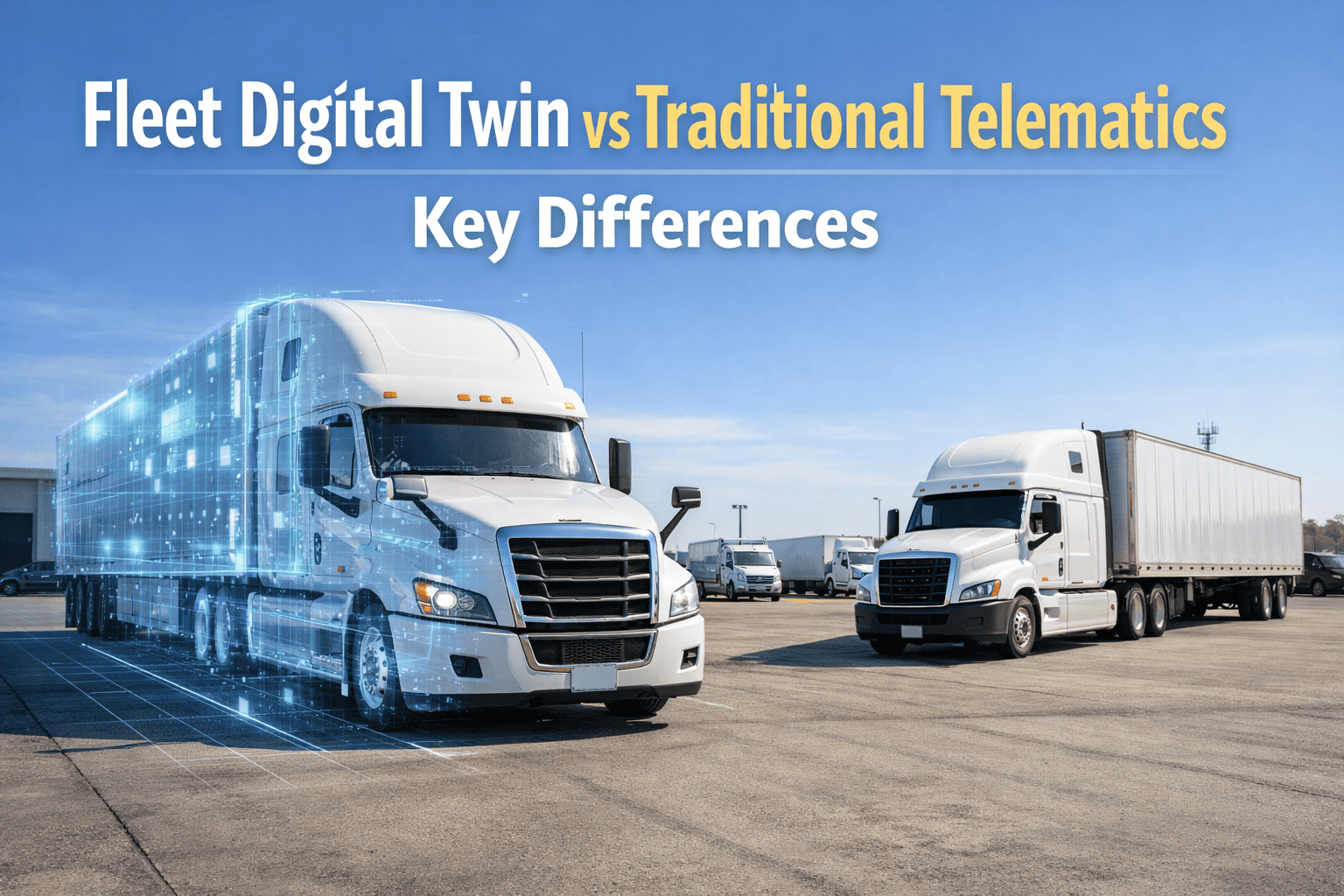
Traditional telematics tells you where your trucks are and how fast they're going. Digital twins tell you why Vehicle #47 will need a transmission repair in 6 weeks, which route configuration will save $127,000 in fuel next quarter, and what happens to your delivery times if you add 5 vehicles to the Denver hub. The difference isn't incremental it's the gap between a rearview mirror and a crystal ball. While telematics revolutionized fleet visibility over the past two decades, digital twin technology represents the next evolutionary leap: from passive monitoring to active simulation, from reactive alerts to predictive intelligence, from tracking what happened to modeling what will happen. Sign up for FleetRabbit to experience next-generation fleet intelligence today.
Beyond Tracking: Intelligence That Predicts and Optimizes
FleetRabbit combines digital twin technology with practical fleet management — giving you predictive maintenance, simulation capabilities, and operational intelligence that traditional telematics can't match.
Frequently Asked Questions
What is the fundamental difference between digital twins and telematics?
The core difference is architectural: telematics is a data collection and reporting system, while a digital twin is a living simulation that models, predicts, and optimizes. Telematics answers "what is happening?" Digital twins answer "what will happen, why, and what should we do about it?"
Fundamental Architecture Comparison
Traditional Telematics
Data flow: One-way collection from vehicle to dashboard. GPS coordinates, speed, fuel levels, and engine codes stream to a central system for display and basic alerting.
Intelligence: Rule-based alerts (speed > 70mph = notification). Historical reporting on past events. No predictive capability beyond simple trending.
Scope: Individual vehicle monitoring. Each truck is a separate data stream with limited cross-fleet analysis.
Digital Twin Platform
Data flow: Bidirectional integration across all systems. Telematics data feeds the twin, but so does maintenance history, route data, weather, traffic, driver behavior, and external factors.
Intelligence: AI/ML-powered simulation and prediction. The twin models vehicle behavior physics to predict failures, optimize routes, and simulate scenarios before execution.
Scope: Holistic fleet ecosystem. Every vehicle, driver, route, and external factor exists as an interconnected digital model.
How Each Technology Processes Information
Telematics: Observe → Report → Alert
Sensors collect data → System displays current state → Rules trigger alerts when thresholds are crossed. The process is reactive: something happens, then you find out about it. Analysis is backward-looking, showing what occurred.
Digital Twin: Observe → Model → Simulate → Predict → Optimize
All data feeds a physics-based simulation → AI continuously updates the model → System runs scenarios to predict outcomes → Recommendations optimize future operations. The process is proactive: the twin anticipates problems and opportunities before they materialize.
What can digital twins do that telematics cannot?
Digital twins unlock capabilities that are architecturally impossible with traditional telematics — not because telematics vendors haven't thought of them, but because the underlying technology cannot support simulation, prediction, and virtual testing at the level digital twins enable.
Exclusive Digital Twin Capabilities
Predictive Component Failure
Digital twins model the physics of component wear — not just "engine hours > 5000 = check engine" but "this specific transmission's vibration signature combined with load history and thermal patterns indicates 78% probability of failure within 6 weeks." Telematics can tell you a code was thrown; digital twins tell you when the code will be thrown.
What-If Scenario Simulation
Before making any operational change, run it through the digital twin first. "What happens to fuel costs if we shift Denver deliveries to night hours?" "How does adding 3 trucks affect route efficiency?" "What's the impact of the new I-70 construction on our Colorado network?" Telematics shows you the results after you've made the change; digital twins show you before.
Cross-System Optimization
Digital twins model the entire operational ecosystem — vehicles, drivers, routes, maintenance, fuel, weather, traffic, customer requirements — as an interconnected system. Optimization considers all variables simultaneously. Telematics optimizes in silos: route software doesn't know about maintenance schedules, maintenance systems don't know about delivery commitments.
Continuous Learning & Adaptation
Every mile driven, every repair completed, every route deviation feeds back into the digital twin, continuously improving its predictive accuracy. The system gets smarter every day. Telematics rules stay static until someone manually updates thresholds — they don't learn from outcomes.
Virtual Vehicle Testing
Test new vehicles, routes, or operational procedures in the digital environment before committing resources. "How would electric trucks perform on our mountain routes?" Run the simulation with your actual route data, load profiles, and weather patterns. Telematics requires real-world trials with real-world costs and risks.
Root Cause Analysis
When problems occur, digital twins trace causality across the entire system. "Fuel costs increased 12% last month — why?" The twin identifies that 3 vehicles had degraded injectors causing 8% efficiency loss, route changes added 4% miles, and driver behavior changes accounted for the remainder. Telematics shows the symptom; digital twins diagnose the disease.
How do the data requirements differ between telematics and digital twins?
Telematics operates on a relatively narrow data stream — primarily GPS and basic engine diagnostics. Digital twins are data-hungry systems that integrate information from every available source to build comprehensive operational models. The difference in data scope directly translates to the difference in insight depth.
Data Source Comparison
Traditional Telematics Data
- GPS location (lat/long coordinates)
- Vehicle speed and heading
- Engine hours and odometer
- Basic OBD-II diagnostic codes
- Fuel level percentage
- Ignition on/off status
- Hard braking/acceleration events
- Idle time duration
~15-20 data points per vehicle, updated every 30-120 seconds
Digital Twin Data Ecosystem
- All telematics data (foundation layer)
- Complete maintenance history & parts data
- Driver behavior patterns & performance
- Route geometry, elevation, road conditions
- Weather data (historical & forecast)
- Traffic patterns (real-time & predictive)
- Load/cargo weight and distribution
- Fuel purchase and consumption details
- Customer delivery requirements & SLAs
- Tire pressure, temperature, wear patterns
- Component-level sensor data (vibration, thermal)
- External market data (fuel prices, regulations)
100+ data points per vehicle, continuous streaming with historical context
Why More Data Matters:
- Context enables prediction — Knowing that engine temperature is 210°F means nothing alone. Knowing it's 210°F while climbing a 6% grade, with a 42,000 lb load, in 95°F ambient temperature, after the cooling system was serviced 3 months ago — that's predictive intelligence
- Patterns emerge from breadth — Digital twins identify that vehicles serviced at Shop A have 23% more repeat repairs than Shop B. Telematics doesn't track service quality.
- Optimization requires completeness — You can't optimize fuel costs without understanding route elevation, load weight, traffic timing, and driver behavior simultaneously. Telematics provides pieces; digital twins provide the puzzle.
- Simulation demands fidelity — Accurate "what-if" scenarios require modeling reality with precision. The more data points feeding the twin, the more reliable the predictions.
What's the ROI difference between telematics and digital twin investments?
Telematics ROI is well-documented after two decades of industry adoption — typically 10-15% operational cost reduction through better visibility and basic optimization. Digital twin ROI builds on this foundation but unlocks additional value layers that telematics cannot access, typically delivering 3-5x the return of telematics-only implementations.
ROI Comparison — 100-Vehicle Fleet Annual Impact
Telematics-Only Implementation
Digital Twin Implementation
Where Digital Twin ROI Comes From:
- Predictive maintenance — Catching failures before they happen eliminates roadside breakdowns ($2,500+ per incident), reduces repair costs by 25-40% through planned vs. emergency service, and extends component life by optimizing operating conditions
- Advanced route optimization — AI-powered routing that considers vehicle condition, driver capability, traffic prediction, and delivery windows simultaneously delivers 15-25% greater fuel savings than GPS-based routing alone
- Reduced unplanned downtime — Digital twins reduce unplanned maintenance events by 35-50%. For a truck earning $800/day, each prevented breakdown day = $800 preserved revenue
- Asset lifecycle extension — Optimized operating conditions extend vehicle useful life by 15-20%, deferring $150,000+ replacement costs per truck
- Decision accuracy — Simulation prevents costly mistakes. One avoided bad decision on fleet expansion, route restructuring, or vendor selection can pay for the entire platform
Can digital twins work with existing telematics systems?
Yes — digital twins are designed to layer on top of existing telematics infrastructure, not replace it. Your current GPS tracking, ELD compliance, and basic diagnostics continue functioning while the digital twin adds prediction, simulation, and optimization capabilities. This architectural approach protects your telematics investment while unlocking new value.
Integration Architecture
API Integration
Digital twin platforms connect to your existing telematics via standard APIs. Geotab, Samsara, Verizon Connect, Omnitracs, and other major providers all offer API access that digital twins consume. No hardware changes required — your existing devices continue transmitting; the data now feeds both systems.
Data Lake Architecture
Digital twins aggregate data from multiple sources into a unified data lake. Your telematics data joins maintenance records, fuel card transactions, HR driver data, and external feeds. The twin accesses this consolidated view — something no single telematics platform provides alone.
Complementary Dashboards
Many operations keep telematics dashboards for real-time dispatch and ELD compliance while using digital twin interfaces for strategic planning, predictive analytics, and simulation. The tools serve different purposes and coexist in the technology stack.
Gradual Enhancement
Start with core digital twin capabilities — predictive maintenance and basic simulation — then expand to advanced optimization as the organization matures. The platform grows with your needs without requiring telematics replacement at any stage.
Upgrade Your Fleet Intelligence — Keep Your Telematics
FleetRabbit integrates with your existing telematics to add digital twin capabilities — predictive maintenance, simulation, and AI-powered optimization. No rip-and-replace required.
How does predictive maintenance differ between the two systems?
This is where the gap between telematics and digital twins becomes most dramatic. Telematics-based maintenance is fundamentally reactive or interval-based. Digital twin maintenance is truly predictive — understanding the physics of wear and forecasting failures before symptoms appear.
Maintenance Approach Comparison
Telematics: Reactive Alerts
How it works: Engine throws a fault code → Telematics displays the code → You react by scheduling service.
The problem: By the time a code appears, damage has often already occurred. A P0300 misfire code means cylinders are already misfiring — the preventable failure window has closed.
Result: You're always chasing problems that have already started. Maintenance is reactive even when dressed up as "proactive monitoring."
Digital Twin: True Prediction
How it works: The twin models component wear physics → Continuously updates degradation curves from sensor data → Predicts failure probability windows → Schedules service before symptoms appear.
The advantage: "Injector #3 shows 12% flow degradation trending toward misfire threshold. At current trajectory, P0303 will occur in 2,400 miles. Recommend service within 2 weeks."
Result: You prevent failures rather than respond to them. Service happens when convenient and cost-effective, not when roadside breakdowns force your hand.
Predictive vs. Reactive Maintenance — Cost Per Incident
Digital twins prevent 35-50% of unplanned breakdowns. For a 100-vehicle fleet with 2 breakdowns/vehicle/year, that's 70-100 prevented incidents = $217,000-$310,000 annual savings.
What simulation capabilities do digital twins provide?
Simulation is the digital twin's superpower — the ability to test scenarios virtually before committing real resources. This capability has no equivalent in traditional telematics, which can only observe reality, not model alternatives to it.
Digital Twin Simulation Use Cases
Fleet Expansion Planning
"We're considering adding 10 trucks to the Phoenix hub. What's the optimal vehicle mix? Where should they be deployed? What's the true cost impact including maintenance, fuel, and driver requirements?" The digital twin simulates the expansion with your actual route data, customer patterns, and operational constraints — showing ROI projections before you sign purchase orders.
Route Network Redesign
"What if we consolidated the Denver and Colorado Springs operations into a single hub?" Simulate the combined network: delivery time impacts, fuel cost changes, driver schedule implications, customer service effects. Identify the optimal configuration before disrupting current operations.
Electrification Planning
"Which routes are viable for electric trucks today? Where do we need charging infrastructure? What's the true TCO comparison?" The twin models your actual routes with real load profiles, elevation changes, and temperature variations — far more accurate than generic EV range calculators.
Disruption Response
"Major I-25 closure expected for 6 months. How do we adapt?" Simulate alternate routing strategies, identify impacted customers, calculate cost increases, and develop mitigation plans — all before the construction starts.
Contract Bidding
"A new customer wants dedicated service to 47 locations. Can we serve them profitably at the proposed rate?" Model the new routes integrated with existing operations, identify capacity constraints, calculate true costs, and bid with confidence backed by simulation data.
Workforce Planning
"What's the impact of the new HOS regulations? How many additional drivers do we need? What's the optimal shift structure?" Simulate regulatory scenarios against your actual operation to plan proactively rather than react desperately.
How do alerting and notification systems compare?
Telematics alerts are threshold-based: "If X exceeds Y, send notification." Digital twin alerts are context-aware and predictive: "Given the full operational context, here's what you should know and why it matters."
Alert System Evolution
Telematics Alerts
Alert: "Vehicle #47 - Engine Temperature High (220°F)"
What's missing: Is this dangerous or normal for the conditions? Should the driver pull over? Is there underlying mechanical failure? What's the right action?
Typical response: Dispatcher calls driver, driver doesn't know what to do, truck may or may not need service, everyone's stressed.
Digital Twin Intelligence
Alert: "Vehicle #47 - Engine temp 220°F climbing 6% grade with 38,000 lb load in 92°F ambient. Within normal parameters for conditions. Cooling system performing as expected. No action required. Temp will normalize within 4 miles at grade crest."
Alternative scenario: "Vehicle #47 - Engine temp 220°F on flat terrain, light load, 72°F ambient. ABNORMAL. Coolant flow degradation detected. Recommend immediate pull-over and inspection. Nearest safe stop: Exit 147 truck stop, 2.3 miles. Service request auto-generated."
Result: Right action, right time, full context. No unnecessary panic, no missed critical issues.
What's the implementation timeline difference?
Telematics implementation is relatively quick — install hardware, configure dashboards, train users. Digital twin implementation involves deeper integration but follows a phased approach that delivers value incrementally while building toward full capability.
Implementation Timeline Comparison
Telematics Deployment
Full deployment: 4-6 weeks. Value realization: Immediate visibility, 3-6 months for measurable ROI.
Digital Twin Deployment
Phased deployment: 3-6 months for full capability. Value realization: Incremental from Month 2, full ROI by Month 6-12.
When should a fleet upgrade from telematics to digital twin?
Not every fleet needs a digital twin today. The technology delivers maximum value when certain operational conditions exist — but fleets that do match the profile see transformative results. Here's how to assess readiness.
Digital Twin Readiness Assessment
Strong Candidates for Digital Twin
- Fleet size 50+ vehicles (economies of scale)
- High asset value (trucks $150K+, specialized equipment)
- Complex operations (multi-hub, varied routes, diverse cargo)
- Maintenance-intensive vehicles (refrigeration, hydraulics, PTOs)
- Tight service SLAs with penalty clauses
- Already using telematics successfully
- Executive support for data-driven transformation
- Planning major changes (electrification, expansion, restructuring)
May Want to Wait
- Fleet under 25 vehicles (ROI harder to justify)
- Simple, repetitive operations (fixed routes, standard cargo)
- Low-value assets where replacement is easier than optimization
- No current telematics foundation to build on
- Organizational resistance to technology adoption
- Limited IT resources for integration
- No near-term major operational decisions pending
Signals You've Outgrown Telematics-Only:
- You're making decisions on gut feel — If fleet expansion, route changes, or vendor selections happen without data-driven simulation, you're leaving money on the table
- Maintenance is still surprising you — If roadside breakdowns happen "unexpectedly" despite telematics, you need predictive capability
- You can't answer "what if" — When leadership asks about electrification feasibility or acquisition integration, and you can't model the scenarios, that's a digital twin gap
- Optimization feels maxed out — If telematics-driven improvements have plateaued and you need the next level of efficiency gains
- Complexity is overwhelming — If the interaction between routes, maintenance, drivers, and external factors is too complex for human planners to optimize
What KPIs differentiate telematics from digital twin performance?
Telematics and digital twins track different types of metrics because they operate at different levels of intelligence. Telematics excels at operational visibility metrics; digital twins add predictive and optimization metrics that telematics cannot measure. Sign up for FleetRabbit to start tracking next-generation fleet KPIs:
KPI Capability Comparison
The KPIs That Matter Most:
- Prediction Accuracy — Digital twins should achieve 85%+ accuracy on 30-day failure predictions. Track this to validate the system is learning your fleet's patterns.
- Prevented Breakdowns — Count roadside failures before and after digital twin implementation. Target: 35-50% reduction in Year 1.
- Decision Accuracy — Track how often simulation recommendations match real-world outcomes. This builds organizational confidence in data-driven decisions.
- Time to Insight — How long does it take to answer complex questions? Digital twins should answer in minutes what previously took days of analysis.
- Optimization Capture Rate — What percentage of identified optimization opportunities are actually implemented? Low rates indicate organizational adoption issues, not technology limitations.
Ready to Move Beyond Telematics?
FleetRabbit delivers digital twin capabilities that build on your existing telematics investment — predictive maintenance, simulation, and AI-powered optimization that transforms fleet operations from reactive to proactive.