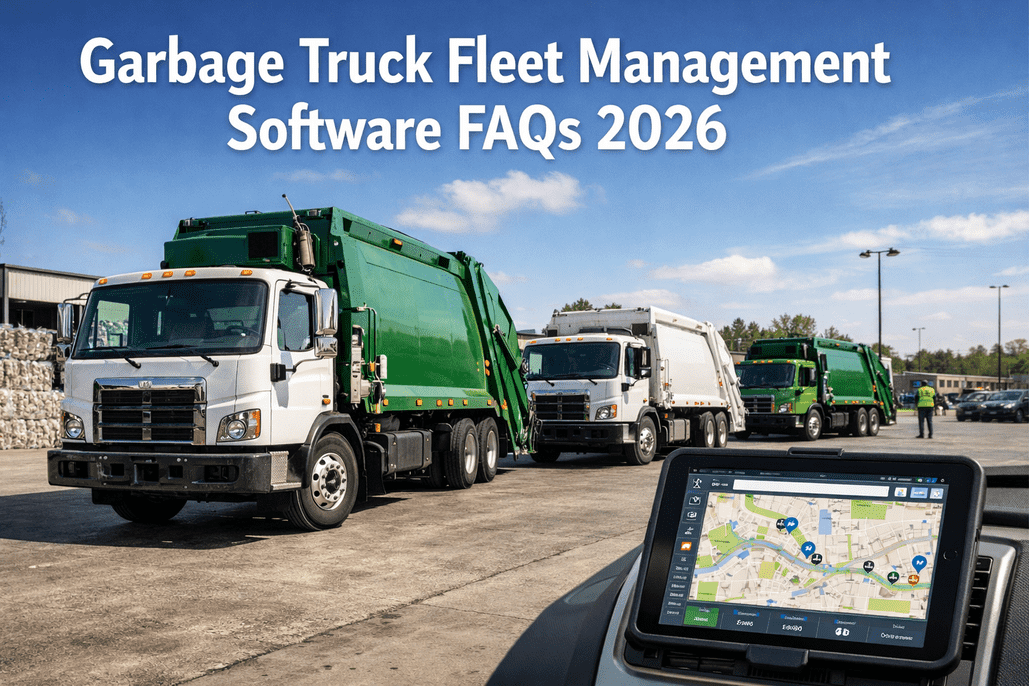
Garbage trucks are the least fuel-efficient vehicles on American roads — averaging just 2.5 miles per gallon according to the U.S. Department of Energy, with residential collection trucks often dropping to 1-3 MPG in stop-and-go service. A single refuse truck burns approximately 10,000 gallons of diesel per year, costing $35,000-$40,000 in fuel alone at 2026 prices. Multiply that across a fleet of 140,000 refuse trucks operating nationwide, and the fuel bill for America's garbage collection runs into the billions. This extreme fuel consumption, combined with punishing duty cycles that destroy brakes, hydraulics, and tires faster than any other commercial vehicle application, makes fleet management software essential for survival. The right platform reduces fuel costs by 15-30% through route optimization, cuts maintenance expenses by 20-35% with predictive scheduling, and eliminates the service failures that cost municipal contracts. Sign up for FleetRabbit to get started with digital DVIRs and maintenance management built for refuse fleets.
Purpose-Built for Refuse Fleets
FleetRabbit includes specialized DVIR checklists for rear loaders, front loaders, side loaders, roll-off trucks, and street sweepers — covering hydraulics, compactors, and lift mechanisms out of the box.
Frequently Asked Questions
What is garbage truck fleet management software?
Garbage truck fleet management software is a specialized technology platform designed to manage the daily operations of refuse collection vehicles — including route planning, GPS tracking, maintenance scheduling, driver management, fuel monitoring, and regulatory compliance. It differs from general fleet management software because it addresses challenges unique to waste collection: extreme stop-and-go duty cycles with 800-1,200 stops per shift, hydraulic compactor and lift arm monitoring, container tracking at the bin level, service verification proving each address was collected, and integration with waste-specific systems like scale houses, billing platforms, and municipal reporting portals.
Three Critical Operational Layers
Field Layer
Mobile apps for pre-trip inspections, turn-by-turn route navigation, service confirmation (marking each stop as completed, skipped, or blocked), and exception reporting with photo documentation. FleetRabbit's HVI platform delivers waste-specific DVIR checklists — rear loaders get packer panel and tipper arm items, roll-off trucks get cable and winch checks, street sweepers get brush and vacuum system items.
Operations Layer
Real-time fleet visibility — where every truck is, how far along its route, which trucks are running behind, and which have mechanical issues. When a truck breaks down at 10 AM with 400 stops remaining, the dispatcher redistributes work across available trucks within minutes.
Management Layer
Analytics including fuel cost per route, maintenance cost per vehicle, driver performance scores, on-time collection rates, and compliance documentation for DOT audits and municipal contract reporting.
The U.S. waste collection services industry reached $86.1 billion in 2026 across 19,829 businesses, while the global garbage truck market is valued at $15.9 billion and projected to hit $24.8 billion by 2035. As fleets modernize and municipalities demand more accountability, software adoption is shifting from optional to essential — particularly for operators competing for municipal contracts where service level agreements require digital proof of performance.
How does fleet software reduce fuel costs for garbage trucks?
Fuel is the single largest controllable expense for refuse fleets, and garbage trucks are the most fuel-inefficient vehicles in commercial transportation — averaging approximately 2.5 MPG according to the U.S. Department of Energy's Alternative Fuels Data Center. Residential collection trucks operating in dense stop-and-go patterns often achieve just 1-3 MPG, consuming roughly 10,000 gallons of diesel annually per vehicle. At $3.50-$4.00 per gallon in 2026, that's $35,000-$40,000 per truck per year. Fleet management software attacks fuel costs from multiple angles simultaneously.
Fuel Cost Reality Check — 50-Truck Refuse Fleet
How Software Reduces Fuel Costs
Route Optimization (20-30% Mile Reduction)
Waste-specific routing algorithms reduce total miles by sequencing stops to minimize deadheading, avoid unnecessary U-turns with 40-foot vehicles, balance routes by completion time, and account for service-side requirements (which side the bin is on), one-way streets, seasonal changes, and landfill/transfer station proximity when compactor bodies reach capacity.
Idle Time Management (50% of Operating Time)
Refuse trucks spend approximately 50% of operating time idling — at collection points, transfer stations, during breaks, and at traffic signals. At 0.8 gallons/hour of idling, a truck idling 4 hours per shift burns 3.2 gallons doing nothing. Software monitors idle events, alerts dispatchers, and generates driver-specific reports. Reducing idle from 50% to 35% on a 50-truck fleet saves 80,000+ gallons annually.
Driver Behavior Monitoring (30%+ Variance)
Research shows driver behavior accounts for 30%+ variance in fuel consumption between best and worst performers on identical routes. Aggressive acceleration, hard braking, excessive speed between stops, and improper engine braking increase fuel burn significantly. Driver scorecards and coaching feedback narrow this variance by 40-60%, delivering measurable fleet-wide savings.
Maintenance-Driven Optimization
Catches mechanical issues that degrade fuel economy — under-inflated tires, dirty air filters, malfunctioning fuel injectors, exhaust aftertreatment problems forcing the engine to run richer. A well-maintained truck at proper tire pressure can gain 3-8% fuel economy versus a neglected one.
Does the system support residential and commercial waste fleets?
Yes — modern garbage truck fleet management platforms handle both residential and commercial collection operations, though the operational requirements differ significantly. Effective software must accommodate both simultaneously, as most waste haulers serve both markets from the same fleet.
Residential vs. Commercial Operations
Residential Collection
High-frequency, low-revenue-per-stop routes where a single truck services 800-1,200 homes per shift. Fixed weekly or bi-weekly schedules with different collection streams (trash Monday, recycling Thursday, yard waste every other Wednesday). Service verification is critical — municipalities require proof every address was collected, and missed-pickup complaints must be resolved within hours. RFID bin-level tracking identifies which specific cart was serviced. Routing demands street-level optimization for cul-de-sacs, school zones with time restrictions, and seasonal changes like leaf collection.
Commercial Collection
Fewer stops (20-80 per route), larger containers (2-8 cubic yard dumpsters and 20-40 cubic yard roll-offs), variable service frequencies (daily, 2x/week, on-call), and subscription billing tied to service delivery. Software tracks container inventory — which customer has which container, when it was last serviced, and whether frequency matches the contract. Roll-off operations add dispatch complexity with real-time ETA communication. Commercial routes also deal with loading dock schedules, gated facilities, and time-of-day noise restrictions.
The best platforms handle both modes within a single system — FleetRabbit's digital DVIR templates adapt to vehicle type regardless of route assignment, AMCS Platform manages residential and commercial operations in a unified ERP, and Routeware's scheduling engine handles alternating residential schedules alongside demand-driven commercial dispatch. Your trucks, drivers, and maintenance operations span both — your technology should too.
How does garbage truck GPS tracking work?
GPS tracking for garbage trucks goes far beyond simple dot-on-a-map location monitoring. Refuse fleet GPS systems combine satellite positioning with cellular data transmission, onboard vehicle diagnostics, and waste-specific sensors to create a comprehensive real-time picture of fleet operations.
GPS Tracking Technology Stack
Hardware Foundation
Telematics devices installed in each truck — Geotab uses a GO device via OBD-II port, Samsara uses a vehicle gateway. Devices receive GPS signals from multiple satellite constellations (GPS, GLONASS, Galileo) for 2-3 meter accuracy, transmitting over 4G/5G at 2-5 second intervals. Also captures engine diagnostics, PTO status (compactor/lift arm engagement), and speed/acceleration data.
Service Verification
Records timestamped GPS waypoints at each collection stop, confirming the truck was at the correct address at the recorded time. Advanced systems pair GPS with arm-side cameras or RFID readers to document the bin was actually lifted and emptied. This data becomes irrefutable evidence for customer disputes, municipal contract audits, and insurance claims.
Real-Time Fleet Visibility
When a truck breaks down, dispatchers see which trucks are nearby with remaining capacity. Priority service calls route to the nearest available truck instantly. Geofencing tracks entry/exit at landfills, transfer stations, and customer sites — automating dwell time records and weight ticket documentation.
Operational Analytics
Heat maps show where trucks spend the most time (traffic bottlenecks, slow-service areas). Route replay reviews any truck's entire day minute by minute. Trend analysis reveals patterns — like a route consistently running 45 minutes over schedule every third Tuesday due to recurring construction.
Can the platform optimize daily garbage collection routes?
Route optimization for garbage collection is one of the most computationally complex routing challenges in logistics — significantly harder than package delivery or long-haul routing. A residential route may include 800-1,200 stops that must be sequenced to minimize total drive time, fuel consumption, and driver fatigue while satisfying dozens of real-world constraints simultaneously.
Waste-Specific Routing Constraints:
- Service-side requirements — determining which side of the street each bin is on, requiring specific turn sequences to keep the collection arm closest to the curb
- One-way streets and turn restrictions — critical in dense residential neighborhoods with 40-foot refuse vehicles
- Time windows — school zones, hospital areas, gated communities, and noise-restricted hours
- Landfill/transfer station proximity — trucks must dump when the compactor reaches capacity, adding transit miles if not optimized
- Seasonal schedule variations — yard waste spring through fall, leaf collection in autumn, holiday-adjusted schedules
- Route balancing — all drivers should finish at approximately the same hour to control overtime costs
Route Optimization Impact — 50-Truck Fleet
RouteSmart consistently delivers 20-30% mile reductions for waste fleets — before counting reduced tire, brake, and labor costs.
Dynamic re-optimization handles daily chaos. When a truck breaks down with 400 remaining stops, the system redistributes work across available trucks in minutes. Street closures reroute automatically. Missed-pickup complaints identify the nearest truck that can service the address without disrupting its remaining route. AMCS Route Optimizer performs this in real time, while RouteSmart provides the static master-route foundation each day. GIS-based algorithms model actual street networks — accounting for vehicle turning radius, road gradient, and historical collection time data refined by machine learning.
How does maintenance tracking prevent garbage truck breakdowns?
Garbage trucks endure the most punishing duty cycles of any commercial vehicle — 1,000+ stop-start cycles per shift, constant hydraulic activation, heavy loads stressing frames and suspensions, corrosive waste exposure, and tight urban maneuvering. A typical refuse truck operates at 50% idle time, accumulating engine hours far faster than odometer miles — making time/mileage-based maintenance dangerously inadequate.
Three Lines of Maintenance Defense
Digital DVIRs — First Line of Defense
FleetRabbit's HVI platform provides waste-specific inspection checklists covering items generic platforms miss: hydraulic fluid levels and leak checks, compactor blade condition and packer panel operation, lift arm cylinder integrity, tipper arm grip pads, body corrosion, tailgate latch mechanisms, and safety interlocks. Drivers complete inspections on mobile in under 5 minutes with photo documentation. A hydraulic leak caught during morning DVIR costs $200 at the depot — the same failure mid-route costs $5,000+ in towing, roadside repair, missed collections, and SLA penalties.
Predictive Maintenance — Sensor-Driven Forecasting
Software monitors hydraulic pressure trends across thousands of compactor cycles — gradual pressure decline signals pump or cylinder wear weeks before catastrophic failure. Engine diagnostics (coolant temperature trends, oil pressure patterns, DPF soot loading, transmission shift quality) feed algorithms that identify developing problems. Compactor cycle counting enables component-life scheduling far more accurate than calendar intervals — a heavy commercial truck cycles its compactor twice as often as a residential truck covering the same miles.
Automated Work Orders — Closing the Loop
When software identifies a developing issue — recurring DVIR item, sensor threshold, or PM interval due — it automatically creates a work order, assigns the technician, checks parts inventory, and schedules repair during a window that minimizes route disruption. Fleet managers get dashboard visibility into pending work, parts on order, and asset availability forecasts.
Maintenance Tracking Results:
- 20-35% reduction in total maintenance costs with comprehensive tracking systems
- 25-40% reduction in unplanned downtime through predictive scheduling
- $200 vs $5,000+ — depot repair vs. mid-route breakdown cost comparison
- Under 5 minutes — digital DVIR completion time vs. 20+ minutes on paper
Does it support multiple waste streams (solid, recycling, organics)?
Modern waste fleet management software must handle multiple waste streams because virtually no collection operation runs a single stream anymore. Municipal contracts typically require separate collection of MSW, single-stream recycling, organics/food waste, yard waste, bulky items, and sometimes hazardous household waste — each with different schedules, vehicles, destinations, and reporting obligations.
Multi-Stream Management Capabilities
Multi-Stream Scheduling
Residential trash weekly Mon-Wed, recycling bi-weekly alternating Thursdays, organics weekly Friday, yard waste every other week April-November. Software generates separate route manifests, assigns appropriate vehicles (compartment recycling trucks vs. MSW rear-loaders), and handles holiday cascading adjustments automatically — saving operations managers hours weekly.
Stream-Specific Vehicle Tracking
Recycling trucks with compartment dividers require different DVIR items than standard compactors. Organics vehicles need leak-proof body and washout scheduling. FleetRabbit adapts checklists to vehicle type and body configuration — compartment divider inspections for recycling, body seal integrity for organics, standard compactor checks for MSW.
Contamination Tracking
When recycling contamination exceeds acceptable thresholds (15-25%), entire loads get rejected at the MRF and rerouted to landfill. AMCS Vision AI detects contamination at point of collection. Routeware analytics track contamination by route, neighborhood, and individual address — providing data for targeted reduction programs.
Diversion Rate Reporting
Tracks what percentage of collected material actually gets recycled versus landfilled. Helps municipalities meet sustainability mandates, report on waste reduction goals, and justify investment in recycling and organics programs through measurable data.
How does driver performance monitoring work?
Driver performance monitoring tracks and scores behaviors that impact fuel consumption, vehicle wear, safety, and service quality. Refuse collection is consistently ranked among the most dangerous occupations in America, and driver behavior accounts for 30%+ variance in fuel consumption between best and worst performers. Sign up to track driver performance across your fleet:
Driver Monitoring Technology Stack
Telematics Behavior Tracking
Continuous data capture: harsh braking (critical in residential areas), aggressive acceleration between stops, excessive speed in residential zones, extended idle time, seatbelt compliance. Waste-specific metrics include PTO engagement patterns (compactor efficiency), reverse speed and frequency (leading accident cause), and route adherence. Platforms like Samsara and Geotab generate daily driver scorecards.
AI-Powered Dash Cameras
Samsara and Motive detect 15+ unsafe behaviors in real time — cell phone use, eating while driving, drowsy driving, following distance, stop sign violations, lane departure. For refuse trucks in residential neighborhoods, these AI detections trigger instant in-cab alerts before accidents occur. Cameras also serve as exoneration tools when homeowners claim damage.
Coaching Workflows
Software identifies lowest-scoring drivers and assigns coaching — in-person reviews of dash cam clips or automated mobile modules. Effective programs show improvement within 30-60 days: speed compliance from 60% to 90%+, harsh braking events dropping 40-50%, and fuel decreases of 8-15%. FleetRabbit complements this with DVIR compliance tracking.
Monitor Every Truck, Every Driver, Every Route
FleetRabbit combines digital DVIRs, maintenance tracking, and driver performance monitoring in one platform — giving refuse fleet managers complete operational visibility.
Is the system compliant with municipal and DOT regulations?
Garbage truck fleet management software must support a layered regulatory environment — federal DOT/FMCSA requirements, state environmental regulations, and local municipal contract obligations. Compliance failures carry consequences from DOT fines and out-of-service orders to municipal contract termination.
Regulatory Compliance Layers
Federal DOT/FMCSA
DVIR documentation under 49 CFR 396.11 — FleetRabbit's digital DVIR provides timestamped, GPS-located, photo-documented records that exceed paper forms during DOT audits. Hours of Service tracked through ELDs is mandatory for vehicles over 26,001 lbs GVWR (most Class 7/8 refuse trucks). Annual vehicle inspection documentation, driver qualification files, and drug/alcohol testing records must be readily accessible during FMCSA audits.
EPA & State Environmental
Diesel emissions systems (DPF, SCR, DEF) must be properly maintained — software tracks DPF regeneration cycles, DEF consumption rates, and emissions fault codes to prevent violations and costly engine derates. California's CARB regulations and Clean Truck Check program require specific emissions standards, with non-compliant vehicles facing daily fines exceeding $950. Fleet software tracking emission compliance status and certification expiration prevents costly violations.
Municipal Franchise Agreements
The most detailed requirements for most operators: 95%+ on-time collection SLAs with per-point penalties, 24-hour missed-pickup resolution, tonnage reporting by waste stream (monthly/quarterly), diversion rate targets with financial incentives, fleet emissions or fuel-type mandates, noise restrictions, and detailed reporting formats. Software that auto-generates compliance reports from GPS verification, scale tickets, route records, and DVIR data saves dozens of admin hours monthly and prevents missed deadlines.
What ROI can waste fleets expect from fleet management software?
Return on investment from garbage truck fleet management software is among the highest of any technology investment a waste operator can make, with most fleets achieving full payback within 3-6 months. Sign up to start building your savings case today:
Comprehensive ROI — 50-Truck Refuse Fleet
Typical software investment: $150,000-$250,000/year → ROI ratio: 3.5:1 to 5.8:1. Most fleets achieve payback within the first quarter.
Fuel savings deliver the fastest returns because refuse trucks are so fuel-intensive — even 15% reduction represents $280,000 annually for a 50-truck fleet at $3.75/gallon. Maintenance cost reduction comes from catching problems early: a $200 depot fix versus $5,000+ mid-route breakdown with towing, overtime labor, and SLA penalties. One regional hauler with 150 trucks achieved 32% lower maintenance costs and 28% better route efficiency after implementing digital DVIR and predictive maintenance.
Revenue Protection — The Overlooked ROI Category:
- Municipal SLA penalties — A fleet losing 2% on a $10M contract loses $200,000/year that GPS service verification recovers entirely
- Contract renewal strength — Documented performance data improves competitive bidding outcomes
- Customer retention — Reducing missed pickups prevents $500-$2,000 per account in acquisition costs for commercial haulers
- Insurance benefits — Digital DVIR and dash cam documentation reduces claims and may lower premiums
See the ROI on Your Refuse Fleet
Start a free trial of FleetRabbit — no credit card, no contracts. Deploy digital DVIRs across your refuse fleet this week and start capturing the maintenance and compliance data that drives real savings.