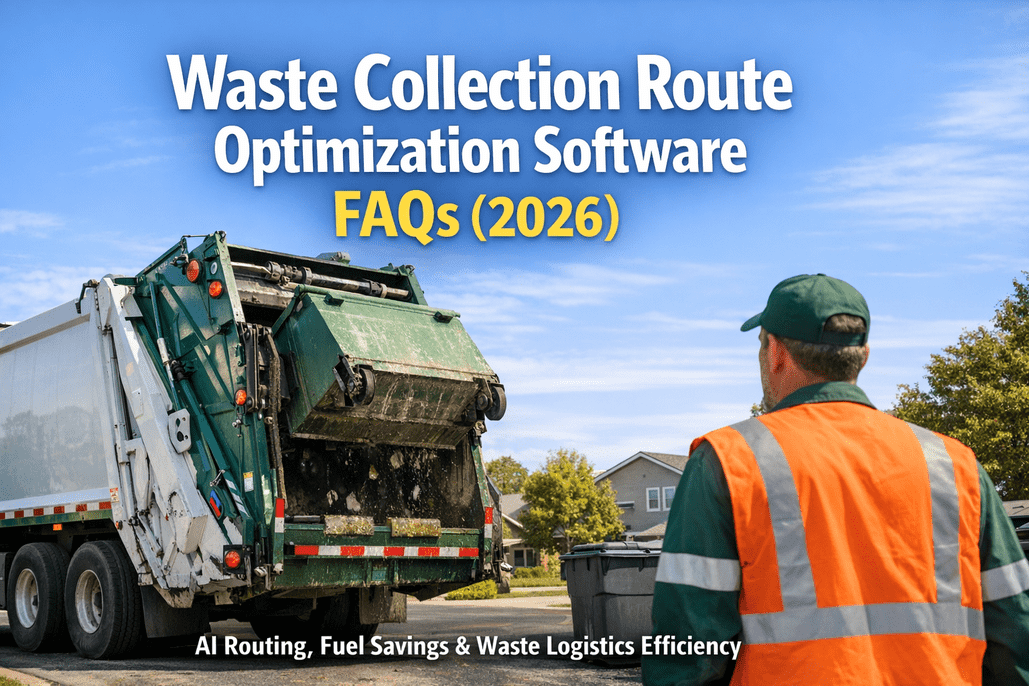
Route optimization is the single highest-ROI feature in waste fleet management — consistently delivering 20-30% reductions in miles driven, translating to hundreds of thousands of dollars in annual fuel savings for mid-size fleets. For garbage trucks averaging just 2.5 miles per gallon and consuming 10,000 gallons of diesel per year, every unnecessary mile costs $1.40-$1.60 in fuel alone. Waste collection routing is also among the most computationally complex challenges in logistics — far harder than package delivery or long-haul trucking — because residential routes involve 800-1,200 stops per shift with dozens of real-world constraints including service-side requirements, one-way streets, seasonal schedules, time windows, and compactor-capacity dump trips. AI-powered route optimization software solves this complexity at scale, cutting fuel costs, eliminating overtime, improving on-time collection rates, and reducing the carbon footprint of waste operations. Sign up for FleetRabbit to start optimizing your waste fleet operations today.
Smarter Routes. Lower Fuel Bills. Fewer Missed Pickups.
FleetRabbit combines digital DVIRs, maintenance tracking, and fleet visibility to keep every truck on its optimized route — and off the breakdown list.
Frequently Asked Questions
What is waste collection route optimization software?
Waste collection route optimization software uses advanced algorithms, GIS mapping, and real-time data to calculate the most efficient paths for garbage trucks to follow during collection operations. Unlike generic routing tools that find the shortest distance between two points, waste-specific platforms solve a far more complex problem — sequencing hundreds or thousands of stops across an entire service area while satisfying constraints unique to refuse collection.
How Route Optimization Works — From Data to Driver
Data Ingestion
The system imports your complete service universe — every address, container type, collection frequency, vehicle fleet specs, landfill/transfer station locations, and road network with restrictions. GIS mapping builds a digital model of your entire operating territory including one-way streets, turn restrictions, weight limits, and service-side requirements.
Algorithm Processing
Combinatorial optimization algorithms — enhanced by AI and machine learning — evaluate millions of possible route sequences to find the optimal solution. They balance competing objectives: minimize total miles driven, balance routes by completion time across drivers, respect all constraints, and minimize the number of vehicles required. This computation would take human planners weeks; software does it in minutes.
Route Generation
The output is a set of turn-by-turn route manifests — one per truck per day — with every stop sequenced for maximum efficiency. Each manifest includes estimated arrival times, expected completion time, dump-trip timing, and per-stop instructions. Routes are exported to mobile apps for drivers or in-cab navigation systems.
Execution and Feedback
As drivers execute routes, GPS telematics feed actual completion data back to the system. Machine learning compares planned vs. actual times per segment, refining time estimates for future optimization cycles. Routes get progressively better as the system learns your territory.
The market leaders in waste-specific route optimization include RouteSmart (20+ years of GIS-powered waste routing), AMCS Route Optimizer (integrated with their waste ERP), and Routeware (municipal-focused with citizen portal integration). At Casella Waste Systems, route optimization reduced miles by 21%, cut fuel use by 5,000 gallons per year, and prevented 52 metric tons of emissions annually. Meridian Waste freed up 34% of solid waste vehicles and eliminated 26% of route miles in a single market.
How does AI improve garbage route planning?
Traditional route planning relies on static algorithms that calculate an optimal sequence once and hold it until a planner manually updates it — often quarterly or annually. AI-powered route planning fundamentally changes this by introducing machine learning, predictive analytics, and continuous adaptation that improve routing quality over time without human intervention.
AI Capabilities in Route Planning
Pattern Learning
AI analyzes months of historical route data — actual collection times per stop, seasonal volume variations, traffic patterns by day and time, and driver-specific completion rates — to build predictive models. A stop that takes 8 seconds on Monday may take 25 seconds on recycling Thursday because bins are heavier and more numerous. Static algorithms miss this; AI captures it and adjusts route timing accordingly.
Predictive Scheduling
Machine learning forecasts waste generation patterns — predicting which areas will have heavier volumes during holidays, which commercial accounts need more frequent service during peak seasons, and which neighborhoods generate yard waste surges in autumn. This enables proactive route adjustments before problems occur rather than reactive fixes after trucks are already overloaded.
Dynamic Re-Optimization
When a truck breaks down at 10 AM with 400 stops remaining, AI redistributes that workload across available trucks in real time — calculating proximity, remaining capacity, and route impact for each option. When a street closure is reported, affected stops reroute automatically. When a missed-pickup complaint arrives, the system identifies the nearest truck that can service the address with minimal disruption.
Continuous Improvement
Every completed route becomes training data. The system identifies segments that consistently run over or under estimated time, adjusts models, and produces better routes the next cycle. REEN's AI system combines machine learning with combinatorial optimization techniques for performance that improves with every execution.
How much fuel savings can route optimization deliver?
Route optimization consistently delivers the largest measurable ROI of any waste fleet technology investment. The savings are substantial because garbage trucks have the worst fuel economy of any commercial vehicle (2.5 MPG average) and operate the most inefficient duty cycles (constant stop-and-go with 50% idle time). Every mile eliminated saves significantly more fuel than it would for any other fleet type.
Before vs. After Route Optimization
Before Optimization
After Optimization (25% Reduction)
Real-world results confirm these numbers. Casella Waste Systems cut fuel by 5,000 gallons per year per optimized market. RouteSmart consistently delivers 20-30% mile reductions for waste clients. Washington DC's Department of Public Works saved 2,400 miles annually on bulky pickup routes alone. A 2023 ArcGIS study of waste collection in Saitama, Japan, found 7-13% mileage reduction with optimized routing. AI-powered platforms report fuel savings of 20-30% through machine learning that improves routes over time. For waste fleets specifically, even a conservative 15% route improvement on a 50-truck fleet saves $280,000+ annually in fuel before counting tire, brake, labor, and vehicle lifecycle benefits.
Does it support dynamic routing based on fill levels?
Yes — dynamic fill-level routing represents the next evolution of waste collection optimization, moving from fixed-schedule collection (every Tuesday regardless of need) to demand-based collection (only when containers actually need service). This approach is particularly transformative for commercial accounts, public space bins, and roll-off operations where fill rates vary widely.
Fill-Level Routing Technology
IoT Fill-Level Sensors
Ultrasonic or infrared sensors mounted inside containers measure fill levels and transmit data via cellular or LoRaWAN networks. The system knows which bins are 80%+ full and need service versus which are only 20% full and can wait. Rubicon and REEN both deploy smart container monitoring for demand-based collection.
Demand-Based Route Generation
Instead of routing trucks to every container on a fixed schedule, the software generates daily routes that include only containers approaching capacity. This eliminates the biggest waste in traditional collection: trucks visiting half-empty bins. Studies show demand-based routing reduces total collection trips by 30-40%, dramatically cutting fuel, labor, and vehicle wear.
Overflow Prevention
Predictive analytics forecast when containers will reach capacity based on historical fill patterns, weather, events, and seasonal trends. The system schedules collection before overflow occurs — preventing the public complaints, health hazards, and contract penalties that come with overflowing bins in public spaces.
Dynamic fill-level routing is most impactful for commercial and public-space collection where fill rates are highly variable. A restaurant dumpster might fill in 2 days during weekends but take 5 days midweek. Fixed Tuesday/Friday service either collects too early (wasting a trip) or too late (overflow). Fill-level routing adapts to actual demand, delivering service precisely when needed. For residential curbside collection where every household puts bins out on the same day, the impact is smaller — but even here, sensors on neighborhood-level containers can optimize supplemental collection runs.
Can the system adjust routes for traffic and weather?
Advanced route optimization platforms incorporate real-time traffic data, weather forecasts, and road condition reports to dynamically adjust routes during execution. This capability is particularly valuable for waste collection because refuse trucks operate during peak traffic hours in residential neighborhoods and are significantly impacted by adverse weather conditions.
Real-Time Route Adjustment Capabilities:
- Live traffic integration — Software ingests data from GPS fleet devices and traffic APIs to identify congestion, then reroutes trucks around delays. A 20-minute traffic jam with a truck idling at 0.8 gallons/hour costs $2.40 in fuel per incident — across a 50-truck fleet experiencing daily delays, that adds up to $30,000+ annually
- Road closure and construction — When a street is blocked, the system automatically reroutes affected stops to alternate approaches and adjusts the sequence to minimize backtracking
- Weather-responsive scheduling — Heavy rain, snow, and ice change collection dynamics. Routes may need wider turns on icy roads, extra time per stop when bins are frozen or snow-covered, and adjusted schedules when severe weather makes collection unsafe
- Seasonal variation modeling — Yard waste surges in autumn, holiday volume spikes in December, and spring cleaning bulky-item increases all affect route timing. AI systems learn these patterns and pre-adjust routes before the disruption hits
- Event-based rerouting — Street fairs, parades, construction projects, and school zones create recurring or one-time access restrictions. Geofencing identifies these zones and the system routes around them automatically
REEN's AI-driven system explicitly factors traffic patterns, weather forecasts, and entry restrictions into every route calculation. The result is routes that reflect reality — not just theory — and adapt as conditions change throughout the day. For waste fleets where a single delayed truck can cascade into overtime for multiple drivers and missed-pickup complaints from hundreds of households, this real-time adaptability is operationally critical.
How does smart waste routing reduce overtime?
Overtime is one of the largest controllable labor costs for waste fleets, and unbalanced or inefficient routes are the primary driver. When one driver finishes at 2 PM while another is still collecting at 5:30 PM, the problem isn't driver speed — it's route design. Smart routing eliminates overtime by addressing its root causes systematically.
How Routing Eliminates Overtime
Time-Balanced Route Design
Algorithms distribute stops so all drivers finish within the same 30-minute window. Rather than balancing by stop count (which ignores that some stops take 3x longer than others), the system balances by estimated completion time — accounting for stop duration, drive time between stops, and dump-trip transit. In Loveland, CO, Routeware's optimization decreased stops per route by 30%, meaning drivers finish earlier and complete daily maintenance tasks.
Realistic Time Estimation
AI learns actual service times per stop — factoring in container type, setback distance, terrain, and even specific addresses that consistently take longer (gated access, steep driveways, narrow alleys). Static planners using flat 10-second-per-stop estimates consistently under-time routes, building overtime into the schedule before the day starts.
Buffer and Contingency Planning
Smart systems build appropriate buffers for dump trips, traffic variability, and mechanical delays without over-padding routes. They know that a Tuesday recycling route takes 12% longer than Monday trash because recycling bins are heavier and more numerous. This prevents the cascading delays that turn a 15-minute setback into 90 minutes of overtime.
Overtime Cost Impact — 50-Truck Fleet
Is it suitable for municipal and private waste fleets?
Yes — route optimization software serves both municipal and private waste operations, though each has distinct requirements. The most capable platforms handle both simultaneously, which matters because many haulers serve municipal contracts alongside private commercial accounts from the same fleet.
Municipal vs. Private Fleet Requirements
Municipal Operations
Fixed residential routes servicing every household on schedule. Complex alternating schedules (recycling every other week, yard waste seasonal). Citizen complaint portals requiring rapid missed-pickup response. Service verification proving 95%+ completion for contract SLAs. RFID bin-level tracking for individual household accountability. Public reporting requirements for tonnage, diversion rates, and sustainability metrics. Budget transparency and audit trails.
Private Hauler Operations
Mixed commercial and residential routes. Variable-frequency service (daily, 2x/week, on-call). Revenue-driven optimization — prioritizing profitable routes and right-sizing service levels. Roll-off dispatch requiring real-time scheduling. Customer billing integration tied to service verification. Fleet right-sizing to minimize capital investment. Competitive territory expansion planning and new-customer route integration.
Routeware specializes in municipal-focused waste routing with citizen portals and government reporting. AMCS Platform covers both municipal and private with its enterprise ERP. RouteSmart serves both segments with GIS-powered optimization that handles residential collection and commercial routing. Rumpke Waste used RouteSmart to target profitable new customers and increased response rate by 3-4x by integrating new accounts into existing optimized routes rather than creating inefficient standalone runs.
How does route optimization integrate with GPS tracking?
Route optimization and GPS tracking are complementary technologies that create a closed-loop system — optimization plans the ideal route, GPS tracks actual execution, and the data feeds back to improve future routes. Together they deliver far more value than either technology alone.
Integration Architecture
Plan vs. Actual Comparison
GPS records the actual path each truck follows, enabling comparison against the planned optimized route. When drivers deviate — skipping stops, changing sequence, taking unauthorized breaks — the system flags the variance. This accountability ensures that carefully optimized routes are actually followed, not freelanced by drivers who prefer their own familiar paths.
Real-Time Progress Monitoring
Dispatchers see every truck's position overlaid on the day's route plan. They can instantly identify which trucks are ahead of schedule, on track, or falling behind — and intervene before a delay cascades into overtime or missed pickups. When a truck reports a mechanical issue, the dispatcher sees nearby trucks and their remaining workload to make instant redistribution decisions.
Service Verification
GPS timestamps at each stop create an irrefutable record of service completion. Combined with RFID readers or arm-side cameras, the system proves that the truck was at the address and the container was serviced. This data satisfies municipal SLA requirements, resolves customer disputes, and provides contract compliance documentation.
Machine Learning Feedback Loop
Actual GPS data — real travel times between stops, actual service durations, true traffic patterns — feeds back into the optimization engine. Routes planned with theoretical estimates gradually improve as the system learns from thousands of actual route executions. This is how AI-powered platforms deliver progressively better routes over time without manual intervention.
Complete Fleet Visibility for Optimized Operations
FleetRabbit provides the digital DVIR, maintenance tracking, and fleet health data that keeps your optimized routes running on schedule — because the best route plan fails when trucks break down mid-route.
Can dispatchers modify routes in real time?
Yes — real-time route modification is a critical capability for waste operations where daily disruptions are the norm, not the exception. A single truck breakdown, street closure, or severe weather event can impact dozens of routes and hundreds of stops. Modern platforms give dispatchers the tools to respond instantly.
Real-Time Dispatch Capabilities:
- Stop reassignment — Drag-and-drop stops between trucks on the dispatch console. When Truck 7 breaks down with 400 stops remaining, the dispatcher redistributes to Trucks 3, 5, and 12 based on proximity and remaining capacity
- Route insertion — Add emergency stops (missed-pickup complaints, new service requests, special pickups) into the optimal position within an active route without disrupting the remaining sequence
- Route re-sequencing — Reorder remaining stops when a street closure blocks the planned path, or when a driver needs to return to the depot mid-route for a mechanical issue
- Driver communication — Push updated route manifests directly to driver mobile apps or in-cab tablets with turn-by-turn navigation reflecting the changes
- Impact preview — Before committing changes, dispatchers see estimated impact on completion time, miles, and fuel for affected routes — enabling informed decisions under pressure
- Automated redistribution — Some platforms offer one-click automatic work redistribution that AI calculates the optimal reassignment across all available trucks, saving dispatchers minutes of manual planning during time-critical situations
The dispatcher's ability to modify routes in real time is what turns static route optimization from a planning tool into a live operations platform. Without it, a single disruption can cascade through the entire day. With it, dispatchers maintain control and keep service levels high regardless of what the day throws at them.
What KPIs improve with route optimization software?
Route optimization impacts virtually every operational KPI that waste fleet managers track. The improvements are measurable within 30-45 days of implementation, with full benefits typically realized within 90 days. Sign up for FleetRabbit to start tracking these metrics across your fleet:
Key Performance Indicators — Expected Improvements
Total Miles Reduction
The primary KPI. Fewer miles = less fuel, less tire/brake wear, less driver fatigue, and lower emissions. Track total fleet miles weekly and compare against pre-optimization baseline.
Fuel Cost Reduction
Direct result of fewer miles plus reduced idle time from more efficient stop sequencing. Monitor fuel cost per route, per vehicle, and per stop to identify remaining optimization opportunities.
On-Time Completion Rate
Balanced routes with accurate time estimates mean drivers finish within their scheduled window. This is the KPI that protects municipal contracts — most SLAs require 95%+ on-time collection with financial penalties for each point below threshold.
Overtime Reduction
Time-balanced routing eliminates the route imbalances that create overtime. Track weekly overtime hours and cost — target under 2% of total labor hours for well-optimized operations.
Vehicle Wear Reduction
Fewer miles and smoother routing (less stop-and-go, fewer U-turns, reduced backtracking) extend brake life, tire life, and overall vehicle lifecycle. Track maintenance cost per mile as the proxy metric.
CO2 Emissions Reduction
Every gallon of diesel not burned eliminates 10.18 kg of CO2. A 50-truck fleet saving 125,000 gallons annually prevents 1,272 metric tons of emissions — meaningful for sustainability reporting and ESG commitments.
Additional KPIs to Track:
- Missed pickups per 1,000 stops — Target under 2. Route optimization with service verification catches misses in real time
- Driver route adherence — Percentage of stops completed in optimized sequence. Low adherence means drivers are freelancing and losing the optimization benefit
- Trucks required per service area — Optimization often frees vehicles. Meridian Waste freed 34% of trucks in one market
- Cost per stop — The ultimate efficiency metric combining fuel, labor, maintenance, and overhead per collection point
- Route planning time — Digital optimization takes minutes versus hours or days for manual planning. Routeware notes planners can rebalance routes far more frequently with software
Start Measuring What Matters
FleetRabbit gives waste fleet managers the inspection, maintenance, and operational data to track KPIs and prove ROI. Start your free trial — no credit card, no contracts.