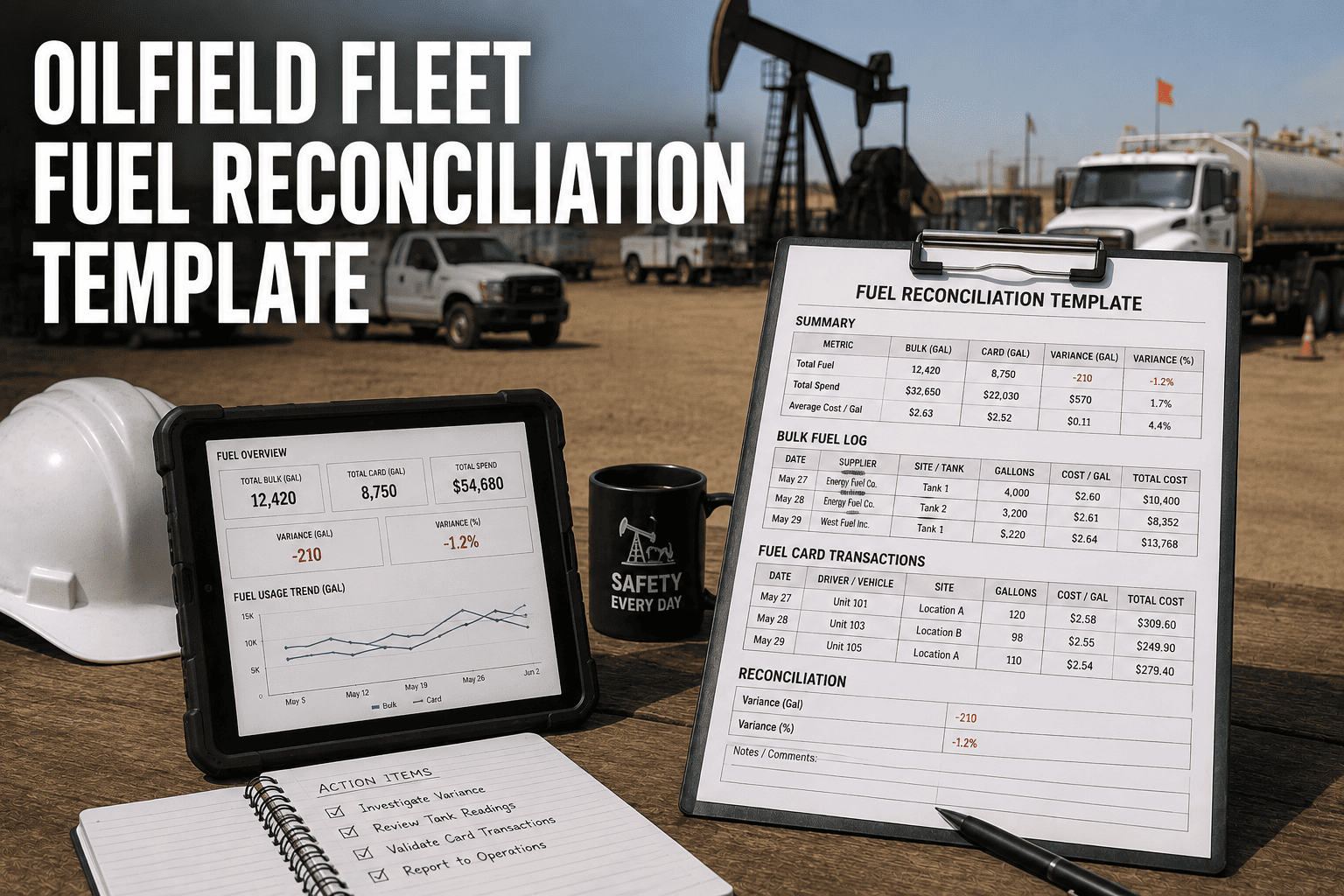
Oil and gas fleets operating across remote well sites, pipeline corridors, and lease roads face unique fuel management challenges: excessive idling during equipment standby, route inefficiencies on unpaved access roads, and limited visibility into consumption patterns across dispersed assets. Fleet Rabbit provides real-time fuel analytics, idle monitoring, and driver behavior insights that help operations teams identify waste, optimize routing, and maintain compliance—without requiring new hardware or disrupting existing workflows. Book a Demo to see Fleet Rabbit in action.
15–25%
Typical fuel spend recovery potential through systematic tracking and targeted interventions
$1,000–$3,600
Annual fuel cost per vehicle attributable to excessive idling in oilfield operations
5–7%
Average fuel spend impacted by theft or unauthorized use across industry fleets
8–12 hrs
Quarterly administrative time saved through automated IFTA and compliance reporting
Fuel Waste in Oil and Gas Fleets Is Often Invisible Without Structured Tracking. Fleet Rabbit Makes It Measurable.
Fleet Rabbit connects to existing telematics and fuel card systems to capture consumption data, idling patterns, route efficiency, and driver behavior in a centralized dashboard—enabling targeted interventions without hardware replacement or operational disruption.
The Hidden Cost of Fuel Inefficiency in Oil and Gas Fleet Operations
Before implementing optimization strategies, it is important to understand where fuel waste typically occurs in oilfield fleets. Manual tracking and reactive management leave significant consumption patterns unaddressed—patterns that structured analytics can help identify and reduce.
Excessive Idling During Equipment Standby
Service trucks, frac units, and water haulers often idle for extended periods while supporting wellsite operations. Without per-vehicle idle tracking, these costs remain aggregated and difficult to address.
Route Inefficiencies on Lease Roads and Remote Access
Static routing does not account for real-time road conditions, weather impacts, or wellsite scheduling changes. Unnecessary mileage accumulates without visibility into optimization opportunities.
Fuel Theft and Unauthorized Use
Remote operating locations and dispersed assets create opportunities for siphoning, card misuse, or buddy fueling. Without GPS-verified transaction matching, anomalies may go undetected.
Driver Behavior Impact on Consumption
Acceleration patterns, speed management, and braking behavior affect fuel efficiency. Without behavior scoring, coaching opportunities remain subjective rather than data-informed.
How Fleet Rabbit Supports Fuel Optimization for Oil and Gas Fleets
Fleet Rabbit integrates with existing telematics, fuel cards, and dispatch systems to provide structured fuel analytics without requiring hardware replacement. Data is captured at source and presented in actionable formats for operations teams. See a live demo focused on fuel tracking, idle reduction, and compliance reporting.
01
Fuel Card and Telematics Integration
Connects to WEX, Fleetcor, and major telematics providers via API. Syncs fuel transactions with GPS location data to verify purchases and flag anomalies automatically.
02
Idle Time Monitoring and Alerts
Tracks idle duration by vehicle, location, and driver. Configurable thresholds trigger alerts for excessive idling, enabling targeted coaching or policy adjustments.
03
Driver Behavior Analytics
Scores driving patterns including acceleration, braking, and speed management. Identifies coaching opportunities with measurable tracking of improvement over time.
04
Route Efficiency Insights
Analyzes completed routes against optimal paths considering traffic, terrain, and delivery windows. Highlights opportunities for mileage reduction without schedule disruption.
05
Automated IFTA and Compliance Reporting
Generates quarterly fuel tax reports by jurisdiction with audit-ready documentation. Reduces manual compilation time and supports regulatory submissions.
06
Maintenance-Fuel Correlation
Links consumption anomalies to potential maintenance needs such as tire pressure, filter status, or engine diagnostics. Enables proactive service before efficiency declines further.
Regulatory Framework Support for Fuel and Emissions Reporting
Fleet Rabbit supports compliance documentation for fuel-related regulatory requirements commonly faced by oil and gas fleet operators.
IFTA Fuel Tax Reporting
Automated calculation of fuel use by jurisdiction with exportable quarterly reports formatted for state and provincial submissions.
EPA Emissions Documentation
Fuel consumption data structured to support Scope 1 emissions calculations using GHG Protocol or EPA emission factors.
FMCSA Recordkeeping
Digital DVIR and maintenance records linked to vehicle usage data, supporting audit requests with timestamped, tamper-evident documentation.
HAZMAT Shipping Documentation
Generates required shipping papers and consignment notes for regulated cargo, with driver certification cross-referencing before dispatch.
Deployment Approach for Oil and Gas Fuel Optimization
Fleet Rabbit follows a structured onboarding process designed for dispersed fleet operations—delivering initial visibility within the first week and full feature activation within two weeks. No hardware installation required.
01
Asset and Data Audit
Map vehicles, fuel cards, and telematics sources
02
System Integration
Connect fuel cards and GPS via API
03
Baseline Configuration
Set idle thresholds and alert parameters
04
Team Training
Onboard dispatchers and field supervisors
05
Go-Live and Review
Activate monitoring and schedule check-in
Typical Timeline and Expected Outcomes
Every Fleet Rabbit engagement follows a defined onboarding sequence with measurable milestones. Results vary by fleet size, operating conditions, and intervention follow-through. Request the full onboarding scope document tailored to your fleet profile.
Days 1–3
Integration and Baseline
Connect fuel card accounts and telematics providers via API
Import historical fuel and mileage data for baseline analysis
Configure idle thresholds and alert parameters per vehicle class
Days 4–10
Pilot Monitoring
Activate fuel tracking on highest-utilization vehicle segments
Review initial idle and route efficiency reports with operations team
Identify quick-win opportunities such as excessive idle locations
Days 11–14
Full Activation
Expand monitoring to full fleet with all configured parameters
Enable automated IFTA reporting and compliance documentation
Schedule 30-day review to assess intervention effectiveness
REALISTIC EXPECTATIONS: MEASURABLE IMPROVEMENTS WITH CONSISTENT INTERVENTION
Fleets that systematically address identified fuel waste opportunities—such as reducing excessive idling, coaching drivers on efficient behavior, and optimizing routes—typically see consumption improvements within the first 60–90 days. Results depend on operational follow-through and baseline conditions.
5–10%
Idle reduction potential
8–12%
Driver behavior impact
8–15%
Route efficiency gains
Start Tracking Fuel Waste. Identify Optimization Opportunities in Two Weeks.
Fleet Rabbit's fixed-scope onboarding means no open timelines, no hardware installation, and no months of customization before you gain visibility. Deploy at $5/vehicle/month and begin monitoring within 72 hours.
Use Cases from Oil and Gas Fleet Deployments
These examples reflect common scenarios where Fleet Rabbit has supported fuel optimization efforts. Outcomes depend on fleet size, operating conditions, and intervention consistency. Request additional details for the use case most relevant to your operations.
A regional service fleet supporting wellsite operations had limited visibility into idling patterns across dispersed assets. Fleet Rabbit's idle tracking identified high-duration locations and enabled targeted coaching. Administrative time for fuel reporting was also reduced through automated IFTA generation.
10 hrs
Reporting time saved
A water hauling operation sought to reduce unnecessary mileage on lease road networks. Fleet Rabbit's route analysis highlighted recurring inefficiencies and supported dispatch adjustments. Driver behavior scoring helped identify coaching opportunities for fuel-efficient operation.
An operator managing assets across remote basin locations needed to verify fuel purchases against actual vehicle location. Fleet Rabbit's GPS-verified transaction matching flagged anomalies for review and reduced time spent on manual reconciliation.
95%+
Transaction verification
4 hrs/wk
Reconciliation time saved
What Fleet Teams Say About Fleet Rabbit
Fleet Rabbit helped us identify idling patterns we did not know we had. The automated IFTA reports also cut our quarterly paperwork time significantly. It is a practical tool for day-to-day fuel management.
Fleet Operations Supervisor
Regional Oilfield Services Provider
Frequently Asked Questions
Does Fleet Rabbit require new hardware for fuel tracking?
No. Fleet Rabbit connects to existing fuel card providers and telematics systems via API. Where gaps are identified during onboarding, targeted additions may be recommended—but full hardware replacement is not required.
Which fuel card and telematics providers does Fleet Rabbit integrate with?
Natively integrates with WEX, Fleetcor, Samsara, Verizon Connect, Geotab, and custom dispatch platforms via REST API. Integration scope is confirmed during the initial asset audit.
How does Fleet Rabbit handle operations in areas without cellular coverage?
Mobile apps for DVIR and fuel logging work offline at remote locations, syncing data automatically when connectivity is restored. GPS tracking uses satellite fallback where cellular is unavailable.
What compliance reports can Fleet Rabbit generate?
Automated IFTA quarterly reports, FMCSA DVIR records, HAZMAT shipping documentation, and emissions data formatted for ESG or regulatory submissions. All reports are exportable in standard formats.
How long does it take to see fuel analytics after onboarding?
Baseline fuel data is available within 3–5 days of integration. Idle patterns, route efficiency, and behavior scores begin populating as vehicles operate. Meaningful trend analysis typically requires 2–4 weeks of data.
Can Fleet Rabbit scale with fleet growth?
Yes—from 10 to 10,000+ vehicles. Add vehicles, locations, and users without re-implementation. Pricing is $5/vehicle/month with no volume minimums.
Track Fuel Use. Identify Waste. Optimize Operations in Two Weeks.
Fleet Rabbit provides oil and gas fleet teams with real-time fuel analytics, idle monitoring, driver behavior insights, and automated compliance reporting—integrated with existing telematics in 5–7 working days, at $5/vehicle/month, with no new hardware required.
Fuel card and GPS integration via API
Idle monitoring with configurable alert thresholds
Automated IFTA and emissions reporting
Offline-capable mobile apps for remote operations
May 22, 2026
By Jason
All Posts