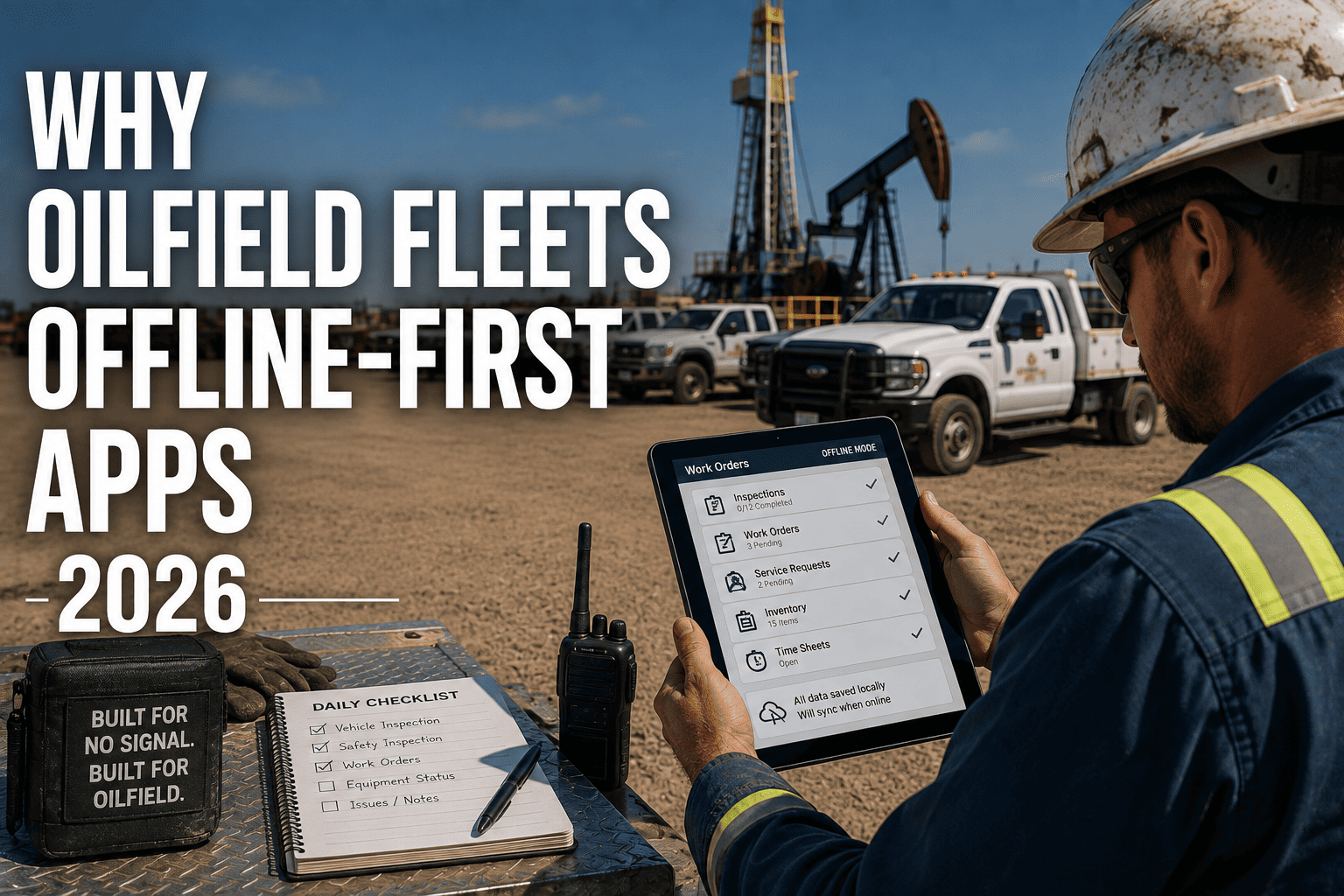
A drilling crew eighty miles from the nearest cell tower doesn't stop working just because the signal drops. Trucks still need pre-trip inspections, equipment still needs safety checks, and incidents still need to be logged the moment they happen. The software they rely on either keeps up with that reality or it doesn't. In 2026, the fleet apps winning at the wellhead are the ones built offline-first from the ground up, not the ones that simply show a spinning loader when the bars disappear.
Offline-first apps store data on the device first and treat the network as an enhancement rather than a requirement, so inspections, work orders, and safety logs keep working through full shifts with zero connectivity. Oilfield fleets are adopting them because more than four out of five well locations have unreliable or no cellular coverage, and every gap in a cloud-only app becomes a gap in compliance, safety, and maintenance data.
The Connectivity Reality at the Wellhead
Remote pads, pipeline corridors, and offshore platforms are exactly where standard fleet software falls apart. Connectivity isn't a rare edge case in oilfield operations. It's the default operating condition for a meaningful share of every shift.
What "Offline-First" Actually Means
Most software marketed as "works offline" is really a web app with a cache, and caches fail the moment a form gets complex or a photo needs attaching. True offline-first architecture flips the entire model: the device is the source of truth, and the cloud is where data eventually lands, not where it has to start.
Standard Cloud-Connected App
- Freezes or shows errors the moment signal drops
- Inspections and forms get lost if the app closes offline
- Crews revert to paper, creating a second data source
- Fleet managers see field activity hours or days late
Offline-First Oilfield App
- Runs identically with or without a signal
- Every inspection, photo, and signature saves locally, encrypted
- One digital record, no paper backup needed
- Automatic sync the instant connectivity returns
Connectivity Isn't Just On or Off
For a multi-well pad operation, connectivity behaves more like a spectrum than a switch. A device might be fully offline for one stretch, catch a weak reattach near a highway, then land on strong Wi-Fi back at the yard. Software built for the oilfield needs to recognize each of those states and sync intelligently, rather than draining a battery on a fixed timer that fires whether there's anything worth sending or not.
FleetRabbit's mobile platform functions identically with or without a connection, so your field teams never lose an inspection again. Sign up to try it on your own devices.
How Offline-First Syncing Actually Works
The technology behind a seamless offline experience runs through four stages, and a field crew never has to think about any of them.
Capture Locally
Inspections, signatures, and photos save directly to the device with encryption, no network required.
Queue Securely
Every record waits in an on-device queue, safe from app closures, restarts, or dead zones lasting a full shift.
Detect Reconnection
The app recognizes a stable signal, Wi-Fi, or a charging dock and triggers sync at the right moment automatically.
Sync & Alert
Data uploads to the cloud and fleet managers get notified within minutes of reconnection, not at end of shift.
Where Offline-First Pays Off Across Fleet Operations
Connectivity resilience isn't a single feature bolted onto a fleet app. It touches nearly every workflow a field crew and a fleet manager depend on.
Pre-Trip & DVIR Inspections
Drivers complete full digital inspections and capture signatures at any wellsite, with automatic sync once back in range.
Engine-Hour Maintenance Logs
Technicians log service events on-device even in a shop with no signal, keeping engine-hour maintenance schedules accurate.
Safety & Incident Reporting
HSE audits and incident reports get captured with photos the moment something happens, not hours later from memory.
Fuel Tickets & Dispatch
Field tickets and dispatch updates log locally at the pad and reconcile automatically, cutting the paperwork trail entirely.
What Changes for a Fleet Manager
The value of offline-first isn't only felt in the field. It's felt on the dashboard side, where a fleet manager stops discovering problems a day late. A drilling contractor that switched to purpose-built offline mobile tools saw inspection completion climb from 61 to 94 percent and cut daily administrative burden by more than four hours, simply because crews stopped re-entering the same data twice.
The Battery and Bandwidth Tradeoff
Poorly built offline apps sync on a fixed timer, burning battery on retries that have nothing new to send. Offline-first platforms sync opportunistically instead, waiting for a stable reconnection, a known Wi-Fi network, or a charging dock before pushing data, which keeps devices alive for a full shift without sacrificing how current the data stays.
Real Impact: Before vs After Offline-First Adoption
Inspection Completion
Admin Hours Recovered Daily
Issue Detection Speed
Downtime From Missed Maintenance
Fleet managers evaluating a switch don't need to take these figures on faith. The fastest way to see how an offline-first workflow behaves on an actual ruggedized device is to book a demo at a location with no signal at all and watch the sync happen live once connectivity returns.
Frequently Asked Questions
FleetRabbit's offline-first mobile platform keeps inspections, maintenance logs, and safety reporting running at every remote wellsite, with zero data loss and automatic sync the moment connectivity returns.