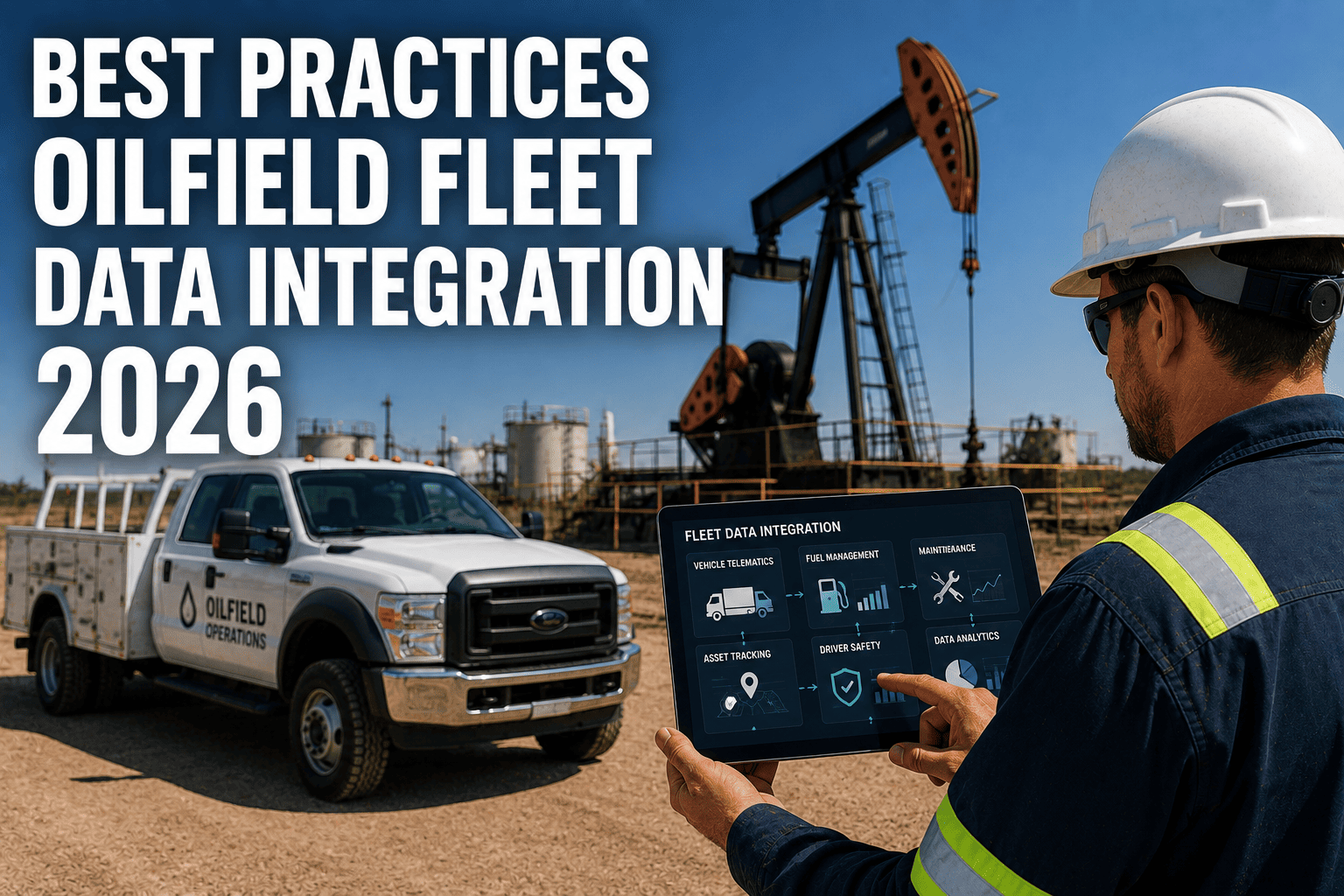
Most oilfield operators aren't short on data. They're short on data that talks to each other. Telematics knows where a truck is. The ERP knows what it cost to run. The CMMS knows when it broke down. SCADA knows what was happening at the wellsite at the time. None of these systems were built with each other in mind, so fleet coordinators end up doing the integration work by hand, copying numbers between spreadsheets while the operational moment they actually needed to act on has already passed. Getting these systems talking to each other isn't a nice-to-have dashboard project. It's the difference between reacting to problems a day late and catching them in real time.
The typical oilfield fleet operation runs 6 to 9 separate software systems that don't share data automatically, costing teams 3 to 6 hours of manual reconciliation daily. Roughly 71 percent of operators still manage this through spreadsheets and manual exports. Modern API-based integration eliminates most of that reconciliation and turns next-day fault detection into a near-instant alert.
The Systems Every Oilfield Fleet Is Juggling
Before fixing the silo problem, it helps to see the actual shape of it. A typical oilfield fleet operation has data scattered across a predictable set of systems, each doing its own job well while staying completely blind to what the others know.
What Disconnected Systems Actually Cost You
The cost of data silos rarely shows up as a single line item, which is exactly why it survives budget reviews year after year. It shows up as a fleet coordinator manually copying telematics coordinates into a dispatch spreadsheet, a finance team looking at a maintenance cost in the ERP with no link back to the fault code or vehicle location that caused it, and a maintenance team learning about a wellsite fault the next morning instead of the moment it happened. For equipment sitting eighty miles from the nearest depot, that lag is what turns a planned repair into an emergency callout.
The Compounding Effect Of Disconnected Data
Individually, each gap looks survivable. A day's delay on a fault alert, a missing cost code, a fuel transaction that doesn't quite match the telematics log. Stacked across dozens of vehicles and multiple systems, these small gaps compound into a fleet operation making capital and staffing decisions on numbers that are already out of date by the time anyone sees them.
FleetRabbit's open API connects telematics, ERP, CMMS, fuel cards, and SCADA into a single operational view, most integrations live within days. Sign up free to see your systems in one dashboard.
Best Practices For Connecting Oilfield Fleet Systems
Fleets that pull this off successfully tend to follow the same handful of practices, regardless of which specific platforms they're connecting.
1. Start With The Highest-Friction Manual Process
Don't try to integrate everything at once. Identify the single most painful manual reconciliation task, usually matching telematics fault codes to CMMS work orders, or fuel card transactions to vehicle consumption logs, and solve that connection first. Early wins build the case for expanding the integration roadmap.
Signs You've Picked The Right Starting Point
The process eats hours every week, involves more than two systems, and directly affects a decision someone makes daily, like dispatch routing or maintenance prioritization.
2. Choose API-Based Connections Over Custom Middleware
Older integration projects relied on custom-built middleware that broke every time a vendor updated their software. Modern fleet platforms offer pre-built API connectors to major telematics, ERP, and fuel card providers, cutting both implementation time and long-term maintenance burden dramatically.
3. Give Every Data Point A Common Reference
A fault code, a cost entry, and a work order need to reference the same vehicle ID, timestamp format, and location standard across every connected system. Without that shared reference, integration just moves the reconciliation problem instead of solving it.
4. Route Real-Time Alerts To The Right Team Instantly
Integration only pays off if the data actually reaches someone in time to act. A fault code detected at a remote wellsite needs to reach the maintenance team within minutes, not surface in the next morning's shift briefing, which is often the gap between a routine repair and an expensive breakdown.
5. Build Financial Context Back Into Operational Data
Finance teams reviewing rising maintenance costs need to see the engineering story behind the numbers, not just a total. Linking ERP cost codes back to the fault history and vehicle location that generated them turns a flat expense report into a decision-ready diagnostic.
| Integration Pair | What It Unlocks | Typical Setup Time |
|---|---|---|
| Telematics + CMMS | Fault codes trigger work orders automatically instead of waiting for manual entry | 2 to 5 business days |
| Fuel Cards + Telematics | Transaction data cross-checked against consumption to flag fraud or overbilling | 1 to 3 business days |
| ERP + Maintenance Records | Cost codes linked to the operational event, giving finance engineering context | 3 to 7 business days |
| SCADA + Fleet Dispatch | Wellsite status informs routing decisions without a phone call to the field | 5 to 10 business days |
We'll walk through your current systems and show exactly which connections deliver the fastest return. Book a demo to get a tailored integration plan.
Before And After: What Changes Once Systems Talk To Each Other
The clearest way to see the value of integration is side by side with the manual process it replaces.
- Fault codes discovered during the next shift briefing
- Fuel transactions reconciled manually at month-end
- Finance sees cost totals with no operational context
- Compliance reports assembled by hand from multiple exports
- Fault codes trigger work orders within minutes of occurring
- Fuel data cross-checked against telematics automatically
- Every cost code linked to the vehicle, fault, and location behind it
- Compliance reports generated on demand from live data
Key Takeaways
Oilfield fleet data integration isn't about adding another dashboard to look at. It's about removing the hours of manual work that sit between something happening in the field and someone being able to act on it. The fleets making the fastest progress aren't the ones integrating everything simultaneously, they're the ones picking the single highest-friction manual process, connecting it with an API-based approach, and expanding from there once the value is proven.
If your team is still reconciling telematics, fuel, and maintenance data by hand across separate systems, that reconciliation time is the clearest signal of where to start.
FleetRabbit connects telematics, ERP, CMMS, fuel cards, and SCADA data into a single operational platform, eliminating the manual reconciliation eating your team's time. Start free or talk to our team about your specific systems.