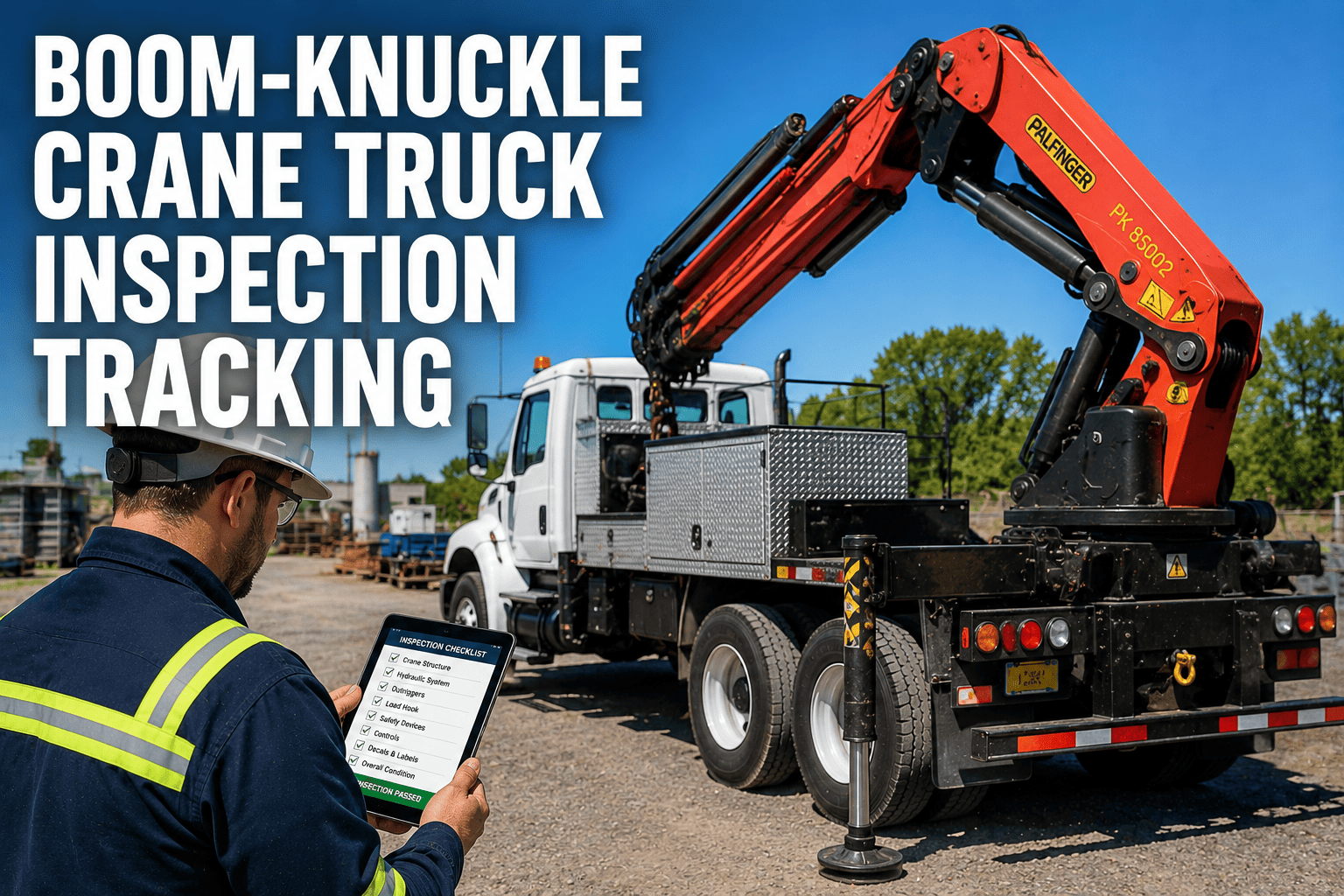
A boom truck rolls up to an oilfield location at 6 a.m. with a full crew waiting on it, and the lift does not happen. Not because of weather, not because of the load, but because the annual inspection sticker expired eleven days ago and nobody caught it before the truck left the yard. That single missed date can shut down a location for hours while a replacement unit gets dispatched, and it is one of the most common, most preventable delays in crane truck operations. The equipment was fine. The paperwork was not.
Boom and knuckle crane trucks require three layers of inspection: a pre-use check before every shift, a documented periodic inspection monthly, and a comprehensive annual inspection by a qualified person, each governed by OSHA and ASME B30.5. Add operator certification, load chart currency, and DOT vehicle compliance, and a single truck can be tracking six or more expiration dates at once. Missing any one of them can pull a truck off a job site regardless of mechanical condition. See how one dashboard tracks every date across your crane fleet with a free FleetRabbit trial.
The Three-Tier Inspection Schedule
Every boom or knuckle crane truck operates under the same layered inspection structure, regardless of who owns it or what it lifts. Each tier has its own frequency, its own required qualification level, and its own record retention rule.
Boom Truck vs Knuckle Boom: What Changes in the Inspection
Both crane types fall under the same OSHA and ASME B30.5 framework, but the physical inspection points differ enough that a single generic checklist misses items specific to each design.
Telescopic Boom Trucks
Inspection focuses on telescoping cylinder condition, boom section wear, wire rope reeving, and the load moment indicator's calibration across the full boom length and angle range.
Articulated Knuckle Boom Cranes
Inspection shifts toward hydraulic cylinder seals at each knuckle joint, pin and bushing wear at articulation points, and the rated capacity indicator's accuracy across multiple folding configurations rather than a single straight boom line.
| Component | Telescopic Boom Truck | Knuckle Boom Crane |
|---|---|---|
| Primary Wear Point | Telescoping cylinder and boom section wear pads | Knuckle joint pins, bushings, and hydraulic seals |
| Capacity Indicator | Load moment indicator across boom length and angle | Rated capacity indicator across folding configurations |
| Wire Rope Check | Full reeving path through boom sheaves | Shorter reeving path, higher cycle frequency per joint |
| Common Failure Mode | Cylinder drift or uneven telescoping under load | Joint play from worn pins affecting positioning accuracy |
FleetRabbit tracks pre-use, periodic, and annual inspection dates alongside operator certifications and vehicle compliance for every boom and knuckle crane in your fleet. Try it free with your current fleet, or walk through your own crane records with our team.
The Documents That Actually Get Checked at the Gate
Before a boom truck is allowed onto most oilfield or industrial sites, someone at the gate checks paperwork, not just the equipment. A truck can be mechanically sound and still get turned away over a single missing document.
Operator Certification
Every operator must hold current certification for the specific crane type and capacity class they are running, along with a site-specific evaluation on the exact unit assigned that day.
Load Chart and Capacity Indicator Currency
Load charts must match the crane's current configuration, and the rated capacity or load moment indicator must show valid calibration certification, not just a functioning display.
Vehicle Compliance and DOT Records
A truck-mounted crane that travels public roads carries commercial vehicle obligations on top of crane inspection requirements, including annual DOT inspection and current registration.
What Happens When a Certification Lapses
A single expired document rarely causes a mechanical failure, but it reliably causes a schedule failure. A truck turned away at a gate check means a delayed lift, an idle crew, and in many oilfield contracts, a documented safety violation that follows the operating company into its next bid review. Because these dates rarely expire in a predictable order across a mixed fleet, most operators discover a lapse the same way the crew in the opening example did, at the gate, with the truck already loaded and dispatched. Centralizing every crane's inspection, certification, and vehicle compliance dates in one system removes that risk before a truck ever leaves the yard, and it is worth seeing how that tracking works with a quick demo from the FleetRabbit team.
A crane truck fleet is only as reliable as its least current document. Mechanical readiness and paperwork readiness have to move together, or the equipment sits idle for reasons that had nothing to do with the equipment itself. If your fleet is ready to stop tracking inspection and certification dates by spreadsheet, start a free trial with FleetRabbit or book a short demo to see your own crane fleet's compliance status in one place.
FleetRabbit tracks pre-use, periodic, and annual crane inspections alongside operator certifications and vehicle compliance, with automatic alerts before anything lapses. Get started today, no credit card required.