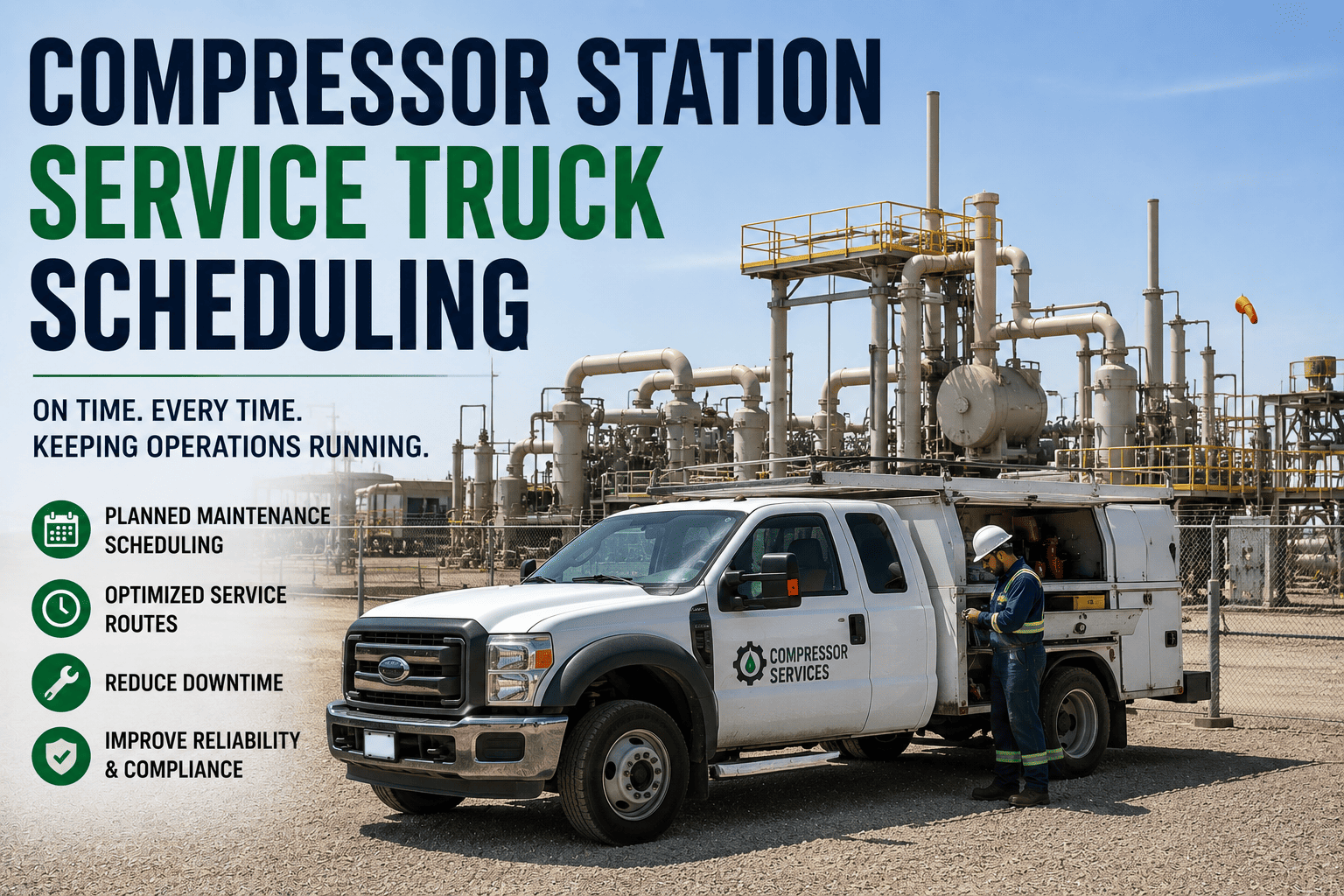
A compressor station going down for even a few hours does not behave like a normal breakdown. Gas gathering slows, downstream producers back up, and a midsize station outage can exceed 250000 dollars in lost throughput and penalties before a single wrench turns. Yet most midstream fleets still schedule their service trucks the same way a delivery company schedules its vans, first come first served, nearest truck wins. Compressor stations do not work that way. Some sites carry the entire gathering system on their backs. Others are backups that can slip a day without anyone noticing. Sign up for a free trial at https://ai.fleetrabbit.com and see how station-aware scheduling changes the math for your fleet.
Compressor station service truck scheduling works best when trucks are routed by station priority tier, engine-hour intervals, and parts availability, not just by distance. Reciprocating compressor valves and bearings wear non-linearly, so time-based routing alone misses 30 to 90 percent of early warning windows that condition data would otherwise catch. Fleets that combine priority tiering with predictive alerts cut emergency truck rolls by 35 to 50 percent.
Why Standard Truck Scheduling Falls Apart at Compressor Stations
Most fleet scheduling tools were built for delivery routes, pickup windows, and mileage optimization. Compressor stations run on a completely different logic. These sites operate around the clock under SCADA monitoring, and a single reciprocating or centrifugal unit failing unexpectedly can ripple through an entire gathering network, backing up wellhead production and triggering contractual throughput penalties. When a service truck scheduling system ignores which station actually matters most on a given day, technicians end up chasing the nearest job instead of the most urgent one.
The second failure point is timing logic. Filter changes, lubrication, and safety valve testing can run on a fixed calendar because they degrade predictably. But compressor valves, rotor bearings, and seal-gas systems on reciprocating units wear unevenly, which means a technician showing up right on schedule might be catching a healthy part or missing a failing one entirely. Layering engine-hour data and condition trends on top of the calendar gives dispatchers a truer picture of when a truck actually needs to roll.
The Hidden Cost of Guesswork Scheduling
When station priority, engine hours, and parts status are not connected, dispatchers default to gut feeling. That gut feeling usually favors whichever station called last or whichever truck is closest, not the station carrying the most throughput risk. Over a year, that guesswork compounds into avoidable emergency dispatches, wasted technician hours, and stations quietly drifting past safe maintenance windows.
FleetRabbit ranks every compressor station by throughput impact, engine-hour status, and parts readiness, then routes your technicians to whichever site actually needs them first. Start your free trial and see your stations ranked automatically.
The Three-Tier Station Priority Model
A practical way to fix distance-based dispatch is to rank every compressor station into a priority tier before a single truck gets assigned. This turns scheduling from a reactive guessing game into a structured decision that any dispatcher can follow, whether or not they have years of field experience.
Tier 1: Critical Throughput Stations
These are the stations carrying the largest share of gathering volume, often supporting the highest number of connected wellheads. A Tier 1 station experiencing an unplanned shutdown creates the fastest-moving financial and contractual damage, so these sites get first access to the next available truck and the shortest response window, typically within hours rather than days.
What Triggers a Tier 1 Dispatch
Vibration or temperature readings trending outside normal range, engine-hour intervals approaching valve or bearing thresholds, or any SCADA alarm tied to a critical unit should all trigger an immediate scheduling review for Tier 1 sites.
Tier 2: Standard Gathering Stations
These stations matter, but a short delay does not cascade into major throughput loss. Tier 2 sites follow normal engine-hour and calendar-based scheduling, with technicians routed efficiently around Tier 1 priorities rather than displacing them.
Tier 3: Backup and Redundant Stations
Backup compression units that only carry load during peak demand or another station's downtime can absorb longer scheduling windows. Grouping Tier 3 visits with nearby Tier 1 or Tier 2 stops keeps technician routes efficient without risking throughput.
Matching Truck Dispatch to Engine-Hour and Parts Data
Priority tiers tell a dispatcher which station matters most. Engine-hour tracking and parts availability tell them when a truck should actually go. Combining all three turns scheduling into a system rather than a habit.
| Scheduling Factor | What It Signals | Typical Trigger Point | Dispatch Action |
|---|---|---|---|
| Station Priority Tier | Throughput share and contractual exposure of the site | Assigned during onboarding, reviewed quarterly | Determines order of truck assignment across open work orders |
| Engine-Hour Interval | Cumulative run time against manufacturer service thresholds | Typically 80 to 90 percent of the rated interval | Schedules a planned visit before the hard threshold arrives |
| Condition Trend Data | Vibration, temperature, and oil analysis drift on reciprocating units | 7 to 21 days ahead of probable failure | Moves a routine visit up to an urgent one, regardless of calendar |
| Parts Readiness | Whether valves, seals, or bearings are staged at or near the station | Lead times can run several weeks for critical spares | Holds dispatch until parts confirm, or reroutes truck to a ready site first |
| Technician Skill Match | Certification for reciprocating versus centrifugal unit work | Checked at job assignment | Routes the correctly skilled technician instead of the closest one |
Reciprocating Versus Centrifugal Units: Two Different Scheduling Rhythms
Reciprocating compressors, common across gas gathering, boosting, and reinjection, wear valves and bearings unevenly, which makes pure time-based scheduling unreliable. Centrifugal units used in transmission and storage tend to follow steadier degradation curves, so calendar and hour-based scheduling holds up better. Building both rhythms into one scheduling system means dispatchers stop applying a single template to equipment that behaves in two very different ways.
This is also where technician routing becomes a scheduling decision, not just a maintenance one. A reciprocating unit trending toward valve failure needs a technician certified on that equipment family, dispatched ahead of the fixed calendar date. A centrifugal unit approaching its scheduled interval can be folded into a normal weekly route. Booking a demo at https://calendly.com/fleet-rabbit/30min lets your team walk through how this split looks against your own station list.
FleetRabbit connects engine-hour tracking, condition alerts, and parts status to every service truck on your schedule, so dispatchers see exactly which compressor station needs a technician today. Sign up free or book a walkthrough with our team.
Metrics That Tell You Your Scheduling Model Is Working
A scheduling model is only as good as the numbers it moves. Preventive maintenance compliance tracks the percentage of planned station visits completed within their intended week, and low compliance usually points to trucks being pulled toward emergencies instead of planned work. Mean time between failures on critical rotating equipment should climb as priority tiering and condition data catch problems earlier. Cost per station, normalized against throughput, should trend down as emergency truck rolls become rarer and planned visits become the norm.
Reading the Trend, Not Just the Snapshot
A single good month does not confirm a scheduling model works. Watch these metrics over two to three quarters. Fleets that shift from reactive to tiered, condition-aware scheduling typically see preventive maintenance compliance climb steadily while emergency dispatch counts fall in the same window, a pattern worth confirming before scaling the approach across every station on the network.
Frequently Asked Questions
Key Takeaways
Compressor station service truck scheduling breaks down when it borrows logic built for delivery routes. Stations are not equal, compressor components do not wear on a straight line, and a truck without staged parts is a wasted trip regardless of how fast it got there. Ranking stations into priority tiers, tracking engine-hours alongside condition data, and confirming parts readiness before dispatch turns scheduling from a daily guessing game into a repeatable system.
Fleets that combine these three factors typically cut emergency truck rolls by 35 to 50 percent while keeping preventive maintenance compliance climbing quarter over quarter. The stations carrying the most throughput risk get the fastest response, backup stations absorb flexibility without cost, and technicians spend more of their day fixing equipment instead of driving to the wrong site first.
FleetRabbit ranks your stations, tracks engine-hour intervals, and confirms parts readiness before a technician ever leaves the yard. Stop routing trucks by distance and start routing them by what your gathering system actually needs. Start your free trial today, no credit card required.