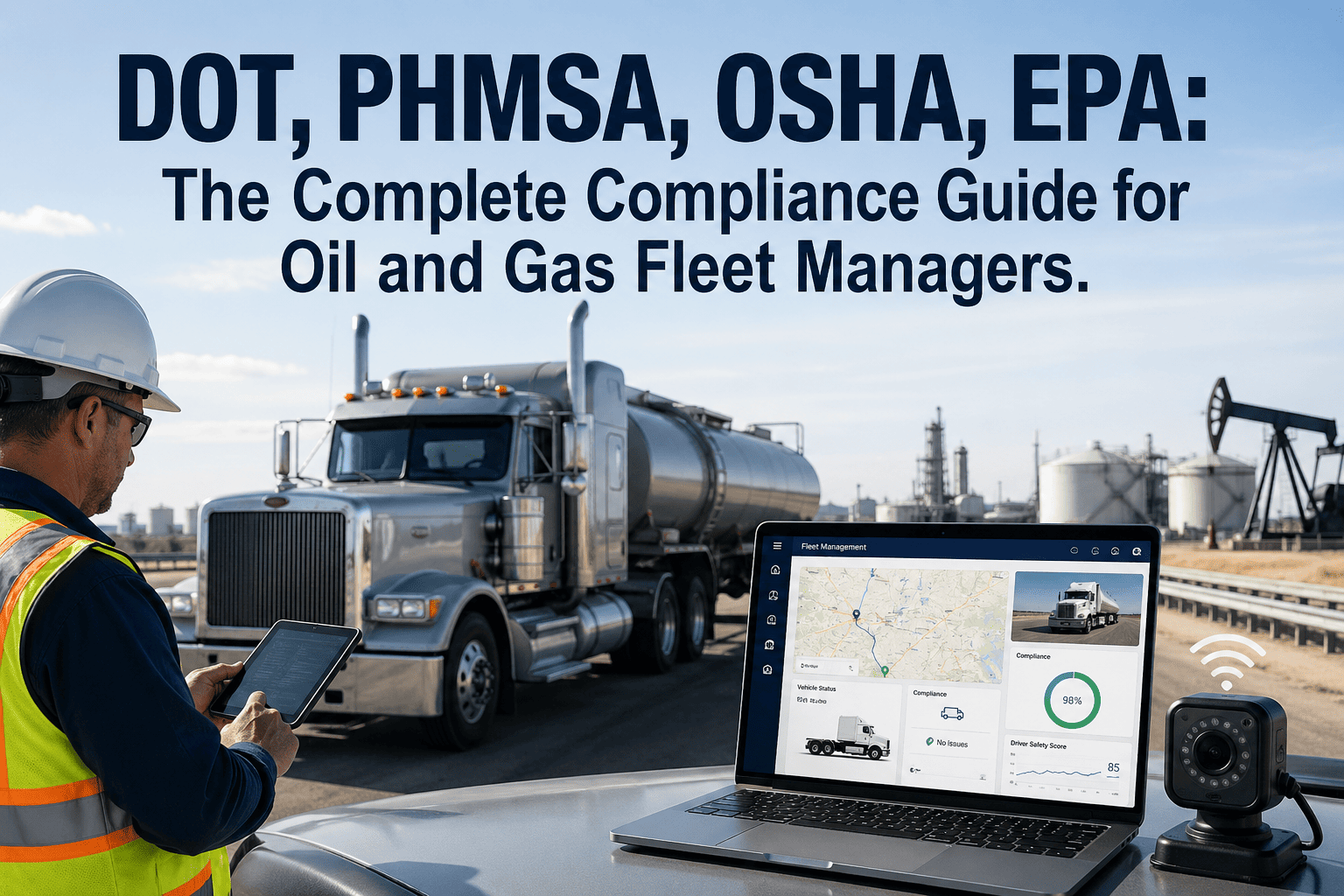
DOT, PHMSA, OSHA, and EPA regulations govern every dimension of oil and gas fleet operations — from driver licensing and vehicle inspection records to HAZMAT transport documentation, wellsite safety standards, and environmental spill prevention obligations. Fleet managers and operations executives who attempt to manage these four overlapping frameworks through disconnected spreadsheets, paper files, and manual reminder systems consistently face audit failures, regulatory penalties, and personal liability exposure when incidents occur. This definitive 2026 compliance guide walks through every regulatory obligation across DOT, PHMSA, OSHA, and EPA frameworks — and explains precisely how FleetRabbit's digital compliance platform automates audit-ready documentation, driver certification tracking, and HAZMAT compliance across all four simultaneously. Book a 30-minute demo to see FleetRabbit's compliance automation in action.
HEROCompliance Guide for Oil and Gas Fleet Managers
Four regulatory frameworks. One automated compliance platform. FleetRabbit gives fleet managers and operations executives audit-ready documentation, certification tracking, and HAZMAT compliance management — without the manual overhead that breaks paper-based systems.
Why Multi-Framework Regulatory Compliance Is the Highest-Risk Gap in Oilfield Fleet Operations
Oil and gas fleet operations sit at the intersection of four independent regulatory frameworks — each with its own inspection requirements, documentation obligations, penalty structures, and enforcement agencies. Managing them in parallel without an integrated system is where compliance failures begin.
The fundamental challenge is not that any single framework is unmanageable — it is that all four must be managed simultaneously, across every vehicle, every driver, and every site, without a single lapsed certificate, missing inspection record, or incomplete shipping document. Paper-based systems and disconnected spreadsheets fail this challenge consistently. The compliance gaps they create are invisible until an enforcement inspection or an incident makes them catastrophically visible.
FleetRabbit was purpose-built to unify all four regulatory obligations into a single digital compliance platform — automating the documentation, tracking, alerting, and audit export functions that paper systems require manual intervention to perform. Start your free trial and see how FleetRabbit consolidates your compliance obligations →
DOT Compliance for Oil and Gas Fleet Operations
The Department of Transportation's Federal Motor Carrier Safety Administration governs commercial vehicle operations through 49 CFR Parts 390–399. For oilfield fleets, DOT compliance is not optional — it is the foundational regulatory obligation affecting every vehicle, every driver, and every trip.
Driver Qualification Files and Licence Verification
49 CFR Part 391 requires operators to maintain a complete Driver Qualification File for every commercial vehicle driver — including valid CDL documentation, medical examiner certificates, employment history, driving record abstracts, and drug and alcohol testing records. Oilfield fleets with drivers moving between sites frequently experience qualification file gaps when certificates expire without automated tracking. FleetRabbit maintains a live digital Driver Qualification File per driver, with automated expiry alerts at 60, 30, and 7 days before any certificate lapses — eliminating the manual checking process that creates regulatory gaps.
PHMSA Compliance: HAZMAT Transport in Oil and Gas Fleet Operations
The Pipeline and Hazardous Materials Safety Administration regulates every aspect of hazardous materials transport — from the shipping paper in the driver's cab to the placard on the tank body to the emergency response information accessible to first responders. PHMSA non-compliance penalties are among the most severe in the regulatory landscape.
Hazardous Materials Shipping Papers (49 CFR Part 172)
Every HAZMAT shipment requires a shipping paper containing the proper shipping name, UN identification number, hazard class, packing group, quantity, and emergency contact telephone number. FleetRabbit stores HAZMAT shipping documentation digitally against each journey — accessible to drivers, dispatchers, and auditors without paper filing retrieval. Documents are timestamped and tamper-evident for enforcement proceedings.
Vehicle Placarding Compliance Verification
49 CFR Part 172 Subpart F mandates specific placards based on cargo class and quantity thresholds. FleetRabbit's pre-trip inspection workflow includes HAZMAT placarding verification checkpoints — confirming correct placement, legibility, and match to shipping documentation before dispatch is authorized. Placard discrepancies trigger automatic work order escalation and dispatch blocking.
HAZMAT Driver Qualification and Training Records
49 CFR Part 177 requires HAZMAT drivers to be trained in recognition, handling, and emergency response procedures for their specific cargo classes. FleetRabbit tracks HAZMAT training completion, endorsement validity, and recertification schedules per driver — preventing dispatch of an unqualified driver to a HAZMAT load before the journey plan is approved.
HAZMAT Incident Reporting Under 49 CFR Part 171
PHMSA requires written incident reports within 30 days for HAZMAT releases during transport — and immediate telephonic reporting for fatalities, injuries, or evacuation events. FleetRabbit's incident documentation module captures GPS location, cargo details, driver information, and photographic evidence automatically upon impact detection — reducing the time from incident to structured regulatory report from days to hours.
OSHA Compliance for Oil and Gas Fleet and Driver Safety
OSHA's oil and gas standards extend beyond wellsite operations to cover every worker at risk — including vehicle drivers operating in or adjacent to hazardous environments. Fleet managers who treat OSHA compliance as a wellsite-only concern consistently miss driver-specific obligations that create enforcement exposure.
H₂S Awareness and Respiratory Protection Standards
29 CFR 1910.134 and 1926.103 require respiratory protection programs for workers potentially exposed to H₂S during transport or site access. FleetRabbit tracks H₂S awareness training completion and respiratory equipment inspection records per driver — creating the documented training history required by OSHA to demonstrate a systematic safety program during enforcement proceedings. Lapsed H₂S certifications trigger automatic dispatch blocking for affected wellsite routes.
Driver Fatigue Standards and Hours of Service Integration
OSHA's General Duty Clause (Section 5(a)(1)) has been applied to driver fatigue cases where employers knowingly dispatched fatigued drivers. FleetRabbit's fatigue monitoring layer goes beyond FMCSA HOS daily limits — tracking cumulative rotation fatigue across multi-day oilfield shift cycles and generating pre-dispatch fatigue alerts that create a documented employer due-diligence record. This dual-framework monitoring (DOT and OSHA) is critical for oilfield fleets running 12–16 hour crew rotations.
OSHA 300 Log and Incident Reporting Requirements
29 CFR 1904 requires employers with 11 or more employees to maintain OSHA 300 injury and illness logs — including vehicle-related incidents that result in work-related injury or illness. FleetRabbit's incident documentation module captures driver injury data, vehicle status, GPS coordinates, and photographic evidence at the time of incident — generating the structured recordkeeping entries required for OSHA 300 log compliance without manual retrospective data collection.
PPE Verification and Wellsite Access Authorization
OSHA standards 29 CFR 1910.132 and 1926.95 require employers to assess hazards and ensure appropriate PPE is provided and used. FleetRabbit's Zone 07 HSE compliance checklist verifies that every vehicle dispatched to a wellsite carries the minimum PPE kit — high-visibility vest, safety footwear, hard hat, eye protection — with photo documentation of PPE presence captured at pre-trip inspection and stored against the vehicle dispatch record for OSHA audit evidence.
EPA Compliance for Oil and Gas Fleet Operations
Environmental Protection Agency regulations impose documentation, spill prevention, and reporting obligations on fleet operations transporting oil, produced water, chemicals, and other environmentally regulated materials. Fleet managers frequently underestimate EPA compliance exposure until an enforcement event reveals the gap.
SPCC Plan Integration for Fleet Operations
The Spill Prevention, Control, and Countermeasure rule (40 CFR Part 112) requires facilities with oil storage above threshold quantities to maintain written SPCC plans covering transport operations. FleetRabbit's vehicle inspection records and fluid integrity documentation provide the operational evidence base that SPCC plans require — documenting pre-trip fluid containment checks, leak detection findings, and corrective action work orders in a tamper-evident audit trail accessible during EPA inspection events.
Produced Water and Flowback Transport Records
Produced water transport is subject to state waste manifest requirements and, where volumes exceed thresholds, federal EPA notification obligations. FleetRabbit maintains structured transport records for produced water tankers — including volume, origin well, disposal facility, chain of custody documentation, and driver certification status — creating the audit trail required for both state and federal environmental compliance review.
Tier II Chemical Inventory Reporting Support
EPCRA Section 312 Tier II reporting requires annual disclosure of hazardous chemicals stored or transported above threshold quantities. FleetRabbit's HAZMAT cargo tracking provides the chemical inventory data — cargo type, UN number, volume, transport frequency — that compliance teams need to complete accurate Tier II submissions without manual inventory reconstruction from dispatch logs.
Emissions Compliance and Vehicle Registry
EPA emissions standards under the Clean Air Act apply to commercial vehicles operating in non-attainment areas or subject to state implementation plan requirements. FleetRabbit maintains vehicle specification records, emission certification status, and OBD-II fault code history — providing the documented evidence base required to demonstrate fleet emissions compliance during EPA regional office inspections.
Spill and Release Incident Documentation
EPA Comprehensive Environmental Response, Compensation, and Liability Act (CERCLA) Section 103 requires immediate notification to the National Response Center for releases of hazardous substances above reportable quantities. FleetRabbit's impact detection and incident documentation module captures GPS location, cargo classification, and vehicle status immediately — providing the factual record required for NRC notification and subsequent EPA incident response coordination.
Waste Manifest Tracking for Drill Cuttings and Chemicals
RCRA Subtitle C hazardous waste manifests must accompany drill cuttings, spent chemicals, and other listed wastes transported from oilfield sites. FleetRabbit stores waste manifest records digitally against each transport event — including generator, transporter, and disposal facility information — creating the complete chain of custody documentation required for RCRA enforcement audits.
How FleetRabbit Solves the Four-Framework Compliance Challenge
Six integrated platform pillars that replace disconnected compliance processes — deployed on your fleet in 5–7 working days with full historical data migration and dedicated onboarding support.
Unified Certification Tracking
Every driver licence, medical certificate, ADR qualification, H₂S awareness certificate, HAZMAT endorsement, and vehicle inspection document tracked in one system — with automated alerts at 60, 30, and 7 days before expiry across all four regulatory frameworks.
Digital DVIR and Inspection Records
Mobile pre-trip and post-trip inspection workflows replace paper DVIRs. Critical defects block vehicle dispatch. Every inspection is timestamped, geotagged, and stored for FMCSA, OSHA, and EPA audit — creating an incontrovertible compliance record across the full fleet lifecycle.
HAZMAT Documentation Management
Shipping papers, UN number records, SDS references, ADR vehicle certificates, and PHMSA transport documentation stored digitally per vehicle and per journey — accessible to drivers and auditors without manual filing retrieval. Auto-matched to driver qualification status before dispatch authorization.
ELD-Compliant HOS and Fatigue Monitoring
FMCSA and OSHA dual-framework fatigue monitoring — ELD-compliant daily HOS limits plus cumulative rotation fatigue tracking across multi-day oilfield cycles. Pre-dispatch alerts and fleet-wide fatigue status on a live dashboard without manual log review.
Incident Documentation and Reporting
Automatic incident evidence package generation — GPS coordinates, vehicle speed, driver HOS status, cargo classification, inspection history, and photographic evidence — structured for DOT, PHMSA, OSHA 300 log, and EPA NRC notification requirements simultaneously.
Audit-Ready Record Export
Complete compliance audit packs generated on demand — inspection history, certification status, incident logs, HAZMAT records, maintenance documentation — in formats compatible with FMCSA, OSHA, PHMSA, and EPA audit requirements. Average generation time: under 2 hours versus 3-day paper retrieval.
FleetRabbit Regulatory Coverage: DOT · PHMSA · OSHA · EPA
| Framework | Key Regulatory Requirements | FleetRabbit Compliance Output |
|---|---|---|
| DOT / FMCSA | 49 CFR Part 391 driver qualification, Part 395 HOS and ELD, Part 396 DVIR and vehicle maintenance, Part 382 drug and alcohol testing | Digital DVIR records, ELD-compliant HOS tracking, driver qualification file automation, FMCSA audit pack export, CSA score monitoring |
| PHMSA | 49 CFR Part 171 incident reporting, Part 172 shipping papers and placarding, Part 177 HAZMAT driver requirements, carrier registration obligations | HAZMAT shipping document storage, driver ADR/HAZMAT certificate tracking, incident evidence package generation, carrier registration expiry monitoring |
| OSHA | 29 CFR 1910.134 respiratory protection, 1904 injury recordkeeping, 1910.132 PPE, General Duty Clause fatigue obligations, H₂S standards | H₂S and PPE certification tracking, OSHA 300 log data capture, fatigue pre-dispatch alerting, incident documentation for enforcement proceedings |
| EPA | 40 CFR Part 112 SPCC, CERCLA Section 103 release reporting, EPCRA Tier II, RCRA waste manifest, Clean Air Act vehicle emissions | Fluid integrity inspection records for SPCC, HAZMAT cargo tracking for Tier II, waste manifest storage, NRC notification evidence package, vehicle emissions certification registry |
| State / Regional | Texas RRC, North Dakota PSC, California CARB, Alberta AER, ADNOC GCC standards, DGMS India, DVSA UK/EU | Configurable compliance record structures per operating jurisdiction, regional audit pack generation, multi-site compliance dashboard with jurisdiction-specific exception flagging |
Executive Reporting and Compliance Intelligence for VP and C-Suite Leaders
For operations VPs and C-suite executives, regulatory compliance is not a field-level operational concern — it is a board-level balance sheet risk. FleetRabbit delivers the real-time compliance intelligence that senior leaders need to intervene before a regulatory incident becomes a financial and reputational crisis.
Live Multi-Framework Compliance Dashboard
Every compliance obligation across DOT, PHMSA, OSHA, and EPA frameworks consolidated on a single live dashboard — open certification gaps, overdue inspection records, HAZMAT document deficiencies, and HOS compliance rates visible to fleet managers and executives simultaneously. Data refreshes every 60 seconds without manual intervention or field supervisor data submission.
Predictive Regulatory Risk Scoring
FleetRabbit's analytics engine identifies drivers and vehicles trending toward high-risk compliance status — combining rising HOS violations, deteriorating inspection scores, approaching certificate expiry, and HAZMAT documentation gaps into a composite risk flag. Intervention is triggered before an enforcement event, not after a citation forces reactive remediation.
Insurance and Legal Evidence Packages
When an incident occurs, FleetRabbit generates a complete, tamper-evident evidence package within minutes — GPS track, speed at impact, HOS history, cargo classification, inspection status, driver certification record, and photographic documentation — structured for simultaneous submission to DOT, PHMSA, OSHA, and EPA as required. Clients report 22% average insurance premium reductions using verified telematics safety records.
Automated Regulatory Digest Reports
Weekly and monthly compliance performance summaries automatically distributed to VP and C-suite stakeholders — covering certification health across all frameworks, inspection completion rates, open incident counts, HAZMAT documentation status, and regulatory risk score trends — without requiring field supervisors to manually compile and submit data upward.
We had FMCSA, PHMSA, and OSHA obligations tracked across three separate spreadsheets, a paper filing system, and a calendar reminder app. FleetRabbit replaced all of it. I now get a weekly digest covering all four frameworks across 11 sites — and the system tells me what needs attention before it becomes a problem, not after an inspector shows up.
Proven Compliance Outcomes at FleetRabbit-Deployed Oilfield Fleets
Frequently Asked Questions
Expert answers to the compliance questions fleet managers and executives ask most about DOT, PHMSA, OSHA, and EPA obligations in oil and gas fleet operations.