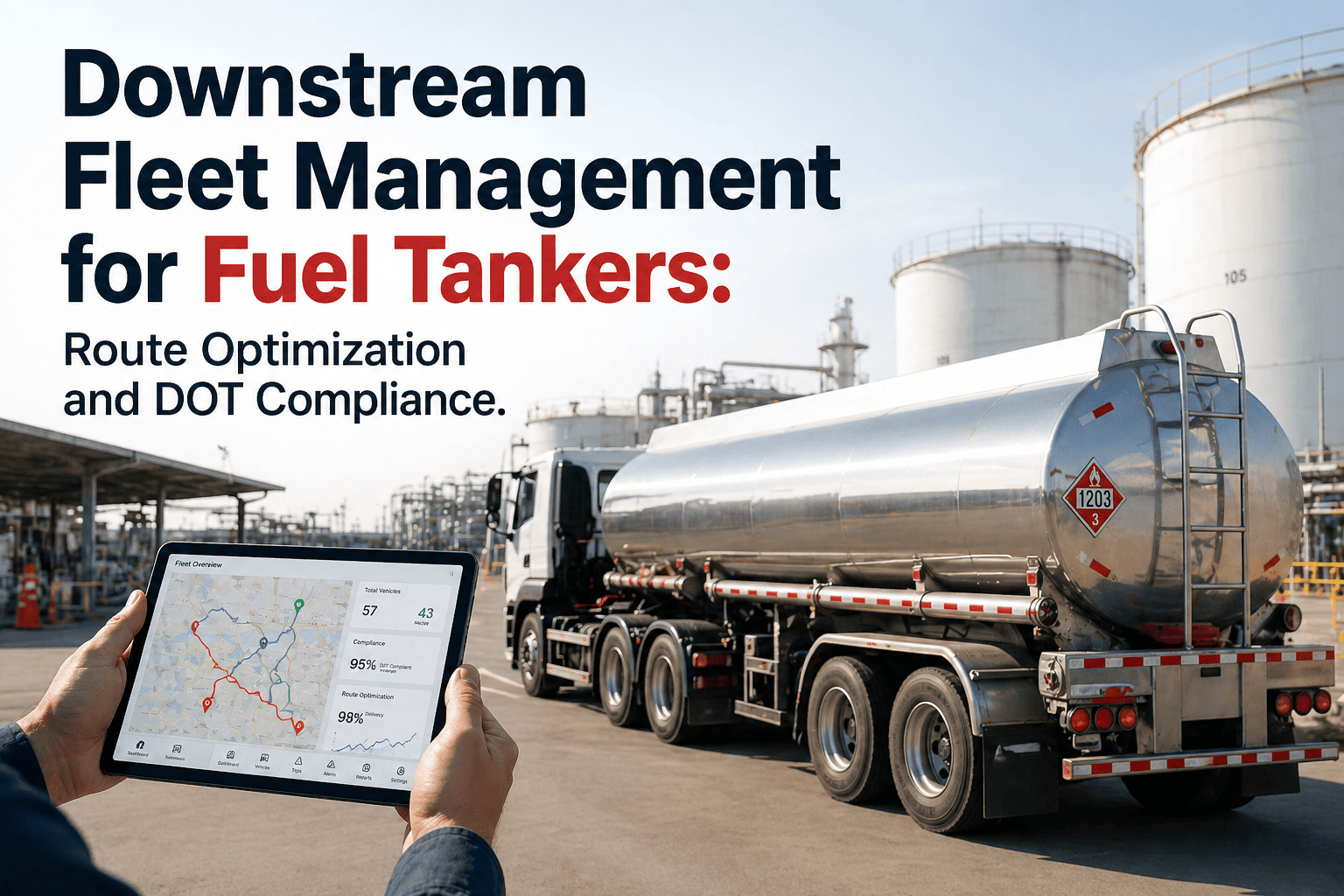
Managing fuel tanker fleets in downstream oil and gas operations isn't just about getting product from terminal to customer — it's about orchestrating multi-stop delivery routes across DOT HOS constraints, maintaining HAZMAT compliance documentation, optimizing load sequencing to minimize product contamination risk, and coordinating real-time schedule changes when customer demand shifts mid-route. In 2026, downstream fleet managers running fuel distribution operations face a complexity matrix that basic dispatch software fundamentally cannot solve: balancing delivery efficiency against regulatory compliance, driver hours against customer commitments, route optimization against safety protocols, and load planning against equipment limitations. Traditional fleet management platforms treat fuel tankers like generic commercial vehicles — ignoring the industry-specific requirements around product compartmentalization, vapour recovery systems, bottom-loading protocols, and the cascade of compliance documentation required for every gallon delivered. FleetRabbit's downstream fleet management platform was purpose-built for fuel distribution operations, integrating route optimization with DOT compliance monitoring, HAZMAT documentation workflows, real-time delivery tracking, and automated scheduling that accounts for driver HOS limits, product compatibility restrictions, and terminal loading constraints. A Gulf Coast fuel distributor managing 87 tanker trucks across retail, commercial, and aviation fuel segments deployed FleetRabbit to replace their legacy dispatch system — achieving 18% reduction in deadhead miles, 34% improvement in on-time delivery performance, zero DOT HOS violations across 12 months, and $340K annual savings from route optimization and compliance automation. This comprehensive analysis explores how downstream fleet managers optimize fuel tanker operations, why generic fleet platforms fail at distribution complexity, and how purpose-built solutions deliver measurable improvements in efficiency, compliance, and profitability. Book a demo to see downstream fuel tanker management in action.
From Manual Dispatch to Intelligent Route Optimization
Why Downstream Fuel Distribution Defies Generic Fleet Management
Fuel tanker fleet management operates under constraints that make conventional fleet optimization approaches fundamentally inadequate. Unlike dry freight or general cargo operations where routing decisions prioritize simple distance and time minimization, downstream fuel distribution requires simultaneous optimization across multiple competing variables: driver hours of service limits, product compartmentalization and contamination prevention, customer delivery windows, terminal loading schedules, equipment capability matching, HAZMAT documentation requirements, and real-time demand volatility. Generic fleet platforms treat these as edge cases to be handled manually; purpose-built downstream systems recognize these as core operational requirements that must be automated to achieve sustainable efficiency.
Critical Constraints in Downstream Fuel Distribution
Multi-Stop Route Complexity
Single tanker serving 8–12 customer locations per day with varying delivery windows, product requirements, and unload times. Manual routing optimization becomes mathematically intractable beyond 5 stops — resulting in 15–25% unnecessary miles from suboptimal sequencing.
DOT Hours of Service Enforcement
Federal HOS regulations limit driving to 11 hours within 14-hour duty period with mandatory 30-minute breaks. Dispatchers manually tracking driver hours across 80+ trucks create scheduling conflicts and compliance violations when routes extend beyond estimated duration.
HAZMAT Documentation Requirements
Every fuel delivery requires shipping papers, emergency response information, driver certification verification, and placard compliance documentation. Missing or incorrect HAZMAT paperwork discovered during DOT inspection results in out-of-service orders and penalty exposure.
Product Compatibility & Compartment Management
Tankers with multiple compartments delivering different fuel grades must prevent cross-contamination through proper sequencing, heel management, and equipment compatibility verification. Manual load planning creates costly product quality incidents and customer complaints.
Real-Time Schedule Disruptions
Customer demand changes, weather delays, traffic incidents, and equipment failures require immediate route re-optimization. Dispatchers using static routing tools spend hours manually recalculating schedules while drivers wait for updated instructions.
Delivery Window Adherence
Retail stations, aviation fueling facilities, and commercial accounts specify narrow delivery windows (often 2–4 hour ranges). Late arrivals create operational disruptions; early arrivals get turned away. Generic routing ignores time window constraints entirely.
The Dispatch Productivity Gap
Fleet managers using spreadsheet-based dispatch systems report spending 3.5–4.5 hours per day on route planning, driver communications, and schedule adjustments for a 40-truck operation. FleetRabbit's automated routing and real-time optimization reduces this to under 45 minutes daily — freeing dispatch capacity to focus on exception handling and customer service rather than repetitive calculation work that algorithms execute in seconds.
The Gulf Coast distributor in our case study had three full-time dispatchers managing 87 trucks using spreadsheets and phone calls. After FleetRabbit deployment, the same fleet runs with two dispatchers handling 15% higher delivery volume. Start free trial — deploy intelligent dispatch in 7–10 days →
AI-Powered Multi-Stop Route Optimization for Fuel Delivery
Route optimization in fuel distribution isn't simply finding the shortest path between points — it's solving a complex constraint satisfaction problem where optimal routes must simultaneously minimize distance, respect delivery time windows, account for driver HOS limits, sequence deliveries to prevent product contamination, match equipment capabilities to customer requirements, and adapt dynamically when real-time conditions change. FleetRabbit's routing algorithm was purpose-built for downstream operations, incorporating fuel-specific constraints that generic optimization engines ignore entirely.
FleetRabbit Route Optimization Intelligence
Delivery Order Aggregation
System ingests customer delivery orders with product types, volumes, delivery windows, unload time estimates, and special requirements (bottom load only, vapor recovery, emergency orders) from dispatch interface or ERP integration
Constraint-Aware Clustering
AI algorithm groups deliveries into feasible routes considering: driver HOS availability, tanker compartment configuration, product compatibility, geographic proximity, and delivery window overlap — creating initial route candidates
Stop Sequence Optimization
For each route, system calculates optimal delivery sequence minimizing total distance while respecting time windows, preventing product cross-contamination through proper sequencing, and ensuring driver completes route within HOS limits
Equipment & Driver Assignment
Platform matches optimized routes to available tankers with compatible compartment configurations and certified drivers with sufficient HOS remaining — automatically accounting for equipment maintenance schedules and driver availability
Real-Time Dynamic Re-Routing
As conditions change (traffic delays, new urgent orders, equipment failures, customer cancellations), FleetRabbit recalculates optimal routes in real-time and pushes updated turn-by-turn directions to driver mobile devices
Route Optimization Impact: Before vs. After FleetRabbit
Before FleetRabbit (Manual Dispatch)
After FleetRabbit (AI Optimization)
Fleet-Wide Route Optimization ROI
Automated DOT HOS Compliance and HAZMAT Documentation
DOT Hours of Service violations and HAZMAT documentation deficiencies represent the two highest-risk compliance areas in fuel tanker operations — with individual violations carrying $5,000–$16,000 penalties, CSA score impacts that trigger intervention from regulators, and potential out-of-service orders that immediately ground vehicles and disrupt customer deliveries. FleetRabbit's compliance automation monitors driver HOS in real-time, prevents routes from being assigned when driver lacks sufficient hours, auto-generates required HAZMAT documentation for every load, and maintains audit-ready compliance records accessible during roadside inspections.
DOT Hours of Service Automation
Real-Time HOS Monitoring
Platform integrates with ELD systems to track driving time, on-duty hours, and required break periods — calculating remaining available hours for each driver in real-time
Violation Prevention Logic
Route assignment engine automatically blocks dispatch if projected route duration exceeds driver's available HOS — preventing violations before they occur rather than discovering them after
Predictive Hours Forecasting
System forecasts when each driver will reach HOS limits based on current route progress — enabling proactive schedule adjustments before driver runs out of hours mid-route
Break Compliance Enforcement
Automated reminders alert drivers when mandatory 30-minute break is approaching — route optimization accounts for required break timing in schedule calculations
HAZMAT Documentation Workflows
Automated Shipping Papers
FleetRabbit auto-generates DOT-compliant shipping papers for every load including: proper shipping name, hazard class, identification number, quantity, emergency contact information
Driver Certification Tracking
System maintains digital repository of HAZMAT endorsements, tank endorsements, and training certifications — blocking load assignment to drivers with expired credentials
Placard Compliance Verification
Platform verifies correct placarding requirements based on product being hauled and generates digital placard display guide for driver reference at loading terminal
Audit-Ready Documentation
Complete compliance records stored digitally and accessible via driver mobile app during roadside inspections — eliminating paper document management entirely
Zero HOS Violations Across 12 Months
Prior to FleetRabbit deployment, the Gulf Coast distributor averaged 2.3 DOT HOS violations per month across their 87-truck fleet — accumulating $89K in penalties over 24 months and degrading their CSA BASIC scores toward intervention thresholds. After implementation, automated HOS monitoring and route blocking prevented all violations — achieving 12 consecutive months with zero HOS citations during DOT inspections and roadside encounters.
DOT compliance automation isn't optional in 2026 — it's the only sustainable way to manage regulatory complexity at scale. FleetRabbit's HOS and HAZMAT systems prevent violations before they occur. Start free trial — deploy compliance automation →
Intelligent Delivery Scheduling and Load Planning
Delivery scheduling in downstream operations extends beyond simply assigning delivery dates — it requires coordinating terminal loading windows, matching tanker compartment configurations to multi-product orders, sequencing loads to prevent contamination, balancing driver workload across the fleet, and adapting schedules dynamically when demand changes or operational disruptions occur. FleetRabbit's scheduling intelligence automates the complex constraint matching that consumes hours of dispatcher time daily when managed manually.
FleetRabbit Scheduling & Load Planning Intelligence
Customer delivery requests flow into FleetRabbit from phone orders, ERP integrations, or customer portal submissions — capturing product type, volume, delivery location, time window preferences, and special handling requirements
System analyzes tanker fleet compartment configurations to identify vehicles capable of handling each delivery — accounting for compartment sizes, vapor recovery equipment, bottom-loading capability, and product compatibility restrictions
Platform schedules terminal loading appointments based on available rack capacity, product availability, and driver arrival timing — preventing terminal congestion and minimizing loading wait times
AI routing engine sequences deliveries optimizing for: distance minimization, time window compliance, product contamination prevention, and driver HOS constraints — generating turn-by-turn navigation for driver mobile app
When disruptions occur (new urgent orders, traffic delays, equipment breakdowns), system recalculates optimal schedules in real-time and updates all affected drivers automatically via mobile push notifications
Load Planning Scenarios: FleetRabbit Intelligence
Multi-Product Compartment Optimization
Contamination Prevention Sequencing
Emergency Order Integration
Real-Time Delivery Tracking and Customer Communication
Downstream fuel distribution customers — whether retail stations, commercial accounts, or aviation facilities — demand delivery visibility and proactive communication about arrival timing, especially when tight operational windows require precise coordination. FleetRabbit's real-time tracking and automated customer notifications transform delivery operations from "the driver will be there sometime today" to precise ETA predictions updated dynamically as route conditions change.
Live GPS Tracking and Geofence Monitoring
Real-time vehicle location tracking with automated notifications when tanker enters customer geofence — typically 15–30 minutes before arrival — allowing receiving facilities to prepare unloading equipment and personnel
Predictive ETA Calculations
AI-powered arrival time predictions accounting for current traffic conditions, historical route timing data, remaining stops on route, and driver break requirements — updated every 5 minutes as conditions change
Automated Customer Notifications
Configurable SMS or email alerts sent to customer contacts at: route start, 2 hours before arrival, 30 minutes before arrival, and upon delivery completion with BOL documentation attached
Digital Delivery Confirmation
Driver captures delivery details via mobile app: product volumes delivered per compartment, meter readings, customer signature, and delivery photos — eliminating paper BOLs and enabling instant customer access to delivery documentation
Exception Alert Management
Automated escalation when delivery delays exceed threshold or customer reports delivery issue — routing alerts to appropriate dispatch personnel based on severity level and enabling proactive customer service recovery
Implementing Downstream Fleet Management Platform
Transitioning from spreadsheet dispatch to intelligent fleet management requires structured deployment that minimizes operational disruption while maximizing speed to value. FleetRabbit's downstream implementation delivers immediate quick-wins in route efficiency and compliance automation within the first week, while building comprehensive platform capability over 30–60 days.
Phase 01: Core Configuration
Phase 02: Automation Activation
Phase 03: Intelligence Optimization
Phase 04: Continuous Improvement
Frequently Asked Questions
How does FleetRabbit's route optimization differ from Google Maps or generic routing tools?
Generic routing tools optimize for shortest path or fastest time between points. FleetRabbit simultaneously optimizes across fuel-specific constraints: driver HOS limits, delivery time windows, product contamination prevention, equipment compatibility, and real-time traffic — constraints that Google Maps doesn't understand.
Can FleetRabbit integrate with our existing ERP system for order intake and billing?
Yes. FleetRabbit offers bi-directional API integration with major petroleum ERP platforms (P97, PDI, Sapphire, ProMax) enabling automated order import, delivery confirmation export, and billing data synchronization without manual duplicate entry.
What happens when emergency orders come in mid-day requiring immediate route changes?
FleetRabbit's real-time re-routing identifies the optimal truck to handle emergency delivery based on current location, remaining HOS, equipment compatibility, and impact to existing customer commitments — then automatically updates driver navigation with revised route in under 60 seconds.
How does the platform prevent DOT HOS violations when routes run longer than expected?
FleetRabbit continuously monitors actual route progress against driver's remaining HOS. If delays threaten to push driver over limit, system alerts dispatch and suggests alternative solutions: re-assigning remaining deliveries, scheduling driver swap, or postponing non-critical stops to next day.
Does FleetRabbit work for mixed fleets handling both petroleum and non-petroleum deliveries?
Yes. Platform manages mixed operations including fuel distribution, lubricant delivery, chemical transport, and dry freight within the same fleet — applying appropriate compliance rules, routing constraints, and documentation requirements based on product type being hauled.
Can customers access delivery documentation and track their deliveries in real-time?
Yes. FleetRabbit includes customer portal where clients can view scheduled deliveries, track live ETA updates, receive automated notifications, and access digital BOL documentation immediately upon delivery completion — reducing customer service call volume by 60–70%.
Replace Spreadsheet Dispatch With Intelligent Fleet Management
FleetRabbit delivers complete downstream platform — multi-stop route optimization, automated DOT/HAZMAT compliance, intelligent load planning, real-time delivery tracking, and customer communication — purpose-built for fuel distribution operations, deployed in 7–10 days, delivering measurable ROI within 30 days.