Drilling site fleet coordination represents one of the most logistically complex challenges in oilfield operations — dozens of service vehicles, fluid haulers, pipe transport units, crew carriers, and specialized equipment converge on active drill sites according to interdependent operational sequences where a single delayed or miscoordinated delivery can halt drilling progress costing $50,000 to $150,000 per hour in rig standby time. FleetRabbit's real-time fleet tracking and dispatch coordination platform eliminates the communication gaps, scheduling conflicts, and visibility blindspots that transform manageable logistical complexity into costly operational disruptions across upstream drilling operations. Schedule a demonstration of FleetRabbit's drilling site fleet coordination capabilities.
Drilling Site Fleet Coordination Guide for Oilfield Operations
Why Drilling Site Fleet Coordination Fails Without Real-Time Visibility
Active drilling operations require synchronized delivery of materials, equipment, and personnel on sequences where timing deviations cascade into exponentially larger operational disruptions. A drilling fluid delivery that arrives two hours late because a dispatcher lacks real-time vehicle position data does not simply delay that delivery — it delays the entire drilling program, idles the rig crew at standby rates, potentially compromises wellbore conditions requiring additional remediation, and creates scheduling conflicts for subsequent service operations that propagate delays throughout the remaining drilling schedule.
The fundamental coordination problem in drilling site fleet management stems from information asymmetry — dispatchers scheduling deliveries lack real-time knowledge of where vehicles actually are, what their current load status is, what traffic or road conditions they face on lease road approaches, and how their arrival timing interacts with competing priorities at the drill site. FleetRabbit eliminates this information asymmetry by providing all coordination stakeholders with a common operational picture of fleet position, status, and estimated arrival data updated continuously from GPS telematics.
Deploy Real-Time Fleet CoordinationFleetRabbit eliminates drilling site fleet coordination failures by giving dispatchers, fleet managers, and drill site supervisors a shared real-time operational picture of every vehicle's position, load status, and estimated arrival time — preventing the information asymmetry that converts minor delays into costly rig standby events. Start your free trial and transform drilling logistics coordination today.
Pre-Spud Fleet Mobilization Planning Framework
Effective drilling site fleet coordination begins weeks before spud date — the mobilization planning phase that determines equipment availability, route feasibility, access permit requirements, and staging logistics determines whether the drilling program launches on schedule or absorbs avoidable delays before the first bit rotation.
Three Weeks Before Spud — Asset Assessment and Route Survey
FleetRabbit's fleet availability dashboard identifies which vehicles in the assigned fleet segment will be in serviceable condition for mobilization — cross-referencing scheduled maintenance windows, predicted service due dates based on current hours, and existing job commitments that could conflict with drilling program mobilization requirements. Route survey coordination identifies load restrictions, bridge weight limits, and permit requirements for oversize or overweight loads on lease road approaches to the drill site location.
One Week Before Spud — Dispatch System Configuration
FleetRabbit dispatch system configuration for the drilling program includes geofence establishment at the drill site pad, staging areas, and key delivery waypoints; delivery sequence schedule upload aligning vehicle assignments with planned operational milestones; and driver assignment confirmation verifying current certification status, route familiarization, and communication equipment functionality for remote location operations. Alert threshold configuration establishes ETA deviation triggers that notify coordinators when delivery timing risks slipping past acceptable windows.
Day Before Spud — Pre-Mobilization Verification
Pre-mobilization vehicle inspection completion through FleetRabbit's digital DVIR platform verifies the mechanical condition of all vehicles assigned to Day 1 mobilization loads — ensuring that pre-trip inspection defects are identified and resolved before mobilization rather than discovered during time-critical delivery sequences. Load verification procedures confirm that all materials required for initial drilling operations are staged, manifested, and assigned to specific vehicles in the dispatch sequence.
Spud Day — Coordinated Mobilization Execution
Spud day fleet coordination through FleetRabbit provides all stakeholders — drilling supervisor, materials coordinator, logistics dispatcher, and company man — with synchronized real-time vehicle position visibility eliminating the radio-dependent coordination that previously required constant verbal check-ins to maintain situational awareness. Automated arrival notifications at geofence boundaries confirm delivery sequence progress without requiring manual vehicle tracking, freeing all parties to focus on operational rather than administrative coordination tasks.
Give Every Coordination Stakeholder Real-Time Fleet Visibility
FleetRabbit's shared operational dashboard eliminates the information silos that force drilling supervisors, materials coordinators, and dispatchers to manage logistics through disconnected radio calls and phone updates — replacing blind coordination with continuous GPS-verified vehicle position and ETA visibility.
Coordinating Fleet Operations During Active Drilling Phases
Active drilling phases create the most demanding fleet coordination environment in oilfield operations — multiple simultaneous delivery sequences, unpredictable demand variations driven by formation conditions, and concurrent access management across drill site infrastructure that was designed for operational sequence rather than logistical flexibility.
Drilling Fluid and Solids Control Logistics
Active drilling fluid management requires continuous supply chain coordination between base fluid delivery, additive transport, weighted material hauling, and produced cuttings removal — all operating simultaneously with sequence dependencies that demand real-time coordination rather than pre-scheduled delivery windows that cannot accommodate formation-driven rate variations. FleetRabbit's live dispatch platform enables logistics coordinators to adjust fluid delivery sequences in response to real-time drilling rate information from rig operations without disrupting other active delivery sequences.
Casing String and Cementing Operations
Casing delivery and cementing operations represent the highest time-sensitivity delivery sequences in the drilling program — casing strings must arrive at the drill site in the correct joint sequence within the specific operational window between total depth achievement and casing running commencement. FleetRabbit coordinates casing delivery tracking with rig operations communication, providing certified ETA data that drilling supervisors use for casing crew mobilization timing decisions.
Drill Pipe and BHA Component Coordination
Drill string management requires coordinated transport of drill pipe, drill collars, and bottom hole assembly components on delivery sequences aligned with planned drilling intervals and anticipated trip requirements. FleetRabbit tracks component deliveries against planned drilling interval schedules, alerting logistics coordinators when delivery timing risks creating inventory shortfalls at the drill site before anticipated requirement dates.
Crew Transport and Personnel Logistics
Crew change transportation at remote drill sites requires precise timing coordination between crew departure from accommodation facilities, site arrival, and outgoing crew departure — logistics failures that strand incoming crews at remote sites or leave rig operations understaffed during crew change windows create both safety exposure and production continuity risk that real-time transport tracking prevents.
Real-time dispatch coordination eliminates the $50,000 to $150,000 per-hour rig standby costs that accumulate when fleet coordination failures delay critical drilling site deliveries — FleetRabbit provides every stakeholder with the shared operational visibility that prevents logistics failures before they become production disruptions. Book a drilling site coordination demonstration for your operation.
Driver Accountability in Drilling Site Fleet Operations
Drilling site fleet operations place unique demands on drivers — remote location navigation, time-sensitive delivery pressure, hazardous material handling, and extended shift operations create a safety and performance risk profile that requires systematic monitoring and accountability beyond what standard commercial fleet operations demand.
Oilfield lease roads present unique speed management challenges — unpaved surfaces with variable conditions, livestock and equipment crossing hazards, and approaching vehicle blind corners require strict speed discipline that operator HSE programs mandate but that without monitoring cannot be systematically verified. FleetRabbit's speed monitoring captures violations with GPS location context, enabling site-specific speed zone enforcement and targeted coaching for habitual violators before safety incidents occur.
Drilling support operations frequently push drivers toward HOS limits through extended shift structures that create regulatory exposure when ELD monitoring is absent or when violations go undetected until DOT roadside inspection. FleetRabbit's ELD integration maintains continuous HOS status monitoring with automated violation alerts before hours limits are reached, enabling dispatch adjustments that maintain compliance without disrupting drilling program continuity.
Every vehicle supporting active drilling operations must complete DOT-compliant pre-trip inspection before each shift — a requirement that time pressure from tight delivery schedules creates systematic risk of abbreviated or skipped inspections. FleetRabbit's digital DVIR platform enforces inspection completion before vehicle dispatch authorization, using mandatory photographic documentation and GPS-verified execution to ensure that pre-trip inspections represent genuine mechanical verification rather than administrative check completion.
Drilling program schedules create fatigue risk through extended operational periods, night shift requirements, and the operational pressure that accompanies time-critical delivery sequences. FleetRabbit's driver behavior monitoring identifies fatigue-associated driving patterns — increased harsh braking frequency, late-night speed spikes, and trip duration outliers — enabling safety managers to intervene with rest requirements before fatigue-impaired driving creates accident risk on remote lease road operations.
Safety and Regulatory Compliance in Drilling Site Fleet Operations
Commercial Vehicle Compliance
All CMV operations supporting drilling programs require current DOT compliance documentation — DVIR records, annual inspection currency, driver qualification files, and ELD logs accessible for roadside inspection. FleetRabbit maintains digital compliance records with automated expiration alerts and one-click audit package generation satisfying DOT documentation requirements within 2 hours of enforcement request versus 40 to 60 hours of manual records assembly.
Client HSE Program Requirements
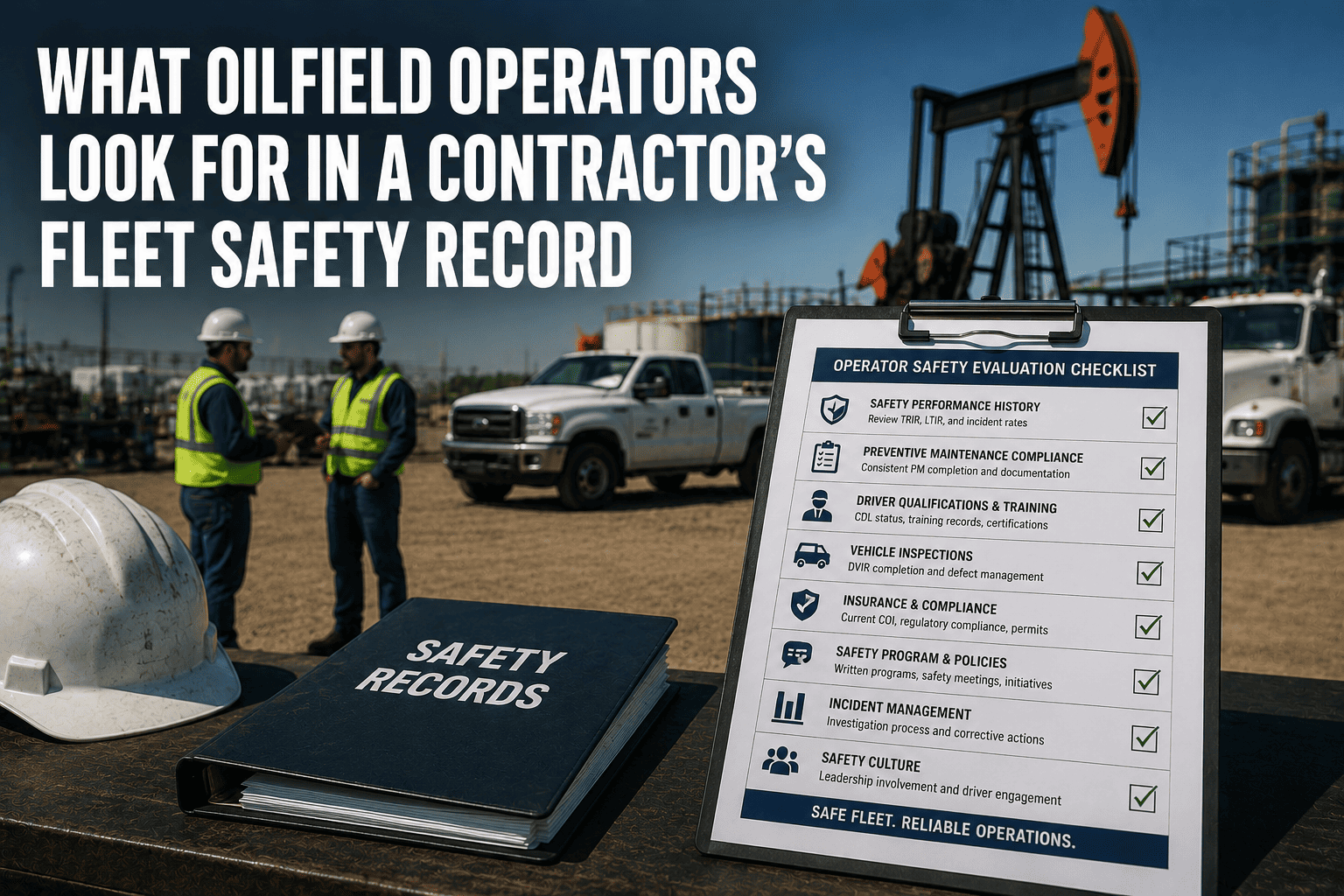
Major operator HSE programs impose transportation safety requirements beyond federal DOT minimums — journey management protocols, vehicle inspection standards, driver qualification minimums, and incident reporting procedures that contractor fleet operations must document through auditable systems. FleetRabbit's inspection and compliance platform provides the documented program execution evidence that client HSE audit teams require during prequalification and operational audits.
Fluid Transport and Spill Prevention
Drilling fluid transport vehicles carrying chemically treated mud or produced water require spill prevention documentation, route-specific response plans, and driver training verification for hazmat transport compliance. FleetRabbit integrates spill kit inventory verification into pre-trip inspection workflows, route restriction enforcement through geofence controls, and incident notification routing that activates environmental response protocols when access to water bodies is detected.
Journey Management and Fatigue Control
Operator HSE programs increasingly require documented journey management plans for remote site operations — planned route verification, maximum continuous driving limits, mandatory rest stops, and real-time monitoring of driver location against planned route. FleetRabbit's GPS tracking and HOS monitoring provide the documented journey management compliance evidence that replaces informal verbal check-in protocols with verifiable position and hours data.
Drilling Logistics Reporting for Operations Leadership and Company Executives
Live Pad Operations Dashboard
Real-time fleet position map filtered to vehicles assigned to the active drilling program provides drilling supervisors and company representatives with live logistics status without requiring radio contact with dispatchers or transport coordinators. Inbound delivery ETA displays enable operational planning — scheduling crane crew positioning, pipe rack preparation, and materials handling personnel for confirmed arrival windows rather than estimated arrival ranges derived from departure time plus distance assumptions.
Multi-Well Program Logistics Performance
Operations managers overseeing multiple concurrent drilling programs require consolidated logistics performance visibility — delivery on-time rates by contractor, vehicle utilization efficiency across the drilling fleet, and logistics-attributable delay frequency analysis that identifies coordination improvement opportunities across the broader drilling program portfolio.
Transportation Safety and Compliance Documentation
HSE teams require drilling program transportation safety documentation for internal audit processes, operator HSE program submissions, and regulatory compliance verification. FleetRabbit generates comprehensive transportation safety reports covering inspection compliance rates, driver safety performance, incident records, and journey management documentation in formats meeting both internal HSE program standards and operator client reporting requirements.