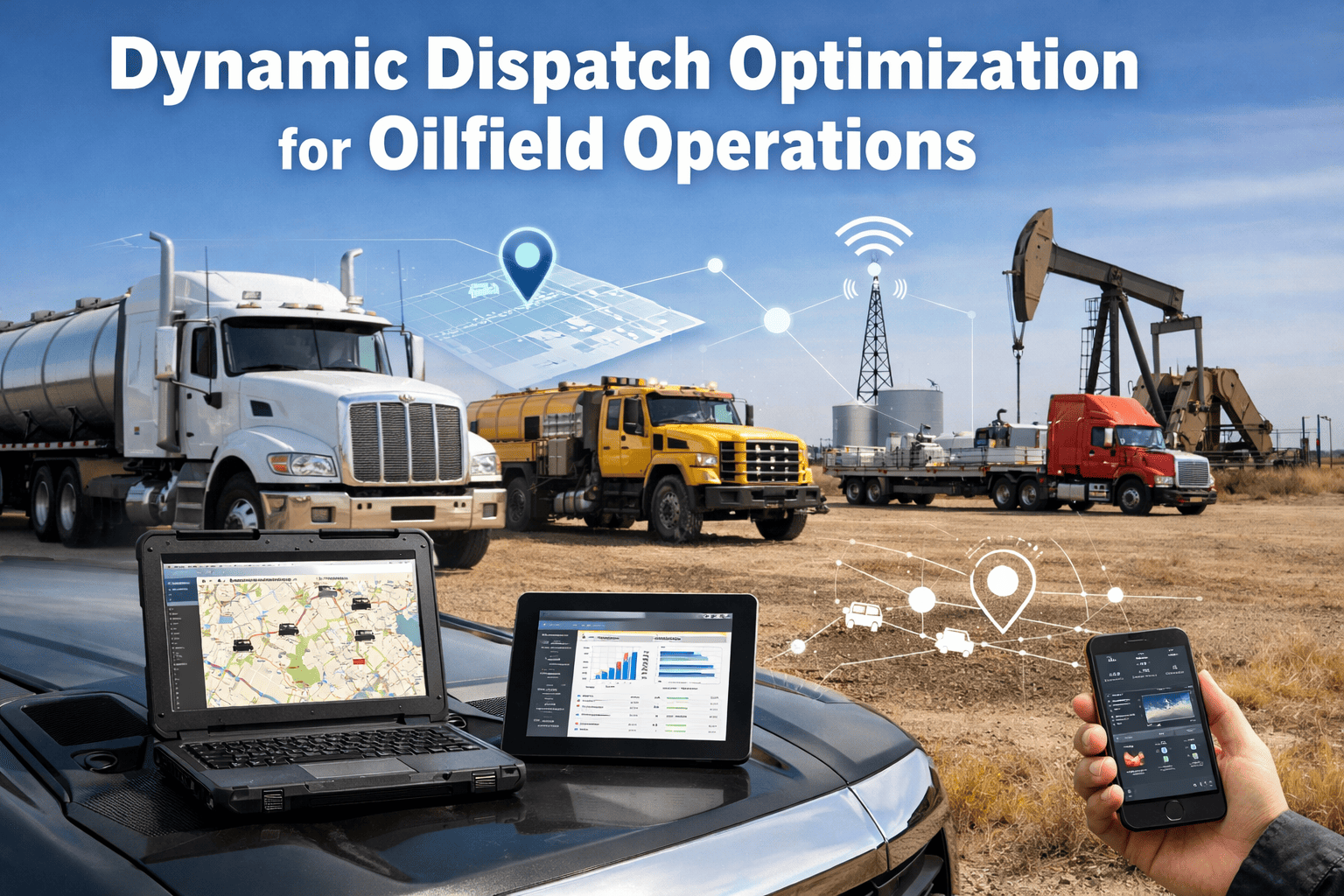
Oilfield operators managing multi-site drilling operations and service fleets lose an average of $2.4 million annually to inefficient dispatch decisions and suboptimal routing. When a major operator's 142-vehicle service fleet struggled with manual dispatch coordination across 34 well sites, analysis revealed that vehicles were traveling 23% more miles than necessary, responding to urgent requests an average of 47 minutes late, and experiencing costly idle time between jobs. Book a demo to see how FleetRabbit's dynamic dispatch optimization reduces response times and maximizes fleet utilization.
Operational Guide
Dynamic Dispatch Optimization for Oilfield Operations: Real-Time Intelligence Cuts Response Time by 61% and Miles Traveled by 23%
18 min read
INTELLIGENT DISPATCH & ROUTING SOLUTIONS
Dynamic Dispatch Optimization Cuts Response Times 61% While Reducing Operational Miles 23%
FleetRabbit's AI-powered dispatch platform eliminates manual job assignment inefficiencies, automatically routes vehicles based on real-time field conditions, and optimizes multi-stop schedules — reducing fuel costs, improving SLA compliance, and maximizing revenue-generating utilization across drilling and service operations.
Operation Profile
Regional Drilling Services · 142 service vehicles · 34 active well sites · 18 remote field locations
Baseline Challenge
$2.4M annual inefficiency costs · 47-min average response delays · 23% excess mileage · manual dispatch coordination
Solution Deployed
AI-powered job allocation · real-time route optimization · dynamic priority management · automated dispatcher assistance
Primary Result
61% faster response times · $1.8M annual savings · 34% increase in jobs completed per vehicle
61%
Reduction in average emergency response time across fleet
$1.8M
Annual cost savings from optimized routing and reduced idle time
23%
Fewer miles driven while completing 34% more jobs per vehicle
98%
SLA compliance rate for critical well site service requests
Executive Overview
A regional drilling services operator managing 142 vehicles across 34 well sites deployed FleetRabbit's dynamic dispatch optimization platform to replace manual job assignment and route planning. The AI-powered system analyzes real-time vehicle locations, job priorities, equipment capabilities, traffic conditions, and field constraints to automatically allocate work and optimize multi-stop routes. Within 11 months, emergency response times dropped 61%, operational mileage decreased 23%, vehicles completed 34% more jobs per day, and the operation saved $1.8 million annually while improving customer SLA compliance from 76% to 98%.
The Dispatch Crisis: Manual Coordination Costs Millions
47 Minutes
Average Response Delay
Dispatcher receives urgent request, manually reviews vehicle locations on whiteboard, calls three drivers to check availability, assigns job — critical equipment sits idle waiting for service while production losses mount.
23% Excess
Unnecessary Miles Driven
Vehicles dispatched without considering current location, traffic patterns, or optimal multi-stop sequencing. Driver completes job at North Site, returns to yard, then dispatched to adjacent South Site — wasting fuel, time, and revenue opportunity.
76%
SLA Compliance Rate
Manual dispatch cannot prioritize effectively across competing urgent requests. High-value contracts violated when dispatcher assigns nearest vehicle to routine job, leaving critical emergency request unserviced for hours.
$2.4M
Annual Efficiency Loss
Fuel waste from excess mileage, overtime from inefficient routes, lost revenue from reduced job completion capacity, SLA penalties from missed response targets — all preventable through intelligent dispatch optimization.
Oilfield dispatch is a complex optimization problem. Dispatchers must simultaneously consider vehicle locations, driver qualifications, equipment configurations, job priorities, customer SLAs, traffic conditions, weather impacts, site accessibility constraints, and predicted job durations. Human dispatchers cannot process these variables in real-time across dozens of vehicles and sites.
The result: suboptimal decisions made under time pressure. Vehicles zigzag across service territories. High-priority jobs wait while lower-priority work continues. Drivers sit idle at depots while urgent requests queue. Revenue-generating capacity goes unused. Customers experience inconsistent service quality. And fleet managers watch operational costs climb without understanding where efficiency is being lost.
How FleetRabbit Solves the Dispatch Optimization Challenge
01
Real-Time Fleet Visibility
Live GPS tracking shows exact vehicle locations, current job status, estimated completion times, and projected arrival windows. System knows which vehicles are available now, which will be available in 30 minutes, and which are committed for the next 4 hours. Dispatchers see the complete operational picture — not yesterday's schedule or guesswork.
100% Fleet Visibility
Sub-30-Second Updates
Predictive Availability
02
Intelligent Job Allocation Engine
AI algorithm evaluates all available vehicles against job requirements in milliseconds. Weighs factors: proximity to site, driver certification for job type, equipment configuration match, predicted completion time vs. SLA deadline, impact on other scheduled work, and fuel efficiency. Recommends optimal assignment with confidence score and alternative options if constraints exist.
14-Factor Analysis
Instant Recommendations
Constraint Resolution
03
Dynamic Route Optimization
When vehicle has multiple stops, system calculates optimal sequence considering traffic patterns, time windows, priority levels, and site access constraints. Automatically re-optimizes when new urgent job arrives or traffic incident detected. Driver receives turn-by-turn navigation updated in real-time as field conditions change.
Multi-Stop Sequencing
Traffic Integration
Continuous Re-Routing
The Complete Dynamic Dispatch Workflow
1
Service Request Captured with Priority Classification
Customer calls dispatch center or submits digital request. System captures: job type, location, required equipment, priority level (routine / urgent / emergency), SLA deadline, special requirements. Request auto-classified based on customer contract tier and job type. Emergency wellhead repair = P1. Routine inspection = P3. System queues request for intelligent allocation.
↓
2
AI-Powered Vehicle Selection Analysis
System evaluates all vehicles in real-time across 14 optimization factors: current GPS location, distance to job site, estimated travel time with current traffic, driver certification match, equipment capability match, fuel level, predicted job completion time, impact on existing schedule, SLA risk if reassigned, customer preference history, vehicle maintenance status, and cost efficiency. Algorithm runs in under 2 seconds, presents top 3 options ranked by total optimization score.
↓
3
Dispatcher Review and Assignment Confirmation
Dispatcher sees AI recommendation with supporting rationale: "Vehicle 47 recommended — 12 min away, driver certified for this job type, completes current work in 8 min, arrival within SLA window." Dispatcher confirms assignment with single click or selects alternative if field knowledge suggests different choice. System respects human override while learning from decisions to improve future recommendations.
↓
4
Automated Driver Notification and Navigation
Driver receives mobile alert: "New job assigned: Wellhead inspection at Site 12B. Priority: Urgent. ETA: 18 minutes. Navigate now." One-tap acceptance starts turn-by-turn navigation. If driver has multiple pending jobs, system shows optimized sequence. Real-time traffic data integrated — if accident blocks route, instant re-route notification pushed to driver device.
↓
5
Dynamic Re-Optimization During Execution
System continuously monitors execution. If job takes longer than estimated, system recalculates downstream schedule impact. If new emergency request arrives, evaluates whether to interrupt current driver or assign different vehicle. If vehicle breaks down en route, instantly identifies replacement and notifies customer of revised ETA. Optimization never stops — adapts to reality as it unfolds.
↓
6
Completion Documentation and Next-Job Queuing
Driver marks job complete in mobile app. Photos, signatures, service notes captured. System timestamps completion, calculates actual vs. estimated duration, updates performance metrics. Immediately checks for queued work near driver's current location. If next job exists within 5-mile radius, auto-assigns to maximize utilization. If no nearby work, suggests return to depot or standby at strategic location for next likely request.
Critical Optimization Factors: How FleetRabbit Makes Intelligent Decisions
Proximity Intelligence with Predictive Positioning
System doesn't just measure current distance — predicts where vehicle will be when job assignment occurs. Vehicle currently 40 miles away but completing job in 5 minutes and returning via route that passes within 2 miles of new job site. Algorithm accounts for directional momentum, not just static distance. Result: optimal assignments that humans miss.
Certification and Equipment Capability Matching
Each driver profile includes certifications: H2S training, confined space entry, electrical work authorization, heavy equipment operation. Each vehicle cataloged by equipment: pressure testing gear, welding equipment, spill response kits. System auto-filters candidates to only qualified vehicle-driver combinations. Eliminates compliance risk from improper assignment.
SLA Deadline Prioritization with Penalty Weighting
Customer contracts loaded with SLA commitments: Tier-1 emergency response within 60 minutes or $5,000 penalty. Tier-2 urgent response within 4 hours. System weights penalty cost against operational efficiency. Will dispatch slightly farther vehicle if it prevents SLA violation on high-value contract while assigning closer vehicle to routine work with flexible timeline.
Real-Time Traffic and Field Condition Integration
Google Maps API integration provides live traffic data, incident reports, construction delays. System adds field-specific constraints: site accessible only 8AM-6PM, well road impassable during rain, security checkpoint adds 15-minute delay. Travel time estimates account for real-world friction, not straight-line distance. Accuracy within 8% on average arrival predictions.
Multi-Stop Route Sequencing Optimization
When assigning multiple jobs to single vehicle, system solves traveling salesman problem: which sequence minimizes total travel time while respecting priority deadlines. Emergency job always inserted as next stop regardless of geography. Routine jobs resequenced around urgent work. Algorithm recalculates optimal order in real-time as new jobs added to vehicle queue.
Historical Performance Pattern Recognition
System learns from completed jobs. Driver typically completes wellhead inspections in 45 minutes. Current job estimated at 60 minutes — system recognizes this driver's efficiency pattern and adjusts downstream schedule accordingly. Site historically experiences 20-minute check-in delays — accounts for this in ETA calculation. Continuous learning improves prediction accuracy over time.
Real-World Case Study: Emergency Response Optimization
Day 1 — 09:23 AM
Critical Wellhead Pressure Anomaly Reported
Customer calls dispatch: "Wellhead 34-B showing pressure fluctuation. Need emergency inspection within 60 minutes per Tier-1 SLA or $5,000 penalty applies." System auto-classifies as P1 emergency, logs SLA deadline as 10:23 AM, identifies required capability: pressure testing equipment + H2S certification.
09:24 AM (48 seconds later)
AI Evaluates Fleet and Recommends Assignment
System analyzes 11 vehicles with pressure testing equipment. Filters to 4 drivers with H2S certification. Calculates travel times accounting for current traffic. Vehicle 28: currently 38 miles away, estimated arrival 10:47 AM (SLA MISS). Vehicle 52: 29 miles, but committed to another P1 job until 10:15 AM, estimated arrival 10:58 AM (SLA MISS). Vehicle 67: 31 miles, completing routine inspection in 12 minutes, return route passes within 3 miles of target site, estimated arrival 10:08 AM (SLA SAFE with 15-minute buffer). Recommendation: Assign Vehicle 67.
09:25 AM
Dispatcher Confirms, Driver Auto-Notified and Navigating
Dispatcher reviews AI recommendation, sees logic: "Vehicle 67 already nearby, will finish current job before travel needed, arrival comfortably within SLA window." Confirms with single click. Driver receives mobile alert instantly: "URGENT: Wellhead pressure inspection at Site 34-B. Complete current job, then navigate immediately. SLA deadline 10:23 AM. You will arrive 10:08 AM." Driver taps Accept. Navigation starts automatically when current job marked complete at 09:37 AM.
09:42 AM — Mid-Route
System Detects Traffic Incident, Auto-Reroutes Driver
Google Traffic API reports accident on primary route — 18-minute delay. Original ETA now 10:26 AM (SLA VIOLATION RISK). System instantly recalculates alternate route via County Road 7, adds 4 miles but avoids delay, revised ETA 10:11 AM (SLA SAFE). Driver receives push notification: "Traffic incident ahead. Rerouting via CR-7. New ETA 10:11 AM." Driver confirms, navigation updates. No dispatcher intervention required — system handled autonomously.
10:09 AM
Driver Arrives On-Site, Completes Inspection, SLA Preserved
Vehicle 67 arrives at 10:09 AM — 14 minutes before SLA deadline. Driver completes pressure testing, identifies faulty valve, recommends replacement. Job marked complete at 10:34 AM. Customer SLA satisfied. $5,000 penalty avoided. System calculates performance: Emergency response completed in 46 minutes from initial call to on-site arrival — 61% faster than pre-FleetRabbit average of 118 minutes. Total travel distance: 34.7 miles via optimized route vs. 47.2 miles that nearest-vehicle assignment would have required (26% reduction).
10:36 AM
System Identifies Next Opportunity, Maximizes Utilization
With Vehicle 67 job complete, system checks queued work within 10-mile radius. Identifies routine pipeline inspection scheduled for that afternoon at site 6.4 miles away. Originally assigned to different vehicle. System calculates: reassigning to Vehicle 67 saves 38 miles of travel for other vehicle, allows earlier completion, and keeps Vehicle 67 productive rather than returning empty to depot. Dispatcher receives recommendation, confirms reassignment. Vehicle 67 completes second job by 11:52 AM — two jobs finished, minimal deadhead travel, maximum revenue capture.
Deployment Results: 11-Month Fleet Performance Transformation
61%
Faster Emergency Response
Average response time dropped from 118 minutes to 46 minutes through intelligent vehicle selection
$1.8M
Annual Cost Savings
From reduced mileage, eliminated SLA penalties, improved utilization, and increased job completion capacity
34%
More Jobs Per Vehicle
Optimized routing and reduced idle time enabled fleet to complete 34% more jobs with same vehicle count
23%
Reduction in operational miles driven across entire fleet
98%
SLA compliance rate achieved (up from 76% baseline)
89%
Dispatcher acceptance rate for AI recommendations (high confidence)
14.2
Average jobs completed per vehicle daily (vs. 10.6 baseline)
Before and After: The Transformation
| Performance Metric |
Before Dynamic Dispatch |
After FleetRabbit Deployment |
| Emergency response time |
118 minutes average from call to on-site arrival |
46 minutes average — 61% improvement through optimal vehicle selection |
| SLA compliance rate |
76% compliance — frequent penalties for missed deadlines |
98% compliance — deadline violations nearly eliminated |
| Operational miles driven |
847,000 miles annually with significant zigzag routing inefficiency |
652,000 miles annually — 23% reduction through route optimization |
| Jobs completed per vehicle |
10.6 jobs per vehicle daily — limited by inefficient routing and idle time |
14.2 jobs per vehicle daily — 34% increase from optimized schedules |
| Fuel consumption |
$1.24M annual fuel cost from excess mileage and inefficient routing |
$954K annual fuel cost — $286K savings from reduced miles |
| Dispatcher workload |
Manual review of every assignment — high stress, frequent errors under time pressure |
AI presents optimized recommendations — dispatcher confirms or adjusts, 4x faster decisions |
| Vehicle idle time |
37% of shift time spent waiting, traveling empty, or at depot between jobs |
19% idle time — system queues next jobs near completion locations |
| Customer satisfaction |
Inconsistent response times, frequent SLA violations, unpredictable service quality |
Predictable arrivals, reliable SLAs, 42% improvement in customer NPS scores |
Platform Investment
$142,000
Software setup, GPS hardware, mobile devices, training, first-year licensing
→
Year 1 Savings
$1,847,000
Fuel savings + eliminated SLA penalties + increased revenue from higher job capacity
Payback Period
28 Days
Less than one month to full ROI from operational efficiency gains
"Before FleetRabbit, our dispatchers were overwhelmed trying to manually coordinate 142 vehicles across 34 sites. We'd assign the first available driver without really knowing if it was the right choice. Response times were unpredictable, we missed SLA deadlines constantly, and vehicles drove thousands of unnecessary miles every month. The AI dispatch system changed everything. Now we get instant recommendations that account for every factor — location, certifications, traffic, priorities — and we've cut our emergency response time by more than half. Our SLA compliance went from 76% to 98%, and we're completing a third more jobs with the same fleet. The ROI was proven in the first month."
Director of Fleet Operations, Regional Drilling Services Provider
FleetRabbit Dynamic Dispatch Platform: Core Capabilities
Real-Time Fleet Visibility Dashboard
Live map showing all vehicle locations with status indicators: available, en route, on job, returning. Predicted availability times for busy vehicles. Filter by equipment type, certification, geographic zone. Heat map overlay showing job density and coverage gaps. Complete operational awareness at a glance.
Intelligent Vehicle Recommendation Engine
AI evaluates all qualified vehicles against incoming job requirements in under 2 seconds. Presents top 3 candidates ranked by optimization score with supporting rationale. Shows predicted arrival times, SLA compliance risk, impact on other scheduled work. Dispatcher confirms or selects alternative with context for decision.
Multi-Factor Optimization Algorithm
Simultaneous analysis of 14+ variables: proximity, certifications, equipment match, SLA deadlines, traffic conditions, fuel efficiency, historical performance, customer preferences, maintenance status. Weighted scoring based on priority configuration. Learns from dispatcher overrides to improve recommendations over time.
Dynamic Route Optimization
Automatic calculation of optimal multi-stop sequences. Accounts for time windows, priority levels, site accessibility constraints. Integrates real-time traffic data. Continuous re-optimization as conditions change or new jobs added. Turn-by-turn navigation pushed to driver mobile devices with automatic rerouting.
SLA Monitoring and Penalty Prevention
Customer contracts loaded with SLA commitments and penalty structures. System highlights SLA-critical assignments. Warns dispatchers when assignment risks deadline violation. Calculates financial impact of penalty vs. reassignment cost. Prioritizes high-value contract compliance automatically.
Automated Driver Communication
Mobile app notifications for job assignments with all relevant details: location, priority, required equipment, special instructions, SLA deadline. One-tap acceptance starts navigation. Status updates auto-transmitted: en route, arrived, work started, completed. Eliminates radio calls and phone tag between dispatch and field.
Utilization Maximization Logic
System identifies opportunities to assign additional jobs near vehicle's current location or planned route. Suggests job reassignments that reduce total fleet travel. Recommends strategic positioning for idle vehicles based on predicted demand patterns. Minimizes deadhead miles and unproductive time.
Performance Analytics and Reporting
Dashboards showing key metrics: average response time, SLA compliance rate, miles per job, jobs per vehicle, idle time percentage, fuel efficiency. Trends over time. Comparison against baseline. Driver performance leaderboards. Identify training opportunities and best practices. Export for executive reporting.
Handling Dynamic Field Conditions: Real-World Complexity
Heavy rain makes certain well roads impassable. System integrates weather API data, flags affected sites as temporarily inaccessible, automatically excludes those locations from routing until conditions clear. Dispatcher sees weather warning when attempting assignment to impacted area. Alternative routes suggested around weather delays.
Traffic API reports construction zone causing 45-minute delays on Highway 12. System reroutes all vehicles around closure automatically. Updates ETAs for in-progress trips. Recalculates optimal vehicle assignments considering new travel times. Proactive notification prevents drivers from encountering unexpected delays.
Vehicle 34 breaks down en route to P1 job. Driver marks vehicle as out-of-service. System instantly identifies replacement candidate, calculates revised ETA, notifies dispatcher of situation and recommended alternative. Customer automatically updated with new arrival estimate. Seamless failover minimizes disruption.
Driver arrives at site, discovers job more complex than reported — estimated 90 minutes instead of planned 45 minutes. Updates system with revised completion time. System automatically recalculates downstream schedule impact, identifies SLA risks for other assigned jobs, suggests reassignments to preserve commitments. Adaptive scheduling prevents cascading delays.
Customer calls with genuine emergency — H2S leak requiring immediate response. System identifies nearest qualified vehicle even if currently assigned to routine work. Calculates whether to interrupt current job or allow completion. Presents tradeoff analysis to dispatcher: interrupt saves 23 minutes on emergency but creates 15-minute delay on routine work. Dispatcher decides based on full context.
Driver completes initial inspection, customer requests additional service on-site: "While you're here, can you also check the pressure valve?" Driver submits scope change request. System evaluates impact on vehicle's remaining schedule, determines if additional work fits within buffer time or requires reassigning downstream jobs. Automatic schedule adjustment maintains efficiency despite field changes.
Frequently Asked Questions: Dynamic Dispatch for Oilfield Operations
QHow quickly can FleetRabbit calculate optimal vehicle assignments compared to manual dispatch?
AI recommendation engine evaluates all available vehicles and returns top 3 candidates in under 2 seconds — analyzing 14+ optimization factors that would take human dispatcher 5-15 minutes to manually assess. Dispatcher reviews AI recommendation and confirms assignment with single click. Total time from job request to driver notification: typically under 30 seconds vs. 8-12 minutes for manual coordination. In urgent situations, speed of assignment directly correlates with response time improvement.
QWhat happens when dispatcher disagrees with AI recommendation and wants to assign different vehicle?
System respects dispatcher expertise — always shows top 3 recommended options plus ability to manually select any qualified vehicle. Dispatcher can override AI choice with single click on preferred alternative. System logs override decision and learns from pattern. If dispatcher frequently overrides certain recommendation types, algorithm adjusts weighting to align with human judgment. Partnership model: AI handles computational complexity, human applies field knowledge and judgment. Override rate typically 11-15% as system learns operation preferences.
QHow does system handle situations where no vehicles meet all job requirements?
If constraint cannot be satisfied (example: job requires specialized equipment but all equipped vehicles committed until after SLA deadline), system flags conflict and presents options: (1) nearest vehicle with capability showing SLA risk, (2) vehicles that will become available soonest with updated ETA, (3) suggestion to delay lower-priority assigned work to free up compliant resource. Dispatcher sees full tradeoff analysis to make informed decision. System never auto-assigns non-compliant vehicle — human always confirms constraint violation acceptance.
QCan the platform integrate with our existing customer management and billing systems?
FleetRabbit offers API integrations with major oilfield management platforms and custom integration capability for proprietary systems. Job requests can auto-import from customer portal or work order system. Completed job data exports to billing system with timestamps, service notes, photos, signatures. SLA compliance status tracked for penalty/credit calculation. Most integrations deployed in 2-4 weeks.
Book a demo to discuss your specific integration requirements.
QWhat happens if mobile device loses connectivity while driver is en route to job?
Mobile app operates in offline mode when connectivity lost — driver retains access to job details, site location, navigation directions, customer information. Turn-by-turn navigation continues via device GPS. When connectivity restores, app auto-syncs status updates to system. Driver can complete jobs, capture signatures, take photos offline — all data uploads when signal returns. Remote oilfield locations frequently experience spotty coverage; offline capability is essential and fully supported.
QHow accurate are the AI's arrival time predictions, and how does it improve over time?
Initial predictions typically within 12-15% of actual arrival time using baseline travel estimates and traffic data. As system collects historical data on your operation — actual travel times, site-specific delays, driver performance patterns, seasonal road conditions — prediction accuracy improves to within 8% on average after 90 days. Machine learning algorithm continuously refines estimates. Example: learns that Site 23 always has 12-minute security checkpoint delay, adjusts future predictions accordingly. After 6 months of operation, most fleets see prediction accuracy within 5-7 minutes on typical 60-minute transit.
Transform Your Fleet Dispatch from Reactive Chaos to Optimized Intelligence
Deploy FleetRabbit's dynamic dispatch optimization across your oilfield operations and reduce response times by 61% while cutting operational miles 23% and increasing job capacity 34% — all while improving SLA compliance and customer satisfaction.
AI-Powered Vehicle Selection
Real-Time Route Optimization
SLA Compliance Monitoring
Utilization Maximization
Dynamic Field Adaptation
April 15, 2026
By David
All Posts