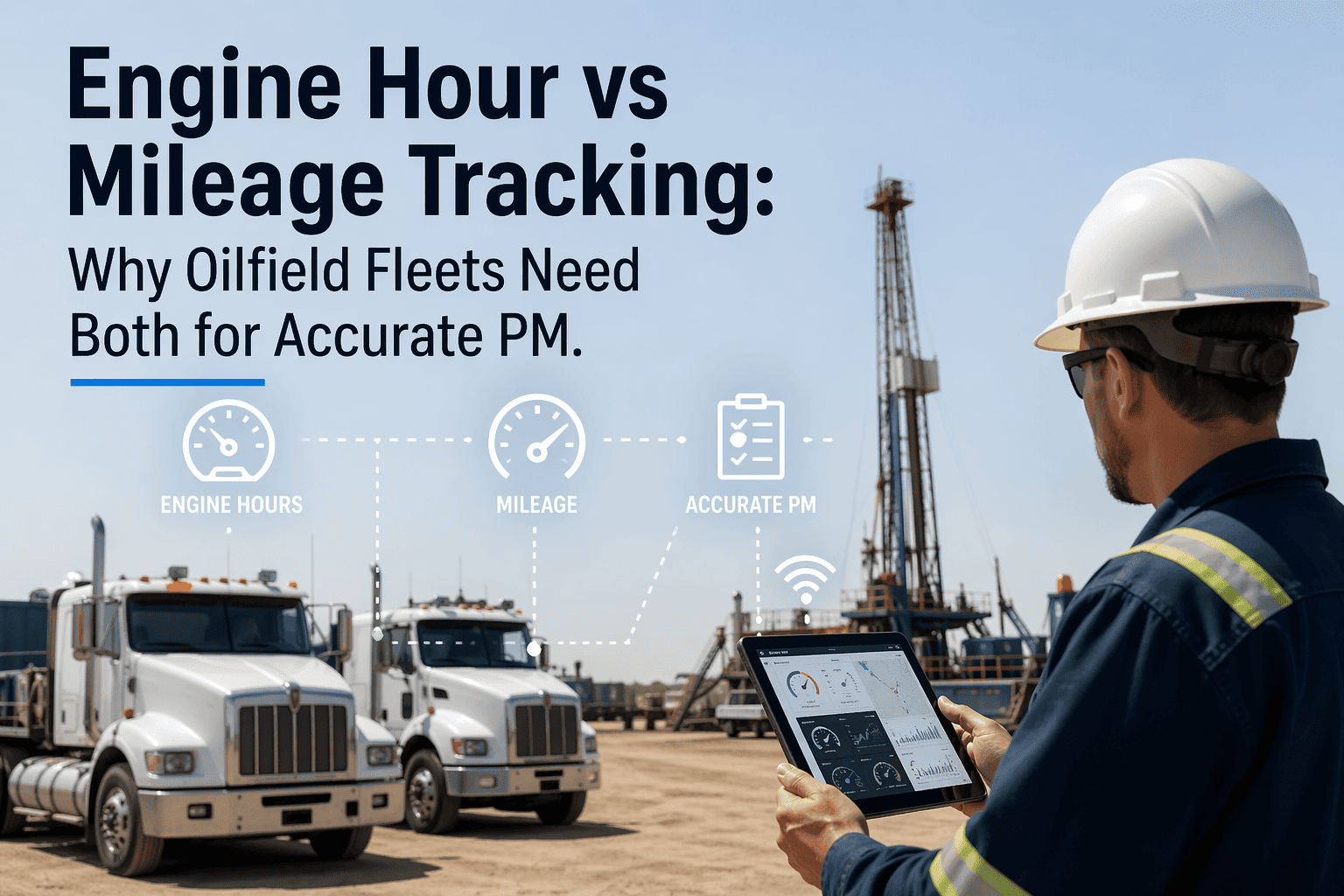
The moment a wellsite frac truck operator shuts down the engine and reports "we just finished the job," the fleet maintenance system records a number: 840 miles driven. What the mileage counter doesn't show is the 47 hours that same truck spent idling under load at the wellsite — pumping, pressurizing, and operating hydraulic systems while the odometer barely moved. That 47-hour operational window is where the engine wore, the transmission heated, the alternator cycled, and the coolant system degraded — but if your preventive maintenance schedule only tracks mileage, none of that wear registers as service-interval accumulation. FleetRabbit's dual-trigger PM engine solves this: tracking both engine hours and mileage simultaneously across every oilfield vehicle, triggering the correct service interval based on whichever threshold arrives first. Book a demo to see how FleetRabbit tracks engine hours and mileage for precise oilfield PM scheduling.
Oilfield Fleets Need Both for Accurate Preventive Maintenance
Mileage-only PM scheduling misses the mechanical wear that oilfield vehicles accumulate during stationary operations — idling under load, hydraulic cycling, and wellsite duty. FleetRabbit triggers preventive maintenance from engine hours AND mileage, ensuring every service interval reflects actual operating stress, not just distance traveled.
Why Mileage-Only PM Scheduling Systematically Fails Oilfield Fleets
A highway transport fleet's maintenance paradigm is simple: vehicles accumulate wear through distance traveled. Oil changes at 10,000 miles, tire rotations at 7,500 miles, transmission service at 60,000 miles. The relationship between mileage and mechanical stress is linear and predictable because the engine operates under relatively consistent load conditions — highway cruise speed, minimal idle time, predictable RPM ranges.
Oilfield vehicles operate in the opposite condition. A frac truck may sit at a wellsite for 12 hours running hydraulic pumps, cycling the transmission between forward and neutral 400 times, operating the PTO system under load, and maintaining engine RPM at 1,800–2,200 for extended periods — all while the odometer accumulates 6 miles driving between the yard and the site. That 12-hour operational period produces engine wear, transmission heat cycling, alternator load stress, and coolant system degradation equivalent to 300+ highway miles — but the PM schedule sees it as 6 miles of service interval consumption.
The result: critical service intervals arrive weeks or months before the mileage counter triggers the scheduled maintenance appointment. Engine oil degrades from extended high-temperature operation. Transmission fluid breaks down from thermal cycling. Coolant loses effectiveness from prolonged heat exposure. But the maintenance schedule — programmed to trigger at 10,000 miles — never flags the vehicle for service because it's only at 4,200 miles despite having accumulated 340 engine hours of operational stress.
How Different Oilfield Vehicle Types Accumulate Engine Hours vs Mileage
The hour-to-mileage ratio varies dramatically by oilfield vehicle type — making single-trigger PM scheduling impossible to calibrate correctly across a mixed fleet.
Spend majority of operational time stationary at wellsite running hydraulic pumps and PTO systems under high load. A typical 8-hour deployment accumulates 50–80 miles of travel but 8–10 engine hours of wear.
Operate in mixed duty cycles — hauling water between sources and wellsites (mileage accumulation) plus extended idle periods during loading, unloading, and wellsite standby (engine hour accumulation without mileage).
Highest hour-to-mileage disparity in oilfield operations. Service rigs may operate continuously for 14+ hours at a single wellsite accumulating minimal mileage while running winches, hydraulic systems, and auxiliary equipment under sustained load.
Closest to highway transport duty cycle in oilfield operations — hauling pipe between yards and drilling sites with limited stationary operation. However, loaded weight and off-road terrain create mechanical stress that pure mileage tracking underestimates.
Operate primarily on lease roads between crew housing and wellsites with extended idle periods during crew shift changes and wellsite standby. Accumulate more engine hours than highway-equivalent mileage due to rough terrain low-speed operation.
Similar operational profile to water haulers but with higher stationary operation time during chemical mixing, blending operations, and wellsite injection processes. Engine runs continuously during fluid handling even when vehicle is parked.
Stop Scheduling Maintenance on Distance Alone — Track the Wear That Actually Matters
FleetRabbit monitors engine hours and mileage simultaneously for every vehicle in your oilfield fleet — triggering PM work orders based on whichever threshold arrives first, configured per vehicle type and duty cycle.
How FleetRabbit Implements Dual-Trigger Engine Hour + Mileage PM Scheduling
Continuous Engine Hour & Mileage Data Collection
FleetRabbit ingests engine hour data directly from OBD-II diagnostic ports and GPS-based odometer readings simultaneously — updating both counters in real time as vehicles operate. Engine hour accumulation is tracked per ignition cycle and logged against the vehicle asset record with timestamp and geolocation data.
Vehicle-Type Specific Service Interval Configuration
Fleet managers configure PM service intervals per vehicle type with independent thresholds for engine hours and mileage — matching manufacturer recommendations and operational duty cycles. A frac truck might trigger oil service at 250 engine hours OR 10,000 miles, whichever comes first. A pipe hauler might trigger at 500 engine hours OR 12,000 miles.
Automatic Work Order Generation at First Threshold
The moment either engine hours OR mileage crosses the configured service threshold, FleetRabbit automatically generates a structured PM work order assigned to the maintenance team — with full vehicle context, current hour and mileage readings, service history, and recommended action. Dispatchers see the open PM work order linked to the vehicle in the dispatch view.
Post-Service Counter Reset & History Logging
When the maintenance team closes a PM work order in FleetRabbit, the system automatically resets both the engine hour counter and mileage counter for that specific service interval — logging the service completion date, parts used, labor time, and total cost against the vehicle maintenance history. The next service interval begins tracking from zero for both metrics.
How Dual-Trigger PM Scheduling Solves Strategic Fleet Management Challenges
Eliminate Service Interval Overruns Across Mixed Asset Types
Fleet executives managing both high-mileage transport vehicles and low-mileage stationary equipment can no longer apply a single PM scheduling model across the fleet. FleetRabbit's dual-trigger system ensures every vehicle — regardless of duty cycle — triggers service intervals based on actual mechanical stress accumulation rather than forcing all assets into a mileage-only or hour-only paradigm.
Real-Time Fleet PM Compliance Visibility
Operations directors see live PM compliance status for every vehicle across every site on the FleetRabbit executive dashboard — showing which vehicles are approaching engine hour thresholds, which are approaching mileage thresholds, and which have open overdue work orders. No manual spreadsheet consolidation required from field supervisors.
Insurance Premium Reduction Through Documented PM Programs
Carriers offering fleet insurance in oil and gas sectors increasingly require evidence of systematic preventive maintenance programs to qualify for preferred rates. FleetRabbit generates complete PM compliance documentation — service interval adherence, work order closure rates, historical maintenance records — satisfying carrier underwriting requirements and supporting premium reduction negotiations of 15–22% at policy renewal.
Regulatory Compliance Record Generation
FleetRabbit's dual-trigger PM records satisfy FMCSA 49 CFR Part 396 periodic inspection requirements (USA), DVSA operator maintenance standards (UK/EU), and ADNOC contractor fleet compliance mandates (GCC) — all of which require documented evidence of systematic preventive maintenance performed at manufacturer-recommended intervals. Export audit-ready maintenance records in under 2 hours.
What Fleet Managers Gain From Engine Hour + Mileage PM Tracking
Accurate Service Interval Triggers for Stationary Operations
Frac trucks, service rigs, and wireline units no longer miss critical oil changes and filter replacements because the odometer shows low mileage. Engine hour tracking captures the mechanical wear accumulating during wellsite operations — triggering PM work orders at the correct interval regardless of distance traveled.
Prevents Over-Servicing High-Mileage Low-Hour Assets
Pipe haulers and crew transport vehicles operating primarily on highway routes between sites don't trigger unnecessary early service appointments based on engine hour accumulation alone. FleetRabbit's dual threshold system ensures these vehicles service at mileage intervals — avoiding wasted maintenance spend on vehicles that haven't reached mechanical wear thresholds.
Automated PM Compliance Without Manual Hour Logging
Fleet managers no longer rely on drivers manually recording engine hour readings at the end of each shift or field supervisors transcribing hour meters into maintenance spreadsheets. FleetRabbit pulls engine hour data directly from OBD-II ports — automatic, tamper-proof, and continuously updated without human intervention in the data collection process.
Load-Adjusted Service Triggers for High-Stress Operations
FleetRabbit allows fleet managers to configure accelerated service intervals for vehicles operating under extreme load conditions — adjusting engine hour thresholds downward for frac trucks running continuous high-RPM operations or chemical bowsers operating in high-temperature environments. Load-adjusted PM triggers ensure high-stress assets receive more frequent service without forcing the entire fleet onto shortened intervals.
Mileage-Only vs Engine-Hour-Only vs Dual-Trigger PM Scheduling
Your Oilfield Fleet Operates in Hours and Miles — Your PM Schedule Should Too
FleetRabbit tracks both metrics simultaneously, triggers service intervals from whichever arrives first, and generates automatic work orders without requiring manual hour logging or spreadsheet PM tracking.
Real-World Examples: When Engine Hour Tracking Catches What Mileage Misses
Mileage-only scheduling would delay this oil change by 9,360 miles of equivalent wear — allowing the vehicle to operate 62 hours past the recommended service interval. FleetRabbit triggered the PM work order automatically at 250 engine hours (Day 24 of deployment) despite mileage showing only 6.4% of the configured threshold.
Engine-hour-only scheduling would miss this service interval entirely — the vehicle would reach 10,000 miles at Day 36 while still showing only 201 engine hours (67% of hour threshold). FleetRabbit's dual-trigger system scheduled PM at whichever arrived first: mileage in this case, preventing the vehicle from operating another 132 engine hours without service.
This vehicle accumulates engine hours at 22:1 ratio vs mileage due to stationary chemical pumping operations. Mileage-only scheduling would delay transmission service until the vehicle accumulated 60,000 miles — which at current accumulation rate would take 6,428 days (17.6 years). FleetRabbit triggers transmission service every 1,200 engine hours (approximately 136 days at current duty cycle), matching actual mechanical wear.
Common Questions About Engine Hour vs Mileage PM Tracking
Your Oilfield Fleet Doesn't Wear Out in Miles Alone — Stop Scheduling PM That Way
FleetRabbit tracks engine hours and mileage simultaneously across every vehicle in your fleet — triggering preventive maintenance based on actual mechanical stress accumulation rather than forcing all assets into a single-metric scheduling model. Deploy in 5–7 working days at $3/vehicle/month.