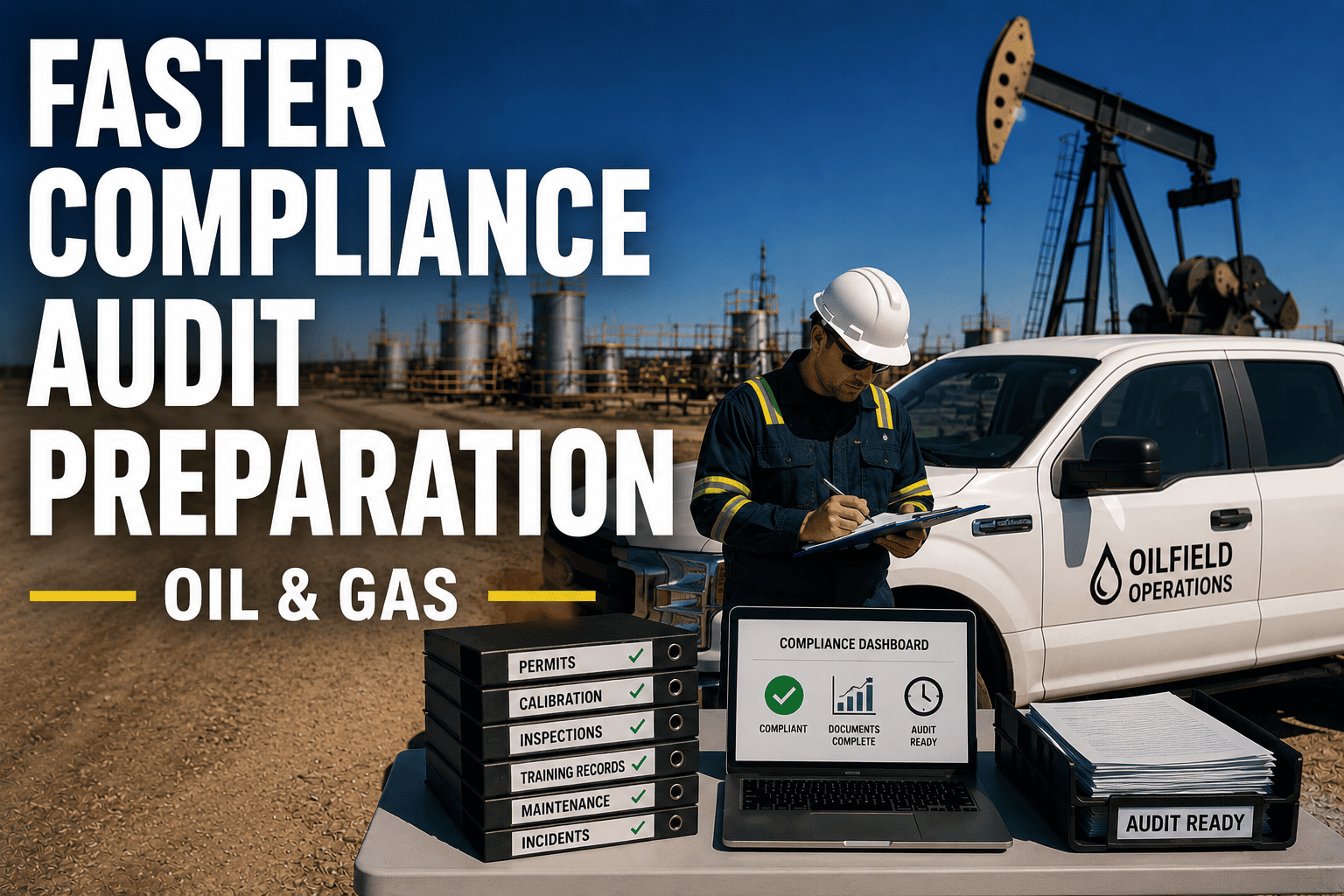
The call usually comes with a few days' notice, sometimes less. A regulator, a client HSE team, or an internal audit group wants your fleet's compliance records, and the clock starts immediately. For most oil and gas operations, that request kicks off a scramble through binders, shared drives, and field logbooks to reconstruct months of inspections, certifications, and maintenance history. It doesn't have to work that way, and the operators who've stopped dreading that phone call all did the same thing first: they stopped storing compliance proof in a dozen different places.
Manual, paper-based audit preparation for oil and gas fleets typically takes 40 to 60 hours of record retrieval and assembly across inspection logs, driver certifications, and maintenance history. Digital, centralized systems can compile the same audit-ready package in under two hours. Missing or inconsistent records are one of the most common causes of audit findings, not equipment condition itself, which means the fastest way to pass an audit is often simply proving what you already did.
The Records Every Audit Actually Checks
DOT, OSHA, EPA, and client HSE audits all look at different regulatory angles, but they converge on the same core question: can you prove, with evidence, that your fleet has been operated and maintained the way it's supposed to be.
Why Audit Prep Drags On the Way It Does
The gap between a two-hour audit pack and a two-day scramble almost always comes down to where the records live and how they're captured in the first place.
| Prep Task | Paper-Based Process | Centralized Digital Process |
|---|---|---|
| Locating Records | Manual retrieval across binders, field logs, and regional offices | Searchable by asset, date, or record type in seconds |
| Verifying Completeness | Cross-checking multiple logbooks for gaps and missing signatures | Automated flags for missing or overdue records before the audit call |
| Proving Authenticity | Paper signatures alone, vulnerable to disputes over dates or edits | Timestamped, geo-tagged records tied to a named inspector at capture |
| Assembling the Package | Manual compilation into a single report, often days of work | One-click export formatted for the specific audit framework |
Building a System That's Always Audit-Ready
Fast audit prep isn't a skill you develop the week before an inspection. It's a byproduct of how records are captured every single day on the field.
Centralize Records Across Every Site
Multi-site operations often end up with inconsistent record-keeping between crews and locations, which turns a straightforward compliance check into a scavenger hunt. Bringing every inspection, certification, and maintenance record into one system removes that friction entirely.
Practical Step
Applying a single checklist standard across every site and asset class means every inspector's record looks the same, which speeds up both internal review and external audits.
Capture Evidence at the Point of Inspection
Records reconstructed after the fact are always weaker than ones captured in the moment. A photo of a defect, a GPS location, and a timestamp taken during the actual inspection carry far more weight than a note added later.
Practical Step
Requiring photo documentation for any flagged defect creates a visual audit trail that closes the exact gap regulators look for during enforcement reviews.
Track Certification and Inspection Expirations Proactively
An audit rarely fails because of one bad inspection. It fails because a certification lapsed, a PM interval slipped, or a defect sat open without a documented resolution. Catching those gaps before an audit request comes in changes the entire conversation.
Practical Step
Setting automated alerts at set intervals before any certification or inspection expires keeps your fleet a step ahead of the exact issues auditors are trained to look for.
FleetRabbit centralizes inspection, certification, and maintenance records across every site, so a full audit package is ready whenever you need it. Start your free trial or book a demo to see audit prep transformed for your fleet.
What Happens When Records Aren't Ready
The cost of a disorganized compliance program rarely shows up until the audit is already underway, and by then the options are limited.
Quick Benchmarks Worth Tracking
Frequently Asked Questions
Fast audit prep is a byproduct of how records are captured every day, not a last-minute effort. FleetRabbit centralizes inspection, certification, and maintenance records across your entire fleet, so you're ready for DOT, HSE, or client audits the moment the request lands. Start your free trial with no credit card required, or book a demo to see it built around your compliance framework.