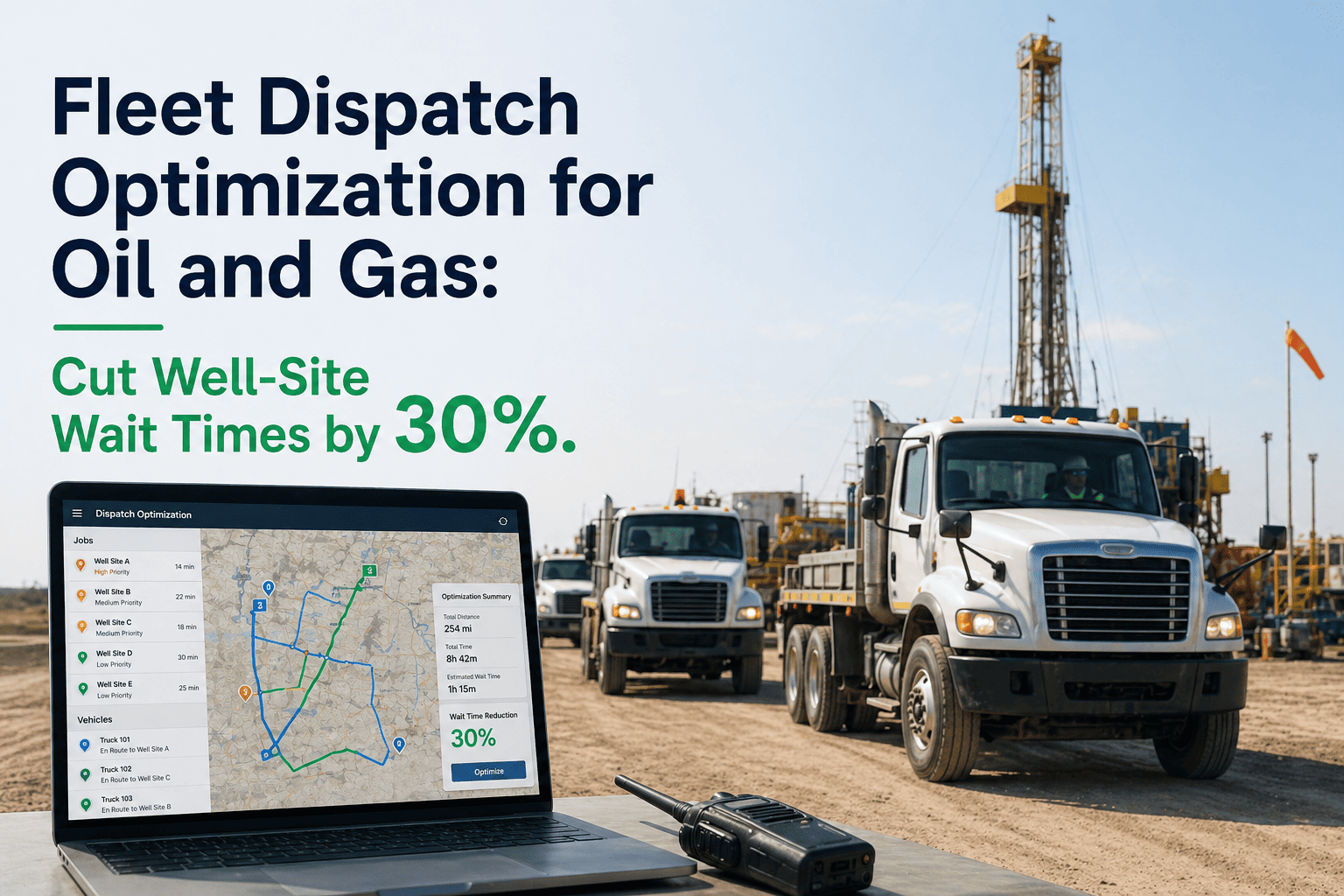
Oil and gas fleet dispatch is not a static scheduling exercise — it is a dynamic, high-stakes coordination challenge where drilling schedules shift hourly, crew availability changes with shift rotations, equipment breakdowns occur without warning, and weather conditions alter route viability in minutes. The fleet manager relying on whiteboards, spreadsheets, or basic GPS tracking is not optimizing dispatch — they are reacting to chaos after delays have already accumulated, well-site wait times have ballooned to 2–4 hours, and non-productive time (NPT) has drained $15,000–$50,000 per day from operational budgets. Traditional dispatch methods fail because they cannot process the complex variable matrix of real-time vehicle location, driver HOS status, equipment compatibility, well-site priority levels, traffic conditions, and sudden schedule changes simultaneously. FleetRabbit’s AI-powered dynamic dispatch optimization engine solves this complexity by automating crew and vehicle assignment based on real-time constraints, re-routing assets instantly when drilling priorities shift, reducing well-site wait times by 30%, and eliminating manual dispatch errors that cause costly operational disruptions. This guide examines how oil and gas operators leverage FleetRabbit’s dynamic dispatch platform to cut wait times, improve asset utilization, and maintain seamless coordination across remote basin operations.Book a demo to see FleetRabbit's Dispatch Optimization.
Fleet Dispatch Optimization: Cut Well-Site Wait Times by 30% with AI-Driven Automation
FleetRabbit replaces manual dispatch chaos with intelligent automation — dynamically assigning crews and vehicles based on real-time constraints, re-routing assets as drilling schedules shift, and eliminating costly well-site delays.
Every hour of well-site wait time costs $15,000+ in non-productive time. Deploy FleetRabbit’s dynamic dispatch in 48 hours — eliminate delays before they start →
Why Manual Dispatch Fails in Dynamic Oilfield Environments
Shifting Drilling Priorities
Drilling schedules change hourly due to geological findings, equipment issues, or weather. Manual dispatchers cannot re-calculate optimal routes for 100+ vehicles in real-time, leading to misaligned asset deployment and idle crews waiting at low-priority sites while high-priority wells go unsupported.
Excessive Well-Site Wait Times
Without real-time visibility into vehicle ETA and site readiness, crews arrive early and wait 2–4 hours for rig access or late and miss critical windows. These delays accumulate into $50,000+ daily NPT losses across multi-rig operations.
Complex Constraint Matching
Dispatching requires matching specific equipment capabilities (e.g., vacuum capacity, lift height) with well-site requirements, while ensuring driver HOS compliance and certification validity. Manual matching is error-prone and slow, often resulting in wrong asset deployment.
Communication Breakdowns
Reliance on phone calls and radio updates creates information lag. Dispatchers lack real-time data on driver status, leading to double-booking assets or sending drivers to completed jobs while other sites remain unstaffed.
How FleetRabbit Optimizes Oilfield Dispatch Operations
Automated Crew & Vehicle Matching
FleetRabbit eliminates manual dispatch guesswork by using AI to match open work orders with the most suitable available assets. The system considers multiple constraints simultaneously: driver HOS remaining, equipment type compatibility (e.g., frac pump pressure rating), certification requirements (HAZMAT, CDL), proximity to well-site, and current traffic conditions. This ensures the right asset arrives at the right time, every time.
Dynamic Re-Routing
When a high-priority well requires immediate support, FleetRabbit identifies the nearest available qualified asset and pushes new turn-by-turn directions to the driver’s mobile app instantly, overriding previous lower-priority stops.
Wait Time Reduction
By synchronizing vehicle ETA with well-site readiness status, FleetRabbit reduces idle time at locations. Drivers receive precise arrival windows, and site managers get alerts 30 minutes prior to arrival to prepare equipment.
Dispatcher Efficiency
Automated assignment frees dispatchers from routine scheduling tasks, allowing them to focus on exception management and strategic coordination. Average time savings: 2.5 hours per dispatcher per day.
Manual dispatch can’t keep up with shifting drilling schedules. See dynamic re-routing in action — book a 30-minute demo →
Daily Dispatch Control with FleetRabbit
Live Dispatch Dashboard
View all active jobs, assigned vehicles, and unassigned work orders on a single map interface. Color-coded status indicators show which assets are en route, on-site, or returning. Drag-and-drop functionality allows manual overrides if needed, with automatic recalculation of downstream impacts.
Driver Mobile App Integration
Drivers receive job assignments directly on their mobile devices with detailed well-site instructions, safety requirements, and contact info. Acceptance confirmation ensures accountability. Real-time chat feature enables direct communication between dispatcher and driver for quick clarifications.
Well-Site Readiness Sync
Integrate with rig management systems to receive real-time updates on well-site status. If a rig is delayed, FleetRabbit automatically holds approaching vehicles or re-routes them to other jobs, preventing unnecessary wait times and fuel waste.
Performance Analytics
Track key dispatch metrics including on-time arrival rates, average wait times, asset utilization percentages, and dispatcher response times. Identify bottlenecks and optimize workflows based on data-driven insights rather than intuition.
Strategic Value of Automated Dispatch Optimization
ROI: Reduced Non-Productive Time
Cutting well-site wait times by 30% directly translates to increased rig uptime and revenue generation. For a typical 5-rig operation, this efficiency gain can recover $150,000–$300,000 annually in previously lost NPT, far exceeding the platform cost.
Operational Agility
Dynamic dispatch enables rapid response to unexpected opportunities or emergencies. Whether it’s a sudden well blowout requiring immediate containment resources or a new discovery needing fast-track support, FleetRabbit ensures assets are deployed optimally within minutes.
Compliance & Safety Assurance
Automated dispatch ensures only compliant drivers with valid certifications and sufficient HOS are assigned to jobs. This reduces regulatory risk and enhances safety by preventing fatigued driving and improper equipment usage.
Scalable Growth Support
As fleet size grows from 50 to 500 vehicles, manual dispatch becomes impossible. FleetRabbit scales seamlessly, handling thousands of daily assignments without additional administrative overhead, supporting expansion into new basins efficiently.
Eliminate Well-Site Delays and Maximize Asset Utilization
FleetRabbit’s AI-powered dispatch optimization reduces wait times by 30%, improves on-time arrivals to 98%, and saves dispatchers 2.5 hours daily. Deploy in 48 hours and start recovering NPT costs immediately.
Deploy Dynamic Dispatch in 48 Hours
System Configuration & Integration
Import vehicle roster, driver profiles, and well-site locations. Configure equipment types and certification requirements. Integrate with existing ELD/GPS providers for real-time location data. Set up user accounts for dispatchers and managers.
Driver Onboarding & Testing
Drivers download the FleetRabbit mobile app and complete brief training on accepting jobs and navigating routes. Conduct test dispatches to verify assignment logic, notification delivery, and map accuracy. Adjust priority rules based on initial feedback.
Live Operations & Optimization
Switch to live dynamic dispatch. Monitor initial performance metrics and fine-tune algorithms for specific basin nuances. Dispatchers transition from manual scheduling to exception management, leveraging AI for routine assignments.
Verified Results from Oilfield Dispatch Deployments
Frequently Asked Questions About Dispatch Optimization
How does FleetRabbit handle urgent, unplanned dispatch requests?
The system instantly identifies the nearest qualified available asset and pushes a high-priority re-route to the driver’s app. Other affected jobs are automatically rescheduled to minimize overall disruption.
Can it integrate with our existing rig scheduling software?
Yes. FleetRabbit offers API integrations with major rig management and ERP platforms to sync well-site status and job requirements in real-time, ensuring dispatch aligns with operational needs.
What happens if a driver rejects an automated assignment?
If a driver rejects a job due to valid reasons (e.g., vehicle issue), the system immediately flags the asset as unavailable and re-calculates the best alternative assignment from the remaining pool of qualified drivers.
Does it work in areas with poor cellular coverage?
Yes. The mobile app caches job details and routes offline. Drivers can accept jobs and navigate using downloaded maps. Status updates sync automatically once connectivity is restored.
How quickly can we see ROI from dispatch optimization?
Most fleets see measurable reductions in wait times and improved dispatcher efficiency within the first 2–4 weeks. Full ROI, including NPT recovery, is typically realized within 3–6 months.
Is training required for dispatchers?
Minimal training is needed. The interface is intuitive, and FleetRabbit provides comprehensive onboarding support. Most dispatchers become proficient within 1–2 days of use.
Stop losing money to well-site wait times. Start your free trial today — optimize dispatch in 48 hours →
Transform Chaos into Coordination with Intelligent Dispatch
FleetRabbit delivers AI-powered dispatch automation that cuts wait times by 30%, boosts on-time arrivals to 98%, and frees dispatchers from manual scheduling. Deploy in 48 hours and start maximizing asset utilization at $3/vehicle/month.