Oil and gas fleet management in 2026 operates in an environment of escalating regulatory scrutiny, compressing operational margins, and investor ESG expectations that were nonexistent five years ago. Fleet managers overseeing frac trucks, water haulers, crude tankers, wireline units, and service vehicles across the Permian Basin, Bakken Shale, GCC producing fields, and North Sea support operations are simultaneously managing FMCSA compliance obligations, HAZMAT documentation requirements, HSE audit evidence trails, maintenance schedules for equipment operating at extreme duty cycles, and driver safety programmes for personnel working in classified hazardous areas. The practices that separated high-performing oilfield fleet operations from reactive, penalty-prone, and accident-affected ones in this environment are consistently the same ten disciplines — implemented with digital tooling that automates the data capture, cross-reference, and evidence generation that manual systems cannot sustain at scale. These are not aspirational recommendations from fleet management consultants unfamiliar with oilfield conditions. They are operational practices distilled from deployments across upstream, midstream, and downstream fleet operations — validated against the specific regulatory frameworks, duty cycle conditions, and compliance requirements that oil and gas fleet management actually faces. FleetRabbit automates the data infrastructure behind each practice, converting them from aspiration to consistent operational reality. Book a demo to see how FleetRabbit implements every best practice in this list across your oilfield fleet.
10 Fleet Management Best Practices for Oil and Gas Companies
From GPS satellite tracking and predictive maintenance to HAZMAT compliance and ESG carbon reporting — these are the 10 operational disciplines that separate high-performing oilfield fleet operations from reactive, penalty-prone, and accident-affected ones. Each practice is deployed and automated in FleetRabbit for immediate operational implementation.
Deploy Satellite GPS Tracking Across Every Vehicle — Including Remote Wellsite and Lease Road Operations
Real-time fleet visibility is the prerequisite for every other fleet management practice on this list. You cannot manage maintenance schedules for vehicles you cannot locate, cannot enforce inspection compliance for assets whose location status you are uncertain of, and cannot respond effectively to breakdown events at wellsite locations you do not have GPS coordinates for. For oilfield fleets, this means satellite GPS tracking — not cellular-dependent telematics that loses contact the moment vehicles leave paved highways for lease road networks. Approximately 70% of active well locations across major producing basins in North America and the GCC are beyond reliable cellular coverage. A tracking platform that loses contact with your fleet for the majority of their working hours is not a tracking platform — it is a partial record of when vehicles are near highways.
FleetRabbit uses dual-mode connectivity — cellular primary, Iridium satellite fallback — maintaining 30-second GPS position updates at all oilfield locations regardless of cellular coverage status. GPS coordinates are accepted for unmapped lease road wellsite locations that do not appear in commercial mapping databases, enabling geofence configuration and arrival/departure logging at pad locations that standard fleet platforms cannot recognise.
Replace Mileage-Based Maintenance Schedules With Engine-Hour Triggers for Every Oilfield Asset Class
Mileage-based maintenance schedules are the single most expensive hidden cost in oilfield fleet operations — because they are systematically incorrect for every vehicle in a fleet that spends significant time at idle or at high load without accumulating odometer distance. A frac truck accumulates engine hours at 4–5x the rate assumed by manufacturer highway-duty PM schedules. A service truck idling at a wellsite for 40% of its shift accumulates engine-based wear at a rate its odometer does not reflect. Scheduling oil changes, filter replacements, and brake inspections at mileage thresholds for these assets guarantees that PM intervals will be missed — producing either premature component failure or unnecessary early replacement, depending on which direction the error runs. Engine-hour PM scheduling aligns service intervals to the actual operating conditions each vehicle type experiences — which for oilfield assets bear no consistent relationship to the mileage figure on the odometer.
FleetRabbit configures independent PM trigger thresholds at 250, 500, and 1000 engine hours per vehicle class — replacing mileage intervals with operating-condition-calibrated schedules. Separate PM clocks track vehicle drivetrain maintenance and process equipment maintenance on the same asset, recognising that a frac truck's fluid end requires service on a different schedule from its engine and transmission.
Deploy AI Predictive Maintenance to Detect Developing Faults 3–6 Weeks Before Breakdown
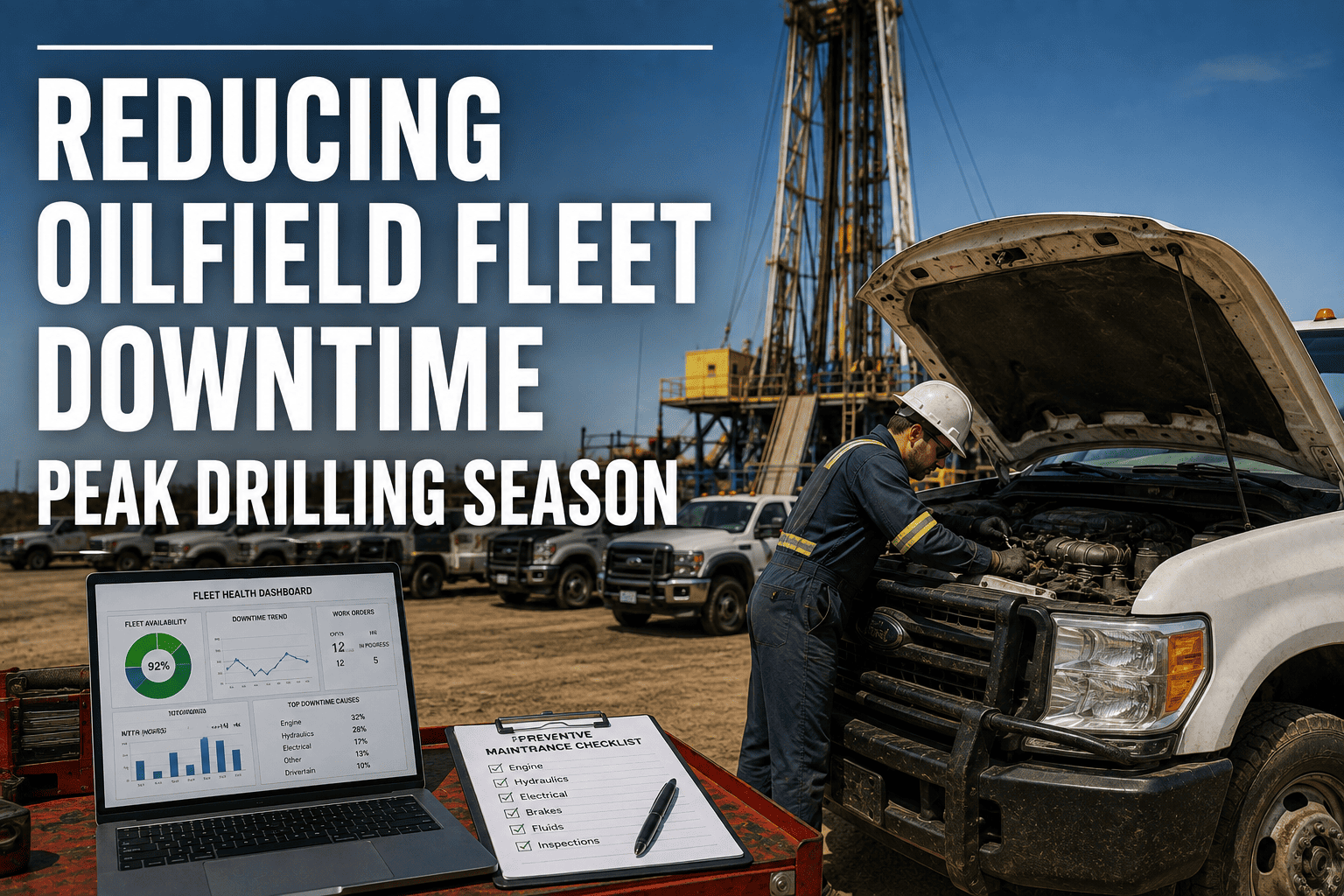
Research across oilfield fleet breakdown events consistently shows that 64–68% of unplanned failures had detectable OBD-II fault code precursors recorded in the vehicle's telematics system 2–6 weeks before the failure event occurred — but were never reviewed because they were buried in a raw fault code log that no one has the capacity to manually review per vehicle per day. Predictive maintenance converts this latent data advantage into operational intervention by applying AI-driven anomaly detection to continuous OBD-II parameter streams — identifying the specific multi-variable fault signature patterns that precede failure events in each vehicle class, distinguishing them from normal operational variance, and routing risk-rated alerts to fleet managers at the intervention window that makes scheduled service possible. A remote breakdown at an active wellsite location costs $150,000–$500,000 when drilling programme delay is included. The same fault repaired during scheduled maintenance costs $2,000–$6,000. The economic case for AI predictive maintenance in oilfield fleet operations is straightforward: preventing one remote pad breakdown per year pays for a 100-vehicle fleet platform for over a decade.
FleetRabbit's AI engine establishes a vehicle-specific operating baseline within 14 days, then monitors 36+ OBD-II parameters simultaneously — generating risk-rated alerts when developing fault patterns cross configured probability thresholds. Alerts are routed directly to the fleet manager with vehicle location, fault pattern context, and recommended intervention timeline.
Deploy All 10 Fleet Management Best Practices Simultaneously — in 5–7 Working Days
FleetRabbit automates the data infrastructure behind every best practice in this list — satellite GPS, engine-hour PM, AI predictive maintenance, digital DVIR, certification tracking, HAZMAT documentation, driver coaching, audit records, ESG reporting, and executive dashboards — deployed across your oilfield fleet in 5–7 working days at $3/vehicle/month.
Enforce Digital DVIR Completion Before Every Dispatch — Including Remote Wellsite Departures
Pre-trip and post-trip vehicle inspection records are a regulatory requirement under FMCSA 49 CFR Part 396, DVSA operator licence conditions, and equivalent GCC frameworks — not an optional safety procedure. Paper DVIR systems fail in oilfield operations because forms are completed in the truck cab before drivers reach the yard where filing occurs, photos cannot be attached to paper forms, defect findings are not automatically escalated to maintenance work orders, and paper forms submitted at a yard are disconnected from what actually happened at a remote wellsite 80 miles away. The result is systematic inspection record incompleteness that surfaces during FMCSA audits as documentation gaps — regardless of whether the physical inspections were conducted. Digital DVIR enforces completion before departure prevents the vehicle moving without a completed inspection record, attaches photo evidence to defect findings, automatically escalates critical defects to maintenance work orders, and creates a tamper-evident regulatory record that satisfies FMCSA evidentiary standards without manual office filing.
FleetRabbit's mobile DVIR app prevents vehicle dispatch without completed pre-trip inspection — the dispatch system blocks vehicle assignment until inspection is recorded. The app works fully offline at remote wellsite locations, timestamping data at point of collection. Defect findings auto-route to maintenance work orders. Complete inspection history is exportable in FMCSA 396.11 or DVSA Section 50 format within 2 hours of audit request.
Automate Driver and Vehicle Certification Tracking With 60/30/7-Day Renewal Alerts
Driver certification failures — expired CDL, lapsed DOT medical certificate, expired H2S awareness qualification, missing site access credential — are among the most common causes of wellsite gate refusals in oilfield operations, costing $8,000–$40,000 per event in delay, rescheduling, and programme disruption. Vehicle certification failures — expired roadworthiness certificate, lapsed pressure vessel certification, insurance certificate not renewed — can invalidate coverage mid-incident and trigger regulatory enforcement at roadside inspection. Neither failure mode should occur in a fleet with automated certification tracking, because both are predictable and preventable by definition — every certificate has a known expiry date that can be monitored and alerted against automatically. The practice of managing certification renewal from a physical filing system or calendar reminder is a structural reliability failure that digital certification management eliminates at the architectural level.
FleetRabbit tracks unlimited certificate types per driver and vehicle — CDL, medical, H2S, ADR, site access credentials, vehicle roadworthiness, pressure vessel certification, insurance — each with independent expiry dates and automated 60/30/7-day renewal alerts to both driver/vehicle owner and fleet manager. Dispatch blocking activates automatically for expired Critical certifications without documented manager override.
Automate HAZMAT Documentation Generation for Every Oilfield Cargo Load Before Departure
Oilfield fleets routinely transport materials classified under ADR, DOT PHMSA, and equivalent GCC frameworks — crude oil, produced water, drilling chemicals, well stimulation acids, and NORM-bearing waste streams. HAZMAT compliance is not a routing exercise. It is a documentation, certification, and equipment obligation that requires correct UN number, hazard class, proper shipping name, and emergency contact on every consignment record, driver dangerous goods training valid for the specific cargo class, vehicle placard displaying the correct hazard information, and SDS accessible offline at the driver's location before the vehicle departs the loading point. Manual HAZMAT documentation completion in field conditions produces the systematic errors — wrong UN number, missing emergency contact, unsigned consignment note — that appear as FMCSA violations at roadside inspection and EPA findings during audit. Automated document generation from a cargo classification database eliminates these errors at the source.
FleetRabbit generates complete HAZMAT documentation packages automatically at dispatch — PHMSA shipping papers and ADR consignment notes with correct UN number, hazard class, proper shipping name, and emergency contact populated from the cargo classification database. Driver ADR certificate is cross-referenced against cargo class before dispatch approval. SDS accessible offline on driver mobile device. Route restriction validation applied per cargo classification.
Implement Data-Driven Driver Coaching Based on Telematics Behaviour Scores — Not Subjective Observation
Driver behaviour is the single most consistent variable in oilfield fleet safety outcomes — because the highest-risk 20% of drivers in any oilfield fleet typically account for 60–70% of preventable safety events, insurance claims, and fuel cost variance attributable to driver-controllable behaviour. Coaching these drivers effectively requires data — specific event records showing which behaviours occurred, at what frequency, on which routes, and with what severity. Subjective supervisory observation at wellsite visits captures a fraction of this data and is liable to bias. Telematics-driven coaching from verified event records produces measurable behaviour change: studies across oilfield fleet deployments consistently show 34–47% reduction in hard braking events within 60 days of data-driven coaching programme implementation. The practice requires a data capture infrastructure — telematics events, driver scores, trip records — that makes the coaching conversation objective rather than opinion-based, and that allows the fleet manager to measure whether coaching is producing behaviour change in the weeks following each session.
FleetRabbit's driver performance module generates composite behaviour scores across six dimensions — safety events, HOS compliance, DVIR completion, fuel efficiency, incident record, and certification status — with in-cab alerts for critical events and monthly coaching report generation per driver. Score band action protocols automatically determine the appropriate fleet manager response for each driver's performance level.
Build Audit-Ready Compliance Records Continuously — Not Retroactively When Audit Notice Arrives
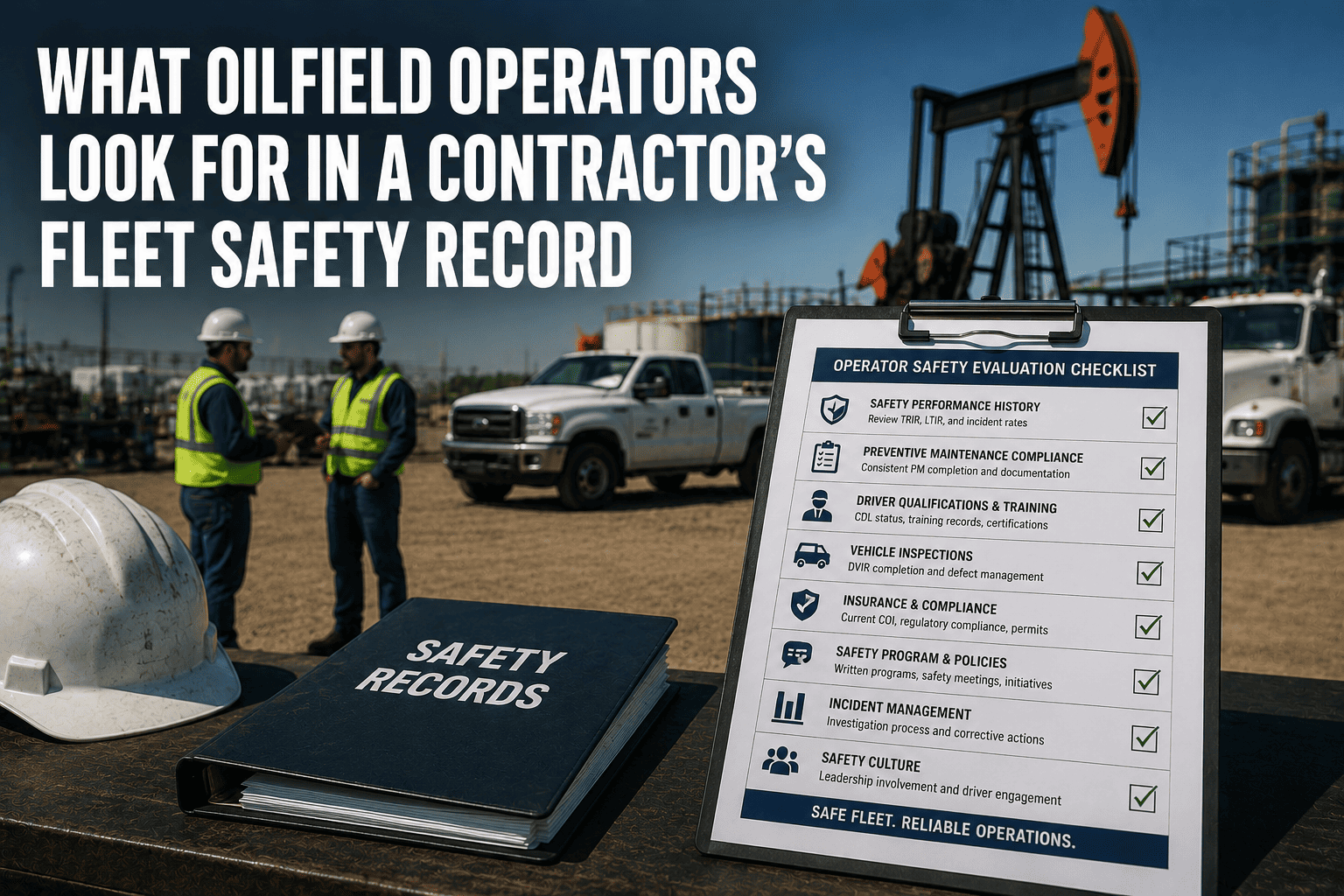
The operational and financial consequence of a FMCSA, PHMSA, DVSA, or ADNOC audit depends almost entirely on the quality of compliance records that exist at the moment the auditor requests documentation — not on the quality of operations that occurred during the audit period. Fleet operations that physically conducted every inspection, completed every maintenance interval, and maintained every driver certification correctly can still face enforcement action when the documentation proving compliance is incomplete, disorganised, not in the format the regulator requires, or cannot be retrieved within the response window. Audit readiness is not a project that begins when an audit notice arrives — it is a data architecture outcome that results from continuous digital record generation throughout normal fleet operations. The audit pack that a PHMSA inspector requests upon arrival at a pipeline operator's facility should be available within 2 hours, not in 3 days after manual retrieval from paper files.
FleetRabbit generates tamper-evident, timestamped compliance records continuously — inspection histories, certification status, maintenance work orders, incident documentation — all stored in an immutable central database with cross-reference linkage between drivers, vehicles, and events. Complete audit packs in FMCSA, DVSA, PHMSA, or ADNOC format are generated within 2 hours for any specified period and asset range.
Establish Verified Fleet Carbon Baselines for ESG Investor and Operator Client Reporting
ESG fleet carbon reporting has moved from voluntary corporate sustainability disclosure to investor covenant requirement, operator client prequalification criterion, and regulatory mandate across multiple jurisdictions simultaneously in 2026. Oil and gas fleet operators managing contractor programmes for ADNOC, Saudi Aramco, BP, Shell, or Equinor are being asked to provide verified fleet carbon footprint data as part of their client operator's Scope 3 emission reporting. Private equity-backed oilfield service companies are carrying ESG covenant provisions requiring verified Scope 1 emission data as loan terms. The SEC's climate disclosure rules require material climate-related risk quantification for public companies. Fleet carbon data assembled manually from disconnected telematics exports — taking weeks to produce and generating figures that no auditor can independently verify against source data — does not satisfy any of these requirements. The practice of establishing and maintaining a verified fleet carbon baseline requires continuous automated fuel consumption capture, configured emission factor application, and audit-trail linkage from reported figures to source telematics data.
FleetRabbit captures fuel consumption per vehicle per shift, applies GHG Protocol, DEFRA, or EPA emission factors per fuel type, and generates verified Scope 1 fleet carbon baselines in real time — with audit-trail linkage to source telematics data. ESG reports are exportable in CDP, GRESB, or investor-specific format without manual data preparation. Idle reduction campaigns generate verified emission reduction figures reportable as quantified ESG outcomes.
Deploy Executive Fleet Intelligence Dashboards That Update in Real Time Without Field Supervisor Data Entry
Operations executives managing oilfield fleet programmes make strategic decisions — capital allocation, contractor selection, insurance programme structure, ESG commitment levels, drilling programme capacity planning — on the basis of fleet performance data. When that data arrives as a manually compiled end-of-week report from field supervisors, it is stale by the time it reaches the VP's inbox, incomplete because individual supervisors across distributed Basin locations summarise rather than report, and unable to surface the cross-referencing that would reveal a correlation between specific driver behaviour patterns and maintenance cost trends on the same vehicles. Executive fleet intelligence in 2026 means real-time operational metrics — fleet-wide vehicle health scores, breakdown risk distribution, compliance status by site, driver performance band distribution, fuel consumption variance — available from a live dashboard that updates continuously without any manual data collection. The executive who sees that three frac trucks across different Basin locations are simultaneously developing OBD-II fault patterns consistent with hydraulic system deterioration can make a proactive maintenance decision that prevents three concurrent pad breakdowns from disrupting an active drilling programme.
FleetRabbit's executive intelligence layer provides real-time fleet health scores, compliance status, driver risk distribution, fuel consumption trending, and predictive maintenance alert summaries — across every site and every asset class — on a configurable dashboard that updates every 60 seconds. Automated weekly and monthly executive digest reports distribute to C-suite and board-level stakeholders without requiring field supervisor data consolidation.
Common Questions About FleetRabbit for Oil and Gas Operations
Implement All 10 Oil and Gas Fleet Management Best Practices — Starting This Week
FleetRabbit deploys the data infrastructure behind every best practice in this list — satellite GPS, engine-hour PM, AI predictive maintenance, digital DVIR, certification tracking, HAZMAT documentation, driver coaching, audit records, ESG carbon reporting, and executive dashboards — on your oilfield fleet in 5–7 working days at $3/vehicle/month. All 10 practices. One platform. One invoice.