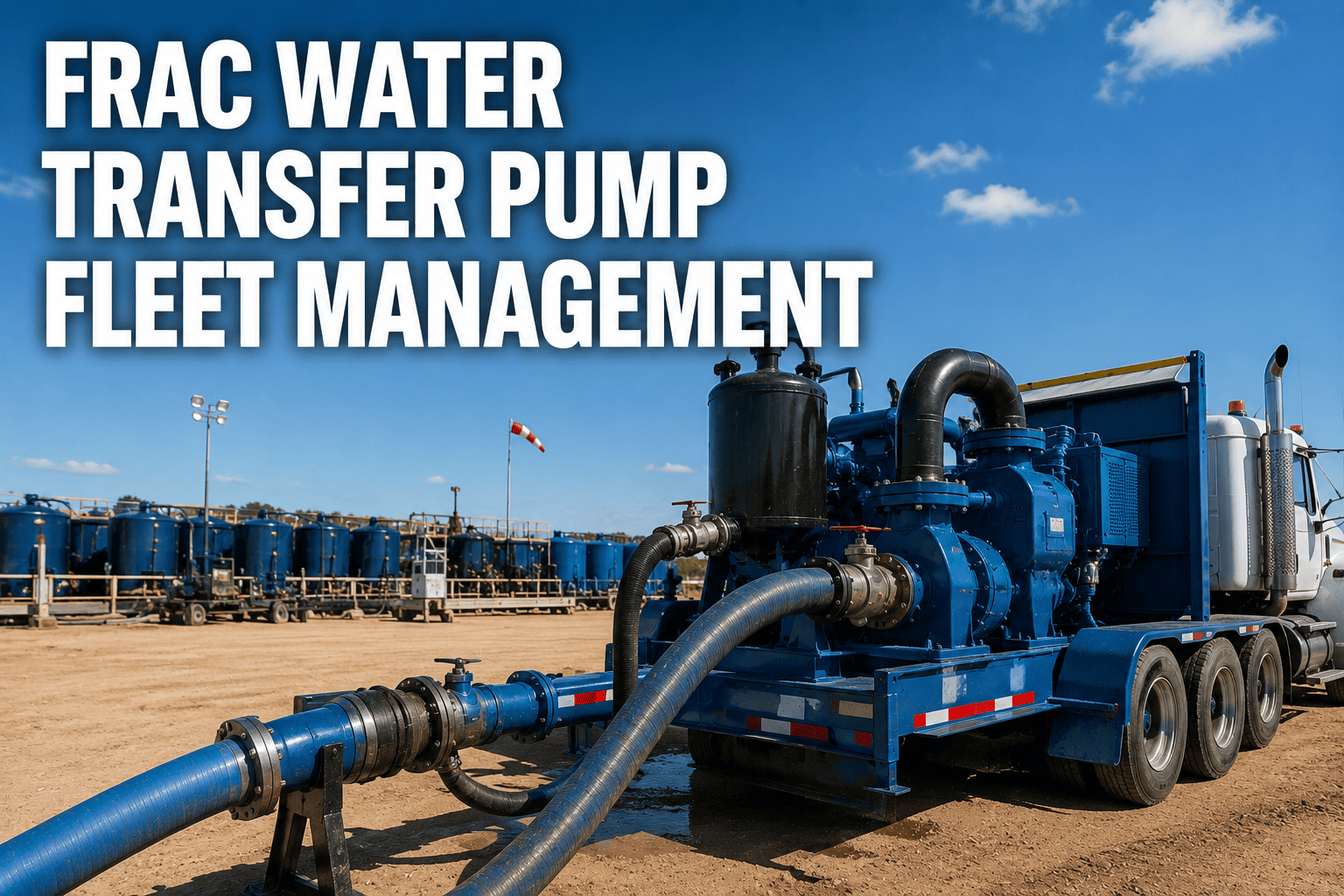
A frac water transfer pump does not behave like a normal fleet vehicle. It might travel only a few miles to reach a well pad, then sit in one spot and run at full throttle for days, moving thousands of barrels of water an hour to keep a completion crew supplied. Mileage tells you almost nothing about how hard that pump has worked. Engine hours, load percentage, and continuous run time tell the real story, and most fleets still track them the same way they track a pickup truck. For completion operations where a stalled water supply can halt an entire frac stage, that gap in visibility gets expensive fast.
Frac water transfer pump fleets need a different management approach than standard trucking fleets because pumps run continuously under heavy load rather than accumulating mileage. Effective management depends on engine-hour and PTO tracking, severe-duty maintenance intervals, and real-time visibility into which pumps are running, idle, or due for service. FleetRabbit gives completion teams that visibility along with crew coordination, so water supply never becomes the reason a frac stage stops.
Why Water Transfer Pumps Wear Differently
Standard fleet maintenance is built around odometer readings and calendar intervals. Water transfer pumps break that model completely, because the wear that matters happens while the unit is parked on location, not while it is driving between jobs.
What Makes Water Transfer Fleet Management Different
Running a water transfer fleet well means tracking a different set of signals than a typical delivery or hauling operation, and reacting to them before a pump becomes the reason a location goes down.
Engine Hours And PTO Time, Not Mileage
Because transfer pumps spend most of their working life stationary, power take-off engagement and total run hours are the metrics that actually predict wear on the engine, transmission, and pump end. A fleet still scheduling service by miles driven will consistently under-maintain its highest-use units.
Continuous Duty At High Load
Water transfer pumps are typically run at a high, steady load for extended stretches rather than in short bursts. That kind of continuous duty accelerates wear on seals, bearings, and fluid ends compared to intermittent operation, which means service intervals need to be shorter and tied to actual usage rather than a generic calendar schedule.
Remote, Multi-Pad Coordination
Water sources, storage, and the well pad itself are often spread across a wide area, connected by temporary pipelines and lay-flat hose. Keeping pumps, tanks, and crews synced across that footprint requires real-time visibility, not a radio call and a guess.
FleetRabbit tracks engine hours, PTO engagement, and load data across your water transfer fleet, so maintenance happens on real usage instead of a guess. See it on your own equipment with a free trial or walk through it with our team first.
Reactive Versus Managed Water Transfer Operations
The difference between a fleet that reacts to problems on location and one that manages them ahead of time shows up directly in uptime and crew coordination.
| Operational Factor | Reactive Approach | Managed Approach |
|---|---|---|
| Maintenance Trigger | Calendar date or driven mileage, unrelated to actual pump use | Engine hours and PTO time tracked against severe-duty intervals |
| Idle Time | Units left running between transfers with no record of wasted hours | Idle versus working time logged, flagged, and reduced over time |
| Failure Response | Crew discovers a problem when water stops flowing on location | Alerts flag abnormal load or hours before a unit fails mid-stage |
| Crew Coordination | Radio calls and manual check-ins across a spread-out water network | Live status of pumps, tanks, and crews visible from one dashboard |
How FleetRabbit Supports Water Transfer Teams
FleetRabbit was built to give completion operations the same level of visibility over pumps and crews that they already expect from the rest of their fleet, adapted to how water transfer equipment actually works in the field.
Usage-Based Maintenance Scheduling
Instead of relying on mileage or a fixed calendar, FleetRabbit schedules service around real engine hours and load history, so pumps come in for maintenance based on how hard they have actually worked.
Automated Hour Alerts
The system flags a pump automatically as it approaches its service threshold, giving crews time to plan a swap or repair during a natural break instead of a mid-stage emergency.
Idle Time Reporting
Run time is broken down into working hours and idle hours, so fleet managers can see exactly how much of a pump's service life is being consumed by units left running unnecessarily between transfers.
Real-Time Asset And Crew Visibility
Every pump, tank, and crew member on a water transfer job can be tracked from a single dashboard, giving supervisors a live picture of the entire network instead of relying on scattered radio updates. Completion teams that sign up for FleetRabbit can see pump status, location, and hours in one place from day one.
What Better Visibility Delivers On Location
Completion teams that move from guesswork to real engine-hour and status tracking tend to see the benefits show up directly in fewer surprises on the pad.
Getting Started With Your Water Transfer Fleet
You do not need to convert your entire fleet at once. Most completion teams start by connecting the pumps working their busiest pads, then expand as they see how engine-hour tracking changes their maintenance planning. You can start a free trial with FleetRabbit to try it on your own equipment, or if you would rather talk through your current water transfer setup first, you can book a short demo with our team.
A single water transfer pump going down mid-stage can stall an entire completion crew. FleetRabbit gives you engine-hour tracking, maintenance alerts, and live visibility across every pump, tank, and crew on location, so water supply is never the reason a job stops. Start your free trial today or book a short demo to see it on your fleet.