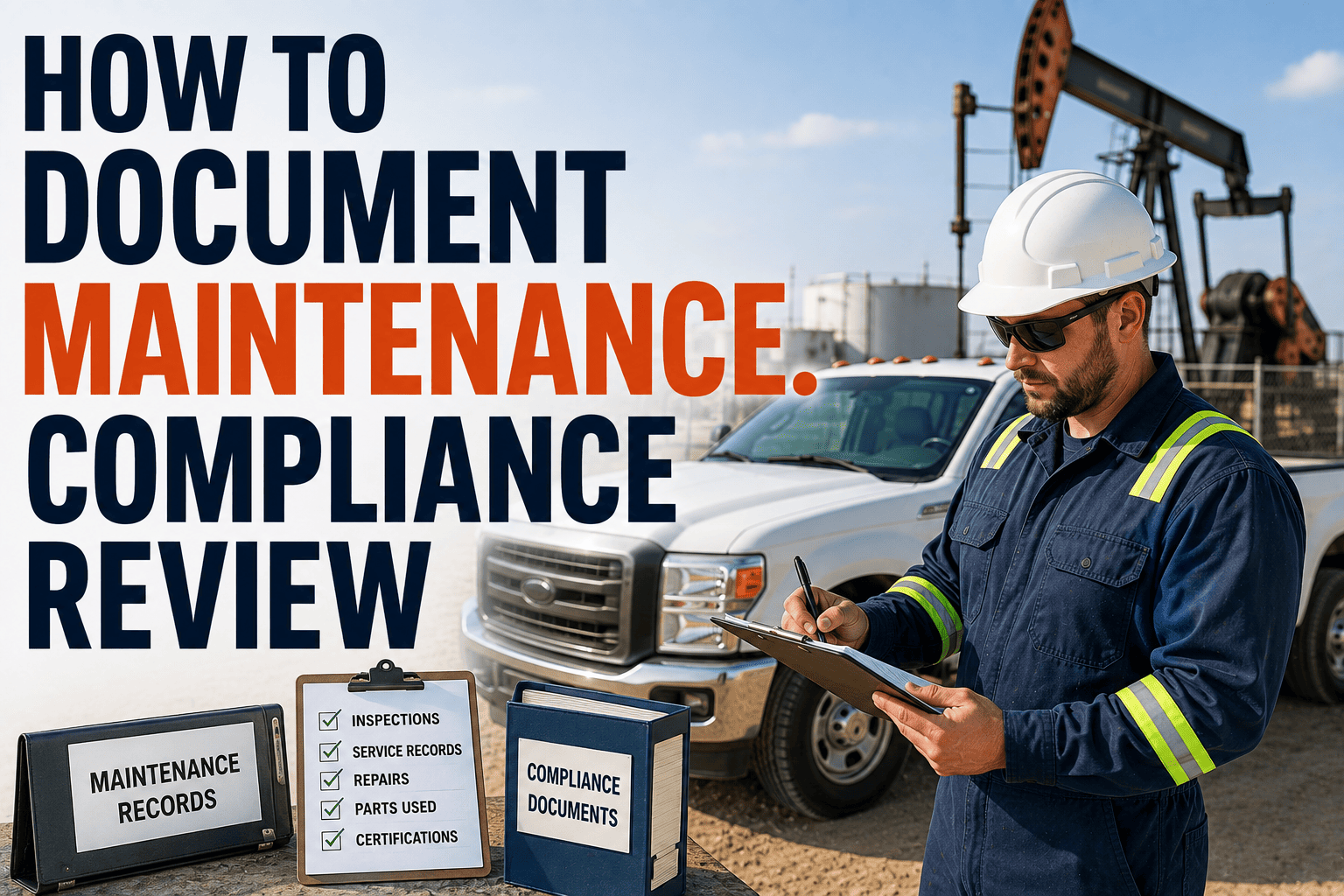
A DOT compliance review can land on your desk with as little as a few weeks notice, and the first thing an auditor asks for is rarely a driver log. It's your maintenance file. Under 49 CFR Part 396, every carrier must be able to produce inspection records, repair orders, and periodic inspection proof for each vehicle, organized well enough that an auditor can trace a truck's entire maintenance history in minutes, not days. Fleets that fail reviews rarely fail because the maintenance was bad. They fail because the paperwork proving the maintenance happened was scattered, incomplete, or impossible to retrieve fast enough.
A DOT compliance review requires documented proof of a systematic maintenance program: driver vehicle inspection reports (DVIRs) for the prior 90 days, annual periodic inspection records, repair and work orders tied to each defect, and a maintenance history file kept for the life of the vehicle plus 6 months. Records must be retrievable within 48 hours. Missing or disorganized files are among the most common reasons carriers fail a review, and vehicle maintenance violations now carry fines between 13,300 and 53,203 dollars.
What an Auditor Actually Pulls From Your Files
Compliance reviews are not a general impression of how clean your trucks look. Auditors work from a checklist, and they request specific documents in a specific order. Knowing that order in advance is the fastest way to walk into a review with confidence instead of dread.
Why the 48-Hour Rule Changes How You Should Store Records
Every document above must be retrievable within 48 hours of an off-site audit request. That single rule is what separates fleets that pass comfortably from fleets that scramble. If your maintenance history lives in a mix of paper folders, spreadsheets, and a shop's local drive, pulling a complete file for even ten vehicles inside two days is genuinely difficult. Fleets that sign up for a centralized maintenance system stop treating the 48-hour window as a fire drill and start treating it as a search bar.
FleetRabbit ties every DVIR, repair order, and inspection certificate to the vehicle it belongs to, timestamped and stored automatically. When an auditor asks for a vehicle's full maintenance history, you pull it in seconds instead of digging through folders.
Building the Maintenance File Auditors Expect
A compliant maintenance file is not one document. It's a chain of four linked records that together prove a systematic program, not a series of one-off fixes. Missing any single link in that chain is what turns a routine review into a finding.
| Record Type | What It Must Show | Retention Period | Common Gap |
|---|---|---|---|
| Vehicle Identification | VIN, make, model, tire size, owner or lessor details | Life of vehicle plus 6 months | Missing for leased or recently added vehicles |
| Preventive Maintenance Schedule | Planned intervals for inspection and service by mileage or time | Life of vehicle plus 6 months | Schedule exists but actual service dates aren't logged against it |
| Inspection and Repair History | Every inspection, defect found, and the repair that closed it | Life of vehicle plus 6 months | Repair orders not linked back to the DVIR that flagged the defect |
| Annual Inspection Certificate | 37-point periodic inspection, dated and signed by a qualified inspector | 14 months from inspection date | Certificate expired or inspector qualification not documented |
Four Steps to an Organized, Audit-Ready File
Getting from scattered paperwork to a defensible maintenance file follows the same sequence for almost every fleet, regardless of size.
1. Consolidate every record into one system
Pull paper DVIRs, shop tickets, and inspection certificates out of filing cabinets and shop trucks and into a single digital record per vehicle. If records live in three places, an auditor only has to find one gap to raise a finding.
2. Link repairs to the defect that caused them
A repair order without the DVIR that triggered it looks incomplete even if the work was done correctly. Every fix should reference the inspection report that flagged the issue, closing the certification chain auditors specifically look for.
3. Track certificate expiration before it happens
Annual inspection certificates lapse on a rolling 14-month cycle. A single overdue vehicle discovered mid-review signals to the auditor that your tracking process, not just one certificate, is the real problem.
4. Run an internal audit on a sample of vehicles
Before any external review, pick 10 to 15 percent of your fleet and try to produce a complete file for each vehicle inside 48 hours. Whatever's missing or slow to find is exactly what a real auditor will flag first.
Documentation Gaps That Turn Into Violations
Most maintenance-related findings trace back to a small set of repeated mistakes rather than any single catastrophic failure. Recognizing these patterns in your own files before an auditor does is the difference between a clean review and a costly one.
What a Complete Record Chain Looks Like
Auditors are trained to trace a single thread: defect reported, defect certified, defect repaired, repair documented. When that thread is unbroken for a sample of vehicles, reviewers move on quickly. When it breaks anywhere, they start pulling more files. Fleets that book a demo of an automated maintenance platform typically find this chain builds itself, since every DVIR, work order, and certificate is generated and stored against the same vehicle record from day one.
FleetRabbit tracks certificate expirations, links every repair to its originating inspection, and flags incomplete files before they become findings. Walk into your next compliance review knowing exactly what's in your records.
Frequently Asked Questions
Get Ahead of Your Next Compliance Review
A DOT compliance review isn't a test of whether your trucks are safe. It's a test of whether you can prove they're safe, fast, and completely. The fleets that pass without stress are the ones whose maintenance documentation was never scattered in the first place. Every DVIR, every repair order, and every inspection certificate should live in one place, linked to the vehicle it belongs to, ready to hand over the moment it's requested.
FleetRabbit automatically organizes every DVIR, repair order, and inspection certificate into one audit-ready file per vehicle. Stop reconstructing maintenance history under deadline pressure and start pulling it in seconds.