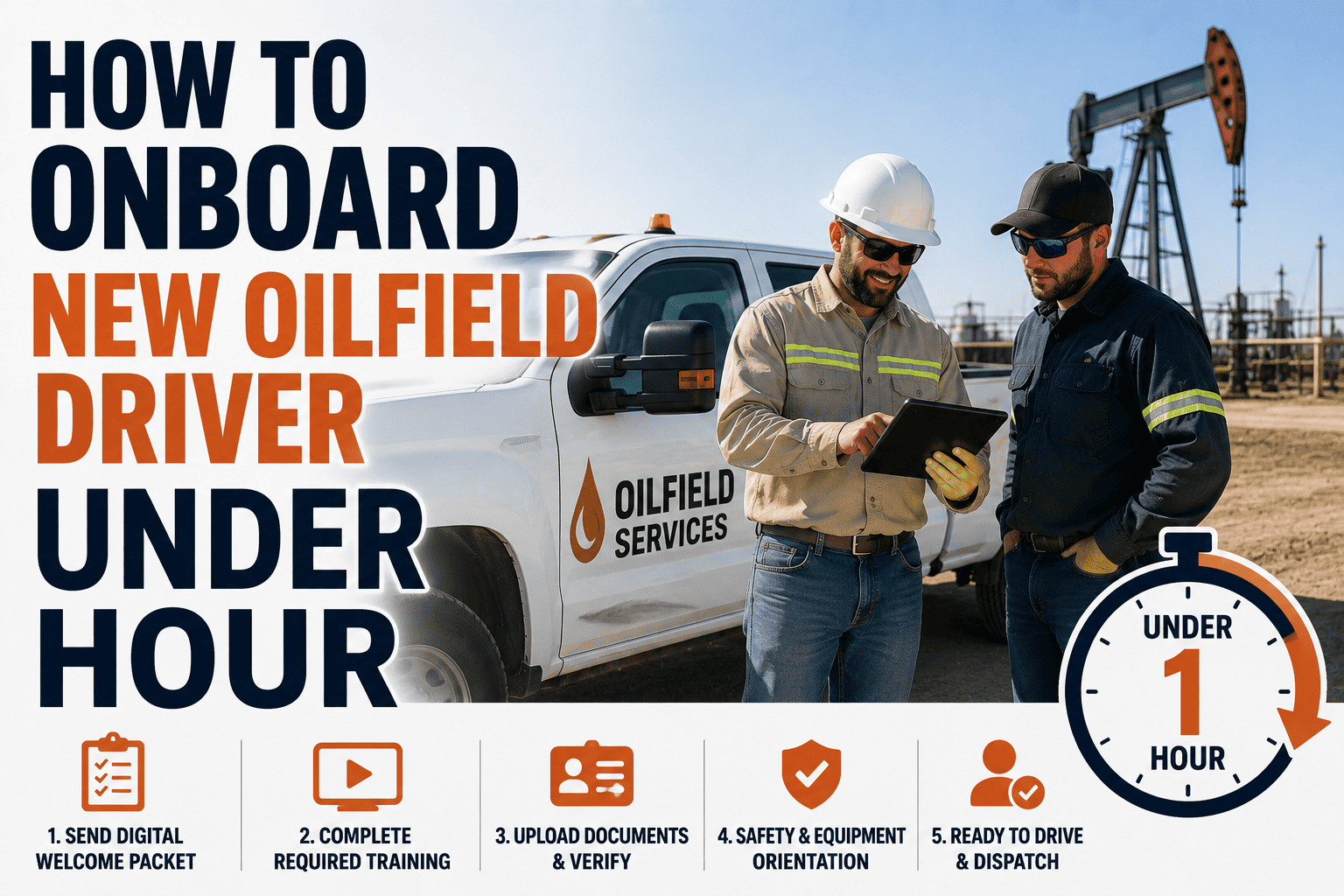
A new oilfield driver showing up on day one should be dispatch-ready within the hour, not stuck waiting on paperwork while a truck sits idle in the yard. Traditional onboarding drags on for days because credential checks, vehicle assignment, safety training, and app setup all happen as separate manual steps, often on paper, often chased down by phone calls. None of that is necessary anymore. With the right digital workflow, a fleet manager can take a new hire from first login to first dispatch in under sixty minutes without skipping a single compliance requirement.
A digital onboarding flow verifies CDL, medical card, and HAZMAT credentials in minutes, assigns a vehicle automatically, delivers safety training on a mobile device, and activates dispatch access, all within roughly 50 minutes. Paper-based onboarding for the same steps typically takes 2 to 5 business days.
The 5-Step Onboarding Flow, Start To Finish
Fast onboarding is not about skipping steps, it is about running the same required steps in parallel and digitally instead of sequentially and on paper. Here is what an oilfield driver onboarding flow looks like when it is built to finish inside an hour.
| Step | What Happens | Time Required | Why It Matters |
|---|---|---|---|
| 1. Credential Upload | Driver uploads CDL, medical card, and HAZMAT endorsement via mobile app | 10 minutes | Creates the digital driver qualification file automatically |
| 2. Automated Verification | System checks document format, expiry dates, and endorsement validity | Instant | Blocks dispatch if any credential is expired or missing |
| 3. Vehicle Assignment | Driver is matched to an available vehicle with GPS and telematics already active | 10 minutes | Links driver identity to vehicle for real-time tracking and reporting |
| 4. Safety Training | Site-specific safety modules and policy acknowledgments completed on device | 15 to 20 minutes | Satisfies HSE prequalification and client safety requirements |
| 5. Dispatch Activation | Mobile app access confirmed for DVIR, dispatch, and hours-of-service logging | 5 minutes | Driver is fully dispatch-ready with a complete digital audit trail |
Step 1 And 2: Credentials That Verify Themselves
Instead of a supervisor manually checking a CDL and medical card against an expiration calendar, the driver photographs each document inside the app. The system reads expiry dates automatically and flags anything incomplete before the driver moves to the next step, which is the same automated qualification verification approach that prevents dispatch of drivers with expired credentials in mature oilfield compliance programs.
Step 3: Vehicle Assignment Without The Radio Calls
Rather than a dispatcher manually matching a new driver to an available truck, the platform assigns a vehicle that already has GPS and telematics active, so tracking, DVIR, and hours-of-service logging start from the driver's very first trip with no separate setup step.
Step 4: Training That Travels With The Driver
Safety training and policy acknowledgment happen on the same device the driver already has in hand, with a timestamped digital signature captured at completion. This creates the audit-ready record that HSE and client prequalification reviews require, without a filing cabinet full of signed paper forms.
What Gets Verified Automatically
CDL status, medical card expiry, HAZMAT endorsement where required, defensive driving certification, and client-specific training modules all get checked against expiry dates the moment they are uploaded, so nothing slips through during a busy hiring week.
FleetRabbit's mobile onboarding flow verifies credentials, assigns vehicles, and delivers safety training from a single app, so your new hires are dispatch-ready the same day they walk in. Start your free trial and run your next onboarding digitally.
Why Slow Onboarding Costs More Than It Looks Like
A driver waiting on paperwork is a truck sitting idle and a route that does not get covered. Multiply a two to five day onboarding delay across a fleet that hires regularly, and the lost productivity adds up fast, on top of the real compliance risk of a driver getting dispatched before every credential is actually verified. Paper-based driver qualification files also make audit preparation painful, since assembling documentation for a DOT or client HSE request can take 40 to 60 hours of manual work when records are not centralized.
The Compliance Risk Of Rushing Manually
Ironically, the manual process that feels careful is often the one with more gaps. A missed expiration date on a spreadsheet or a paper form filed in the wrong folder is far easier to overlook than an automated system that blocks dispatch outright when a credential does not check out.
What To Have Ready Before You Start
To hit the under-an-hour mark, have the driver's CDL, medical card, and any required endorsements ready to photograph, confirm an available vehicle in the system, and load your site-specific safety modules in advance. With those pieces already in place, the onboarding flow itself becomes a formality rather than a bottleneck. If you want to see this running against your own hiring volume, you can book a demo and walk through a live onboarding session.
Every day a new driver waits on paperwork is a day your truck sits idle and your route goes uncovered. FleetRabbit turns credential verification, vehicle assignment, safety training, and dispatch activation into one continuous digital flow that finishes in under an hour, with a complete audit trail behind every step.