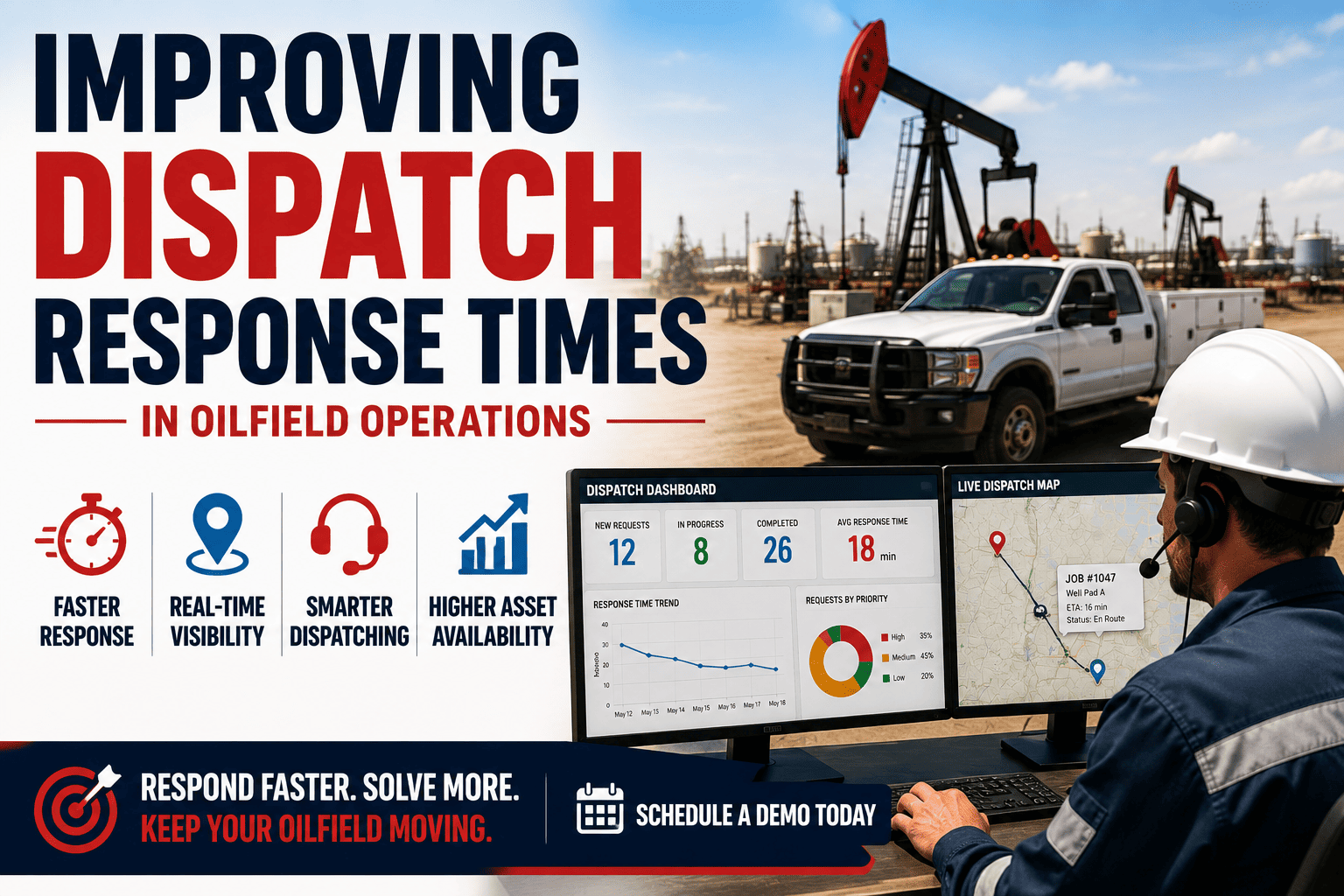
When an oilfield service request comes in, every extra minute a dispatcher spends dialing drivers, checking paper boards, or guessing which vehicle is closest translates directly into wasted rig time, frustrated site supervisors, and mounting fuel costs. Oilfield operations are spread across dozens of well sites, often in remote basins where the nearest qualified vehicle could be 10 minutes away or 60, and a dispatcher working from a phone and a spreadsheet simply cannot tell the difference in real time. The result is slow response, wasted mileage, and service delays that ripple across every site waiting on that crew.
Phone-based oilfield dispatch takes 8 to 12 minutes per assignment just to communicate job details, confirm the address, and get a status acknowledgment. Fleets using real-time, GPS-based dispatch cut that same cycle to 2 to 4 minutes and see overall response times fall by 60 to 70 percent, with on-time arrival climbing to 97 to 98 percent. FleetRabbit makes this shift possible by matching every job to the nearest qualified vehicle automatically.
The Real Cost of Slow Dispatch Response in Oilfield Operations
Every well site running on a delayed crew is a well site losing revenue. Rig downtime while waiting on a service vehicle does not just cost the minutes a truck is late, it cascades into idle personnel, stalled workover schedules, and missed production windows that are far more expensive than the dispatch delay itself. Oilfield operators managing multi-site drilling and service fleets lose an average of 2.4 million dollars annually to inefficient dispatch decisions and suboptimal routing, a figure that reflects wasted mileage, driver idle time, and the opportunity cost of jobs that could have been completed if response times were faster.
Remote, Dispersed Sites Multiply the Problem
Unlike urban service fleets, oilfield operations are spread across basins where the difference between the nearest vehicle and the second-nearest vehicle can be 30 minutes of drive time. Static dispatch decisions made without live vehicle position data guarantee that some jobs get an unnecessarily distant vehicle while a closer, equally qualified truck sits idle at a depot. This is precisely the scenario FleetRabbit's dispatch engine is built to eliminate, matching the job to the closest available and qualified vehicle every time.
Every Minute Late Has a Dollar Value
High-priority jobs waiting behind lower-priority work, drivers idling at depots while urgent calls queue, and inconsistent service quality all point back to the same root cause: dispatch decisions made without real-time intelligence. Operators who want to see the numbers behind their own fleet can book a demo and walk through exactly where dispatch delay is costing them money today.
FleetRabbit's dynamic dispatch engine evaluates job urgency, vehicle location, driver qualification, and site geofences the moment a request comes in, assigning the optimal vehicle automatically instead of leaving it to guesswork. Get started with a free trial and see the difference on your own routes.
What Slows Down Oilfield Dispatch Response Today
Before response times can improve, it helps to understand exactly where the delay comes from. Most oilfield fleets lose time in three predictable places, and each one compounds the others when left unaddressed.
Phone-Based Coordination Breaks Down at Scale
A dispatcher juggling a handful of trucks can manage phone calls reasonably well. A dispatcher coordinating dozens of vehicles across multiple well sites cannot keep pace, and every additional call adds to a growing backlog of jobs waiting for attention. Manual coordination between dispatchers, drivers, and site supervisors is the single biggest driver of slow response in oilfield service fleets.
Static Rosters Ignore Real Vehicle Location
When dispatch decisions are made from a fixed list rather than live GPS position, the "next vehicle up" is rarely the nearest one. This creates unnecessary empty miles, extends response times, and burns fuel that a location-aware assignment would have saved entirely.
No Visibility Into Driver Qualification
Oilfield jobs often require specific certifications, load ratings, or specialized equipment. Dispatching without qualification matching risks sending an unqualified vehicle to a job, forcing a second dispatch and doubling the delay. Matching qualification to job requirements automatically is one of the fastest ways to cut rework and repeat trips.
| Dispatch Factor | Manual Process | FleetRabbit Automated Process | Impact on Response Time |
|---|---|---|---|
| Job Assignment | Dispatcher calls drivers in roster order, 8 to 12 minutes per assignment | System matches nearest qualified vehicle automatically, 2 to 4 minutes per assignment | Cuts assignment cycle by 60 to 70 percent |
| Vehicle Selection | Static roster, next vehicle regardless of distance | Live GPS comparison of every available vehicle to job location | Reduces unnecessary miles by up to 23 percent |
| Driver Acknowledgment | Verbal confirmation over phone, prone to miscommunication | Mobile app push notification with one-tap accept and navigation | Removes multi-minute confirmation delay |
| Qualification Check | Dispatcher relies on memory or paper records | Automatic matching of certifications and equipment to job requirements | Prevents repeat dispatch from unqualified assignment |
| ETA Accuracy | Rough verbal estimate with no live update | Predictive ETA refined by historical site data and traffic conditions | Improves to within 5 to 7 minutes accuracy after 6 months |
A Faster Dispatch Workflow, Step by Step
Improving response time is not about working faster on the phone, it is about removing the phone from the critical path entirely. Here is how a real-time dispatch workflow compresses a 10 to 15 minute cycle into 2 to 4 minutes.
Job Request Logged Instantly
Live Fleet Scan Runs Automatically
Driver Accepts On Mobile
For a typical 5-rig operation, cutting well-site wait times by 30 percent recovers between 150,000 and 300,000 dollars annually in previously lost non-productive time. FleetRabbit deploys in 48 hours with minimal training, and most dispatchers become proficient within 1 to 2 days. Sign up today to start optimizing your dispatch decisions.
Dispatch Performance Metrics Fleet Managers Should Track
You cannot improve what you do not measure, and dispatch response time is no exception. Fleet managers who track the right metrics know exactly where delay is coming from and how much each improvement is worth.
Average Response Time
This is the time between a job request being logged and the assigned vehicle arriving on site. Fleets using real-time dispatch intelligence typically report an average response time near 29 minutes with a 97 percent on-time arrival rate, compared to manual operations where late responses averaging 47 minutes are common.
Dispatch Cycle Time
This measures how long it takes from job request to driver acceptance, separate from travel time. Manual phone-based coordination runs 8 to 12 minutes per assignment, while automated mobile acceptance workflows bring that down to 2 to 4 minutes.
Empty Mile Percentage
Miles traveled without directly serving a job request indicate poor vehicle-to-job matching. Fleets relying on static rosters instead of live location data have reported traveling up to 23 percent more miles than necessary, a gap that closes immediately once nearest-vehicle matching is in place.
Technology Behind Faster Oilfield Dispatch
FleetRabbit's dynamic dispatch engine continuously evaluates job urgency, vehicle location and capability, driver availability, road conditions, permit zones, and site geofences to assign optimal resources in real time. Instead of a dispatcher manually scanning a fleet roster, the system presents the best-matched vehicle automatically, factoring in certifications and equipment requirements so the right crew reaches the right site the first time.
Predictive arrival estimates improve with use. Initial predictions typically fall within 12 to 15 percent of actual arrival time using baseline travel and traffic data. As the system learns from historical performance, including site-specific delays like security checkpoints, prediction accuracy improves to within 8 percent after 90 days, and within 5 to 7 minutes on a typical 60-minute transit after 6 months of operation. That means dispatchers and site supervisors get ETAs they can actually plan around, not rough guesses.
Rig management integration adds another layer of efficiency. When a well site reports a delay, FleetRabbit can automatically hold approaching vehicles or redirect them to another job, preventing wasted trips and unnecessary wait time at the gate. Ready to see this in action across your own routes? Sign up for a free trial and connect your fleet in minutes.
Key Takeaways on Improving Oilfield Dispatch Response Times
Slow dispatch response in oilfield service fleets is rarely a driver problem, it is a visibility problem. Phone-based coordination, static rosters, and manual qualification checks combine to push assignment cycles to 8 to 12 minutes and leave crews responding to urgent requests an average of 47 minutes late. Across a large multi-site operation, that gap adds up to 2.4 million dollars in avoidable losses every year.
Real-time dispatch intelligence closes that gap directly. Matching every job to the nearest qualified vehicle, pushing assignments through mobile acceptance instead of phone calls, and refining arrival predictions with historical data brings response times down by 60 to 70 percent and pushes on-time arrival rates to 97 to 98 percent. For a typical 5-rig operation, a 30 percent reduction in well-site wait time alone recovers 150,000 to 300,000 dollars annually, and most fleets are up and running within 48 hours.
The opportunity is measurable and the implementation timeline is short. Fleet managers who move dispatch decisions from a phone and a paper roster to live, automated coordination see the improvement in weeks, not quarters.
Every slow dispatch decision costs your oilfield fleet miles, fuel, and rig uptime that a nearest-vehicle match would have saved. FleetRabbit's real-time dispatch engine cuts response times by 60 to 70 percent and lifts on-time arrival to 97 to 98 percent, deployed across your fleet in as little as 48 hours. Sign up for a free trial today, no credit card required.