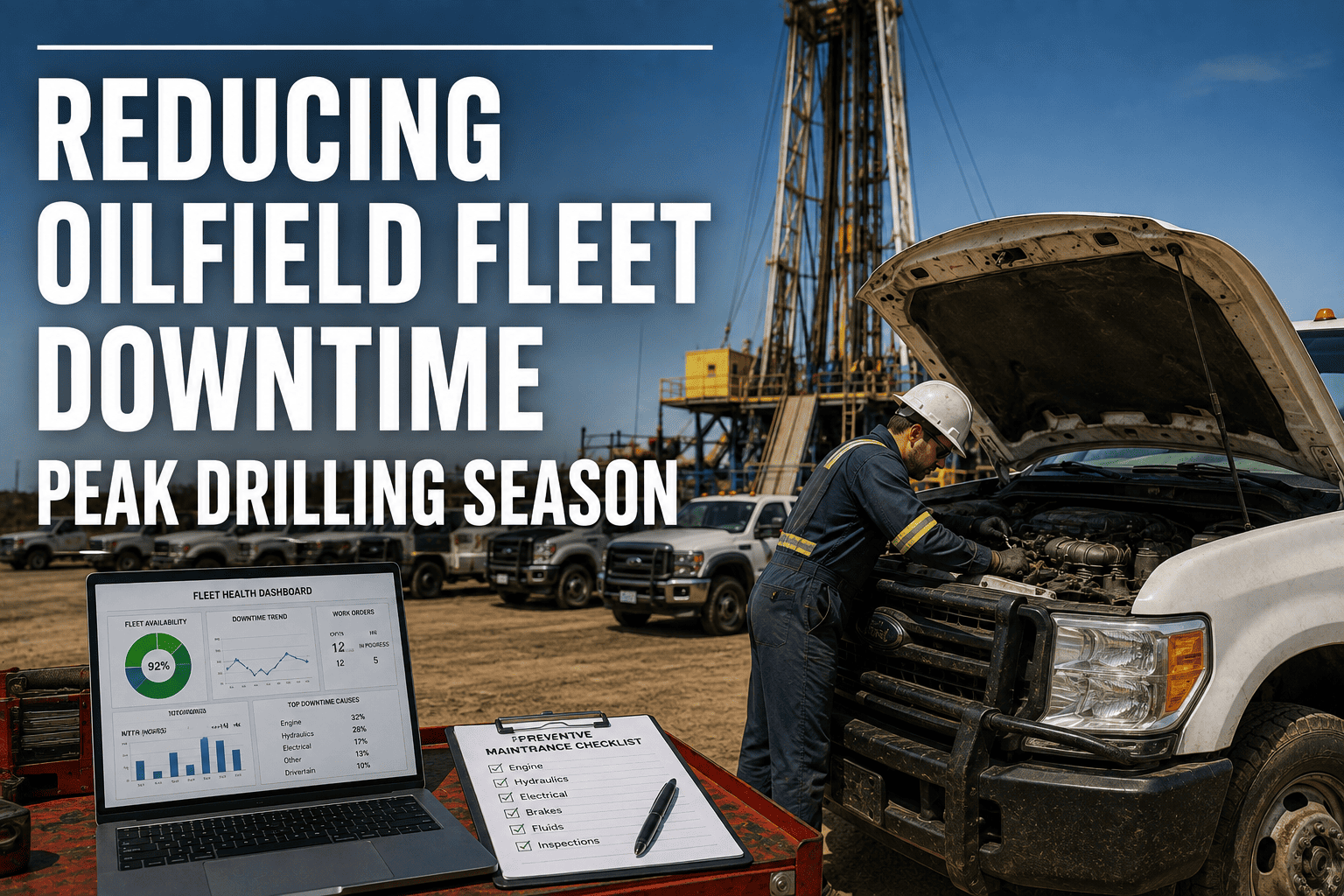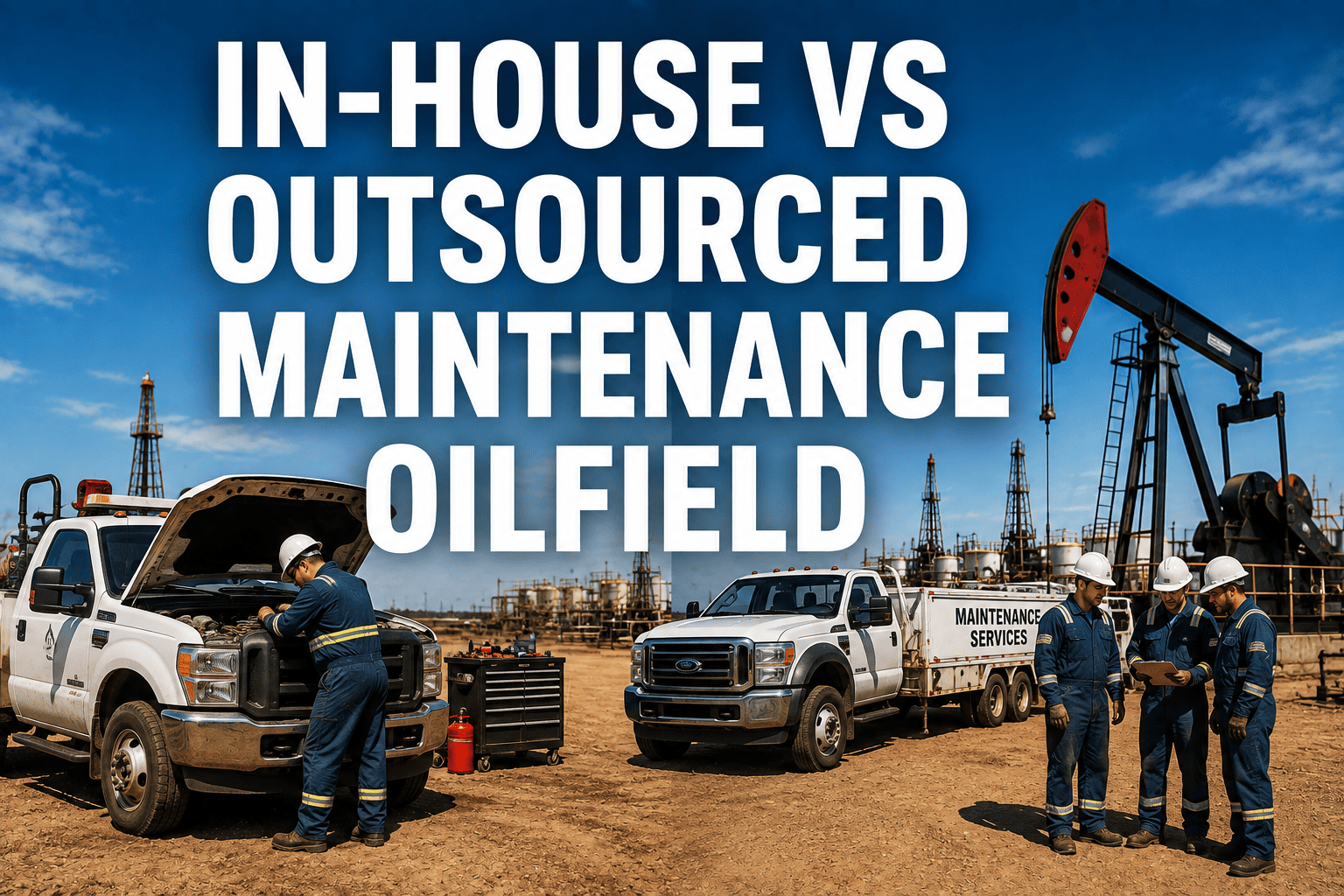
A wellhead service truck breaks down sixty miles down a lease road, and the fleet manager faces the same question every oilfield operator eventually asks: would this have gone differently with our own shop, or is the outside vendor actually the smarter bet? The in-house versus outsourced maintenance decision looks like a simple cost comparison on paper, but for oilfield fleets it is really a question about distance, technician specialization, and how fast a truck can get back to work when it fails sixty miles from anywhere. Getting the answer right changes your cost per mile for years.
In-house shops typically break even around 25 to 30 trucks, running at $0.12 to $0.16 per mile versus $0.18 to $0.25 per mile for outsourced work. Below that fleet size, outsourcing usually wins. Above it, and especially for remote oilfield equipment where breakdowns carry a 3 to 5 times higher recovery cost, in-house control starts paying for itself. Most oilfield operators land on a hybrid model rather than picking one side outright.
In-House Shop
- Lower cost per mile at scale, typically $0.12 to $0.16
- Full control over repair priority and quality standards
- No premium labor rates or parts markup on every job
- Requires $150,000 to $300,000 in startup capital
- Needs consistent volume, usually 25 to 30 trucks, to justify overhead
Outsourced Vendor
- No shop, tools, or technician payroll to carry
- Access to specialty diagnostics for hydraulic and pumping equipment
- Scales instantly with fleet size, no capital investment
- Runs $0.18 to $0.25 per mile with 20 to 40 percent parts markup
- Subject to vendor scheduling and distance from remote wellsites
The Break-Even Math for Oilfield Fleets
The in-house versus outsourced decision often comes down to a single number: how many trucks do you run. Below roughly 25 to 30 trucks, the fixed cost of a shop, lifts, tools, and full-time technicians rarely spreads thin enough to beat outside vendor rates. Above that threshold, a fleet is generating enough maintenance hours that dedicated staff and facilities start paying for themselves. A 30-truck fleet averaging 100,000 miles each covers 3 million fleet miles a year. At $0.133 per mile for an in-house operation against $0.20 per mile outsourced, that gap alone represents roughly $200,000 in annual savings.
Labor Rate Reality
The labor spread is often the biggest single line item. Fleets running a significant share of repairs in-house report technician labor around $45 to $75 per hour, while the same work sent to an outside shop runs $125 to $175 per hour. That difference adds up fast across a fleet doing hundreds of repair events a year, but it only outweighs the fixed overhead of a shop once volume is high enough to keep technicians consistently busy.
FleetRabbit tracks maintenance spend, labor hours, and downtime by vehicle so you can run this break-even math on your own fleet instead of a national average. Sign up free to start tracking, or book a demo and we'll walk through your current cost per mile together.
Why Remote Wellsites Change the Calculation
A breakdown in a fleet yard is an inconvenience. A breakdown sixty to a hundred and twenty miles down a lease road is a production event. Oilfield equipment failures at remote well pad locations carry three to five times the recovery cost of a yard-adjacent breakdown once emergency technician dispatch, specialist equipment transport, and crew waiting time are factored in. That distance penalty applies whether you outsource or run an in-house shop, but it changes how each model performs.
Distance Multiplies the Cost of a Slow Response
An outsourced vendor without a nearby presence has to send a technician across that same lease road distance, often on their own scheduling timeline rather than yours. An in-house team with a technician staged closer to active sites can respond faster, but only if the fleet is large enough to justify positioning staff and parts inventory near the work.
Specialty Equipment Needs Specialty Technicians
Frac pumps, wireline units, cement pumpers, and hydration equipment require hydraulic and pressure-system expertise that not every in-house shop can staff affordably. This is where many oilfield operators lean on specialized mobile maintenance vendors for severe-duty equipment while keeping routine PM work in-house.
In-House vs Outsourced: Side-by-Side Comparison
| Factor | In-House Shop | Outsourced Vendor |
|---|---|---|
| Cost Per Mile | $0.12 to $0.16, improves with volume | $0.18 to $0.25, includes parts markup |
| Startup Investment | $150,000 to $300,000 for facility and tools | None, converts to variable operating cost |
| Repair Priority Control | Full control over scheduling and standards | Subject to vendor queue and availability |
| Specialty Diagnostics | Requires investment in OEM-specific tools | Often included through vendor scale |
| Remote Response Time | Fast if staff are positioned near sites | Slower without a local vendor presence |
| Best Fleet Size | 25 to 30+ trucks with consistent volume | Under 25 trucks or highly dispersed sites |
The Hybrid Model Most Oilfield Fleets Actually Use
Very few oilfield operators run purely one model. Industry survey data shows roughly a third of private fleets already blend in-house and outsourced work, and that split tends to be even more common in oil and gas, where equipment ranges from simple support trucks to complex pressure-pumping units. The planned-versus-unplanned maintenance gap, at roughly seven times the cost difference, matters far more than which model handles the work, which is why the hybrid approach focused on strong PM discipline consistently outperforms a fleet that picks a side but runs a weak schedule.
Step 1: Keep Routine PM In-House
Oil changes, filter service, and standard inspections are high-frequency, low-complexity work that in-house technicians handle efficiently without needing specialized tools.
Step 2: Route Specialty Repairs to Vendors
Hydraulic system overhauls, transmission work, and pressure-pumping equipment repairs go to vendors who already carry the OEM-certified diagnostic tools for that equipment.
Step 3: Position Emergency Response for Remote Sites
Whichever model handles the repair, pre-negotiate response terms for remote lease road breakdowns so a truck sixty miles out is not waiting on a vendor's normal service queue.
Step 4: Track Both Sides in One System
Cost per event, technician hours, and vendor turnaround time need to live in one place so the hybrid split can be reviewed and adjusted as the fleet grows.
How FleetRabbit Supports Either Model
FleetRabbit does not force a fleet into one maintenance model. The platform tracks work orders, cost per event, and technician or vendor performance side by side, whether a repair happens on your own bay or at an outside shop three hours from the wellsite. Oilfield operators using FleetRabbit to coordinate maintenance scheduling and parts availability have reported a 35 percent reduction in maintenance costs and a 45 percent improvement in equipment uptime. If you are trying to figure out where your fleet actually sits on the break-even curve, you can sign up free and start pulling real cost-per-mile data within days, or book a demo and have our team map a hybrid model to your specific equipment and site layout.
Whether you run an in-house shop, lean on outside vendors, or split the work between both, FleetRabbit gives you the cost, compliance, and downtime data to know it is working. Start free and see your real numbers, or talk to our team about your specific fleet.