Equipment reliability in oilfield fleet operations depends on continuous visibility into mechanical health parameters that traditional maintenance schedules cannot capture — yet most operators lack the IoT sensor infrastructure and real-time analytics required to detect developing faults before they produce catastrophic failures. IoT-enabled equipment monitoring systems transform routine operational data into predictive intelligence that enables oilfield fleet managers to intervene before breakdowns occur, schedule maintenance during production-compatible windows, and verify equipment readiness across dispersed basin operations. FleetRabbit's integrated IoT monitoring platform combines engine diagnostics, vibration sensors, temperature monitoring, and GPS-tracked utilization data to deliver real-time equipment health visibility, automated fault detection, and executive-level reliability analytics that measurably improve fleet uptime while reducing emergency repair costs and production disruption risk. This guide details how IoT monitoring enhances oilfield fleet reliability, the sensor architectures that deliver actionable insights in remote operating environments, and the FleetRabbit capabilities that enable fleet managers to scale predictive maintenance across multi-site, multi-contractor operations. Book a demo to see FleetRabbit's IoT monitoring platform for your oilfield fleet.
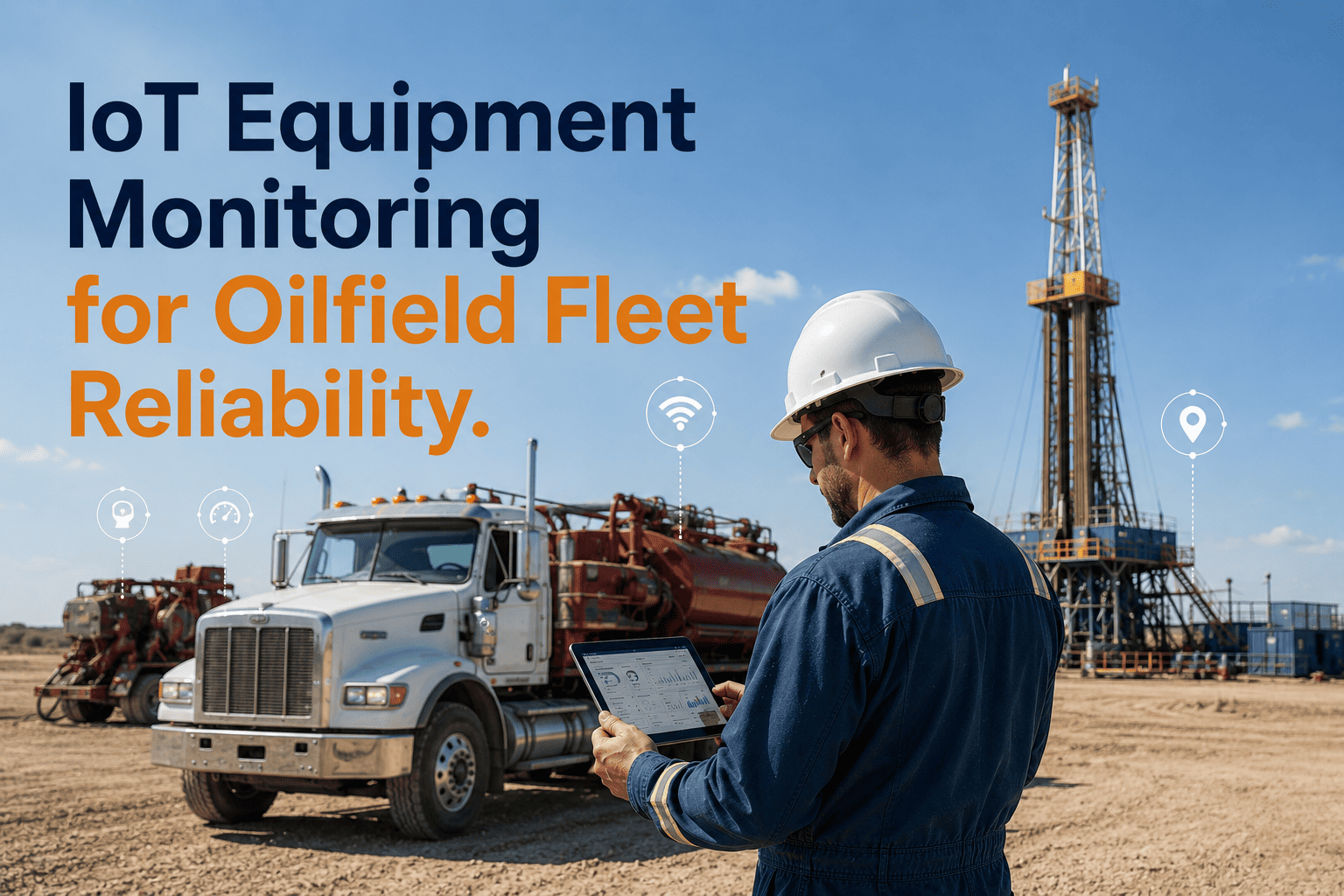
IoT Equipment Monitoring for Oilfield Fleet Reliability
Transform equipment management from reactive repair to predictive intervention. FleetRabbit's IoT monitoring platform delivers real-time sensor analytics, automated fault detection, and reliability forecasting that reduce unplanned downtime by 40–55% while strengthening operational continuity across dispersed oilfield basin operations.
How FleetRabbit's Sensor Framework Delivers Actionable Equipment Intelligence in Remote Oilfield Environments
Oilfield equipment monitoring requires sensor architectures that operate reliably across cellular dead zones, extreme temperature ranges, and high-vibration operating conditions. FleetRabbit's oilfield-optimized IoT framework combines edge processing, store-and-forward telemetry, and satellite backup connectivity to ensure continuous equipment health visibility regardless of infrastructure limitations at remote well pad locations.
Edge Processing for Real-Time Fault Detection
Onboard telemetry units process sensor data locally to detect critical threshold exceedances — bearing temperature spikes, vibration signature changes, or pressure anomalies — without requiring continuous cloud connectivity. Alerts trigger immediately upon detection and transmit via available networks, ensuring rapid response capability even when cellular coverage is intermittent.
Store-and-Forward Telemetry for Connectivity Gaps
Sensor data collected during cellular dead zones stores locally with GPS timestamps and transmits automatically when connectivity restores. Historical trend analysis remains continuous despite intermittent connectivity, enabling reliable predictive modeling without data gaps that compromise fault detection accuracy.
Satellite Backup for Mission-Critical Assets
High-value production-critical equipment can integrate satellite telemetry modules that maintain real-time monitoring capability regardless of terrestrial infrastructure availability. Satellite backup ensures continuous visibility for assets where unplanned downtime carries exponential financial consequences.
Detect Developing Faults Weeks Before Catastrophic Failure
FleetRabbit's IoT monitoring platform identifies bearing temperature trends, vibration signature changes, and pressure anomalies that signal developing mechanical faults — providing the planning window to schedule repairs during production-compatible windows rather than executing emergency interventions during active operations.
FleetRabbit IoT Monitoring Features That Drive Measurable Reliability Improvement
Vibration and Bearing Temperature Monitoring
Continuous monitoring of rotating equipment vibration signatures and bearing temperatures against equipment-specific baseline parameters identifies developing mechanical faults 2–4 weeks before catastrophic failure. FleetRabbit's trend analysis distinguishes normal operational variation from genuine fault progression, reducing false alerts while maintaining genuine risk detection capability.
Engine Diagnostic and Emissions System Monitoring
OBD-II and heavy-duty J1939 integration surfaces engine fault codes, DPF regeneration events, coolant temperature exceedances, and emissions system alerts to fleet manager dashboards within minutes of detection. Predictive fault code analysis identifies precursor patterns that enable intervention before driver-perceptible performance degradation occurs.
Hydraulic and Pneumatic System Pressure Monitoring
Pressure sensors on hydraulic pumps, pneumatic systems, and fluid transfer equipment detect leaks, blockages, and component wear before performance degradation impacts operations. FleetRabbit's pressure trend analysis identifies gradual degradation patterns that single-point pressure readings miss, enabling proactive component replacement.
Environmental Condition Monitoring for Equipment Protection
Temperature, humidity, and particulate sensors monitor operating environment conditions that accelerate equipment wear. FleetRabbit correlates environmental data with maintenance records to identify conditions requiring protective interventions — enabling proactive equipment preservation strategies that extend service life in challenging basin environments.
FleetRabbit IoT Analytics for Operations, Finance, and Strategy Leadership
Portfolio Equipment Health Visibility Without Manual Data Assembly
Live dashboards show equipment health scoring per site, predictive alert status per vehicle class, and maintenance compliance trending across dispersed oilfield operations — updated continuously without field supervisor data consolidation. Operations leaders identify underperforming assets, validate contractor maintenance adherence, and prioritize intervention resources based on reliability deviation from baseline.
Repair Cost Forecasting With Verified Savings Trajectory
FleetRabbit's reliability ROI dashboard projects repair cost reduction timelines based on documented fault prevention metrics, enabling finance teams to incorporate verified maintenance savings into annual budget forecasts. Historical savings data supports capital allocation decisions by demonstrating the ROI of IoT investment through reduced emergency repair expenditure and production disruption avoidance.
Equipment Lifecycle Planning With Data-Driven Replacement Timing
FleetRabbit aggregates equipment health trends, maintenance history, and utilization patterns to forecast optimal replacement timing for aging assets. Lifecycle cost modeling supports strategic fleet renewal decisions with verifiable data demonstrating when total ownership cost of aging equipment exceeds replacement investment threshold.
Incident Investigation Efficiency Through Automated Evidence Assembly
When equipment-related incidents occur, FleetRabbit automatically compiles sensor history, maintenance records, and operational context into a structured investigation package. HSE teams receive investigation-ready evidence in minutes rather than assembling data from multiple systems over 3–4 hours — accelerating root cause analysis and reducing recurrence risk.
Reduce Unplanned Downtime by 40–55% Through IoT-Enabled Predictive Monitoring — Starting This Quarter
FleetRabbit transforms routine sensor data into actionable equipment intelligence that respects oilfield operational realities while driving measurable reliability improvement. With vibration monitoring, engine diagnostics, pressure analytics, and environmental condition tracking generated automatically from IoT sensors, oilfield operators can scale predictive maintenance across multi-site, multi-contractor operations — delivering downtime reduction that improves P&L performance without compromising operational capability.