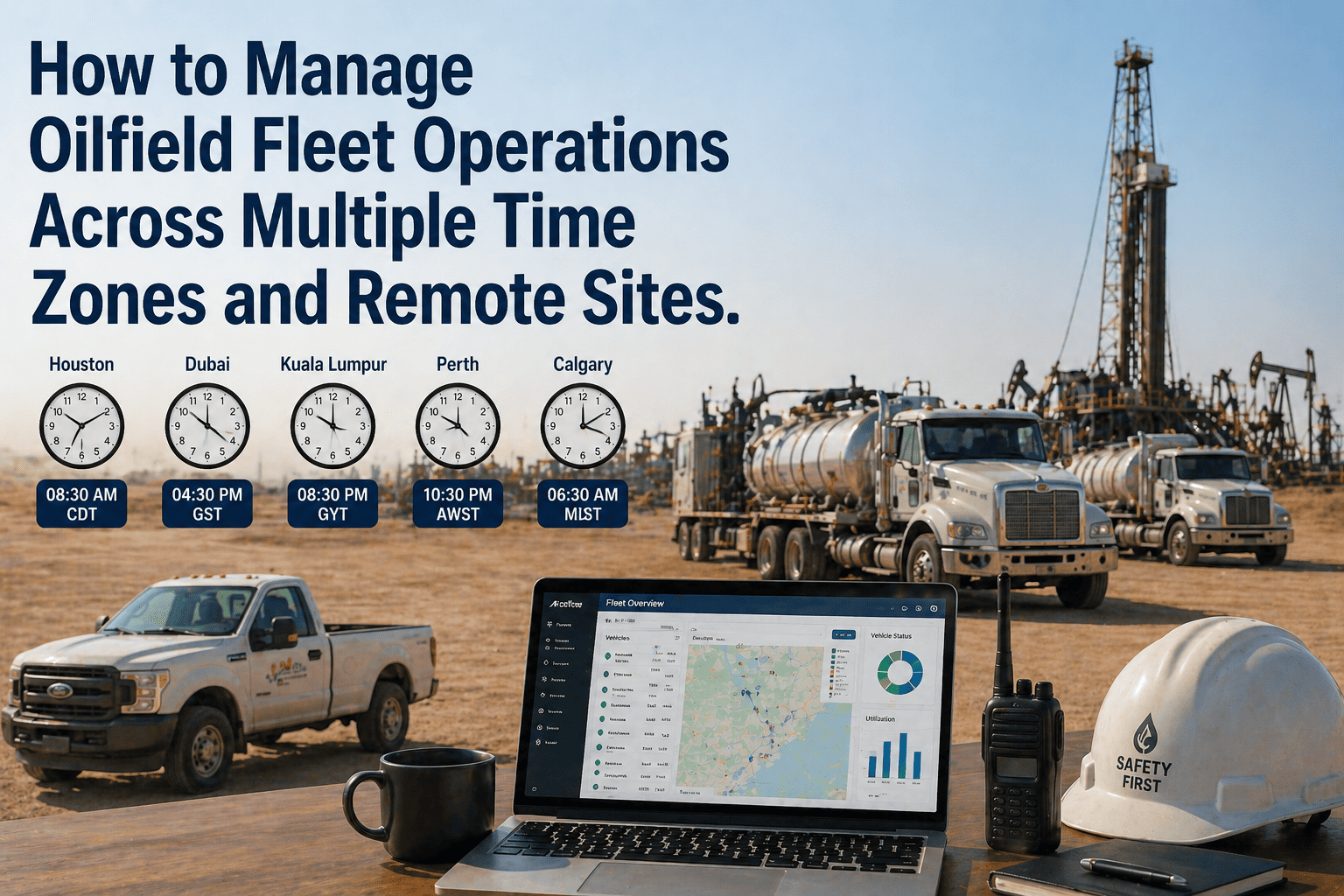
Managing an oil and gas fleet across a single well pad is a logistics challenge. Managing it across forty active well sites, three pipeline corridors, two staging yards, and six states — spanning multiple time zones with contractor vehicles, owned equipment, and rotating shift crews — is an operational intelligence problem that conventional fleet management tools were never designed to solve. The central issue is not vehicle tracking: every GPS system can tell you where a vehicle is. The issue is decision-making context: whether the dispatcher in Houston can make a confident routing decision about a vehicle in the Permian Basin at 3am; whether the HSE director in Aberdeen can verify that a lone-worker check-in protocol is active for the crew in the Bakken; whether the VP Operations in Dubai can see a real-time compliance health score for all 450 vehicles across four countries before the board meeting begins. FleetRabbit's unified multi-site platform was architected specifically for oilfield fleet operations at this level of geographic and organisational complexity — delivering a single operational dashboard that performs identically whether a vehicle is in cell coverage, satellite range, or the middle of a North Sea platform transfer. Book a 30-minute operational assessment with a FleetRabbit multi-site specialist.
How to Manage Oilfield Fleet Operations Across Multiple Sites, Time Zones, and Remote Locations
Unified real-time dispatch, compliance monitoring, and HSE reporting across every well site, pipeline corridor, and staging yard in your operation — regardless of time zone, connectivity status, or regulatory jurisdiction.
Why Standard Fleet Tools Break Down at Scale Across Remote Oilfield Locations
The operational complexity of a multi-site oilfield fleet does not scale linearly. Managing 50 vehicles at one yard is a scheduling task. Managing 450 vehicles across 40 active sites in 4 time zones is an information architecture problem — and most fleet management tools are optimised for the first scenario while being deployed in the second.
Connectivity Dead Zones at the Sites That Matter Most
Remote drilling pads, pipeline inspection routes, and offshore transfer points — where operational risk is highest — are precisely where cellular coverage fails. A GPS platform that loses track of a vehicle 80 miles from the nearest tower has failed the oilfield operator's most critical use case before the first shift begins.
Compliance Frameworks Differ by Region and Operator
A contractor fleet moving between FMCSA-regulated US operations and ADNOC-regulated UAE operations faces two completely different compliance regimes with different certification requirements, reporting formats, and inspection protocols. Most platforms handle one region natively and charge custom development for the rest.
Time Zone Gaps Create Shift Handover Blind Spots
When the Permian Basin fleet coordinator hands over at 6pm CST, it is 11pm in the North Sea and 3am in Abu Dhabi. Shift handover at a multi-site operation requires the incoming coordinator to have an instant complete picture of every active vehicle, every open alert, and every pending compliance deadline — not a manual briefing assembled from disconnected regional systems.
Contractor Fleet Visibility Gaps Across Site Boundaries
Oilfield operators bear HSE responsibility for contractor vehicles on their leases — but contractor vehicles operating across multiple sites may be using different telematics hardware, different fleet management platforms, or no tracking at all. The result is a compliance blind spot across 30–60% of the vehicle movements that the operator is legally responsible for.
Six Platform Capabilities That Unify Multi-Site Oilfield Fleet Operations
FleetRabbit is architected as a multi-site platform from the ground up — not a single-site tool extended through configuration. The following six capabilities work together to create unified operational control regardless of geographic distribution, connectivity status, or regulatory jurisdiction.
Unified Fleet Map Across All Sites and Connectivity Modes
Every vehicle — whether in cellular coverage, satellite range, or making an offshore platform transfer — appears on the same FleetRabbit fleet map with identical data density. There are no "offline" zones on the map, no vehicles that simply disappear when they leave a cell tower's range, and no secondary dashboards for remote or satellite-connected assets. A dispatcher in Houston sees the same complete fleet picture as a regional manager in Abu Dhabi.
Site-Specific Compliance Rules Applied Automatically by Location
FleetRabbit's compliance engine applies different rules based on the site a vehicle is operating in or dispatching to. A driver assigned to a UAE site automatically has ADNOC certification requirements enforced; the same driver on a US assignment has FMCSA requirements applied. H₂S zone requirements activate when a vehicle approaches classified wellsites. No manual rule-switching, no coordinator memory dependency — the platform applies the correct compliance framework automatically.
Lone-Worker Protocol Active at All Remote and Offshore Sites
For vehicles operating at remote sites beyond cellular range — the environment where lone-worker incidents carry the highest response-time risk — FleetRabbit's satellite connectivity maintains the check-in protocol continuously. Missed check-ins escalate automatically to the on-call fleet manager regardless of time zone. SOS events are transmitted via satellite and receive response within minutes, not hours.
Shift Handover Dashboard for Time Zone-Distributed Teams
FleetRabbit's shift handover view presents an incoming coordinator with a complete state-of-fleet summary: active vehicles by region, open alerts ranked by priority, pending work orders, compliance deadlines within 24 hours, and contractor fleet status — all in a single view that requires zero calls to the outgoing shift to construct. This view is the same regardless of which region the incoming coordinator is in.
Multi-Region Regulatory Reporting From a Single Export
When a DOT inspector requests records for US fleet assets, FleetRabbit generates the FMCSA-format audit pack. When an ADNOC contractor pre-qualification audit requires compliance documentation, the ADNOC-format pack is generated from the same data set. When a Traffic Commissioner requests DVSA maintenance records for UK operations, the DVSA-compatible export is available in the same platform. One data set, multiple regulatory format outputs — generated in minutes rather than assembled manually over days.
Executive Cross-Site Performance Dashboard for VP-Level Reporting
Fleet directors and VP Operations access a single executive dashboard showing fleet availability rate by region, maintenance cost per operating hour across all sites, compliance health scores by jurisdiction, incident frequency rates by geography, and open corrective action counts — updated in real time, not compiled monthly. This dashboard makes the fleet performance data that previously required a multi-day regional report compilation available in the time it takes to open a browser tab.
How FleetRabbit Configures Differently for Each Site Type in Your Operation
Multi-site oilfield operations include fundamentally different site types — each with distinct compliance requirements, connectivity profiles, and fleet management needs. FleetRabbit applies site-type-specific configuration automatically based on geofence classification.
What Fleet Directors and VP Operations See When They Open FleetRabbit
The executive experience of multi-site fleet management should not be a quarterly slide deck assembled from regional reports. FleetRabbit's executive dashboard presents a continuous real-time view of operational performance across all sites and regions — with the ability to drill down from a fleet-wide summary to an individual vehicle's maintenance history in three clicks.
What FleetRabbit Gives Every Executive Level
How to Deploy FleetRabbit Across a Multi-Site Oilfield Operation Without Disrupting Active Operations
A multi-site fleet deployment requires a structured phased approach that keeps operations running during transition. FleetRabbit's deployment methodology stages integration by region and site type — delivering immediate value at the first site while systematically extending coverage across the full operation.
Asset Registry and Primary Region Integration
Multi-Region Expansion and Compliance Framework Configuration
Field Deployment: Mobile DVIR and Satellite Connectivity Verification
Executive Dashboard and Maintenance Intelligence Activation
FleetRabbit's phased deployment gets your primary region live within 5–7 days. Multi-region expansion follows a structured 12-week timeline that keeps operations running throughout transition. No hardware replacement, no downtime, no migration risk.
Multi-Site Oilfield Fleet Management: Questions Answered
One Platform. Every Site. Every Time Zone. Every Compliance Framework.
FleetRabbit unifies your oilfield fleet operation across every well site, pipeline corridor, processing facility, and staging yard — regardless of region, connectivity status, or regulatory jurisdiction. Deploy in 5–7 days for your primary region and expand systematically at $3/vehicle/month with no add-on fees.