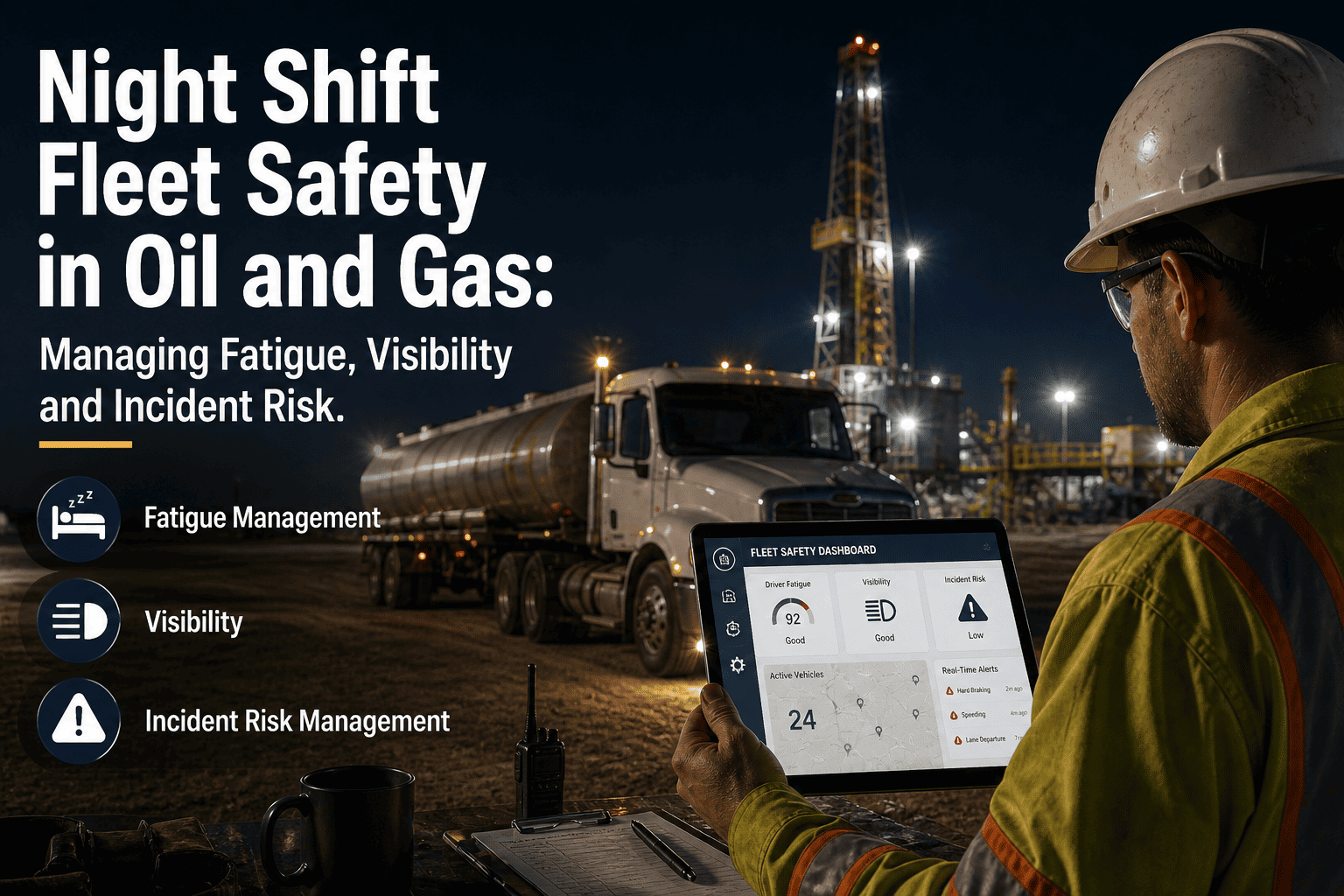
Oil and gas fleet operations do not stop at sunset. Drilling programmes run 24-hour rotations, completion crews work through the night on active fracturing stages, wireline units respond to well control events regardless of the hour, and water haulers run continuous loaded circuits between disposal sites and active pads across the full 24-hour clock. Night shift operations are not an edge case in upstream and midstream fleet management — they are a structural operating reality that carries measurably greater incident risk than equivalent daytime operations across every metric that safety professionals track. Industry safety data consistently demonstrates that oilfield vehicle incidents are 3x more likely during night shift hours, with fatigue being the primary contributing factor in 78% of after-dark crashes involving commercial vehicles in oilfield environments. The challenge for fleet managers and HSE directors is not recognising that night shift operations carry elevated risk — every safety professional knows this. The challenge is implementing a systematic, technology-supported approach to fatigue detection, visibility monitoring, and incident risk management that operates continuously across the full fleet during night operations, rather than relying on individual driver self-assessment in the hours when human judgment is least reliable. FleetRabbit's AI-powered night operations platform delivers exactly this — continuous fatigue scoring, shift-aware alert protocols, real-time driver behaviour monitoring, and automated escalation for developing fatigue indicators — keeping night shift oilfield fleets safer without requiring drivers to accurately self-assess their own impairment. Book a night operations safety assessment with a FleetRabbit HSE specialist.
Night Shift Fleet Safety in Oil and Gas: Managing Fatigue, Visibility and Incident Risk
3x the incident risk. 78% fatigue-related crashes. Lone workers on remote lease roads in the dark. FleetRabbit's AI fatigue scoring and real-time monitoring protect your night shift fleet where standard GPS cannot.
Why Oilfield Night Shift Operations Carry Disproportionate Safety Risk — and Why Standard Approaches Fail
Night shift incidents in oilfield fleet operations are not simply daytime incidents that happened after dark. They occur in a fundamentally different risk environment — different human performance levels, different visibility conditions, different response infrastructure availability, and different consequences when something goes wrong at the end of a remote lease road at 3am with no emergency services within 45 minutes.
The human body's circadian clock reaches its lowest alertness point between 2am and 4am — a biological low that applies regardless of sleep history, caffeine consumption, or individual perception of wakefulness. Night shift oilfield drivers operating in this window are physiologically impaired in reaction time, judgment quality, and hazard detection to a degree comparable to a blood alcohol concentration of 0.05%. Unlike alcohol impairment, drivers at circadian low points are frequently unaware of their reduced capability.
Oilfield shift rotations — typically 7 on / 7 off, 14 on / 14 off, or continuous rotating shifts — accumulate sleep debt that compounds across the rotation. A driver completing the 6th night of a 7-night rotation has accumulated a sleep deficit that significantly exceeds the acute fatigue of a single poor night's sleep, yet no calendar-based HOS compliance system tracks or accounts for cumulative sleep debt across multi-day rotations.
Research consistently demonstrates that the more fatigued a person is, the less accurately they assess their own fatigue level. Drivers at high fatigue states — the exact population that most needs to be off the road — are systematically the least likely to voluntarily report fatigue or request a shift change. Self-reporting-based fatigue management is therefore most unreliable precisely when reliability matters most.
Oilfield lease roads lack the lighting infrastructure, reflective signage, and lane marking of public highways. Night driving on unmapped lease roads requires drivers to navigate by headlight alone on surfaces that may include sudden grade changes, water crossings, equipment crossings, and livestock — hazards that daytime familiarity does not guarantee safe night navigation of, particularly at the 80–100 km/h speeds that time-pressured oilfield drivers maintain.
A night shift incident on a remote lease road involves a combination of factors that maximise consequence severity: longer emergency response times, reduced likelihood of witness presence, potential for extended exposure before discovery, and in H₂S or HAZMAT incidents, the added risk of rescue personnel operating without full situational awareness in darkness. The same incident that generates a manageable response at a daytime well pad can become a fatality on an unlit lease road at 2am.
Night shift dispatchers receiving handover from day shift coordinators inherit incomplete situational awareness — vehicles whose mechanical history, route conditions, and driver fatigue state are not fully communicated in the shift change briefing. These information gaps are the origin of dispatch decisions that send a fatigued driver on a long route, or a vehicle with a developing fault, into the highest-risk operating window of the 24-hour cycle.
Six Capabilities That Protect Oilfield Drivers During Night Shift Operations
FleetRabbit's night operations platform does not simply apply the same GPS tracking with a different clock. Night operations require a qualitatively different monitoring approach — shift-aware alert thresholds, AI fatigue scoring that tracks behavioural indicators rather than relying on self-reporting, and escalation protocols calibrated for the reduced response infrastructure of night hours.
AI Fatigue Scoring — Behavioural Pattern Analysis
FleetRabbit's AI model continuously analyses driver behaviour patterns transmitted through telematics — micro-corrections in steering input, variation in following distance, lane positioning consistency, and acceleration/deceleration smoothness — and compares them against each driver's established baseline. Developing fatigue patterns are scored on a continuous scale, with amber alerts when behavioural degradation reaches early-stage thresholds and red alerts requiring active intervention when patterns match pre-incident signatures.
Shift-Aware Alert Threshold Adjustment
FleetRabbit automatically adjusts alert sensitivity based on shift hour and driver time-on-shift. A speed event at 10am by a driver 2 hours into a day shift is treated differently than the same event at 2am by a driver 9 hours into a night rotation. The system applies progressively lower behavioural thresholds as the shift progresses into high-risk fatigue windows, generating earlier interventions during the hours when human performance degradation is statistically most severe.
Lone-Worker Night Protocol — Satellite SOS and Check-In
Night shift drivers operating at remote wellsites or on extended lease road runs activate FleetRabbit's enhanced lone-worker protocol — with shorter check-in intervals than daytime operations, satellite SOS capability where cellular is unavailable, and automatic escalation to an on-call fleet manager when check-in windows are missed. The protocol recognises that a driver who has fallen asleep at the wheel or experienced a medical event on a remote lease road will not self-activate a safety response.
Cumulative Shift Risk Scoring Across Rotations
FleetRabbit tracks cumulative shift hours across multi-day rotations — generating a rotation fatigue risk score that accounts for total sleep debt accumulation rather than only the current shift's hours. A driver starting their 5th consecutive night shift receives an elevated risk classification at dispatch — triggering shorter check-in intervals, enhanced monitoring sensitivity, and a dispatch recommendation to the fleet manager about rotation rest considerations before the driver departs.
Night Dispatch Certification and Pre-Trip Verification
FleetRabbit's dispatch system applies additional verification requirements for night shift departures — confirming that drivers have completed the minimum rest period since last shift end, that vehicles have current DVIR with no open safety defects, and that route-specific night hazards have been communicated. Night dispatch for H₂S zones requires additional H₂S certification currency verification, recognising that emergency response in H₂S environments at night carries amplified risk.
HSE Night Incident Reporting and Shift Analysis
FleetRabbit's incident reporting system captures night shift incidents with additional data fields specific to fatigue risk assessment — shift hour at incident, days into rotation, hours since last rest, last check-in time before incident, and fatigue score at time of event. This data enables HSE directors to conduct genuine causal analysis rather than recording incidents as unexplained, and to identify patterns that support operational changes like modified rotation schedules or route restructuring.
How FleetRabbit Configures Night Safety Protocols for Different Oilfield Shift Structures
Oilfield operations run multiple shift structures simultaneously — 12-hour rotating shifts on drilling operations, continuous 24-hour programmes on completion operations, and on-call response models for well intervention. FleetRabbit applies shift-type-specific safety configurations automatically based on the assigned shift schedule.
Night Shift Operations and Regulatory Obligations: What FleetRabbit Documents Automatically
Night shift oilfield fleet operations generate specific regulatory documentation obligations — HOS compliance, fatigue management programme evidence, lone-worker safety protocol records, and incident causation data. FleetRabbit generates all of these automatically, creating the audit trail that demonstrates a functioning night operations safety management system to DOT, OSHA, and operator HSE auditors.
Stop Assembling Night Shift Safety Records Manually Before Every Audit
FleetRabbit generates all night operations regulatory documentation automatically — HOS records, fatigue risk scores, lone-worker check-in logs, incident causation data, and ADNOC compliance packs — stored securely for 5 years and exportable in the required format for any regulatory inspection in under 3 hours.
Night Shift Oilfield Fleet Safety: Questions Answered
Protect Your Night Shift Fleet With the Safety Intelligence That Standard GPS Cannot Provide.
FleetRabbit's AI fatigue scoring, shift-aware alert protocols, cumulative rotation risk tracking, satellite lone-worker protection, and automated regulatory documentation give your night shift drivers the same level of monitored safety that daytime operations enjoy — at $3/vehicle/month with no add-on fees and no night-operations surcharge.